Overview
This section describes the basic working principle of the cuStateVec library. For a general introduction to quantum circuits, please refer to Introduction to quantum computing.
Description of state vectors
In the cuStateVec library, the state vector is always given as a device array and its data type is specified by a cudaDataType_t constant. It is user’s responsibility to manage memory for the state vector.
This version of cuStateVec library supports 128-bit complex (complex128) and 64-bit complex (complex64) as types of the state vector.
The size of state vector is represented by the nIndexBits argument which corresponds to the number of qubits in a circuit. Therefore, the size of the state vector is expressed as \(2^{nIndexBits}\).
The type of custatevecIndex_t is provided to express the state vector index, which is a typedef of the 64-bit signed integer.
Bit ordering
In the cuStateVec library, the bit ordering of the state vector index is defined in the little endian order. The 0-th index bit is the least significant bit (LSB).
Most functions accept arguments to specify bit positions as integer arrays. Those bit positions are specified in the little endian order. Values in bit positions are in the range [0, nIndexBits).
In order to represent bit strings, a pair of bitString and bitOrdering arguments is used. The bitString argument specifies bit string values as an array of 0 and 1.
The bitOrdering argument specifies the bit positions of the bitString array elements in the little endian order.
In the following example, "10" is specified as a bit string. Bit string values are mapped to the 1st and 2nd index bits and can be used to specify a bit mask, "*...*10*".
int32_t bitString[]   = {0, 1};
int32_t bitOrdering[] = {1, 2};
Supported data types
By default, computation is executed by the corresponding precision of the state vector, double float (FP64) for complex128 and single float (FP32) for complex64.
The cuStateVec library also provides the compute type, allowing computation with reduced precision.
Some cuStateVec functions accept the compute type specified by using custatevecComputeType_t.
Below is the table of combinations of state vector and compute types available in the current version of the cuStateVec library.
State vector / |
Matrix / |
Compute / |
|---|---|---|
Complex128 / CUDA_C_F64 |
Complex128 / CUDA_C_F64 |
FP64 / CUSTATEVEC_COMPUTE_64F |
Complex64 / CUDA_C_F32 |
Complex128 / CUDA_C_F64 |
FP32 / CUSTATEVEC_COMPUTE_32F |
Complex64 / CUDA_C_F32 |
Complex64 / CUDA_C_F32 |
FP32 / CUSTATEVEC_COMPUTE_32F |
Note
CUSTATEVEC_COMPUTE_TF32 is not available at this version.
Gate fusion
Gate applications account for large proportion of the computation cost in quantum simulators. We can reduce the overall memory footprint required in gate applications by fusing multiple gates into one larger gate.
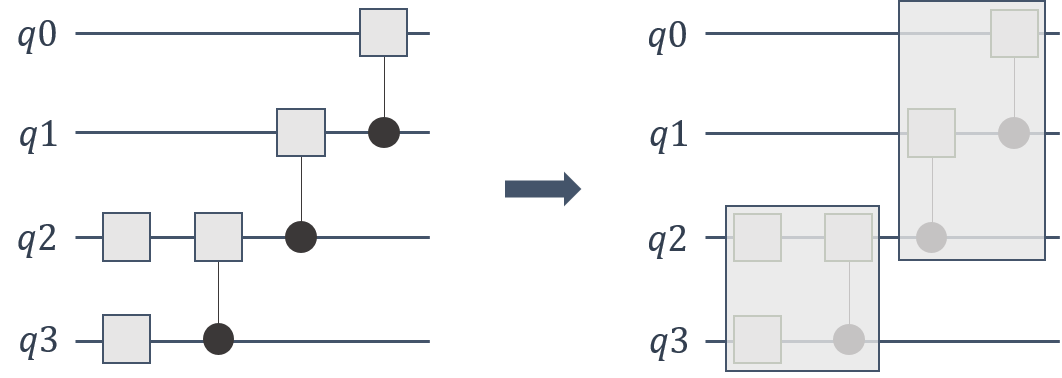
cuStateVec API custatevecApplyMatrix supports these general gate applications with multiple qubits.
For the detailed availability, please refer to custatevecApplyMatrix.