Redfish listener architecture
Example architecture for a ZAPP Redfish listener deployment.
Categories:
The Redfish listener example combines Redfish sensor discovery, a ZAPP Listener pipeline, and ZAPP Aggregator forwarding.
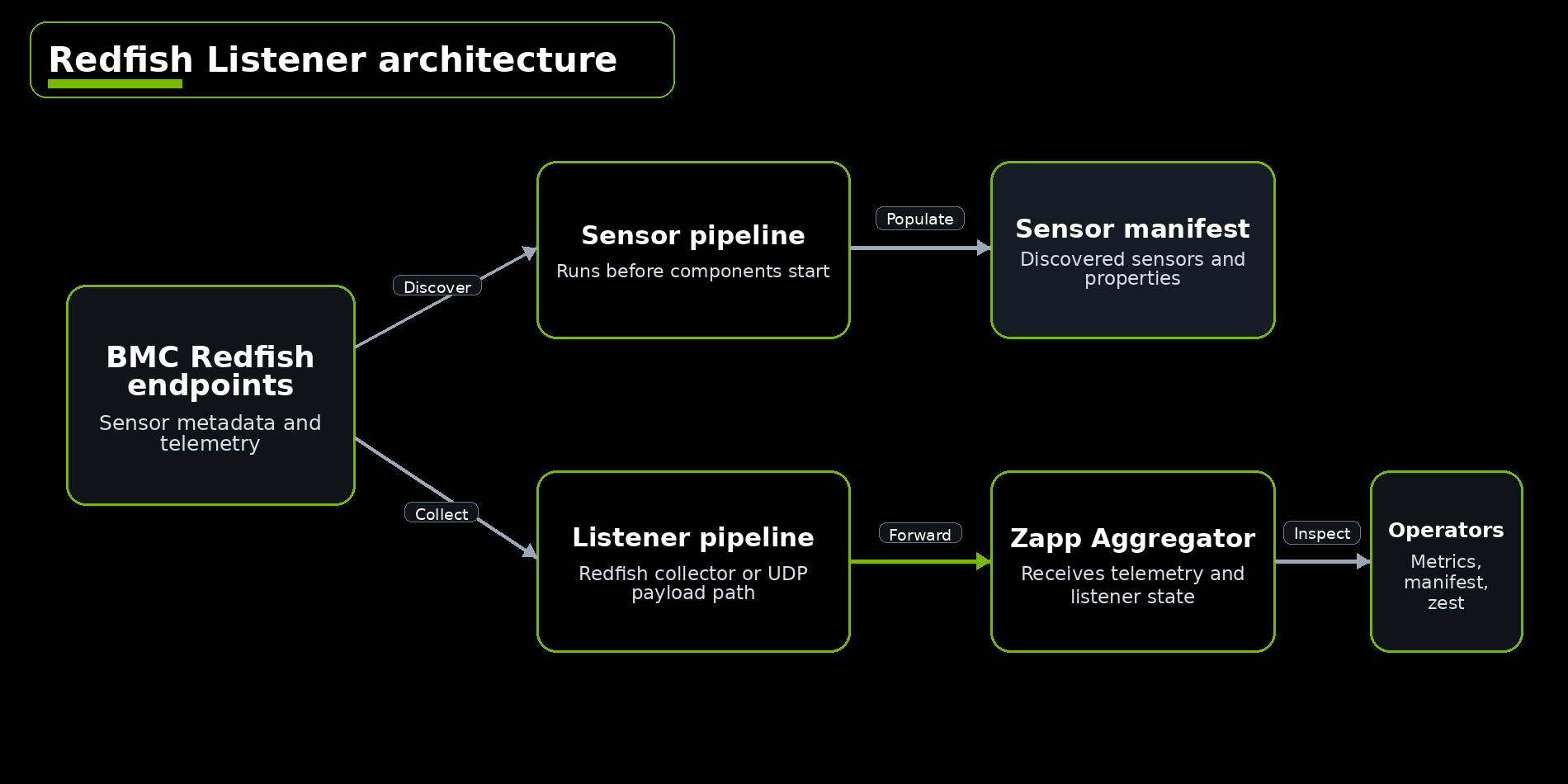
The Redfish listener discovers or collects telemetry from Redfish-enabled baseboard management controllers (BMCs) and forwards telemetry to the ZAPP Aggregator.
Main components
- BMC Redfish endpoints
- BMC Redfish endpoints provide sensor metadata and telemetry from managed infrastructure.
- Sensor pipeline
- The
envPlugins.sensorPipelineconfiguration runs before pipeline components start. It loads or discovers sensors and populates the listener sensor manifest. - Redfish listener pipeline
- The listener pipeline runs inside the
zappcontainer. For Redfish deployments, the pipeline includes Redfish configuration and forwards telemetry to anaggregatorStreamercomponent. - ZAPP Aggregator
- The ZAPP Aggregator receives telemetry from the listener and exposes metrics, manifest data, and subscriber gRPC access.
Data flow
- The listener reads the pipeline file and expands environment and secret references.
- The sensor pipeline reads
envPlugins.sensorPipeline. - ZAPP discovers or loads Redfish sensors into the manifest.
- Pipeline components start.
- The listener forwards telemetry to the ZAPP Aggregator.
- Operators inspect
/metrics,/manifest, or/manifest.jsonto validate deployment health.
The Helm chart mounts the pipeline at /config/pipeline.yaml, mounts Redfish credential files as Kubernetes Secrets, and passes the ZAPP Aggregator address to the listener with --aggregator.