> This page is for version v1.7.0.
> For other versions, use one of these documentation indexes:
> - Latest (v1.6.2) (default): https://docs.nvidia.com/dynamo/latest/llms.txt
> - dev: https://docs.nvidia.com/dynamo/dev/llms.txt
> - v1.6.2: https://docs.nvidia.com/dynamo/v1.6.2/llms.txt
> - v1.7.0: https://docs.nvidia.com/dynamo/v1.7.0/llms.txt
> - v1.6.1: https://docs.nvidia.com/dynamo/v1.6.1/llms.txt
> - v1.6.0: https://docs.nvidia.com/dynamo/v1.6.0/llms.txt
> - v1.5.1: https://docs.nvidia.com/dynamo/v1.5.1/llms.txt
> - v1.5.0: https://docs.nvidia.com/dynamo/v1.5.0/llms.txt
> - v1.4.2: https://docs.nvidia.com/dynamo/v1.4.2/llms.txt
> - v1.4.1: https://docs.nvidia.com/dynamo/v1.4.1/llms.txt
> - v1.4.0: https://docs.nvidia.com/dynamo/v1.4.0/llms.txt
> - v1.3.0: https://docs.nvidia.com/dynamo/v1.3.0/llms.txt
> - v1.2.1: https://docs.nvidia.com/dynamo/v1.2.1/llms.txt
> - v1.2.0: https://docs.nvidia.com/dynamo/v1.2.0/llms.txt
> - v1.1.1: https://docs.nvidia.com/dynamo/v1.1.1/llms.txt
> - v1.1.0: https://docs.nvidia.com/dynamo/v1.1.0/llms.txt
> - v1.0.2: https://docs.nvidia.com/dynamo/v1.0.2/llms.txt
> - v1.0.1: https://docs.nvidia.com/dynamo/v1.0.1/llms.txt
> - v1.0.0: https://docs.nvidia.com/dynamo/v1.0.0/llms.txt
> - v0.9.1: https://docs.nvidia.com/dynamo/v-0-9-1/llms.txt
> - v0.9.0: https://docs.nvidia.com/dynamo/v-0-9-0/llms.txt
> - v0.8.1: https://docs.nvidia.com/dynamo/v-0-8-1/llms.txt
> - v0.8.0: https://docs.nvidia.com/dynamo/v-0-8-0/llms.txt
> - v0.7.1: https://docs.nvidia.com/dynamo/v-0-7-1/llms.txt
> - v0.7.0: https://docs.nvidia.com/dynamo/v-0-7-0/llms.txt
> For clean Markdown content of this page, append .md to this URL. For the complete documentation index, see https://docs.nvidia.com/dynamo/llms.txt. For full content including API reference and SDK examples, see https://docs.nvidia.com/dynamo/llms-full.txt.
# TensorRT-LLM Sidecar
**Experimental.** The sidecars and their deployment examples are
experimental. Manifests, flags, and behavior may change without notice.
`dynamo-trtllm-sidecar` connects a Dynamo worker to TensorRT-LLM's OpenEngine
gRPC server. See [Sidecar Backends](/dynamo/v1.7.0/knowledge-base/concepts/system-architecture/sidecar-backends)
for the architecture.
For the best and latest support, use the upstream TensorRT-LLM nightly image,
which carries the latest gRPC server updates. Nightly builds are the
`nvcr.io/nvidia/tensorrt-llm/release:.dev` tags on
[NGC](https://catalog.ngc.nvidia.com/orgs/nvidia/tensorrt-llm/containers/release/-).
KV routing is available in
`nvcr.io/nvidia/tensorrt-llm/release:1.4.0a0.dev202610180820`, which includes
native KVCM2 event streaming and OpenEngine routing load support.
## Support Matrix
| Feature | Supported |
|---|---|
| Aggregated | Yes |
| Disaggregated | Yes |
| KV routing | Yes |
| Kubernetes multinode tensor parallelism (TP) and attention data parallelism (DP) | Yes |
### Image Cache Identity
With aggregated image-aware KV routing, the sidecar derives an image UUID from
the full URL, including its query string. TensorRT-LLM combines that UUID with
the image content for native cache identity. The same image at different signed
URLs therefore gets separate native KV chains, unlike content-only identity.
For rotating URLs, supply a stable `uuid` on each `image_url` content part to
reuse native KV for unchanged image content. Caller UUIDs disable automatic image
routing hints, so the router does not credit those image blocks for cache
affinity. `--frontend-decoding` is not an alternative on this sidecar: it accepts
media URLs and data URIs, and rejects decoded media.
## Launch Locally
See [`lib/sidecar/trtllm/launch/`](https://github.com/ai-dynamo/dynamo/tree/v1.7.0/lib/sidecar/trtllm/launch)
for all topologies. For example, aggregated serving on one GPU:
```bash
export DYN_DISCOVERY_BACKEND=file # single host: no etcd or NATS needed
./lib/sidecar/trtllm/launch/agg.sh
```
In a second terminal:
```bash
curl -s localhost:8000/v1/chat/completions \
-H 'Content-Type: application/json' \
-d '{"model":"Qwen/Qwen3-0.6B","messages":[{"role":"user","content":"Hello"}],"max_tokens":32}'
```
## Deploy on Kubernetes
See [`lib/sidecar/trtllm/deploy/`](https://github.com/ai-dynamo/dynamo/tree/v1.7.0/lib/sidecar/trtllm/deploy)
for all manifests. For example, aggregated serving:
Before applying, replace `/dynamo-sidecar` in the manifest with a
[sidecar image](/dynamo/v1.7.0/knowledge-base/concepts/system-architecture/sidecar-backends#container-packaging) and create the `hf-token-secret`
Secret that the manifest reads.
```bash
kubectl create secret generic hf-token-secret -n \
--from-literal=HF_TOKEN=
kubectl apply -f lib/sidecar/trtllm/deploy/agg.yaml -n
kubectl port-forward -n svc/trtllm-sidecar-agg-frontend 8000:8000
```
Multinode deployments require complete `leader` and `worker` role PodTemplates. Set
`backendFramework: trtllm` as the examples do: the operator does not infer a backend from a
native engine launch, and on Grove it starts the leader clique after the worker clique only
when the backend is known. The templates own the MPI launch, the SSH setup, the
engine probes, and the sidecar placement. In sidecar mode the operator does not apply
its TensorRT-LLM SSH key mount, `mpirun` wrapper, or worker probe rewrite. See the
[TP example](https://github.com/ai-dynamo/dynamo/blob/v1.7.0/lib/sidecar/trtllm/deploy/multinode_tp.yaml),
where the leader launches every rank with `mpirun` over SSH and runs the only sidecar,
and the [attention-DP example](https://github.com/ai-dynamo/dynamo/blob/v1.7.0/lib/sidecar/trtllm/deploy/multinode_dp.yaml),
where every rank publishes KV events on its own node, so the worker also runs a
sidecar that relays its local events under the leader's worker identity through
OpenEngine's follower metadata endpoint. Engine-failure KV recovery remains incomplete
and is tracked in [DEP #14897](https://github.com/ai-dynamo/dynamo/issues/14897).
The leader runs `trtllm-llmapi-launch trtllm-serve --grpc --grpc-protocol openengine
--host 0.0.0.0` and uses Kubernetes gRPC probes against the standard health service:
`liveness` for the startup and liveness probes, `inference` for readiness. That service
is in TensorRT-LLM nightlies from 2026-10-27; node-local discovery and native KV events
need 1.4.0rc1 or later. Worker `main` containers run `sshd` for the MPI launch and carry
no probes: the leader waits for `sshd`, and losing `sshd` or a rank aborts `mpirun` and
restarts the leader. The release images ship no `sshd`, so the examples install
`openssh-server` at start, and they export the container environment to `sshd` sessions
so Triton JIT on the worker finds CUDA. TensorRT-LLM attention DP requires untied input
and output embeddings; the DP example serves `TinyLlama/TinyLlama-1.1B-Chat-v1.0`.
The multinode examples bind the OpenEngine listener to every Pod interface so the
kubelet can probe it. The listener is unauthenticated: any client that reaches the
Pod IP can run inference and abort requests. Restrict it with a NetworkPolicy, or
bind `127.0.0.1` and use exec probes as `agg_kv_router.yaml` does.
The examples use `DYNAMO_RANK` and `DYNAMO_LEADER_ADDRESS`, which exist only in
DGDs created by operator 1.6.0 or later. For an older DGD, see
[Use the variables in a DGD created before 1.6.0](/dynamo/v1.7.0/kubernetes/installation/multinode-orchestration#use-the-variables-in-a-dgd-created-before-160).
## Topologies
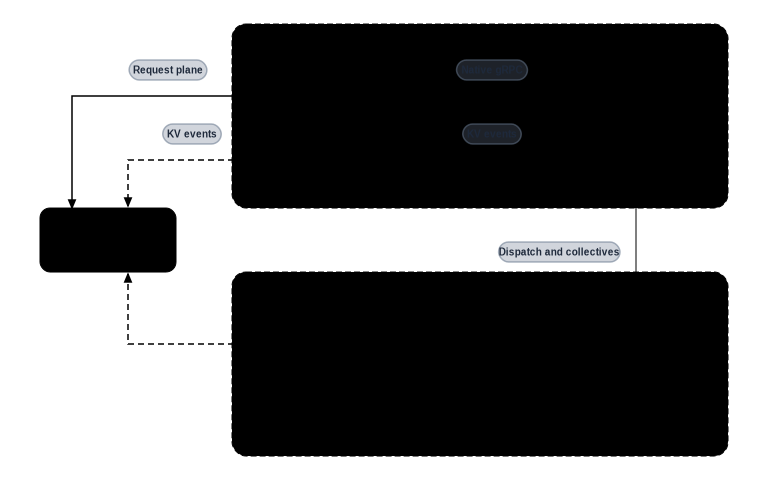
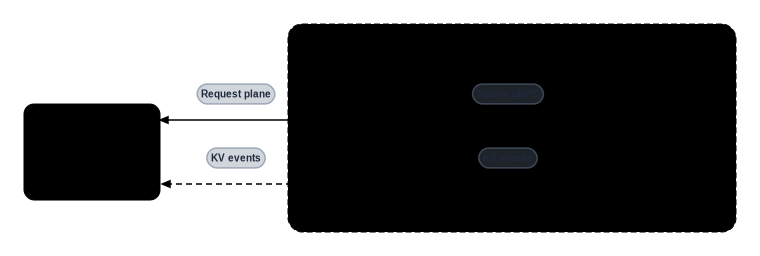
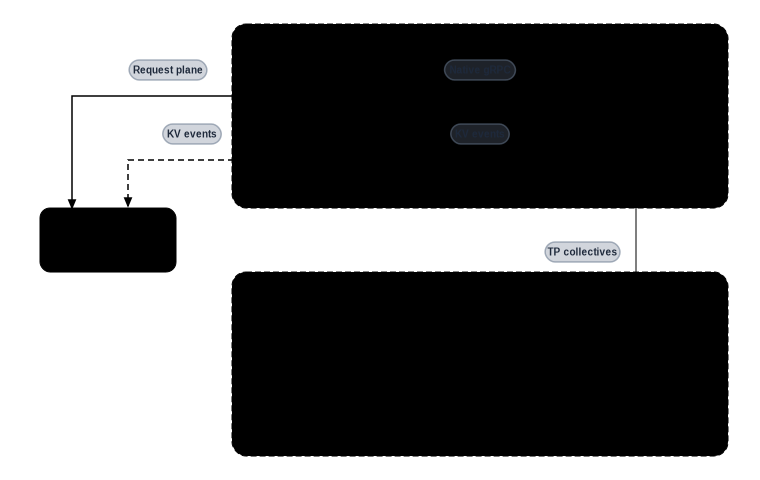
The frontend sends inference requests to each engine's leader sidecar, which forwards them to OpenEngine over gRPC and polls routing load for all attention-DP ranks. Each sidecar discovers its node's KV event sources through OpenEngine and relays local KV events through Dynamo's event plane. Follower sidecars do not serve inference requests.
### Single-Node TP
One engine on one node, with one sidecar.
### Multi-Node TP
One engine spans two nodes. Only the leader node has a sidecar; the follower
node holds the remaining TP ranks.
### Multi-Node DP
Every rank publishes KV events on its own node. The leader sidecar registers all ranks and serves requests; a worker sidecar relays its node-local events without serving. The sidecar forwards the selected attention-DP rank to OpenEngine for KV-aware routing when the engine has more than one attention-DP rank. For single-rank engines, it omits the redundant rank hint and does not synthesize a conversation ID for anonymous requests. Explicit session IDs are preserved.
For multi-rank engines with conversation affinity enabled, OpenEngine currently requires a conversation ID with a rank hint. The sidecar supplies a request-scoped ID when the client provides no session. With KVCM2 `block_reuse_config.policy: per_conversation`, those one-shot IDs can retain conversation state until cache reset or engine restart, causing host memory to grow with anonymous request count. Avoid this combination for sustained anonymous traffic until TensorRT-LLM accepts rank hints without conversation IDs or bounds retained conversation state.