> This page is for version v1.7.0.
> For other versions, use one of these documentation indexes:
> - Latest (v1.6.2) (default): https://docs.nvidia.com/dynamo/latest/llms.txt
> - dev: https://docs.nvidia.com/dynamo/dev/llms.txt
> - v1.6.2: https://docs.nvidia.com/dynamo/v1.6.2/llms.txt
> - v1.7.0: https://docs.nvidia.com/dynamo/v1.7.0/llms.txt
> - v1.6.1: https://docs.nvidia.com/dynamo/v1.6.1/llms.txt
> - v1.6.0: https://docs.nvidia.com/dynamo/v1.6.0/llms.txt
> - v1.5.1: https://docs.nvidia.com/dynamo/v1.5.1/llms.txt
> - v1.5.0: https://docs.nvidia.com/dynamo/v1.5.0/llms.txt
> - v1.4.2: https://docs.nvidia.com/dynamo/v1.4.2/llms.txt
> - v1.4.1: https://docs.nvidia.com/dynamo/v1.4.1/llms.txt
> - v1.4.0: https://docs.nvidia.com/dynamo/v1.4.0/llms.txt
> - v1.3.0: https://docs.nvidia.com/dynamo/v1.3.0/llms.txt
> - v1.2.1: https://docs.nvidia.com/dynamo/v1.2.1/llms.txt
> - v1.2.0: https://docs.nvidia.com/dynamo/v1.2.0/llms.txt
> - v1.1.1: https://docs.nvidia.com/dynamo/v1.1.1/llms.txt
> - v1.1.0: https://docs.nvidia.com/dynamo/v1.1.0/llms.txt
> - v1.0.2: https://docs.nvidia.com/dynamo/v1.0.2/llms.txt
> - v1.0.1: https://docs.nvidia.com/dynamo/v1.0.1/llms.txt
> - v1.0.0: https://docs.nvidia.com/dynamo/v1.0.0/llms.txt
> - v0.9.1: https://docs.nvidia.com/dynamo/v-0-9-1/llms.txt
> - v0.9.0: https://docs.nvidia.com/dynamo/v-0-9-0/llms.txt
> - v0.8.1: https://docs.nvidia.com/dynamo/v-0-8-1/llms.txt
> - v0.8.0: https://docs.nvidia.com/dynamo/v-0-8-0/llms.txt
> - v0.7.1: https://docs.nvidia.com/dynamo/v-0-7-1/llms.txt
> - v0.7.0: https://docs.nvidia.com/dynamo/v-0-7-0/llms.txt
> For clean Markdown content of this page, append .md to this URL. For the complete documentation index, see https://docs.nvidia.com/dynamo/llms.txt. For full content including API reference and SDK examples, see https://docs.nvidia.com/dynamo/llms-full.txt.
# vLLM Sidecar
**Experimental.** The sidecars and their deployment examples are
experimental. Manifests, flags, and behavior may change without notice.
`dynamo-vllm-sidecar` connects a Dynamo worker to vLLM's native gRPC server
(`vllm-rs`). See [Sidecar Backends](/dynamo/v1.7.0/knowledge-base/concepts/system-architecture/sidecar-backends)
for the architecture.
For the best and latest support, use the upstream vLLM nightly image,
which carries the latest gRPC server updates: [`vllm/vllm-openai:nightly`](https://hub.docker.com/r/vllm/vllm-openai/tags?name=nightly).
## Support Matrix
| Feature | Supported |
|---|---|
| Aggregated | Yes |
| Disaggregated | Yes |
| KV routing | Yes |
| Kubernetes multinode tensor parallelism (TP) and hybrid load balancing (hybrid-LB) data parallelism (DP) | Yes |
## Launch Locally
See [`lib/sidecar/vllm/launch/`](https://github.com/ai-dynamo/dynamo/tree/v1.7.0/lib/sidecar/vllm/launch)
for all topologies. For example, aggregated serving on one GPU:
```bash
export DYN_DISCOVERY_BACKEND=file # single host: no etcd or NATS needed
./lib/sidecar/vllm/launch/agg.sh
```
In a second terminal:
```bash
curl -s localhost:8000/v1/chat/completions \
-H 'Content-Type: application/json' \
-d '{"model":"Qwen/Qwen3-0.6B","messages":[{"role":"user","content":"Hello"}],"max_tokens":32}'
```
## Deploy on Kubernetes
See [`lib/sidecar/vllm/deploy/`](https://github.com/ai-dynamo/dynamo/tree/v1.7.0/lib/sidecar/vllm/deploy)
for all manifests. For example, aggregated serving:
Before applying, replace `/dynamo-sidecar` in the manifest with a
[sidecar image](/dynamo/v1.7.0/knowledge-base/concepts/system-architecture/sidecar-backends#container-packaging).
```bash
kubectl apply -f lib/sidecar/vllm/deploy/agg.yaml -n
kubectl port-forward -n svc/vllm-sidecar-agg-frontend 8000:8000
```
Multinode deployments require complete `leader` and `worker` role PodTemplates. Set
`backendFramework: vllm` as the examples do: the operator does not infer a backend from
`vllm serve`, and compilation-cache defaults and inter-pod GMS admission depend on it.
The templates own the native engine commands and sidecar placement. The operator does
not inject executor or coordination flags.
See the [TP example](https://github.com/ai-dynamo/dynamo/blob/v1.7.0/lib/sidecar/vllm/deploy/multinode_tp.yaml),
which uses the multiprocessing executor with a sidecar on the leader only, and the
[hybrid-LB DP example](https://github.com/ai-dynamo/dynamo/blob/v1.7.0/lib/sidecar/vllm/deploy/multinode_dp.yaml),
where every Pod runs a sidecar for its local DP ranks. Unlike `agg.yaml`, which
launches `vllm-rs serve`, both multinode examples launch their serving ranks with
`vllm serve --grpc-port` and `VLLM_USE_RUST_FRONTEND=1`. That entry point needs
vLLM v0.32.0 or later. The examples use it because `vllm-rs serve` does not support
`--data-parallel-hybrid-lb`. The TP worker runs `vllm serve --headless` and also sets
`VLLM_USE_RUST_FRONTEND=1`, although it runs no frontend. vLLM reads the variable in
each Pod to decide whether image models such as Qwen3-VL normalize pixels on the GPU.
The Rust frontend has already normalized them, so a worker without the variable
normalizes them a second time, and image requests return wrong answers with HTTP 200.
Engine-failure KV recovery remains incomplete and is tracked in
[DEP #14897](https://github.com/ai-dynamo/dynamo/issues/14897).
A multinode engine starts only when every rank has joined, and vLLM gives a late
rank 600 seconds by default. Two timeouts set that budget. The Rust frontend waits
`VLLM_ENGINE_READY_TIMEOUT_S` for its engine cores to register, and torch waits
`--distributed-timeout-seconds` for the cross-node rendezvous on both the leader
and the worker. When either expires, the leader's `main` container exits with
`engine input registration timed out` or a store timeout and restarts. The sidecar
is not affected. The TP example sets both to 1800 seconds, which matches the
sidecar's startup deadline and the example's startup probe, so a worker Pod that
pulls the engine image on a cold node still joins the first attempt. The torch
timeout also bounds collectives at run time, so a wedged NCCL call surfaces after
30 minutes instead of 10.
The examples use `DYNAMO_RANK` and `DYNAMO_LEADER_ADDRESS`, which exist only in
DGDs created by operator 1.6.0 or later. For an older DGD, see
[Use the variables in a DGD created before 1.6.0](/dynamo/v1.7.0/kubernetes/installation/multinode-orchestration#use-the-variables-in-a-dgd-created-before-160).
In sidecar mode the operator injects only the topology variables into `main`, not
the vLLM-specific environment. A disaggregated role template must set
`VLLM_NIXL_SIDE_CHANNEL_HOST` from `status.podIP` on its `main`
container, as `disagg.yaml` does, so the decode engine can reach the prefill
engine's NIXL handshake listener. vLLM adds each engine's global data-parallel
index to the side-channel port.
## Topologies
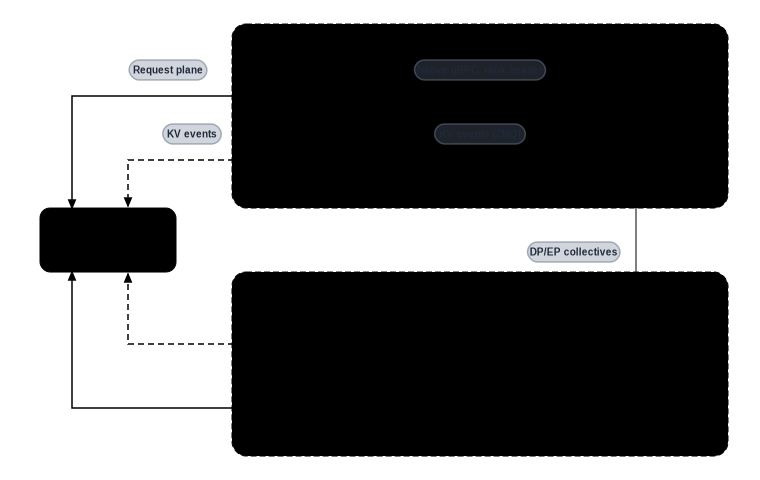
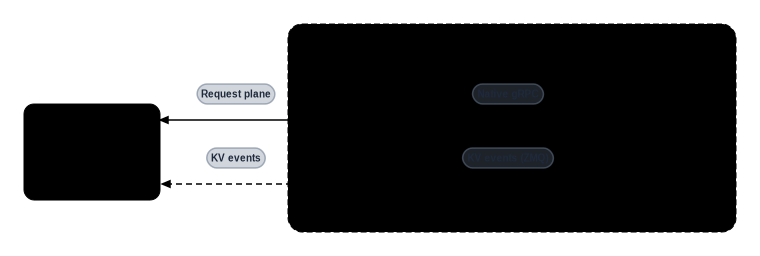
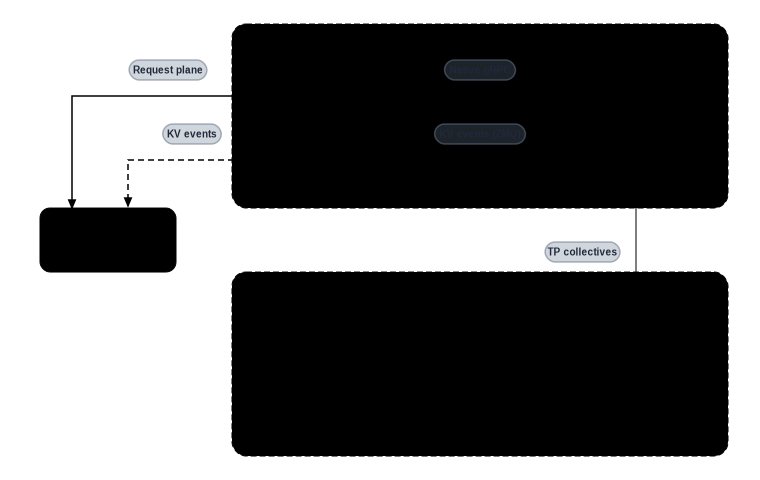
The frontend reaches each sidecar over Dynamo's request, discovery, and event
planes; the sidecar reaches the engine over its native gRPC API. Dashed arrows
carry KV events.
### Single-Node TP
One engine on one node, with one sidecar.
### Multi-Node TP
One engine spans two nodes. Only the leader node has a sidecar; the follower
node holds the remaining TP ranks.
### Multi-Node DP
Hybrid DP load balancing: each node runs vLLM for its local DP ranks plus a
sidecar that serves requests. The frontend routes to either node.