> This page is for version v1.7.0.
> For other versions, use one of these documentation indexes:
> - Latest (v1.6.2) (default): https://docs.nvidia.com/dynamo/latest/llms.txt
> - dev: https://docs.nvidia.com/dynamo/dev/llms.txt
> - v1.6.2: https://docs.nvidia.com/dynamo/v1.6.2/llms.txt
> - v1.7.0: https://docs.nvidia.com/dynamo/v1.7.0/llms.txt
> - v1.6.1: https://docs.nvidia.com/dynamo/v1.6.1/llms.txt
> - v1.6.0: https://docs.nvidia.com/dynamo/v1.6.0/llms.txt
> - v1.5.1: https://docs.nvidia.com/dynamo/v1.5.1/llms.txt
> - v1.5.0: https://docs.nvidia.com/dynamo/v1.5.0/llms.txt
> - v1.4.2: https://docs.nvidia.com/dynamo/v1.4.2/llms.txt
> - v1.4.1: https://docs.nvidia.com/dynamo/v1.4.1/llms.txt
> - v1.4.0: https://docs.nvidia.com/dynamo/v1.4.0/llms.txt
> - v1.3.0: https://docs.nvidia.com/dynamo/v1.3.0/llms.txt
> - v1.2.1: https://docs.nvidia.com/dynamo/v1.2.1/llms.txt
> - v1.2.0: https://docs.nvidia.com/dynamo/v1.2.0/llms.txt
> - v1.1.1: https://docs.nvidia.com/dynamo/v1.1.1/llms.txt
> - v1.1.0: https://docs.nvidia.com/dynamo/v1.1.0/llms.txt
> - v1.0.2: https://docs.nvidia.com/dynamo/v1.0.2/llms.txt
> - v1.0.1: https://docs.nvidia.com/dynamo/v1.0.1/llms.txt
> - v1.0.0: https://docs.nvidia.com/dynamo/v1.0.0/llms.txt
> - v0.9.1: https://docs.nvidia.com/dynamo/v-0-9-1/llms.txt
> - v0.9.0: https://docs.nvidia.com/dynamo/v-0-9-0/llms.txt
> - v0.8.1: https://docs.nvidia.com/dynamo/v-0-8-1/llms.txt
> - v0.8.0: https://docs.nvidia.com/dynamo/v-0-8-0/llms.txt
> - v0.7.1: https://docs.nvidia.com/dynamo/v-0-7-1/llms.txt
> - v0.7.0: https://docs.nvidia.com/dynamo/v-0-7-0/llms.txt
> For clean Markdown content of this page, append .md to this URL. For the complete documentation index, see https://docs.nvidia.com/dynamo/llms.txt. For full content including API reference and SDK examples, see https://docs.nvidia.com/dynamo/llms-full.txt.
# Sidecar Backends
**Experimental.** Sidecar integration is under active development, so this page and the linked support notes may become stale. The sidecar path does not yet match every feature of the in-process backends.
A Dynamo sidecar runs beside the inference engine process. It registers the
engine with Dynamo discovery, forwards engine events into the Dynamo event
plane, and serves requests from the Dynamo frontend by calling the engine's
native gRPC API.
## Backend Support Matrix
**Legend:** Supported = available through the sidecar; Limited = available with restrictions; Engine-configured = enabled in the native engine; No = unavailable. See the linked backend support notes for details.
| Capability | [vLLM](https://github.com/ai-dynamo/dynamo/blob/v1.7.0/lib/sidecar/SUPPORT_NOTES.md#vllm) | [SGLang](https://github.com/ai-dynamo/dynamo/blob/v1.7.0/lib/sidecar/SUPPORT_NOTES.md#sglang) | [TensorRT-LLM](https://github.com/ai-dynamo/dynamo/blob/v1.7.0/lib/sidecar/SUPPORT_NOTES.md#tensorrt-llm) |
|---|---|---|---|
| Text generation, streaming, and cancellation | Supported | Supported | Supported |
| Tool calling through the Dynamo frontend | Supported | Supported | Supported |
| Disaggregated prefill/decode serving | Supported | Supported | Supported |
| KV-aware routing | Supported | Supported | Supported |
| Multimodal input | Supported: image, video, audio | Supported: image, video, audio | Limited: images and video |
| Separate multimodal encoder workers | Supported | No | No |
| LoRA adapters | Supported | No | No |
| Structured output and logprobs | Supported | Supported | Supported: no prompt logprobs |
| Embedding endpoints | No | No | No |
| Runtime weight updates and sleep/wake controls | Limited | No | No |
### Deployment
| Capability | vLLM | SGLang | TensorRT-LLM |
|---|---|---|---|
| Kubernetes single-node deployment | Supported | Supported | Supported |
| Kubernetes multinode deployment | Supported | Supported | Supported |
### Operations and Recovery
| Capability | vLLM | SGLang | TensorRT-LLM |
|---|---|---|---|
| Observability: metrics, logs, and tracing | Limited | Limited | Limited |
| SLA-based planner and autoscaling | No | No | No |
| Native engine cache offloading | Engine-configured | Engine-configured | Engine-configured |
| GPU Memory Service (GMS) | Requires separate integration | Requires separate integration | Requires separate integration |
| Checkpoint/restore | Requires separate integration | Requires separate integration | Requires separate integration |
| Shadow-engine failover | Requires separate integration | Requires separate integration | Requires separate integration |
| In-flight request migration | Supported: opt-in token replay | Supported: opt-in token replay | Supported: opt-in token replay |
| Graceful shutdown and draining | Limited: bounded drain | Limited: bounded drain | Limited: bounded drain |
| Speculative decoding | Engine-configured | Engine-configured | Engine-configured |
For engine-version requirements and launch examples, see [vLLM](/dynamo/v1.7.0/knowledge-base/modular-components/backends/v-llm/sidecar), [SGLang](/dynamo/v1.7.0/knowledge-base/modular-components/backends/sg-lang/sidecar), and [TensorRT-LLM](/dynamo/v1.7.0/knowledge-base/modular-components/backends/tensor-rt-llm/sidecar).
## Design Goals
- Keep the upstream engine's native serve path and argument surface.
- Move toward public, versioned gRPC contracts with explicit backward
compatibility instead of importing private engine APIs.
- Isolate Dynamo and engine dependencies in separate processes.
- Attribute failures through engine-specific and Dynamo-specific logs and health
checks.
- Reuse Dynamo's frontend, routing, planning, and disaggregated-serving
orchestration.
## Architecture
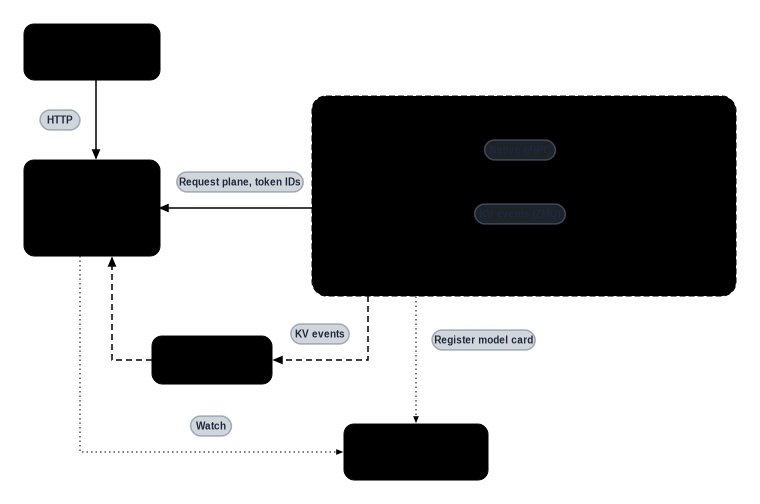
The frontend and router discover sidecars and send requests to them over the
Dynamo request plane. Each sidecar converts requests to the engine's native gRPC
API and streams responses back.
## Responsibilities
| Layer | Responsibility |
|---|---|
| Dynamo frontend and router | OpenAI-compatible API, preprocessing, and routing to sidecars |
| Dynamo sidecar | Engine registration and discovery, request forwarding over native gRPC, and event forwarding |
| Inference engine | Native gRPC request serving, scheduling, sampling, token generation, KV cache, and GPU execution |
## Container Packaging
The sidecar Dockerfile builds all four engine-specific sidecar executables into
one CPU-only image. Deployments select an engine by setting the container
`command`:
| Engine | Container command |
|---|---|
| vLLM | `dynamo-vllm-sidecar` |
| SGLang | `dynamo-sglang-sidecar` |
| TensorRT-LLM | `dynamo-trtllm-sidecar` |
| LPX | `dynamo-lpx-sidecar` |
The image's default entrypoint, `dynamo-sidecar`, maps the short names `vllm`,
`sglang`, `trtllm`, and `lpx` onto those executables. It is a convenience for ad-hoc
`docker run`; the deployment manifests override it with `command`. The inference
engine remains in a separate GPU container, so the sidecar image does not
include vLLM, SGLang, TensorRT-LLM, LPX engines, CUDA, or engine-specific Python
dependencies. The image runs as the non-root `dynamo` user with numeric user ID
`1000` and declares port `9090` for Dynamo system endpoints, so Kubernetes can
enforce `runAsNonRoot`.
The sidecar image is published to NGC for each release, starting with 1.6.0:
```bash
docker pull nvcr.io/nvidia/ai-dynamo/dynamo-sidecar: # 1.6.0 or later
```
To build it from source instead, run from the repository root with the
[sidecar Dockerfile](https://github.com/ai-dynamo/dynamo/blob/v1.7.0/lib/sidecar/Dockerfile):
```bash
docker build -f lib/sidecar/Dockerfile -t dynamo-sidecar:1.6.0-dev .
```
## Pod Layout
Kubernetes sidecar mode is a work in progress.
The engine and sidecar share one worker pod. The engine is the `main`
container; the sidecar is a
[native sidecar](https://kubernetes.io/docs/concepts/workloads/pods/sidecar-containers/):
an init container named `runtime` with `restartPolicy: Always`, which requires
Kubernetes 1.29 or later. The two connect over loopback or a Unix socket.
```yaml
podTemplate:
spec:
initContainers:
- name: runtime
image: nvcr.io/nvidia/ai-dynamo/dynamo-sidecar:
command: [dynamo-vllm-sidecar]
args: [--grpc-endpoint, 127.0.0.1:30001]
restartPolicy: Always
containers:
- name: main
image: vllm/vllm-openai:
```
Kubernetes starts the sidecar before the engine and keeps it running for the
life of the pod. Declaring the `runtime` init container enables sidecar mode in
the Dynamo operator, which gives the sidecar `/live` and `/health` probes on
port `9090`; in host-network LPX Agent Pods the sidecar keeps only the probes its
template declares. These probes do not track engine loading, so keep the engine's own
probes on `main`. Sidecar mode supports worker, prefill, and decode components,
and LPX components through their role templates.
SGLang, vLLM, and TensorRT-LLM multinode deployments require explicit leader and
worker role PodTemplates. Set `backendFramework` explicitly, as the examples do: the
operator does not infer a backend from a native engine command. The leader declares
`runtime`. Worker placement depends on the engine topology. See the
[SGLang guide](/dynamo/v1.7.0/knowledge-base/modular-components/backends/sg-lang/sidecar#deploy-on-kubernetes),
the [vLLM guide](/dynamo/v1.7.0/knowledge-base/modular-components/backends/v-llm/sidecar#deploy-on-kubernetes),
and the [TensorRT-LLM guide](/dynamo/v1.7.0/knowledge-base/modular-components/backends/tensor-rt-llm/sidecar#deploy-on-kubernetes).
## Topologies
Each engine page shows its single-node TP, multi-node TP, and multi-node DP
topologies:
[vLLM](/dynamo/v1.7.0/knowledge-base/modular-components/backends/v-llm/sidecar#topologies),
[SGLang](/dynamo/v1.7.0/knowledge-base/modular-components/backends/sg-lang/sidecar#topologies),
[TensorRT-LLM](/dynamo/v1.7.0/knowledge-base/modular-components/backends/tensor-rt-llm/sidecar#topologies).