> This page is for version v1.7.0.
> For other versions, use one of these documentation indexes:
> - Latest (v1.6.2) (default): https://docs.nvidia.com/dynamo/latest/llms.txt
> - dev: https://docs.nvidia.com/dynamo/dev/llms.txt
> - v1.6.2: https://docs.nvidia.com/dynamo/v1.6.2/llms.txt
> - v1.7.0: https://docs.nvidia.com/dynamo/v1.7.0/llms.txt
> - v1.6.1: https://docs.nvidia.com/dynamo/v1.6.1/llms.txt
> - v1.6.0: https://docs.nvidia.com/dynamo/v1.6.0/llms.txt
> - v1.5.1: https://docs.nvidia.com/dynamo/v1.5.1/llms.txt
> - v1.5.0: https://docs.nvidia.com/dynamo/v1.5.0/llms.txt
> - v1.4.2: https://docs.nvidia.com/dynamo/v1.4.2/llms.txt
> - v1.4.1: https://docs.nvidia.com/dynamo/v1.4.1/llms.txt
> - v1.4.0: https://docs.nvidia.com/dynamo/v1.4.0/llms.txt
> - v1.3.0: https://docs.nvidia.com/dynamo/v1.3.0/llms.txt
> - v1.2.1: https://docs.nvidia.com/dynamo/v1.2.1/llms.txt
> - v1.2.0: https://docs.nvidia.com/dynamo/v1.2.0/llms.txt
> - v1.1.1: https://docs.nvidia.com/dynamo/v1.1.1/llms.txt
> - v1.1.0: https://docs.nvidia.com/dynamo/v1.1.0/llms.txt
> - v1.0.2: https://docs.nvidia.com/dynamo/v1.0.2/llms.txt
> - v1.0.1: https://docs.nvidia.com/dynamo/v1.0.1/llms.txt
> - v1.0.0: https://docs.nvidia.com/dynamo/v1.0.0/llms.txt
> - v0.9.1: https://docs.nvidia.com/dynamo/v-0-9-1/llms.txt
> - v0.9.0: https://docs.nvidia.com/dynamo/v-0-9-0/llms.txt
> - v0.8.1: https://docs.nvidia.com/dynamo/v-0-8-1/llms.txt
> - v0.8.0: https://docs.nvidia.com/dynamo/v-0-8-0/llms.txt
> - v0.7.1: https://docs.nvidia.com/dynamo/v-0-7-1/llms.txt
> - v0.7.0: https://docs.nvidia.com/dynamo/v-0-7-0/llms.txt
> For clean Markdown content of this page, append .md to this URL. For the complete documentation index, see https://docs.nvidia.com/dynamo/llms.txt. For full content including API reference and SDK examples, see https://docs.nvidia.com/dynamo/llms-full.txt.
# SGLang Sidecar
**Experimental.** The sidecars and their deployment examples are
experimental. Manifests, flags, and behavior may change without notice.
`dynamo-sglang-sidecar` connects a Dynamo worker to SGLang's native gRPC
server. See [Sidecar Backends](/dynamo/v1.7.0/knowledge-base/concepts/system-architecture/sidecar-backends)
for the architecture.
For the best and latest support, use the upstream SGLang nightly image,
which carries the latest gRPC server updates: [`lmsysorg/sglang:dev`](https://hub.docker.com/r/lmsysorg/sglang/tags?name=dev).
## Support Matrix
| Feature | Supported |
|---|---|
| Aggregated | Yes |
| Disaggregated | Yes |
| KV routing | Yes |
| Kubernetes multinode tensor parallelism (TP) and attention data parallelism (attention-DP) | Yes |
| Image, video, and audio input | Yes; disaggregated serving is untested |
The sidecar sends a media kind only when the SGLang gRPC server lists it in
`grpc_features` (`image_inputs`, `video_inputs`, or `audio_inputs`), and returns
400 for other media requests.
SGLang downloads `http://` and `https://` media URLs itself, from any host by
default, including `127.0.0.1` and its own HTTP API. Start SGLang with
`--allowed-media-domains` to limit the hosts it fetches.
Media-aware KV routing on wide-token SGLang builds is not supported by the sidecar; see the [multimodal compatibility limits](/dynamo/v1.7.0/knowledge-base/modular-components/backends/sg-lang/sglang-multimodal#wide-token-sglang-builds).
## Launch Locally
See [`lib/sidecar/sglang/launch/`](https://github.com/ai-dynamo/dynamo/tree/v1.7.0/lib/sidecar/sglang/launch)
for all topologies. For example, aggregated serving on one GPU:
```bash
export DYN_DISCOVERY_BACKEND=file # single host: no etcd or NATS needed
./lib/sidecar/sglang/launch/agg.sh
```
In a second terminal:
```bash
curl -s localhost:8000/v1/chat/completions \
-H 'Content-Type: application/json' \
-d '{"model":"Qwen/Qwen3-0.6B","messages":[{"role":"user","content":"Hello"}],"max_tokens":32}'
```
## Deploy on Kubernetes
See [`lib/sidecar/sglang/deploy/`](https://github.com/ai-dynamo/dynamo/tree/v1.7.0/lib/sidecar/sglang/deploy)
for all manifests. For example, aggregated serving:
Before applying, replace `/dynamo-sidecar` in the manifest with a
[sidecar image](/dynamo/v1.7.0/knowledge-base/concepts/system-architecture/sidecar-backends#container-packaging) and create the `hf-token-secret`
Secret that the manifest reads.
```bash
kubectl create secret generic hf-token-secret -n \
--from-literal=HF_TOKEN=
kubectl apply -f lib/sidecar/sglang/deploy/agg.yaml -n
kubectl port-forward -n svc/sglang-sidecar-agg-frontend 8000:8000
```
Multinode deployments require complete `leader` and `worker` role PodTemplates. Set
`backendFramework: sglang` as the examples do; the operator does not infer a backend from
a native engine launch. The templates own the native engine commands and
sidecar placement. See the [TP example](https://github.com/ai-dynamo/dynamo/blob/v1.7.0/lib/sidecar/sglang/deploy/multinode_tp.yaml) and
[attention-DP example](https://github.com/ai-dynamo/dynamo/blob/v1.7.0/lib/sidecar/sglang/deploy/multinode_dp.yaml). Attention-DP requires SGLang 0.5.22 or later and a Dynamo sidecar
with matching attention-DP metadata support. Engine-failure KV recovery remains
incomplete and is tracked in [DEP #14897](https://github.com/ai-dynamo/dynamo/issues/14897).
The examples use `DYNAMO_RANK` and `DYNAMO_LEADER_ADDRESS`, which exist only in
DGDs created by operator 1.6.0 or later. For an older DGD, see
[Use the variables in a DGD created before 1.6.0](/dynamo/v1.7.0/kubernetes/installation/multinode-orchestration#use-the-variables-in-a-dgd-created-before-160).
## Topologies
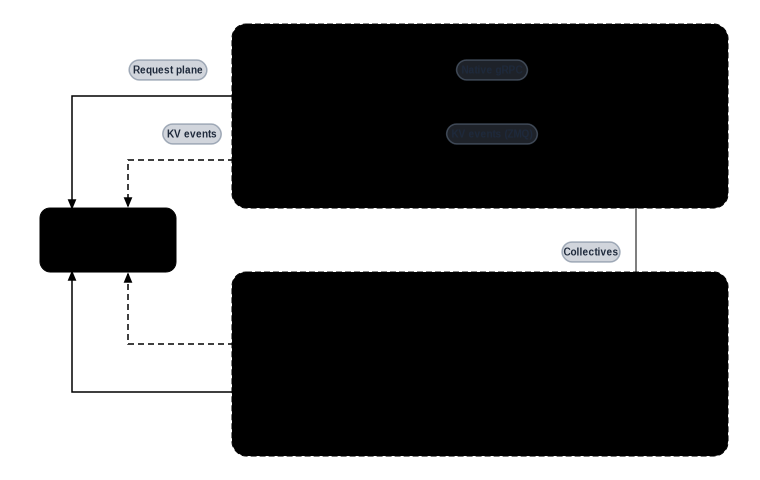
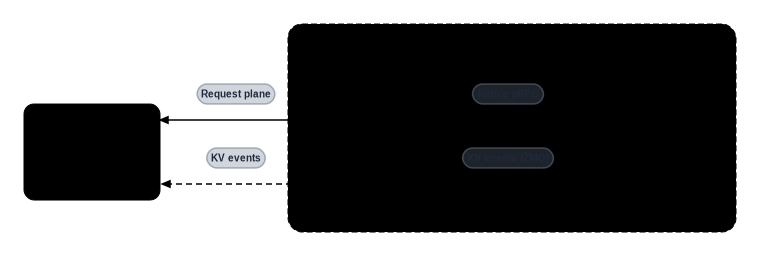
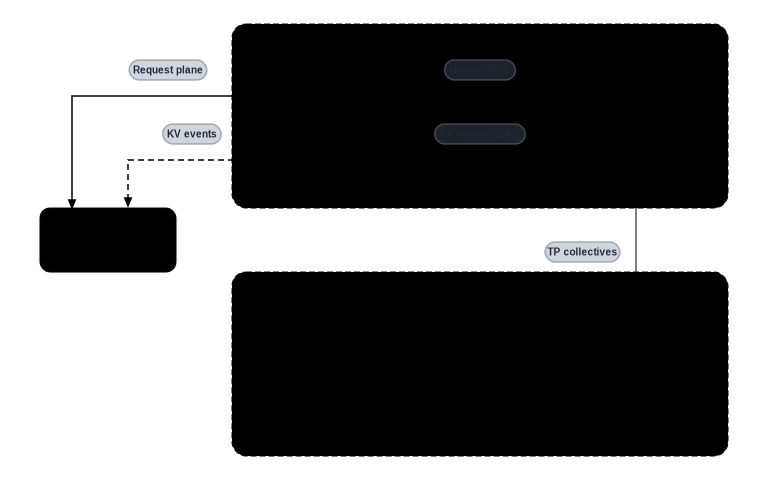
The frontend reaches each sidecar over Dynamo's request, discovery, and event
planes; the sidecar reaches the engine over its native gRPC API. Dashed arrows
carry KV events.
### Single-Node TP
One engine on one node, with one sidecar.
### Multi-Node TP
One engine spans two nodes. Only the leader node has a sidecar; the follower
node holds the remaining TP ranks.
### Multi-Node DP
The leader sidecar registers every DP rank and serves all requests; SGLang
dispatches each one to the right scheduler. The follower sidecar
accepts no requests and relays its node's KV events directly to the frontend.