

Newton–Schulz orthogonalization quality#

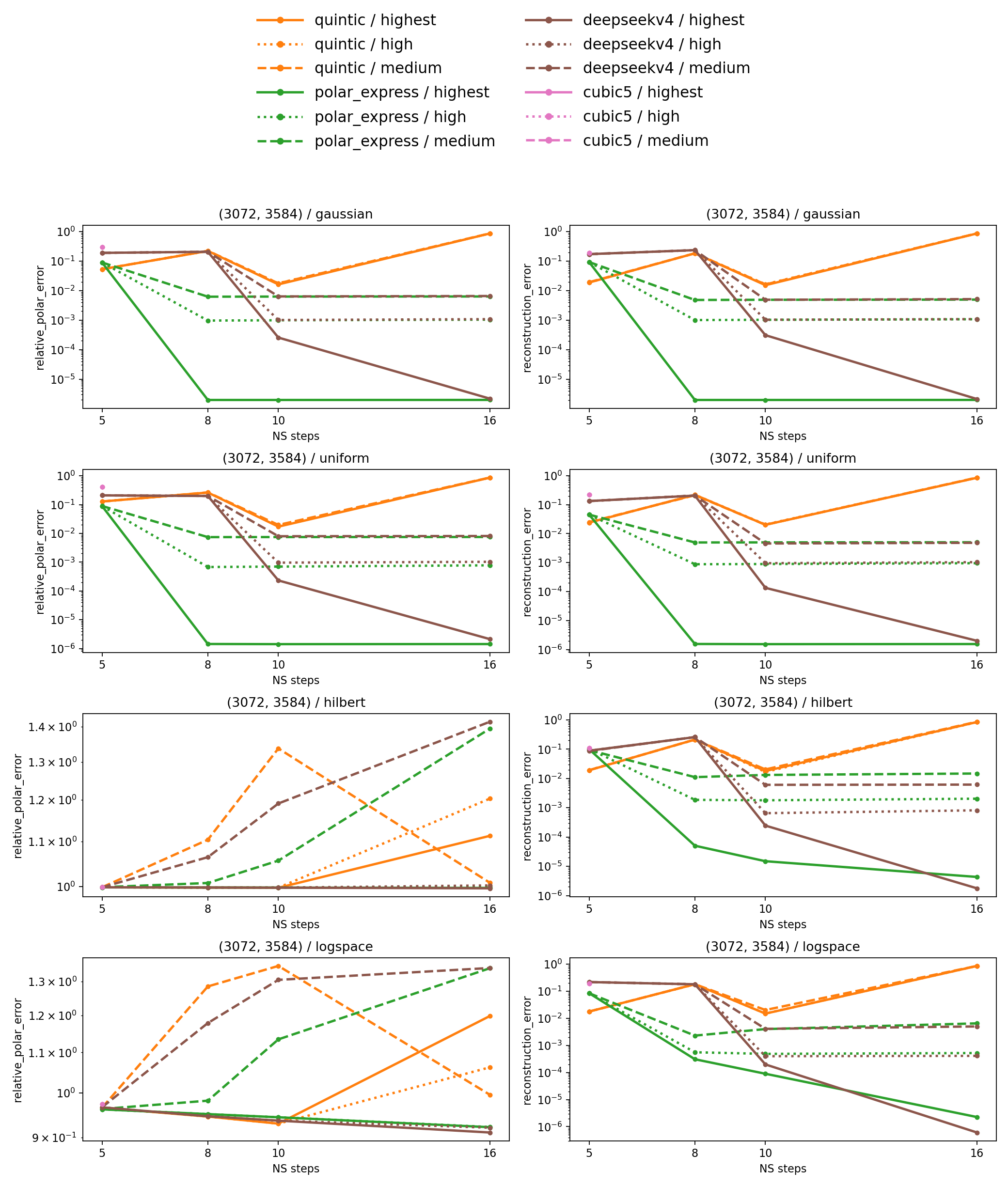
This doc summarizes quality of orthogonalization by Newton-Schulz compared polar decomposition (QDWH).

Run settings#

Setting

Value

Matrix shape

(3072, 3584). From Kimi-K3 MoE layers

Inputs

FP32 Gaussian N(0, 1), uniform [0, 1), Hilbert, and dense logspace

Logspace input

U @ diag(s) @ V.T; independent Gaussian QR factors U, V; s logarithmically spaced from 1e-30 to 1e10; FP64 reconstruction cast to FP32

Steps

5, 8, 10, 16; cubic5 at 5 only

Polar Express schedule

Upstream repeat_penultimate coefficient iterator (main 4ebce60)

NS precision

FP32 tensors with highest and high matmul precision, and BF16 (medium); FP32 normalization and returned output

BF16 reduced-precision reduction

torch.backends.cuda.matmul.allow_bf16_reduced_precision_reduction = False

Reference

torch.linalg.polar in FP64 on the transposed input; factor transposed back

python -m benchmarks.newton_schulz_quality \
  --precisions=highest,high,medium \
  --steps=5,8,10,16 --spectra=gaussian,uniform,hilbert,logspace \
  --output=/tmp/newton-schulz-quality.json \
  --plot=/tmp/newton-schulz-quality.png

Results#

Dense logspace input after FP32 conversion: measured singular values 1.54 to 1e+10, condition number 6.47e+09.

For original input A, NS output X, and FP64 reference polar factors A = H Q:
\[ \begin{aligned} \text{Relative polar error} &= \frac{\lVert X-Q\rVert_F}{\lVert Q\rVert_F} \\ \text{Relative reconstruction error} &= \frac{\lVert HX-A\rVert_F}{\lVert A\rVert_F} \end{aligned} \]

Relative polar and reconstruction errors for Gaussian, uniform, Hilbert, and dense logspace inputs. Solid lines: highest. Dotted lines: high. Dashed lines: medium (BF16).