

Stage 2: Reinforcement Learning (RL)#
This stage post-trains the Nemotron 3.5 Super SFT model with NeMo-RL and NeMo Gym environments: a broad RLVR stage, a panel of specialist teachers, and two phases of Multi-teacher On-Policy Distillation (MOPD) that merge the teachers back into one student. The configs are ported from the configs of the reference run, the internal run that produced the selected checkpoints.
Pending open-source release: The RL data used for Super 3.5 is not yet published (NeMo-RL’s guide says it will be released later), and the agentic teacher and vision-reasoning stage 2 depend on NeMo Gym components that are not public. No RL config has been run end to end on GPUs from this repository. See Open-Source Status.
Training Methodology#
For the full methodology, see §3.2–3.7 of the Nemotron 3.5 tech report. The post-training pipeline follows Nemotron 3 Ultra’s: SFT → RLVR → specialist teachers → MOPD (Figure 4, shown in the overview).
Why Three Sub-Stages#
A single RL run over every domain trades capabilities off against each other. The report instead builds a strong generalist first, pushes individual capabilities further in short specialist runs, and then distills the specialists back into one model:
RLVR: joint RLVR and RLHF across a broad environment mix, from the SFT checkpoint. Its step-120 checkpoint is the MOPD phase-1 student and the starting point of every teacher except RLHF teacher 1.
Specialist teachers: short asynchronous GRPO runs, each optimized for one domain: agentic, reasoning, vision tool use, video reasoning and tracking, vision reasoning, and alignment (RLHF).
MOPD: two phases of on-policy distillation. Each prompt is routed to the teacher that owns its environment; environments with no specialist go to a frozen self-anchor (
generalin the configs), a copy of the student’s starting checkpoint.
        %%{init: {'theme': 'base', 'themeVariables': { 'primaryBorderColor': '#333333', 'lineColor': '#333333', 'primaryTextColor': '#333333'}}}%%
flowchart TD
    SFT["SFT checkpoint"] --> RLVR["RLVR<br/>step 120"]
    SFT --> H1["RLHF teacher 1<br/>(stage 1 → stage 2, step 500)"]

    RLVR -.-> A["Agentic teacher<br/>step 14 (blocked)"]
    RLVR --> R["Reasoning teacher<br/>step 80"]
    RLVR --> V["Vision tool-use teacher<br/>step 40"]
    RLVR --> VID["Video teacher<br/>step 60"]
    RLVR --> VR["Vision-reasoning teacher<br/>(stage 1 step 114 → stage 2 step 20)"]
    RLVR --> H2["RLHF teacher 2<br/>(stage 1 step 200 → stage 2 step 120)"]

    RLVR -->|"student + self-anchor"| M1["MOPD phase 1<br/>step 30"]
    A -->|"35%"| M1
    R -->|"25%"| M1
    H1 -->|"20%"| M1
    V -->|"15%"| M1

    M1 -->|"student + self-anchor"| M2["MOPD phase 2<br/>step 30"]
    H2 -->|"30%"| M2
    V -->|"20%"| M2
    VR -->|"20%"| M2
    VID -->|"20%"| M2

    style SFT fill:#f3e5f5,stroke:#9c27b0
    style RLVR fill:#e1f5fe,stroke:#2196f3
    style M1 fill:#e8f5e9,stroke:#4caf50
    style M2 fill:#e8f5e9,stroke:#4caf50
    style A fill:#eeeeee,stroke:#999999
Edge labels are MOPD prompt shares; the self-anchor takes the remaining 5% (phase 1) and 10% (phase 2). Step numbers are the checkpoints selected in the reference run. The report gives the RLVR, reasoning, video, vision-reasoning, and MOPD phase-1 steps; the agentic, vision tool-use, RLHF, and MOPD phase-2 steps come from the reference run (for phase 2, see Phases). The dashed edge marks unconfirmed lineage (see Agentic Teacher).
Per-Stage Parameters#
Stage |
CLI |
Start from |
Nodes ( |
External servers (reference run) |
Prompts × gens |
Max sequence |
LR |
Selected step |
|---|---|---|---|---|---|---|---|---|
RLVR |
|
SFT |
144 |
26 nodes: GenRM, general judge, safety judge |
512 × 16 |
80K |
4e-6 |
120 |
Reasoning teacher |
|
RLVR |
64 |
Hosted DeepSeek-V4-Flash judge |
256 × 16 |
128K generation, 256K total |
4e-6 |
80 |
Vision tool-use teacher |
|
RLVR |
16 |
— |
16 × 8 |
32K |
3e-6 |
40 |
Video teacher |
|
RLVR |
32 |
— |
128 × 16 |
64K (16K generation) |
3e-6 |
60 |
Vision-reasoning teacher |
|
RLVR → stage 1 |
32 / 33 |
— |
256 × 16 |
32K |
3e-6 |
114 → 20 |
RLHF teacher 1 |
|
SFT |
32 / 32 |
32 nodes GenRM |
32 × 32 |
48K (16K generation) |
2e-6 |
120 → 500 |
RLHF teacher 2 |
|
RLVR |
64 / 32 |
64 / 32 nodes GenRM, plus 4 nodes abstention judge (stage 2) |
32 × 32 |
48K (16K generation) |
2e-6 |
200 → 120 |
Agentic teacher |
|
RLVR |
128 |
Hosted search judge |
64 × 16 |
192K |
3e-6 |
14 |
MOPD phase 1 |
|
RLVR |
128 |
— |
512 × 1 |
48K generation, 128K context |
2e-6 |
30 |
MOPD, single stage |
|
RLVR |
112 |
— |
512 × 1 |
48K generation, 128K context |
2e-6 |
— |
MOPD phase 2 |
|
MOPD phase 1 |
128 |
— |
1024 × 1 |
128K |
3e-6 |
30 |
All nodes are GB200 with 4 GPUs. run.env.nodes is the Slurm allocation each config requests: training plus generation, and for MOPD the teacher fleets, so MOPD needs no external servers. External judge and GenRM servers run outside the allocation; that column lists what the reference run used. A slash separates the two stages of a two-stage teacher. Batch shapes, sequence lengths, and learning rates are config values. The report states batch shapes only for RLVR, MOPD, and the reasoning, video, vision-reasoning, and agentic teachers.
MTP Boosting#
This recipe does not include MTP boosting. The report trains the MTP head separately from the backbone at two points (§3.7): a 4K-step MTP-only run on the SFT checkpoint, and MTP boosting after MOPD, which starts from that SFT-stage head and trains it for 25K more steps against the final backbone. In both, the backbone is frozen, hidden-state mixing exposes the head to its own drafted states, and the loss is the LK loss: knowledge distillation from the frozen backbone, replacing the temperature-scaled forward KL used for Nemotron 3 Ultra. Training data are on-policy rollouts from the corresponding backbone, at temperature 1 and up to 8K tokens, seeded with prompts from Nemotron-Post-Training-Dataset-v2 and Nemotron-RL-Super-Training-Blends.
Average acceptance length on the SPEED-Bench qualitative split at draft length 7 (Table 8):
Model |
Greedy (temp 0) |
Sampled (temp 1) |
|---|---|---|
SFT checkpoint, native MTP |
4.589 |
4.048 |
SFT checkpoint + 4K MTP-only steps |
5.080 |
4.730 |
Final model, native MTP |
4.287 |
3.787 |
Final model + MTP head from the SFT-stage run |
4.528 |
4.436 |
Final model + 25K MTP boosting steps (released) |
4.718 |
4.612 |
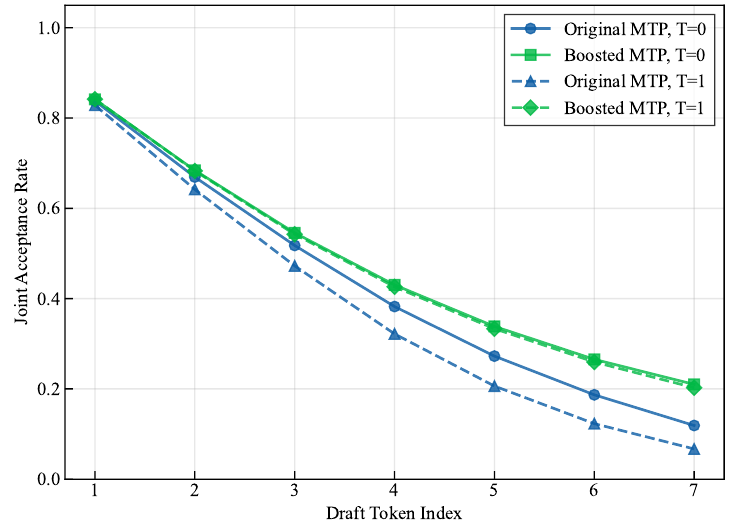
Boosting raises acceptance length by 10.1% (greedy) and 21.8% (sampled), with the largest per-position gains at deeper draft positions.
Across the models in Table 9, the boosted head has the highest average acceptance length under sampled drafting (4.612, against 4.565 for Gemma-4 31B, 4.331 for Qwen3.5-122B-A10B, and at most 4.213 for Qwen3.8-Flash-Next); under greedy decoding Gemma-4 31B (4.837) and Qwen3.5-122B-A10B (4.799) are higher.
Quick Start#
Container#
All RL stages share one container built from src/nemotron/recipes/super35/stage2_rl/Dockerfile. It runs the public NeMo-RL super-v3.5-posttraining branch at commit f299847f1, which pins NeMo Gym e24db4e6:
uv run nemotron kit slurm build YOUR-CLUSTER --recipe super35 --stage rl
The RL configs expect the image at ~/.cache/nemotron/containers/super35-rl.sqsh (run.env.container). Stages with code-execution environments (RLVR, the reasoning teacher, MOPD) also need a NeMo-Skills sandbox image (run.env.sandbox.container).
Data#
Each RL stage reads its own data artifact. Register NeMo Gym JSONL (a training file and an optional validation file) under the name the stage expects:
uv run nemotron super35 data import rl /data/rlvr/train.jsonl --val /data/rlvr/val.jsonl
uv run nemotron super35 data import rl /data/mopd1/train.jsonl --name super35-rl-mopd-phase1-data
Stage |
Data artifact ( |
|---|---|
RLVR |
|
Teachers |
one per config; see Teachers |
MOPD phase 1 / phase 2 |
|
The JSONL files are referenced in place, so keep them on storage the cluster can see.
External Services#
Several stages score rollouts with external model servers (GenRM, LLM judges, safety and NL2Bash judges). The configs read each server’s endpoint and model from environment variables (for example GENRM_BASE_URL), with public Hugging Face model ids where one exists. Each stage README under src/nemotron/recipes/super35/stage2_rl/ lists the variables it needs. MOPD skips reward verification and needs no judges.
The report’s length-penalized GenRM variant is not public; NeMo-RL’s public recipe uses nvidia/NVIDIA-Nemotron-3-Ultra-550B-A55B-GenRM instead.
Using nemotron CLI (Recommended)#
# 1. RLVR from SFT
uv run nemotron super35 rl rlvr --run YOUR-CLUSTER

# 2. Teachers (independent of each other, except the two-stage teachers)
uv run nemotron super35 rl teacher reasoning --run YOUR-CLUSTER
uv run nemotron super35 rl teacher vision --run YOUR-CLUSTER
uv run nemotron super35 rl teacher video --run YOUR-CLUSTER
uv run nemotron super35 rl teacher vision-reasoning --run YOUR-CLUSTER            # stage 1
uv run nemotron super35 rl teacher vision-reasoning -c stage2 --run YOUR-CLUSTER  # stage 2
uv run nemotron super35 rl teacher rlhf --run YOUR-CLUSTER                        # RLHF teacher 1, stage 1
uv run nemotron super35 rl teacher rlhf -c teacher1_stage2 --run YOUR-CLUSTER     # RLHF teacher 1, stage 2
uv run nemotron super35 rl teacher rlhf -c teacher2_stage1 --run YOUR-CLUSTER     # RLHF teacher 2, stage 1
uv run nemotron super35 rl teacher rlhf -c teacher2_stage2 --run YOUR-CLUSTER     # RLHF teacher 2, stage 2

# 3. MOPD
uv run nemotron super35 rl mopd --run YOUR-CLUSTER
uv run nemotron super35 rl mopd -c phase2 --run YOUR-CLUSTER run.model=super35-rl-mopd-phase1-model:vN
# or, without the agentic teacher: NeMo-RL's single-stage MOPD
uv run nemotron super35 rl mopd -c single_stage --run YOUR-CLUSTER

# Preview any stage's resolved config
uv run nemotron super35 rl mopd -c phase2 --dry-run
Only the reasoning and alignment configs stop at their selected step. The others run longer: MOPD phase 2, for example, stops at step 40, and its selected step is 30. Either stop a run with grpo.max_num_steps=<step>, or pin the artifact version saved at the selected step when you start the next stage.
To start RL from the released post-trained checkpoint or another external checkpoint, register it first (nemotron super35 model import rl /path/to/hf_checkpoint, which creates super35-rl-rlvr-model unless you pass --name) and pass it with run.model=....
NeMo-RL’s Super 3.5 Guide#
NeMo-RL publishes its own Nemotron 3.5 Super guide on the same branch, with five standalone configs in examples/nemo_gym/nemotron-3.5-super/ and a Slurm launcher that also starts the judge servers. That guide covers a shorter lineage: Student RLVR, three teachers (RLHF, reasoning, vision), and one MOPD stage. NeMo-RL calls its RLVR stage Student RLVR. This recipe ports the full lineage of the reference run that the report describes. Where both have the same stage, the training settings are the same except for the differences below.
Stage |
This recipe |
NeMo-RL guide |
|---|---|---|
RLVR |
|
|
RLHF teacher |
Two teachers, each with two stages ( |
One |
Reasoning teacher |
|
|
Vision teacher |
|
|
Video, vision-reasoning, and agentic teachers |
Included (agentic is config-only) |
Not included |
MOPD |
Two phases; |
One |
The guide’s NeMo-RL commit is newer than the one this recipe’s configs were ported from. Both use NeMo Gym e24db4e6, and every config here validates against the pinned commit’s GRPO config schema.
Using super35_launch.sh (Direct)#
Alternatively, run NeMo-RL’s own launcher inside the NeMo-RL repository. It covers the shorter lineage (Student RLVR, RLHF, reasoning and vision teachers, one MOPD stage), takes checkpoints and data as paths instead of W&B artifacts, and starts the judge servers in the same Slurm allocation. The NeMo-RL guide is the reference for this path.
git clone --recursive --branch super-v3.5-posttraining https://github.com/NVIDIA-NeMo/RL.git
cd RL
Build the ARM64 NeMo-RL image and the NeMo-Skills sandbox image as described in the guide, and convert both to .sqsh. Each stage is one launcher call; for example, Student RLVR from your SFT checkpoint:
SHARED_ROOT=/shared \
CONTAINER=/shared/images/nemo-rl-super35.sqsh \
SANDBOX_CONTAINER=/shared/images/nemo-skills-sandbox.sqsh \
DATA_ROOT=/shared/data/super35 \
SLURM_ACCOUNT=<your-account> \
SLURM_PARTITION=<your-partition> \
WALLTIME=4:00:00 \
GENRM_CHECKPOINT=nvidia/NVIDIA-Nemotron-3-Ultra-550B-A55B-GenRM \
NL2BASH_CHECKPOINT=Qwen/Qwen3-235B-A22B-Instruct-2507-FP8 \
SAFETY_CHECKPOINT=nvidia/Nemotron-Content-Safety-Reasoning-4B \
MODEL_PATH=/shared/checkpoints/super35-sft \
TRAIN_PATH=/shared/data/super35/rlvr.jsonl \
EXP_NAME=super35-student-rlvr \
bash examples/nemo_gym/nemotron-3.5-super/super35_launch.sh student_rlvr
The other stages are rlhf_teacher, reasoning_teacher, vision_teacher and mopd; the guide lists the variables each one needs. Prepend DRY_RUN=1 to print the allocation and command without submitting.
Verification Status#
See Open-Source Status for what has been verified, stage by stage.
Infrastructure#
Component |
Role |
Documentation |
|---|---|---|
Asynchronous GRPO and on-policy distillation; every stage runs |
||
Reward environments, verifiers, and agent harnesses |
||
Policy training backend (TP, CP, EP) |
||
Rollout generation and teacher serving |
Next Steps#
After MOPD phase 2, evaluate the step-30 checkpoint. The report then applies MTP boosting and quantizes the result to NVFP4.
Reference#
Nemotron 3.5 tech report, §3.2–3.7 (RL, teachers, MOPD, MTP boosting), Tables 8–9
NeMo-RL’s Nemotron 3.5 Super guide: NeMo-RL’s own launcher and configs for a shorter lineage
Nemotron 3 Ultra MOPD: the pipeline Super 3.5 builds on
Artifact Lineage: W&B artifact system
Recipe Source:
src/nemotron/recipes/super35/stage2_rl/