


Supercharge Tree-Based Model Inference with nvForest#
Published 2026-09-03
Tree-based models such as gradient boosted trees and random forests remain some of the most widely used models in machine learning. For structured data, they are often more accurate, easier to train, and easier to interpret than other types of models, such as deep learning models. Libraries like XGBoost, LightGBM, and scikit-learn have made tree models a default choice for tasks such as fraud detection, recommendation systems, and risk scoring.
Once a model is trained, inference is where most of its life is spent, often with high throughput or low latency requirements, and on different hardware than it was trained on. Getting good inference performance is critical, and performing inference on CPUs does not always meet those latency or throughput demands.
We are proud to announce nvForest, a lightweight library for fast inference for tree-based models on NVIDIA GPUs. nvForest builds on our past work on the Forest Inference Library (FIL), which was previously maintained and distributed in cuML. nvForest is easier to install, easier to deploy, and useful to a wider range of applications.
nvForest enables fast inference for a variety of model formats, including cuML, scikit-learn, XGBoost, and LightGBM models. It provides state-of-the-art performance on tree inference, a small binary footprint, and a simple API.
In this post, we explore the motivation behind releasing nvForest as a standalone library, provide updated benchmarks showing the benefits of performing inference with nvForest, and share code samples to help you get started running on your own data today.
Why a standalone library#
FIL has always been a strong inference engine, but bundling it with cuML created some friction for the people who relied on it most. Splitting it out addresses a few specific problems.
First, nvForest is now much lighter to install. Because FIL accelerates models from scikit-learn, XGBoost, and LightGBM, many of its users work primarily in those ecosystems. Bundling it with cuML imposed cuML and all of its dependencies on those users, which was not always possible in constrained environments. nvForest depends only on what it needs, and has a much smaller binary size relative to cuML (50 MiB vs 250 MiB).
Additionally, nvForest does not require a GPU to be installed. One of the features of nvForest is a CPU-only execution mode, and one common usage pattern is to train a model on GPUs and then deploy it on CPUs. Until now, that required a machine with a GPU present, even if the GPU was never used for inference. As a standalone library, nvForest removes that requirement and provides forest inference out of the box on CPUs as well as NVIDIA GPUs.
Quick-start examples#
To get started with nvForest, import the module, load your model, and call
predict().
Inferencing with XGBoost models#
import nvforest

fm = nvforest.load_model("xgboost_model.json", device="gpu")
y = fm.predict(X)
Inferencing with LightGBM models#
import nvforest

fm = nvforest.load_model("lightgbm_model.txt", device="gpu")
y = fm.predict(X)
Inferencing with scikit-learn random forest models#
import nvforest

# skl_model is RandomForestRegressor or RandomForestClassifier
fm = nvforest.load_from_sklearn(skl_model, device="gpu")
y = fm.predict(X)
In addition to the simple Python API, nvForest provides a CMake configuration and a C++ API, to make it easy for C++ applications to provide fast tree inference. See nvForest with C++ (Advanced) for more details.
Auto-optimization#
nvForest allows users to fine-tune inference performance with two
hyperparameters: layout and default_chunk_size. It is difficult to
predict what the optimal values will be for any given model, so it is often
necessary to determine them empirically. nvForest significantly simplifies
this process with a built-in method for auto-optimization at any given batch
size:
fm_optimized = fm.optimize(batch_size=1000)
Here, the batch size is a typical size of each inference request. The
default_chunk_size parameter controls the unit of work for each inference
kernel launch and is typically no more than 32. As part of the optimization,
we need to find the best size for default_chunk_size so that the given
batch is optimally partitioned between inference kernel launches.
optimize() returns a new model
instance. Subsequent prediction calls on that instance use the optimal
performance hyperparameters found for the indicated batch size. You can also
check what hyperparameters were selected by looking at the attributes:
print(fm_optimized.layout)
print(fm_optimized.default_chunk_size)
Performance benchmark#
In order to obtain the most complete understanding of nvForest’s performance characteristics, we performed an exhaustive sweep across a broad range of each of these variables, as summarized in the following table:
Variable |
Values |
|---|---|
Maximum tree depth |
2, 4, 8, 16, 32 |
Tree count |
16, 128, 1024 |
Feature count |
8, 32, 128, 512 |
Batch size |
1, 16, 128, 1024, 1048576 |
We trained scikit-learn RandomForestRegressor models with every
combination of maximum tree depth, tree count, and feature count from the
above table using synthetically generated data. We then measured inference
performance across each of the batch sizes above.
Runtime performance for inference was assessed using synthetically generated
input batches that were drawn from the same distribution as the training
data. We used RandomForestRegressor.predict as the baseline.
To summarize the performance over a variety of model configurations, we plot the 0%, 25%, 50%, 75% and 100% percentile of speedup values for each subset of configurations. The box plot labeled “all-avg” shows the data for all configurations.
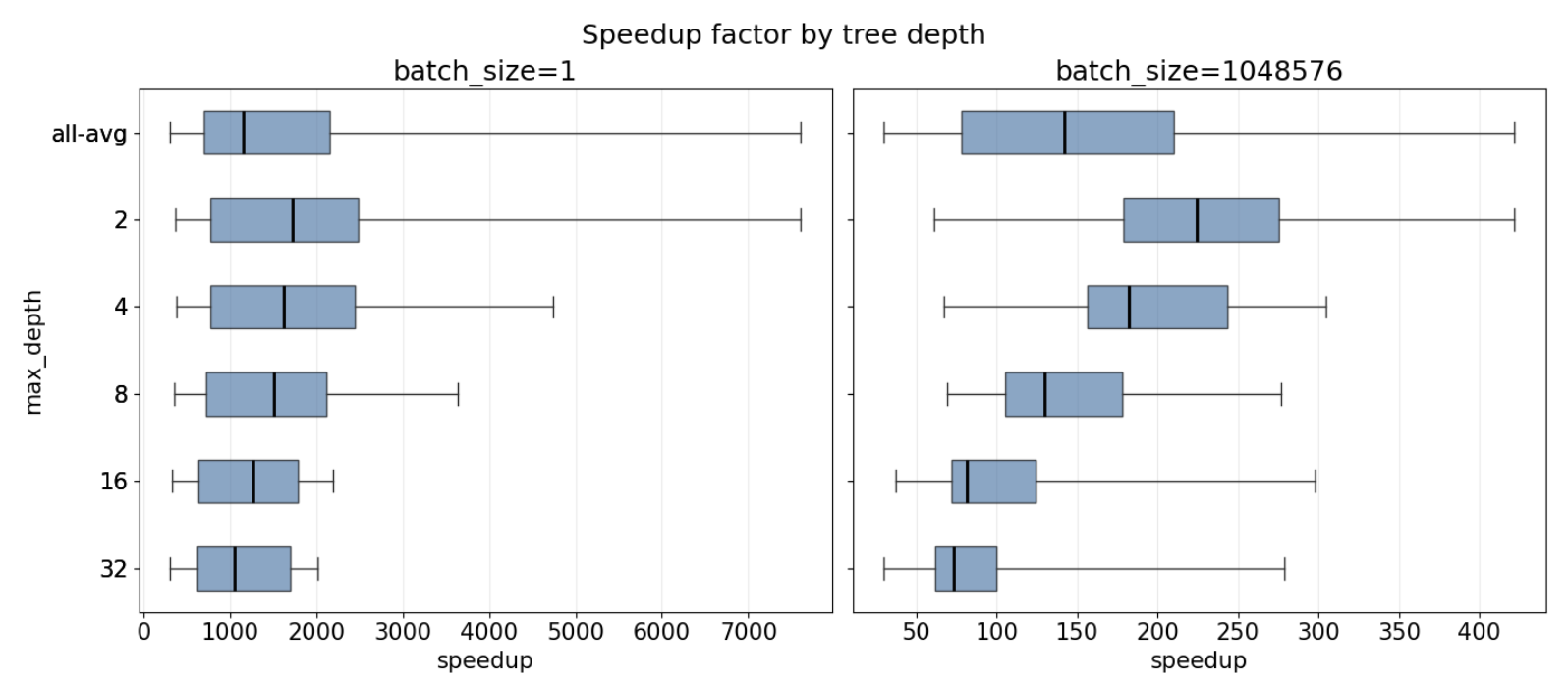
Speedup factor by tree depth.#
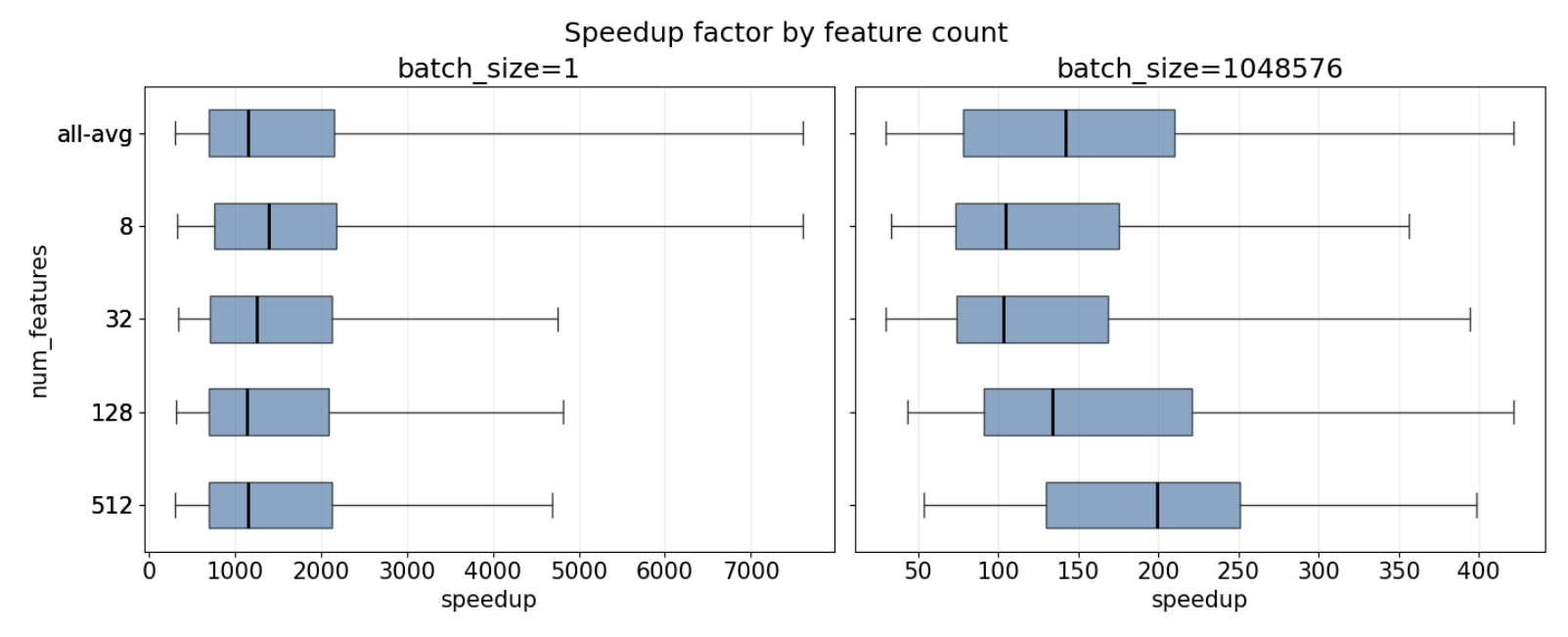
Speedup factor by feature count.#
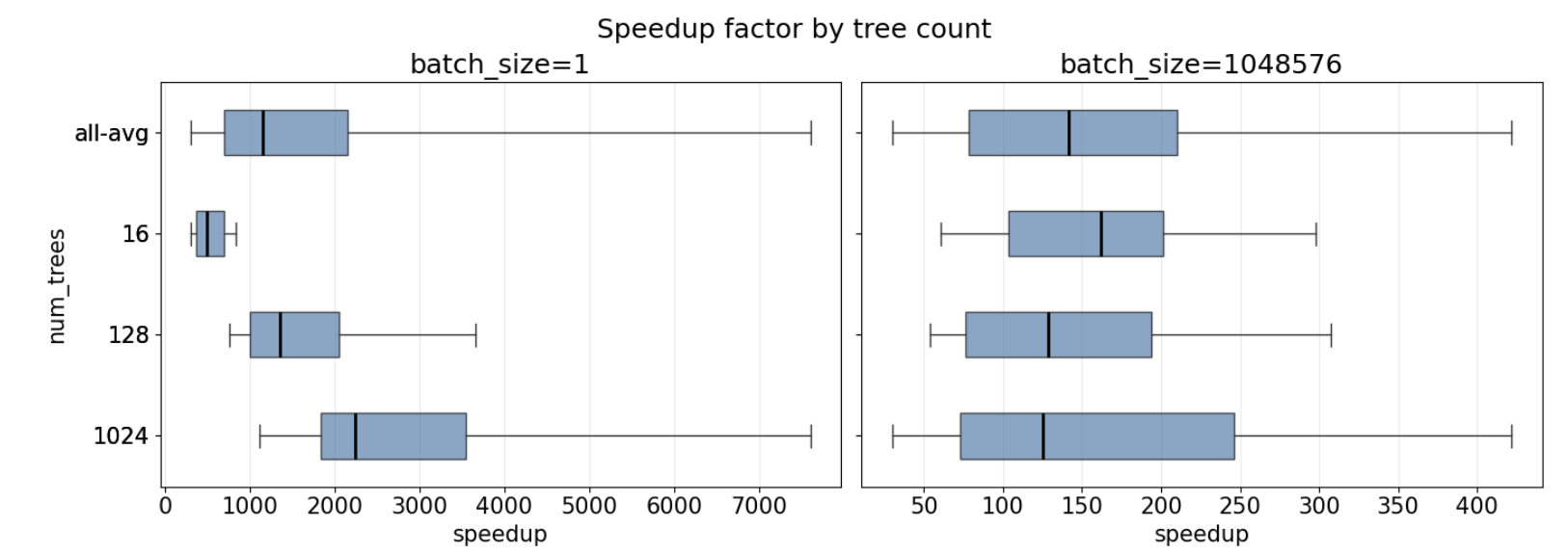
Speedup factor by tree count.#
A single NVIDIA H100 (80GB HBM3) was used for GPU results (nvForest), and a 2-socket Intel Xeon Platinum 8480CL machine was used for CPU results (scikit-learn RandomForest).
In general, nvForest outperforms scikit-learn by 2-3 orders of magnitude for inference latency and throughput. The difference in performance is greatest for shallow tree models (tree depth 8 or less) and models with a high number of trees (1024).
Migrating from FIL#
If you are using FIL today through cuml.fil.ForestInference, you should
migrate your code to use nvForest. Read the migration guide:
Migration guide.
Using cuml.fil.ForestInference will raise an error starting in the
26.10 version of cuML.
Conclusion#
nvForest is available today. You can install it by following instructions in the RAPIDS installation guide.
To get started, head to Getting started with nvForest, try the examples above, and get started performing lightning fast inference on your own tree models!