> For clean Markdown of any page, append .md to the page URL.
> For a complete documentation index, see https://docs.nvidia.com/sdgm/llms.txt.
> For AI client integration (Claude Code, Cursor, etc.), connect to the MCP server at https://docs.nvidia.com/sdgm/_mcp/server.
# Credit Card Fraud Detection Solution
## Solution Background and Business Value
Credit card fraud is a widespread issue affecting **financial institutions, businesses, and consumers**. Fraud occurs when a malicious actor gains unauthorized access to a customer’s credit card and makes fraudulent transactions. Common fraud methods include:
* **Physical theft** of the card.
* **Skimming** card details from payment terminals.
* **Online breaches** where card data is stolen and misused.
To mitigate financial losses, businesses can use **machine learning models** to detect fraud **in real-time**, allowing them to:
* **Identify suspicious transactions early** and intervene before money is lost.
* **Reduce false positives**, ensuring legitimate transactions are not blocked.
* **Enhance fraud detection accuracy** by leveraging **graph-based patterns** in transaction networks.
## Data Requirements and Schema
Kumo AI processes relational data as interconnected tables using **Graph Neural Networks (GNNs)**. This approach allows the model to learn from **transaction patterns, account behavior, and merchant interactions** without extensive feature engineering.
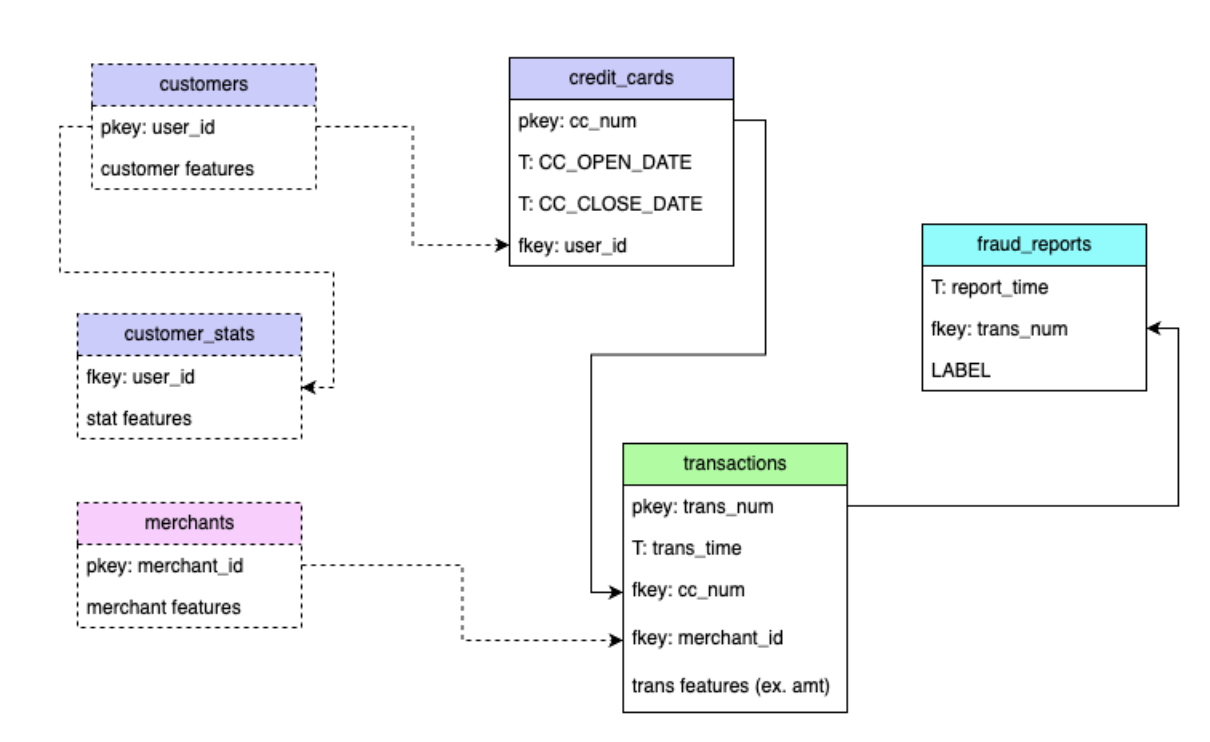 **Core Tables**
1. **Transactions Table**
* Stores all recorded transactions.
* **Key attributes:**
* `transaction_id`: Unique identifier for each transaction.
* `timestamp`: When the transaction occurred.
* `credit_card_id`: Links transaction to a credit card.
* `merchant_id`: Links transaction to a merchant.
* **Optional:** Location, currency, amount, transaction type.
2. **Credit Cards Table**
* Represents unique credit cards in the system.
* **Key attributes:**
* `credit_card_id`: Unique identifier.
* `cc_open_date`: Date when the card was issued.
* `cc_close_date`: Date when the card was closed (if applicable).
* **Optional:** Credit limit, APR, fraud risk score.
3. **Fraud Reports Table**
* Stores fraud labels for transactions.
* **Key attributes:**
* `transaction_id`: Links to the transaction flagged as fraudulent.
* `timestamp`: When the fraud report was filed.
* `label`: 1 if fraudulent, 0 if legitimate.
**Additional Tables (Optional)**
* **Users Table:** Links credit cards to customers.
* **User Stats Table:** Stores aggregated stats like transaction count and total spend.
* **Merchants Table:** Stores merchant details (e.g., category, location, risk rating).
**Entity Relationship Diagram (ERD)**
```mermaid
erDiagram
CREDIT_CARDS {
INT credit_card_id PK
TIMESTAMP cc_open_date
TIMESTAMP cc_close_date
FLOAT credit_limit
}
TRANSACTIONS {
INT transaction_id PK
INT credit_card_id FK
INT merchant_id FK
TIMESTAMP timestamp
FLOAT amount
}
FRAUD_REPORTS {
INT report_id PK
INT transaction_id FK
TIMESTAMP timestamp
INT label
}
CREDIT_CARDS ||--o{ TRANSACTIONS : "used in"
TRANSACTIONS ||--o{ FRAUD_REPORTS : "flagged"
```
## Predictive Query for Credit Card Fraud Detection
**1. Transaction-Level Fraud Detection**
Predict whether a transaction is fraudulent based on past fraud reports:
```pql
PREDICT transactions.LABEL
FOR EACH transactions.transaction_id
```
* **At inference time**, leave `LABEL` empty for new transactions to generate fraud risk scores.
**2. Time-Based Fraud Prediction**
Predict whether a fraud report will be linked to a transaction **in the next 30 days**:
```pql
PREDICT SUM(fraud_reports.LABEL, 0, 30, days) > 0
FOR EACH transactions.transaction_id
ASSUMING COUNT(fraud_reports.*, 0, 30, days) >= 1
```
**3. Credit Card Risk Prediction**
Predict whether a credit card will be associated with fraudulent transactions in the next 7 days:
```pql
PREDICT COUNT(transactions.LABEL, 0, 7, days) >= 1
FOR EACH credit_cards.credit_card_id
ASSUMING COUNT(transactions.LABEL, 0, 7, days) >= 1
```
## Deployment Strategy
**1. Batch Predictions for Fraud Analysts**
* Fraud teams review **high-risk transactions** flagged by the ML model.
* Predictions are generated **hourly or daily** in batch mode.
* Fraud analysts **label new fraudulent transactions**, improving the model over time.
```pql
WHERE transactions.TIMESTAMP > MIN_TIMESTAMP
```
**2. Real-Time Fraud Detection**
* The system generates **instant fraud risk scores** when a transaction occurs.
* High-risk transactions trigger **manual review or two-factor authentication**.
* ML embeddings enhance rule-based fraud detection.
## Building models in Kumo SDK
**1. Initialize the Kumo SDK**
```python
import kumoai as kumo
kumo.init(url="https://.kumoai.cloud/api", api_key=API_KEY)
```
**2. Connect data**
```python
connector = kumo.S3Connector("s3://your-dataset-location/")
```
**3. Select tables**
```python
credit_cards = kumo.Table.from_source_table(
source_table=connector.table('credit_cards'),
primary_key='credit_card_id',
).infer_metadata()
transactions = kumo.Table.from_source_table(
source_table=connector.table('transactions'),
time_column='timestamp',
).infer_metadata()
fraud_reports = kumo.Table.from_source_table(
source_table=connector.table('fraud_reports'),
time_column='timestamp',
).infer_metadata()
```
**4. Create graph schema**
```python
graph = kumo.Graph(
tables={
'credit_cards': credit_cards,
'transactions': transactions,
'fraud_reports': fraud_reports,
},
edges=[
dict(src_table='transactions', fkey='credit_card_id', dst_table='credit_cards'),
dict(src_table='fraud_reports', fkey='transaction_id', dst_table='transactions'),
],
)
graph.validate(verbose=True)
```
**5. Train the model**
```python
pquery = kumo.PredictiveQuery(
graph=graph,
query="PREDICT transactions.LABEL FOR EACH transactions.transaction_id"
)
pquery.validate(verbose=True)
model_plan = pquery.suggest_model_plan()
trainer = kumo.Trainer(model_plan)
training_job = trainer.fit(
graph=graph,
train_table=pquery.generate_training_table(non_blocking=True),
non_blocking=False,
)
print(f"Training metrics: {training_job.metrics()}")
```
**Core Tables**
1. **Transactions Table**
* Stores all recorded transactions.
* **Key attributes:**
* `transaction_id`: Unique identifier for each transaction.
* `timestamp`: When the transaction occurred.
* `credit_card_id`: Links transaction to a credit card.
* `merchant_id`: Links transaction to a merchant.
* **Optional:** Location, currency, amount, transaction type.
2. **Credit Cards Table**
* Represents unique credit cards in the system.
* **Key attributes:**
* `credit_card_id`: Unique identifier.
* `cc_open_date`: Date when the card was issued.
* `cc_close_date`: Date when the card was closed (if applicable).
* **Optional:** Credit limit, APR, fraud risk score.
3. **Fraud Reports Table**
* Stores fraud labels for transactions.
* **Key attributes:**
* `transaction_id`: Links to the transaction flagged as fraudulent.
* `timestamp`: When the fraud report was filed.
* `label`: 1 if fraudulent, 0 if legitimate.
**Additional Tables (Optional)**
* **Users Table:** Links credit cards to customers.
* **User Stats Table:** Stores aggregated stats like transaction count and total spend.
* **Merchants Table:** Stores merchant details (e.g., category, location, risk rating).
**Entity Relationship Diagram (ERD)**
```mermaid
erDiagram
CREDIT_CARDS {
INT credit_card_id PK
TIMESTAMP cc_open_date
TIMESTAMP cc_close_date
FLOAT credit_limit
}
TRANSACTIONS {
INT transaction_id PK
INT credit_card_id FK
INT merchant_id FK
TIMESTAMP timestamp
FLOAT amount
}
FRAUD_REPORTS {
INT report_id PK
INT transaction_id FK
TIMESTAMP timestamp
INT label
}
CREDIT_CARDS ||--o{ TRANSACTIONS : "used in"
TRANSACTIONS ||--o{ FRAUD_REPORTS : "flagged"
```
## Predictive Query for Credit Card Fraud Detection
**1. Transaction-Level Fraud Detection**
Predict whether a transaction is fraudulent based on past fraud reports:
```pql
PREDICT transactions.LABEL
FOR EACH transactions.transaction_id
```
* **At inference time**, leave `LABEL` empty for new transactions to generate fraud risk scores.
**2. Time-Based Fraud Prediction**
Predict whether a fraud report will be linked to a transaction **in the next 30 days**:
```pql
PREDICT SUM(fraud_reports.LABEL, 0, 30, days) > 0
FOR EACH transactions.transaction_id
ASSUMING COUNT(fraud_reports.*, 0, 30, days) >= 1
```
**3. Credit Card Risk Prediction**
Predict whether a credit card will be associated with fraudulent transactions in the next 7 days:
```pql
PREDICT COUNT(transactions.LABEL, 0, 7, days) >= 1
FOR EACH credit_cards.credit_card_id
ASSUMING COUNT(transactions.LABEL, 0, 7, days) >= 1
```
## Deployment Strategy
**1. Batch Predictions for Fraud Analysts**
* Fraud teams review **high-risk transactions** flagged by the ML model.
* Predictions are generated **hourly or daily** in batch mode.
* Fraud analysts **label new fraudulent transactions**, improving the model over time.
```pql
WHERE transactions.TIMESTAMP > MIN_TIMESTAMP
```
**2. Real-Time Fraud Detection**
* The system generates **instant fraud risk scores** when a transaction occurs.
* High-risk transactions trigger **manual review or two-factor authentication**.
* ML embeddings enhance rule-based fraud detection.
## Building models in Kumo SDK
**1. Initialize the Kumo SDK**
```python
import kumoai as kumo
kumo.init(url="https://.kumoai.cloud/api", api_key=API_KEY)
```
**2. Connect data**
```python
connector = kumo.S3Connector("s3://your-dataset-location/")
```
**3. Select tables**
```python
credit_cards = kumo.Table.from_source_table(
source_table=connector.table('credit_cards'),
primary_key='credit_card_id',
).infer_metadata()
transactions = kumo.Table.from_source_table(
source_table=connector.table('transactions'),
time_column='timestamp',
).infer_metadata()
fraud_reports = kumo.Table.from_source_table(
source_table=connector.table('fraud_reports'),
time_column='timestamp',
).infer_metadata()
```
**4. Create graph schema**
```python
graph = kumo.Graph(
tables={
'credit_cards': credit_cards,
'transactions': transactions,
'fraud_reports': fraud_reports,
},
edges=[
dict(src_table='transactions', fkey='credit_card_id', dst_table='credit_cards'),
dict(src_table='fraud_reports', fkey='transaction_id', dst_table='transactions'),
],
)
graph.validate(verbose=True)
```
**5. Train the model**
```python
pquery = kumo.PredictiveQuery(
graph=graph,
query="PREDICT transactions.LABEL FOR EACH transactions.transaction_id"
)
pquery.validate(verbose=True)
model_plan = pquery.suggest_model_plan()
trainer = kumo.Trainer(model_plan)
training_job = trainer.fit(
graph=graph,
train_table=pquery.generate_training_table(non_blocking=True),
non_blocking=False,
)
print(f"Training metrics: {training_job.metrics()}")
```