
Community Showcase#
We love to see how Aerial Testbed is being used by developers, researchers, and the community. Send an email to aerial-info@nvidia.com. Include your project description, project links, and code repository (e.g. GitHub) to be featured here!
The following are examples of demos, use cases, and other amazing showcases from our community.
Northeastern University#
RIC Platform#
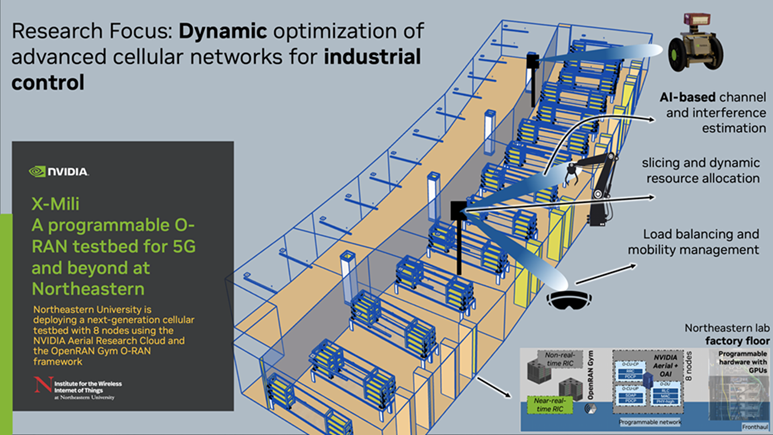
The Northeastern University (NEU) Wireless Institute of Things (WIoT) Institute is advancing the integration of O-RAN technology with NVIDIA’s Aerial Testbed platform. One research topic is integrating an end-to-end (E2E) O-RAN E2 interface within the Aerial Testbed software stack. The integration leverages key components of the O-RAN ecosystem, including the O-RAN Software Community (OSC) RAN Intelligent Controller (RIC), and the OpenRAN Gym framework.
The integration enables two critical functionalities:
Streaming of key performance metrics (KPMs): The system can now transmit relevant performance data in real-time
Enforcement of control actions: Decisions made by the xApps on the near-real time (Near-RT) RIC can be implemented swiftly.
Recent Developments
In July 2023, NEU showcased a significant milestone:
A data-collection xApp running on an OSC RIC
Deployed in a fully automated OpenShift cluster
Connected to an InfluxDB database for telemetry storage
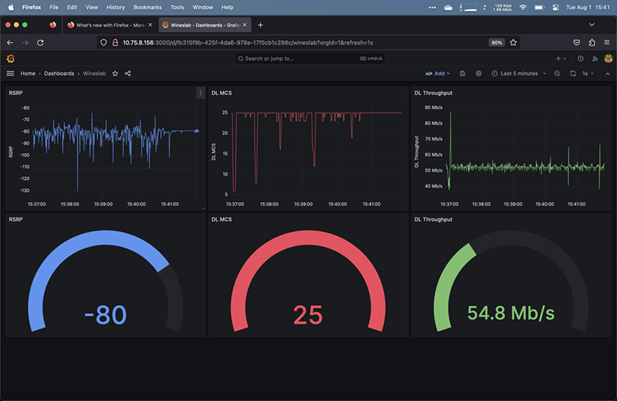
Visualization of on a Grafana dashboard.
Ongoing Work
NEU is currently focused on enhancing the system’s capabilities:
Near-RT Control: The team is working to enable Near-RT control functionalities on the existing infrastructure
8-Node Deployment: The institute is supporting an 8-node NVIDIA Aerial Testbed deployment, which serves as the testbed for these advancements.
This project represents a significant step forward in the implementation of O-RAN technology, potentially improving the flexibility, efficiency, and intelligence of radio access networks.
Open5Gs#
Northeastern University has successfully integrated and validated Open5Gs, an advanced 5G open-source core network, in their experimental lab setup using an OpenShift cluster. This achievement represents a significant step forward in 5G network R&D.
Key Achievements
Microservice Architecture: The core network is built on a microservice architecture, offering flexible deployment and scaling of individual network functions
Optimized User Plane Function (UPF): Delivers high-performance packet processing capabilities
User-Friendly SIM Management: Offers easier management of user SIMs through a graphical interface
Network Slicing Support: Enables the creating of multiple virtual networks on a single physical infrastructure
Deployment Flexibility: Open5Gs demonstrates remarkable versatility in deployment options:
Bare metal installation using standard Linux package managers
Containerized deployment using Docker
Virtualized approach utilizing Helm Charts on K8s and OpenShift
Performance and Compatibility: When integrated with NVIDIA’s Aerial Testbed platform, Open5Gs exhibited impressive performance:
High Stability: Maintained consistent operation during testing
Sustained Performance: Met the performance expectations set for the Aerial Testbed release
MIMO Compatibility: Successfully tested with OAI and 2-layer MIMO configurations
Implications for O-RAN Ecosystem: This successful integration underscores the potential of the disaggregated O-RAN ecosystem. It demonstrates that components from different vendors can seamlessly integrate, fostering innovation and flexibility in 5G network deployments.
The Open5Gs implementation at Northeastern University showcases the power of open-source solutions in advancing 5G technology. By leveraging microservices architecture and supporting various deployment methods, Open5Gs provides researchers and developers with a robust platform for exploring next-generation mobile network capabilities.
X5G#
X5G achieves a groundbreaking 8-node network deployment leveraging NVIDIA’s ARC- OTA, integrating NVIDIA Aerial-CUDA Accelerated RAN for the PHY layer, accelerated on GPU. This innovative solution seamlessly combines with higher layers from the OAI open-source project, through the Small Cell Forum Functional Application Platform Interface (FAPI), setting a new standard for network efficiency and performance.
Private 5G Network#
Northeastern University’s Institute for the Wireless Internet of Things (WIoT) and its Open6G R&D Center have launched the first production-ready private 5G network fully automated through AI. This groundbreaking system is built on NVIDIA Aerial Testbed platform, enabling a fully virtualized, programmable O-RAN compliant network in a campus environment.
Key features of this innovative network include:
Connectivity for 5G devices, supporting video conferencing, browsing, and streaming for experiential learning activities.
Built on open-source programmable components, utilizing compute solutions from partners like Dell Technologies and NVIDIA.
Employs zTouch, Northeastern’s AI-based management, control, and orchestration framework for streamlined deployment and automated configuration.
Runs on Dell servers using OAI and Open5Gs for RAN and core network implementations.
Features base stations based on the NVIDIA Aerial Testbed, integrating a GPU-based PHY layer.
The following UEs have been successfully tested in the system: OnePlus AC2003 Nord Samsung Galaxy S23, Sierra Wireless EM9191 NR 5G Modem, OAI Soft-UE.
The network showcases key features of next-generation wireless systems:
Openness and programmability following the O-RAN architecture.
Resiliency and self-healing behavior through the zTouch automation framework.
Intelligent orchestration for managing xApps, rApps, and dApps.
55 UEs have been tested in a RF cabled test with the Keysight eLSU.
Currently deployed at Northeastern University’s Boston campus, with plans to extend to the Burlington campus, this private 5G network offers unique opportunities for research in next-generation wireless technologies, including spectrum sharing mechanisms, AR/VR, E2E slicing solutions, and advanced security solutions.
There are more details for this project in this blog post. Visit https://wiot.northeastern.edu/ for information about the Northeastern Institute for the WIoT program.

Sterling SkyWave#
Kubernetes Service Management#
Sterling SkyWave Service Management is a developer extension for NVIDIA ATB that enhances its capabilities with two key features:
Kubernetes (K8s) Service Orchestration: Utilizes Helm for application management and includes two main Helm charts: skywave-service-management for gNB servers and oai-5g-basic for CN5G servers. The extension supports both single-node and multi-node deployment topologies, offering flexibility in network setup.
Service Monitoring: Leverages open-source tools such as Grafana, Loki, Promtail, and Prometheus to provide comprehensive monitoring and visualization capabilities. It offers three default dashboards: ATB for gNB and UE status, GPU for NVIDIA Data Center GPU Manager (DCGM) metrics, and Host for system-level metrics.
The Sterling SkyWave Service Management extension is documented here.
GPU MIG Partition by Sterling SkyWave#
The Sterling SkyWave GPU multi-instance GPU (MIG) Partition plugin is documented here.
Application Note
While running Aerial on a GPU partition device, the mps_sm_* parameters in the cuphycontroller config YAML file need to be adjusted
accordingly such that the mps_sm_* value is not over the available streaming multiprocessors (SMs) of the selected MIG devices.
Please refer to the mps_sm_* configurations in cuphycontroller_P5G_FXN.yaml for the following cases:
Running Aerial with MIG disabled
mps_sm_pusch: 108

mps_sm_pucch: 16

mps_sm_prach: 16

mps_sm_pdsch: 82

mps_sm_pdcch: 28

mps_sm_pbch: 18

mps_sm_srs: 16
Running Aerial with MIG enabled on
mig-4g.48gbmps_sm_pusch: 42 mps_sm_pucch: 16 mps_sm_prach: 16 mps_sm_pdsch: 58 mps_sm_pdcch: 10 mps_sm_pbch: 8 mps_sm_srs: 8
Running Aerial with MIG enabled on
mig-3g.48gbmps_sm_pusch: 40 mps_sm_pucch: 16 mps_sm_prach: 16 mps_sm_pdsch: 52 mps_sm_pdcch: 10 mps_sm_pbch: 8 mps_sm_srs: 8
Rice University#
n48 (CBRS) O-RU Interoperability#
The Rice University, Department of Electrical and Computer Engineering has made significant progress in enabling interoperability between NVIDIA ATB software with the Foxconn Citizens Broadband Radio Service (CBRS) O-RU (RPQN-4800E). This collaboration has yielded impressive results in lab testing, demonstrating the potential for advanced 5G and 6G research in the United States.
Key Achievements
Successful Testing: The team achieved stable connectivity for over an hour in an indoor lab environment
Operational Spectrum: Tests were conducted in a 100 MHz band (3.6-3.7 GHz)
Throughput Performance: Achieved 250 Mbps DL and 50 Mbps UL speeds
Equipment Used: Quectel RG520N UE module and OnePlus Nord 5G commercial handset
CBRS Spectrum Importance
The CBRS band (3.55-3.7 GHz) plays a crucial role in 5G deployment in the United States. The Federal Communications Commission (FCC) has opened this spectrum for shared access, implementing a three-tiered system:
Incumbent Users: Government bodies
Priority Access License (PAL): Acquired through FCC auctions or secondary market sublicensing
General Authorized Access (GAA): Available when incumbent and PAL users are inactive
This shared access model, particularly the GAA tier, makes the CBRS band ideal for 5G research and development (R&D). It offers opportunities for experimentation without the high costs associated with PAL access.
Dataset Generation#
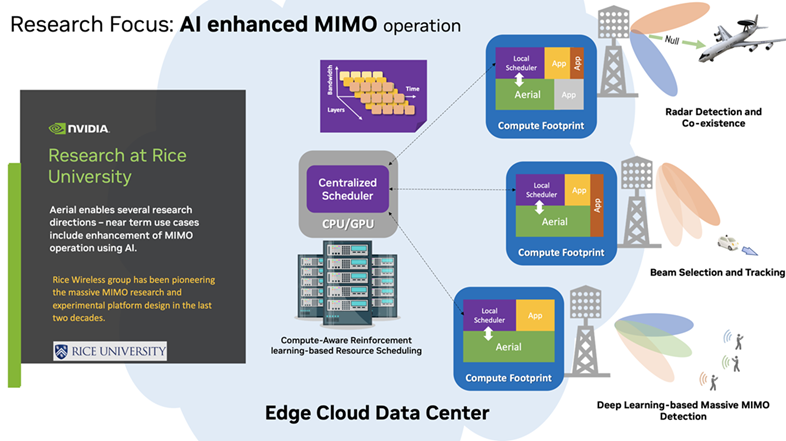
Rice University outlines how NVIDIA Aerial Testbed platform makes several key contributions to the research described in this blog post:
Aerial Testbed provides a 5G-compliant software-defined system that enables dataset generation at each layer of the network, which is crucial for training AI models.
The platform offers capabilities that help researchers pursue:
Representative datasets
E2E OTA performance benchmarking
Real-time implementation and performance evaluation of new algorithms
For deep learning-based MIMO detection research, NVIDIA Aerial Testbed allows for:
Collection of real-world 5G-compliant data
Real-time implementation of AI-based detection algorithms on NVIDIA GPUs
In radar detection and coexistence studies, the platform is used to:
Collect CSI from users affected by radar signals
Potentially implement real-time AI-based radar detection techniques
For self-adapting vRANs research:
It enables benchmarking of wireless performance under varying compute loads
Allows investigation of GPU resource allocation for achieving specific data rates
Supports the development of AI-based schedulers that jointly allocate compute and radio resources
NVIDIA RC-OTA platform serves as a crucial tool for researchers to generate real-world data, implement and evaluate AI algorithms in real-time, and explore various aspects of 5G and beyond network optimization.
Visit https://wireless.rice.edu/ for information about the Rice Wireless program.
HHI Fraunhofer#
Open Test Environment#
6G-RIC Is Significantly Advancing Its Open Test Environment
Open source, E2E deployments are key, offering 6G-RIC researchers and associated startups a highly accessible and versatile platform for experimentation. This encourages innovation and facilitates the testing of emerging technologies, protocols, and applications. The integration of an Open RAN network, based on open-source technologies and NVIDIA ATB, marks a significant milestone for our project. The GPU-centric design is ideal for integrating AI/ML and expediting the creation of demonstrators, which once required significant development time.
Open RAN Network Integration#
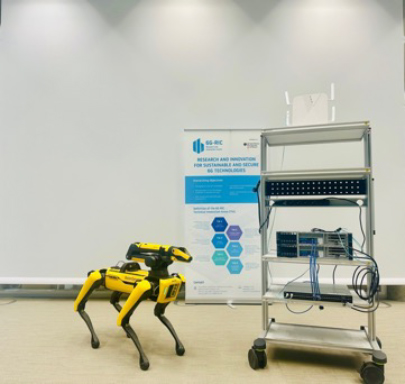
Aerial Spot Demo at Hannover Messe 2024
Fraunhofer has successfully integrated an Open RAN network based on NVIDIA’s ARC-OTA platform, showcasing its capabilities at the Y2024 Hannover Messe 6G-RIC booth in Germany.
This integration demonstrates the potential of advanced wireless technologies and open-source solutions in real-world applications.
Key Components of the Demo
NVIDIA Aerial Testbed Platform: Utilized as the foundation for the Open RAN network.
NVIDIA Aerial-CUDA Accelerated RAN: Employed the library for the High PHY layer, leveraging GPU acceleration for enhanced performance.
Open Air Alliance (OAI): Integrated for higher layer functionalities, complementing the Aerial-CUDA Accelerated RAN.
ETH Zurich#
Real World 5G System#
Integrated Information Processing Group
The Integrated Information Processing (IIP) Group at ETH Zurich has successfully deployed a 5G vRAN system based on the NVIDIA Aerial Testbed platform. This system is fully software-defined and standards-compliant, enabling rapid prototyping and verification of novel baseband algorithms under real-world conditions.
Key Features and Advantages
Software-Defined System: Allows implementation of novel baseband algorithms in CUDA for real-time execution and evaluation through OTA experiments.
Flexibility: Offers the capability to extract real-time data from various parts of the signal processing chain, which is crucial for ML-assisted baseband algorithms.
The following UEs have been successfully tested in the system: iPhone 14 Pro, iPhone 15 Pro, iPhone 16E, Samsung Galaxy S23, Google Pixel 7, OnePlus Nord, Quectel RMU500EK.
Cost-Effective: Reduces development time and verification costs compared to hardware-based prototypes using FPGAs or ASICs.
Research Goals
Develop novel ML-assisted baseband algorithms for future 5G and 6G wireless systems.
Optimize and validate solutions through OTA experiments on a real-world system.
Continue work on user positioning methods using self-supervised channel charting with channel state information (CSI).
ML-Assisted Iterative MIMO Detection and Decoding
The group aims to implement their Deep-Unfolded Interleaved Detection and Decoding (DUIDD) receiver architecture on the NVIDIA platform. This approach:
Fuses MIMO data detection and channel decoding with ML techniques.
Has shown 1.4dB performance gains in simulations over classical iterative detection and decoding solutions.
Will be evaluated under realistic conditions to assess its efficacy and potential for adaptation to instantaneous system and channel conditions.
This real-world 5G system provides a powerful platform for advancing wireless communications research beyond simulations, enabling the development and validation of innovative algorithms in realistic operational environments.
Real-World 5G System Blog
(insert two images here)
OpenAirInterface Software Alliance#
Aerial Testbed Integration#
The OpenAirInterface (OAI) Alliance has demonstrated a 5G vRAN using NVIDIA Aerial CUDA-Accelerated RAN (formerly known as Aerial SDK) at the O-RAN virtual exhibition 2023. This demonstration showcases the integration of NVIDIA’s L1 with OAI’s L2+ to create an accelerated 5G vRAN.
Key Features of the Demonstrations
Hardware Setup: The gNB (O-CU and O-DU) runs on a Dell server with an NVIDIA A100 Tensor Core GPU and ConnectX-6 DX SmartNIC.
Network Configuration: Uses O-RAN 7.2x fronthaul split, connecting to a commercial O-RU and a 5G phone.
Containerized Environment: Two containers run on the edge server - one for NVIDIA Aerial L1 and another for OAI L2+.
Core Network: Runs on a separate server with virtualized network functions (AMF, SMF, UPF) in different containers.
Technical Specifications
Supports frequency range one, 30 kHz subcarrier spacing, 100 MHz bandwidth
TDD config: 2.5ms periodicity, 3ms DL, 1ms UL
Supports 2 layers of DL, 1 UL, and 1 cell
Significance
This demonstration represents a shift towards software-defined, C/C++ programmable 5G base stations, enabling rapid prototyping and improved feature development without FPGA programming. It simplifies the development and testing of new 5G technology and applications, offering a cost-effective and performant alternative to traditional purpose-built custom hardware.
Learn more about this collaboration at the links below:
Singapore University of Technology and Design and Keysight Technologies#
Real-time OTA System#
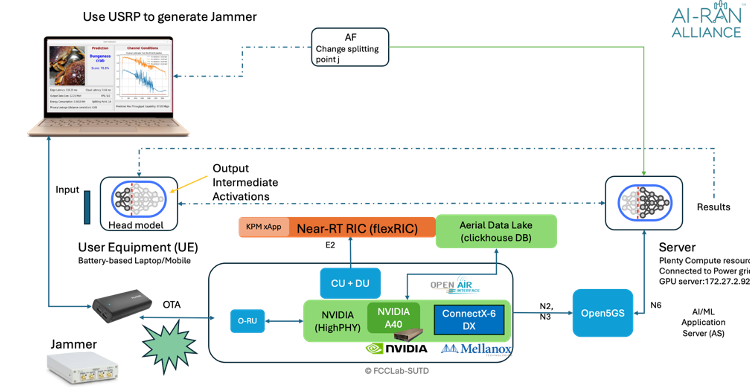
Under the umbrella of the AI-RAN Alliance, the Singapore University of Technology and Design (SUTD), in partnership with Keysight Technologies, used Aerial Testbed and Aerial Data Lake to implement a real-time OTA system that adaptively partitions an AI/ML image classification inference model between user equipment and infrastructure compute resources. The model split point is a function of the propagation channel which itself is determined by real-time spectrum sensing. This work shows how critical metrics such as privacy, end-to-end latency, energy efficiency and throughput can be optimized as a function of the channel.
More information, including a video of the demonstration, can be found here.
DeepSig#
AI-native Air Interface for 6G#
This research work by AI-RAN alliance’s member company, DeepSig is focused on developing and benchmarking an AI-native air interface for 6G physical layer. The goal is also to experiment with pilot-free or pilot-in-the-loop operations, jointly learning the modulation functions in the base station and in the UE. The approach aims to optimize the radio resource utilization for improved capacity over a wide range of specific and broad channel conditions.
The hypothesis of this experiment is to challenge the current 5G air interface design that is model based with convenient assumptions on modulation, pilot, and frame design even though these are performance limiting. AI-native air interface allows AI to inherently design the waveform for a given site that will perform better. The approach allows AI to find the performance and capacity maxima by jointly learning and optimizing the waveform.
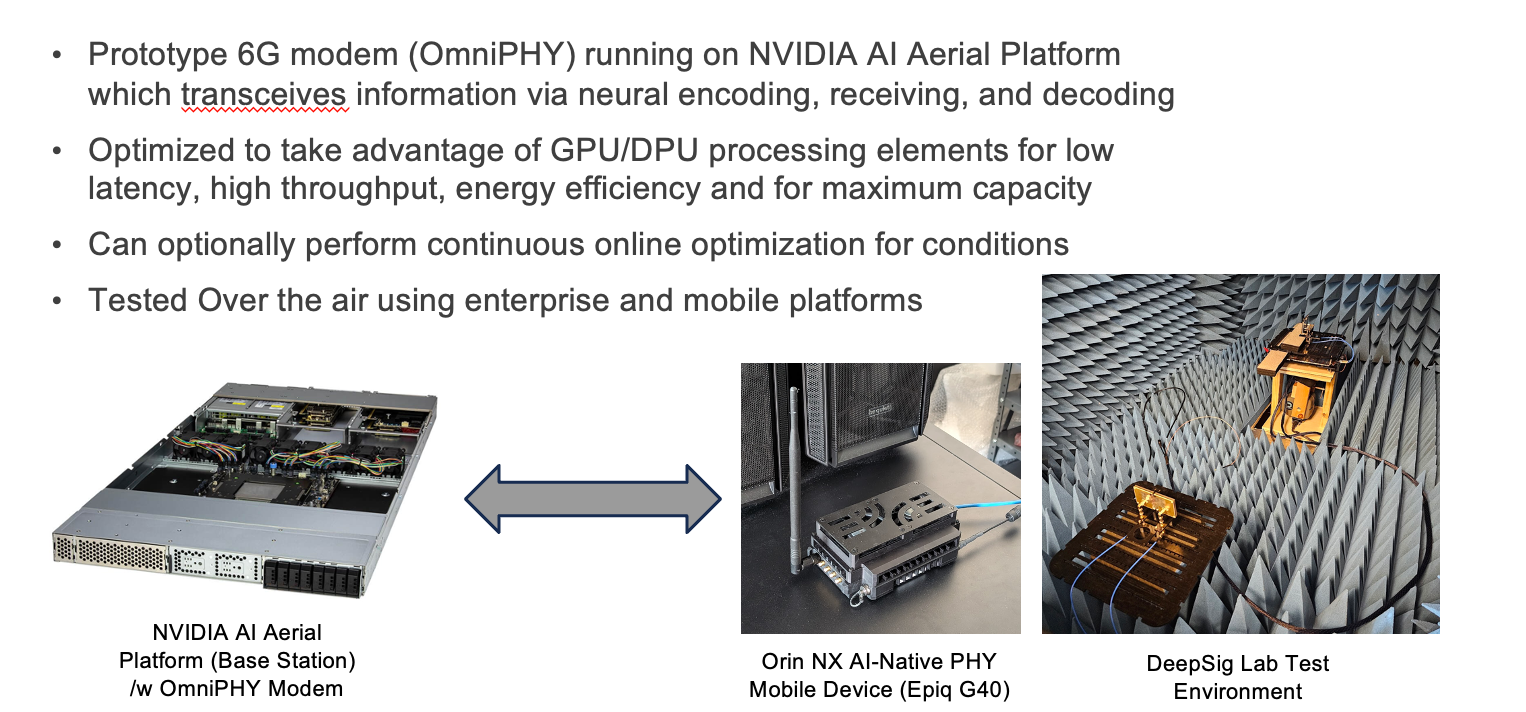
The setup uses the Aerial Testbed as the basis with a programmable UE implemented on a Jetson AGX Orin device:
The learned air interface shows significant promise of improved site-specific performance as demonstrated by DeepSig at MWC2025:
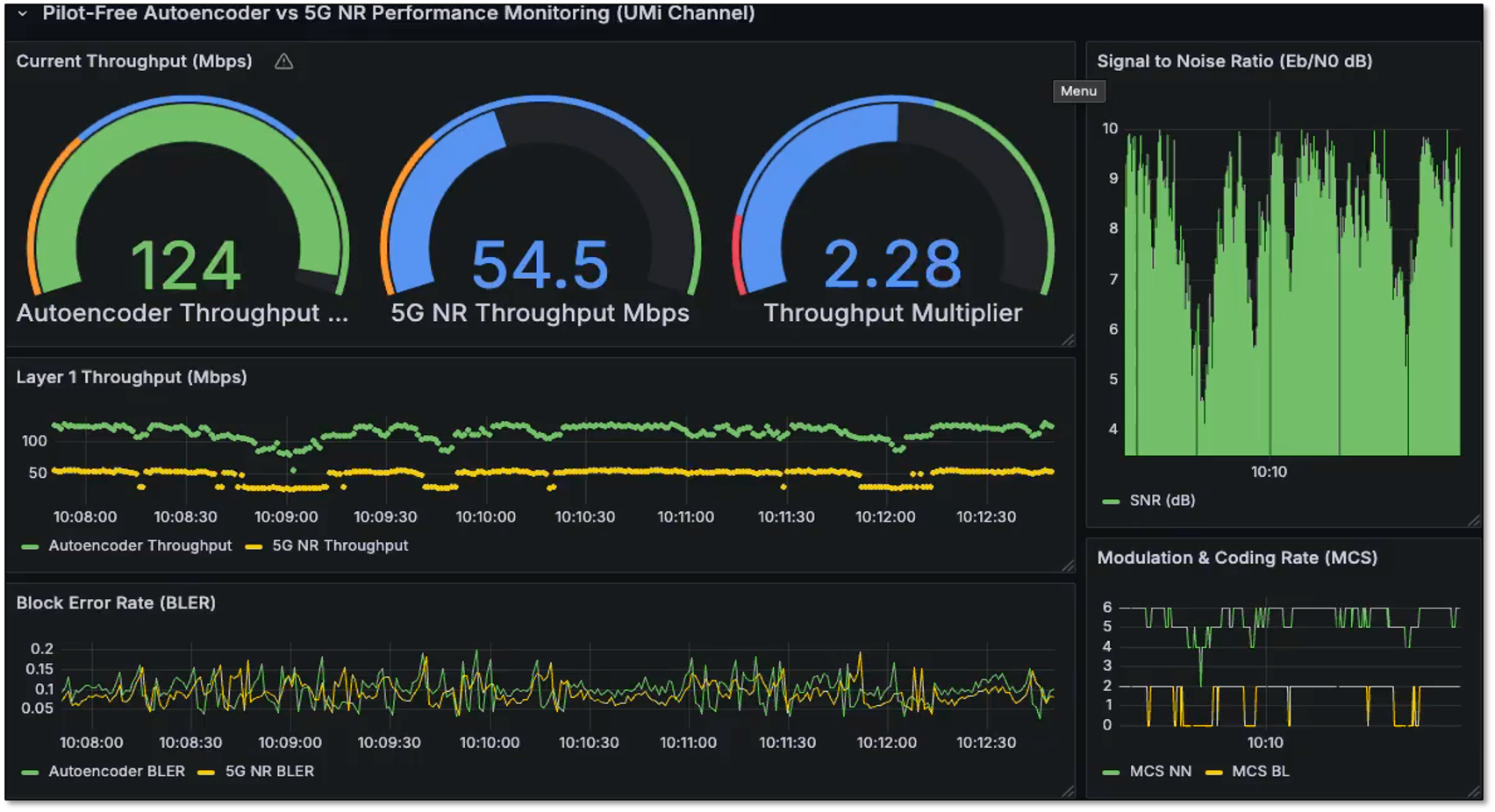
More information on this can be found here.
University of Leeds#
Network-in-a-Box#
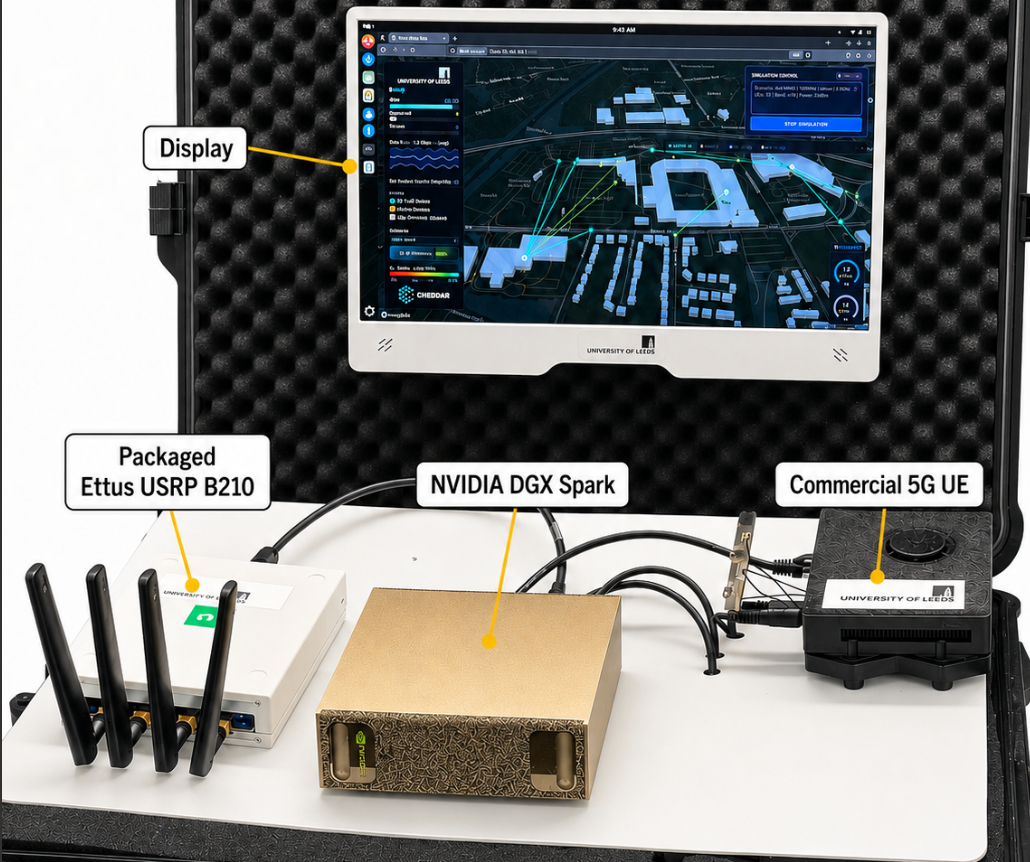
University of Leeds has developed a portable 5G Network-in-a-Box for safe, closed-loop Open RAN energy optimisation. The demonstrator integrates an NVIDIA DGX Spark, Ettus USRP B210 radio front end, commercial 5G user equipment, a Raspberry Pi display, and an OpenAirInterface 5G NR gNB operating in n78 spectrum with 40 MHz bandwidth.
The platform links over-the-air operation with the VIAVI AI Radio System Generator digital twin, UoL’s own digital twin and NVIDIA Sionna, enabling developers to validate optimisation policies before live hardware deployment. An LLM-based intent agent converts operator requests into O-RAN scenarios, while an LSTM forecasting agent guides base-station sleep and wake decisions.
In a four-base-station urban scenario, the framework reduced RAN power consumption by 45.6% while maintaining full UE connectivity. In complex deployments 20-30% gain is shown when accounting for inferencing energy costs. The implementation profiles the energy consumed by the agent execution itself. This demonstrates a practical path to safe, energy-efficient, over-the-air O-RAN experimentation and validation workflows.
At the CHEDDAR and Friends Symposium 2026, the EcoAgentRAN poster received Best Poster and the live 5G Network-in-a-Box demo received Best Demo awards. Read more on Network-in-a-Box.
Yonsei University#
Private AI-RAN and Commercial 5G for Physical AI#
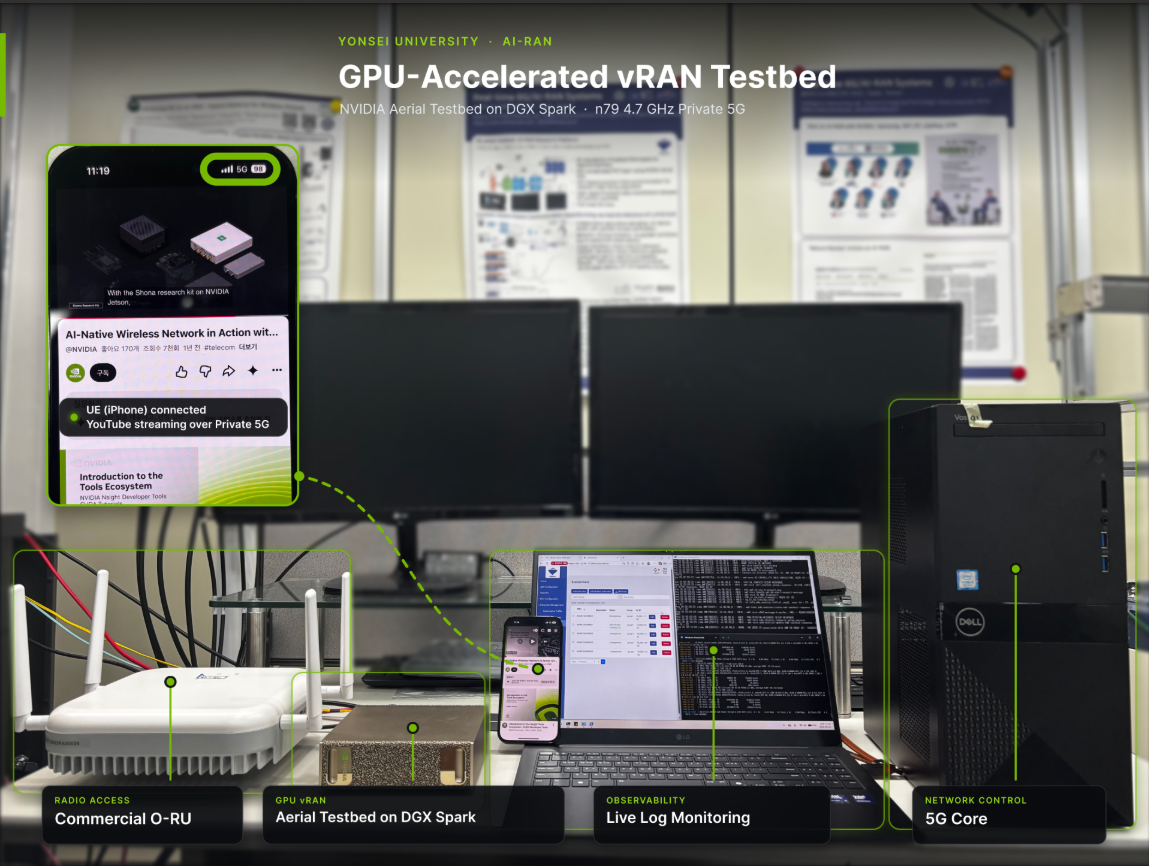
Yonsei University has built a GPU-accelerated vRAN testbed based on NVIDIA Aerial Testbed running on DGX Spark (or H100 GPU). The platform accelerates Layer 1 processing on the GPU and operates in the n79 band using Korea’s 4.7 GHz private 5G spectrum. By integrating a commercial O-RU rather than a USRP-based radio frontend, the testbed provides a realistic environment for over-the-air validation. An iPhone was successfully connected to the network, with end-to-end services demonstrated through applications including YouTube streaming.
Following a year of preparation, the team connected the university’s AI-RAN testbed with LG Uplus’s commercial n78 3.5 GHz 5G network. A device-driven, roaming-like network transition was demonstrated as an industrial mobile device moved between the private AI-RAN coverage area and the commercial network. The device automatically selected the appropriate network as radio conditions changed and maintained connectivity during the transition, demonstrating a practical mobility scenario for robots, drones, and other physical AI systems.
In Korea, private 5G networks operating in n79 and commercial networks operating in n78 have traditionally served distinct business domains. This successful integration suggests a new collaboration model in which AI-native RAN can bridge private and public network ecosystems, extending physical AI services across both enterprise and commercial coverage.
Future work will focus on two areas considered essential for physical AI. First, the team will assess changes in CPU utilization enabled by GPU acceleration while quantifying the associated processing overhead. Second, it will investigate AI-RAN use cases in which the GPU simultaneously executes real-time RAN processing and AI inference workloads. Read more on Yonsei University’s AI-RAN lab.
SynaXG#
SynaSpark Rover: An AI-RAN Super Computer on Wheels#
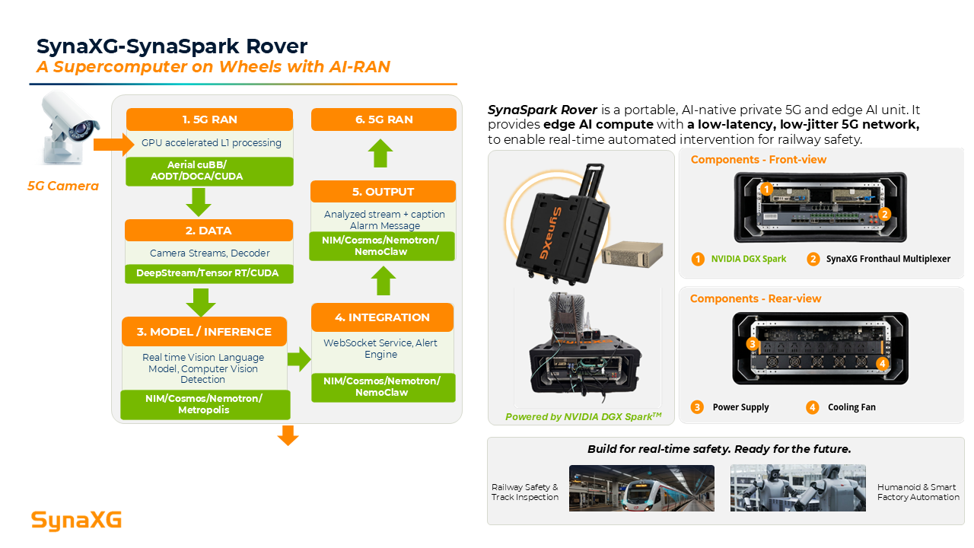
SynaSpark Rover is a mobile AI-RAN platform that combines carrier-grade 5G and edge AI computing to enable real-time operation of robots and other Physical AI systems. Powered by NVIDIA DGX Spark™, the platform provides deterministic low-latency connectivity, high uplink throughput, high capacity (1000 active users/3000 connected users per DGX Spark), super cell (no handover), and scalable edge compute of up to 4 PFLOPS, creating a unified infrastructure for Physical AI. Housed in a rugged case for easy transportation, it powers up in minutes and provides vision AI and other AI inference functions at the edge.
SynaXG has successfully integrated its NVIDIA AI Aerial-based AI-RAN platform with robot manufacturers. SynaSpark Rover achieved more than 2x uplink throughput than regular 5G while reducing 5G latency to 10ms. The robot can seamlessly extend its intelligence using additional GPU resources provided by the AI-RAN edge server. SynaSpark Rover supports FR1 sub-6GHz and FR2 millimeter wave bands.
SynaSpark Rover has been used in low latency systems with vision AI + AI-RAN to enhance railway safety. To ensure safety on railway platforms and tracks, cameras are used to detect any potentially dangerous situation. The latency of the current system in operation is not sufficient enough to ensure safety. SynaXG system cuts the overall latency by half using NVIDIA software stack such as AI Aerial, AODT, DOCA, Cosmos, Metropolis, NIM, Nemotron, TensorRT, DeepStream, Nemoclaw, etc.
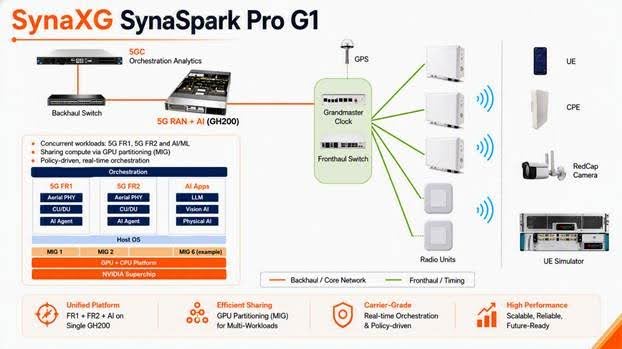
SynaSpark Pro G1: Dynamically Orchestrated FR1 + FR2 + AI#
SynaXG SynaSpark Pro G1 is a unified AI-RAN solution that can run 5G FR1 (Sub-6 GHz), 5G FR2 (mmWave), and AI workloads concurrently on a single server using NVIDIA GH200 Superchip. The solution combines SynaXG’s carrier-grade AI-RAN software stack with NVIDIA Multi-Instance GPU (MIG) technology, allowing AI-RAN and AI applications to share GPU resources efficiently while maintaining service quality. The solution supports 20 concurrent 100 MHz 4T4R NR cells, each with 400 active users/1200 connected users, delivering 36 Gbps aggregate throughput while maintaining 24x7 carrier-grade reliability. The solution supports uplink heavy configurations, low latency, RedCap, and Super Cell.
A policy-driven orchestration framework continuously monitors RAN traffic, latency, throughput, AI service performance, and GPU utilization, dynamically adjusting MIG allocations in real time based on workload demand. This ensures protected FR1 coverage, elastic FR2 capacity expansion, and uninterrupted AI services while maximizing overall GPU efficiency. The solution has integrated with many RU partners in Taiwan, Korea and USA.
Designed for commercial AI-RAN deployments, the platform supports a wide range of AI for RAN, AI and RAN, and AI on RAN use cases on shared infrastructure. The solution supports AI for RAN features such as Network Energy Saving, Link Adaptation, etc. By enabling intelligent resource sharing between RAN and AI workloads, SynaXG delivers a scalable AI-RAN solution that improves infrastructure efficiency, reduces hardware footprint, and accelerates the adoption of next-generation AI-native mobile networks.
Allbesmart#
AI-Native 6G Research in a Box#
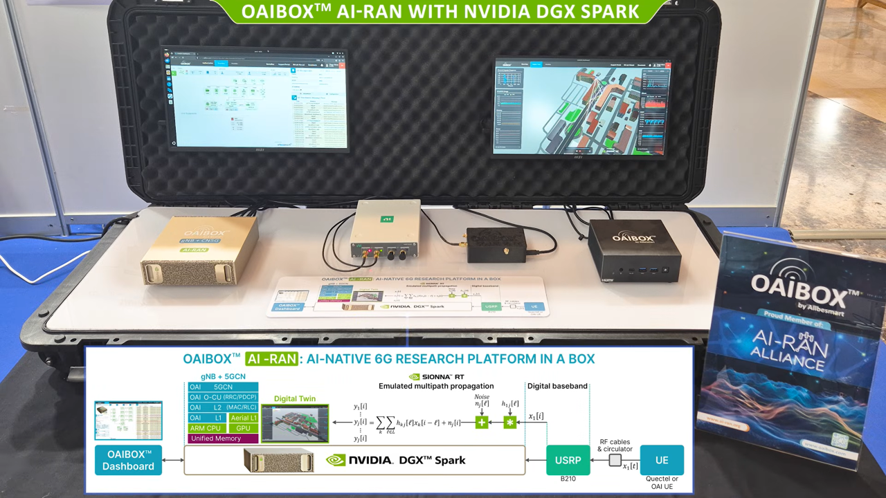
Allbesmart has developed the OAIBOX AI-RAN with NVIDIA DGX Spark, a compact, GPU-accelerated test system for research and development of AI-native 6G technologies. The platform integrates the open-source OpenAirInterface (OAI) 5G stack, including CN5G, gNB, and UE. It integrates NVIDIA Sionna Ray Tracer (RT) for realistic digital twin RF simulation, supporting complex propagation environments, mobility, antenna radiation patterns, and customizable scenarios based on realistic 3D maps. The NVIDIA DGX SPARK with its unified CPU/GPU architecture enables efficient inline acceleration without the need of explicit memory transfers.
The testbed integrates with the web-based OAIBOX Dashboard for end-to-end control, real-time network monitoring and direct access to data pipelines in the 5G stack for AI/ML model and algorithm development. The system is compatible with NVIDIA AI/ML tools, including TensorFlow, LDPC decoding, and Neural Receiver implementations. It also integrates with NVIDIA Aerial L1, providing access to CUDA-accelerated and open-source code for rapid prototyping of AI-native PHY algorithms.
OAIBOX AI-RAN combines the open source OAI stack, NVIDIA DGX Spark, Sionna RT, Aerial L1, and an integrated dashboard into a single platform for end-to-end AI-RAN and 6G research.
A video of the demonstration can be found here.
AI-and-RAN Validation with NVIDIA Aerial and OAIBOX#
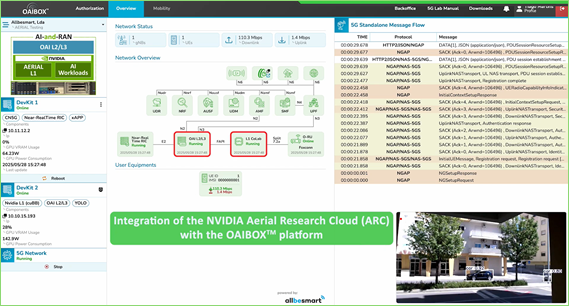
Allbesmart experts have been actively collaborating with NVIDIA and the OAI Software Alliance to integrate NVIDIA Aerial L1 with the OAI stack’s L2/L3 through the Small Cell Forum Functional API (SCF FAPI). The NVIDIA Aerial platform enables researchers to explore emerging AI-RAN paradigms and accelerate innovation in next-generation wireless systems. Allbesmart operates a reference implementation of the NVIDIA Aerial platform in its laboratory.
Through its integration with the OAIBOX test platform, Allbesmart supports Aerial users in system customization, integration, and advanced use cases.
This demonstration showcases the AI-and-RAN concept promoted by the AI-RAN Alliance. A containerized AI-based video classification application runs concurrently on the same NVIDIA GPU that accelerates the 5G L1 protocol, demonstrating how shared GPU capacity can support both 5G RAN processing and AI workloads while creating new monetization opportunities for Mobile Network Operators. A powerful OAIBOX web-based dashboard provides real-time visualization of key system and performance metrics, enabling effective monitoring, analysis, and optimization of the combined AI-and-RAN platform.
A video of the demonstration can be found here.
More information can be found here.
Clemson University#
AetherEdge: Intelligent MEC Task Offloading#
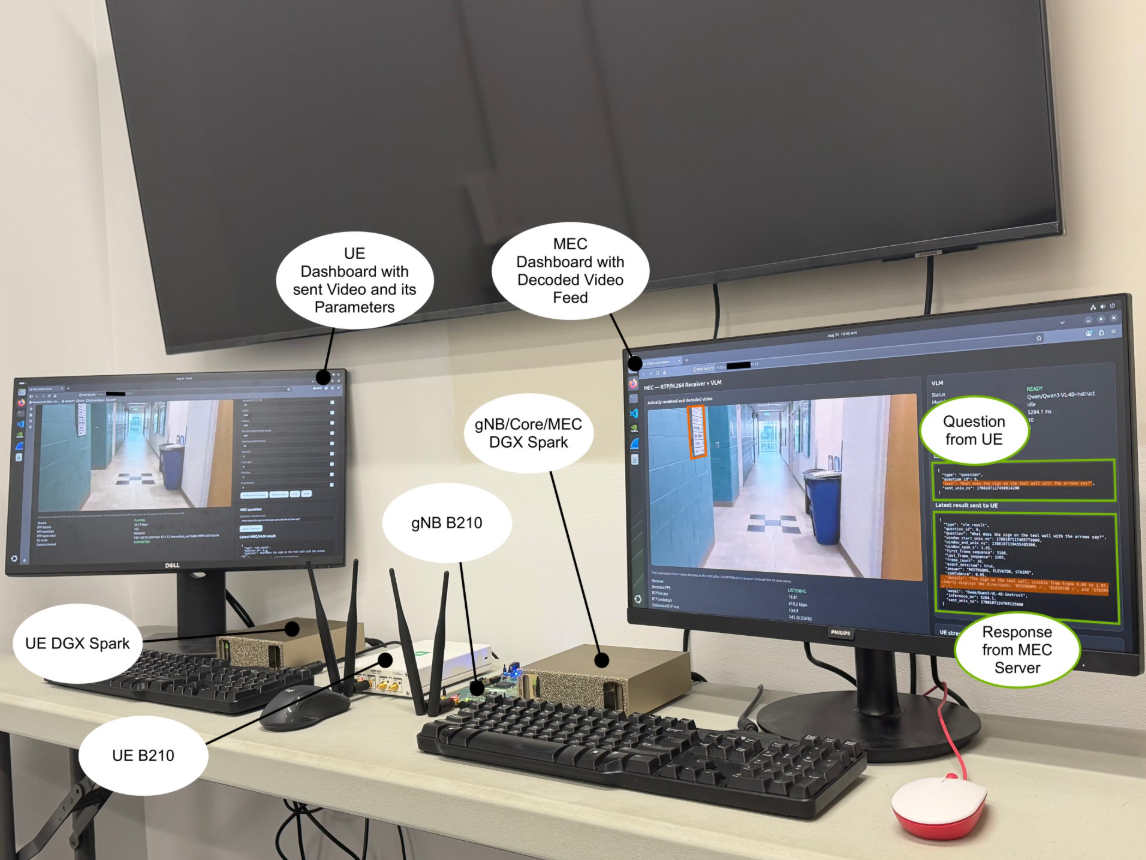
Clemson University’s Intelligent Systems and Wireless Networking (IS-WiN) Laboratory is developing AetherEdge, a live 5G mobile edge computing (MEC) platform for intelligent, radio-aware task offloading. The testbed integrates NVIDIA DGX Spark systems, Ettus USRP B210 radios, an OpenAirInterface (OAI) 5G Core and software UE, and an NVIDIA Sionna Research Kit-based gNB operating with a Split 8 radio interface. A GPU-accelerated MEC application is connected through the 5G N6 data network.
AetherEdge demonstrates multimodal edge AI over a live 5G user plane. The UE streams low-latency H.264 video using RTP while transmitting natural-language queries over WebSocket. At the MEC, Qwen3-VL processes a sliding temporal window of decoded frames and returns structured temporal responses to the UE.
Initial experiments highlight the strong coupling between RAN resource allocation and edge-AI latency. A representative YOLO workload executes in approximately 7.5 ms on DGX Spark, while client-visible latency decreases from more than 4 seconds with 24 PRBs to approximately 700-750 ms with 51 PRBs, showing that radio-resource availability can dominate interactive edge-AI latency.
The next phase will close the loop between the MEC application and RAN. E2SM-KPM telemetry from a FlexRIC xApp will provide real-time network observations to an intelligent offloading controller, following with E2SM-RC RAN control and NVIDIA Aerial dApps using the E3 interface for increasingly fine-grained, low-latency coordination between AI workloads and radio resources.
This initiative is part of Clemson’s broader AI-RAN research program, supported by the NVIDIA Academic Grant Program and NVIDIA 6G Developer Program. Clemson is also expanding the platform with an NVIDIA DGX Station based on the GB300 platform and Keysight O-RAN and 5G NR RAN-emulation capabilities. This next-stage testbed will transition the current Split 8 experiments toward an NVIDIA Aerial CUDA-Accelerated RAN with O-RAN Split 7.2x, providing a pathway from rapid software-defined experimentation to GPU-accelerated, real-time AI-RAN research.