

Architecture Overview#
The NVIDIA AI-Q Blueprint is a multi-agent research system built on the NVIDIA NeMo Agent Toolkit. It uses a two-tier research architecture that keeps simple queries fast while reserving multi-phase deep research for complex topics.
System Flow#
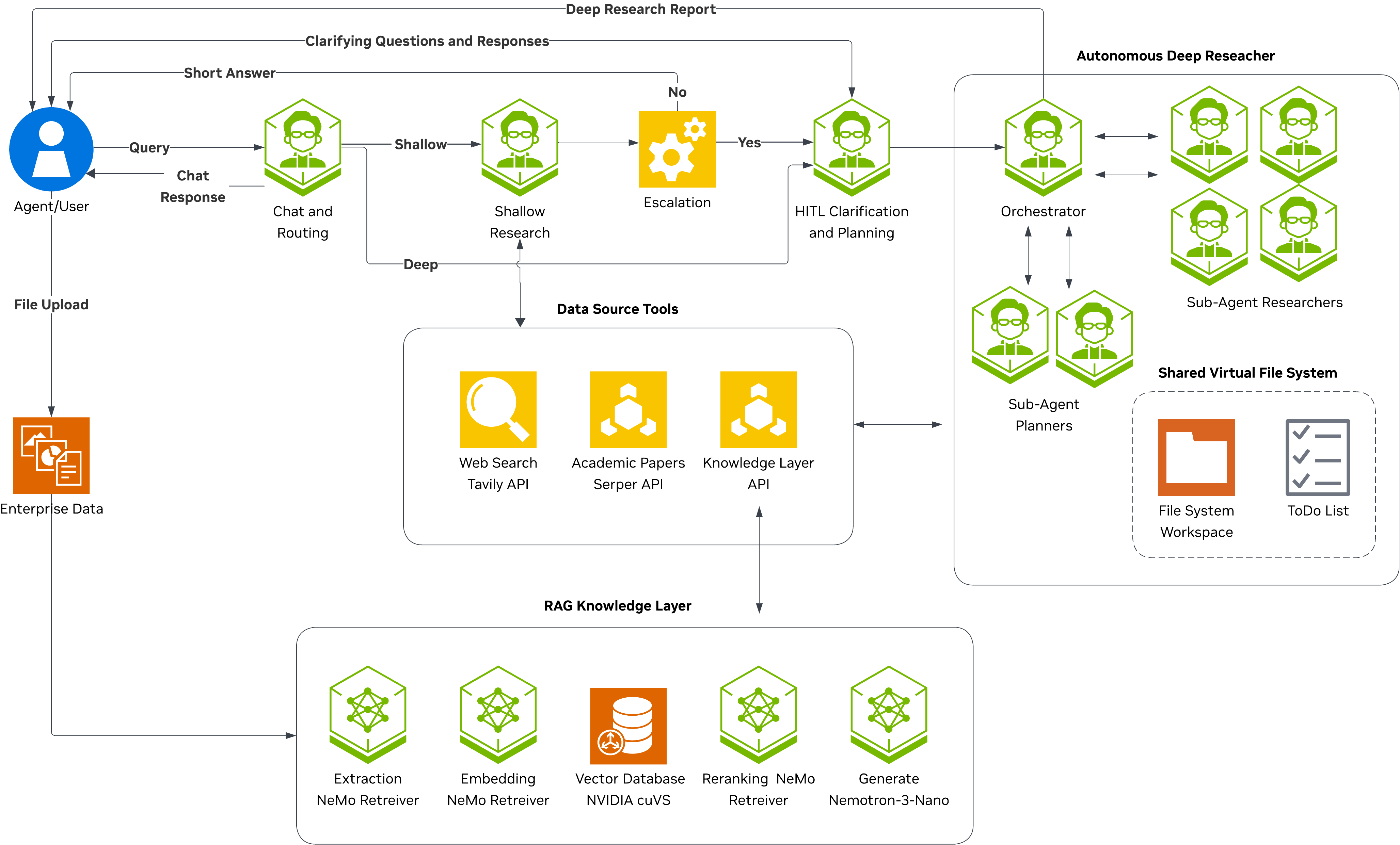
The following diagram shows the full request lifecycle from user query to final response. Every query enters through the Intent Classifier, which decides whether to respond directly (meta), perform a quick tool-augmented lookup (shallow), or initiate a comprehensive multi-agent investigation (deep).
Core Components#
Component |
Role |
Location |
|---|---|---|
Single LLM call: classifies intent (meta/research) and depth (shallow/deep) |
|
|
Optionally gathers missing context and the requested output type before deep research |
|
|
Fast, bounded tool-augmented research |
|
|
Orchestrates optional source routing, structured planning, concurrent research workers, and writer-first synthesis |
|
|
Chat Researcher Orchestrator |
LangGraph state machine coordinating all agents |
|
Orchestrator State Machine#
The ChatResearcherAgent builds a LangGraph StateGraph over ChatResearcherState with
four nodes and conditional edges:
Routing logic:
route_after_orchestration– After the intent classifier runs, the graph inspectsstate.user_intent.intent. Ifmeta, the response is already instate.messagesand the graph routes toEND. Ifresearch, it checksstate.depth_decision.decisionto chooseshallow_researchorclarifier.should_escalate– After shallow research completes, the graph evaluates whether the response warrants escalation to deep research. It checks for empty responses and escalation keywords (“unable to find”, “need more research”, “i don’t have enough information”) in the last 800 characters of the AI response. When escalation triggers, the graph routes to theclarifiernode (not directly todeep_research), so it can gather any missing context or output-shape preference before research. Research planning then occurs inside the deep-research workflow. Escalation is gated by theenable_escalationconfig flag.
ChatResearcherState#
The central state model carries data through the entire workflow:
Field |
Type |
Purpose |
|---|---|---|
|
|
Conversation history (LangGraph message reducer) |
|
|
Authenticated user information for personalization |
|
|
Hard per-request filter for registry-mapped source tools. Unmapped configured or utility tools remain active. |
|
|
Classification result: |
|
|
Routing decision: |
|
|
Final report output from deep research |
|
|
Result from shallow research path |
|
|
Clarification log containing missing context or output-shape preferences |
|
|
Preserved user query for deep research |
|
|
User-uploaded documents with summaries |
Design Decisions#
Two-tier routing: Keeps common queries fast (single tool-calling loop) while reserving multi-stage deep research for complex cases. The intent classifier makes the routing decision in a single LLM call to minimize latency.
LangGraph state machine: Provides explicit, testable routing with conversation checkpointing using
InMemorySaveror persistent backends (SQLite, PostgreSQL).Separated coordination and execution: The deep-research orchestrator invokes optional source-router, planner, and writer task subagents. Research queries run through
run_research_batchas concurrent invocations of a reusable researcher worker, not astask()subagents. The writer is the normative final-synthesis stage. If/shared/output.mdis missing, the runtime can defensively accept a substantive orchestrator-authored Markdown report, but rejects short workflow chatter.Toolkit-independent agents: All agents receive dependencies through constructor injection for testability. NeMo Agent Toolkit registration is a thin layer in
register.pyfiles.Data source filtering:
data_sourcesfilters tools mapped in the data source registry before the active research agents are constructed. Unmapped configured tools remain active and are absent from the router catalog. Routing is advisory, andResearchQuerypreferred and fallback tool names are prompt guidance, while workers remain bound to the full request-filtered set.Evaluation-driven defaults: Routing and research budgets are tuned through benchmarks (FreshQA, Deep Research Bench) and can evolve as evaluation scores improve.
Citation verification and auditability: Research paths capture sources for deterministic citation checks and URL sanitization. Deep-research citation verification is enabled by default and configurable with
enable_citation_verification; it is not an unconditional workflow stage. Refer to Deep Researcher – Citation Verification for details.
References#
Data Flow – request lifecycle, SSE events, async jobs