Helper for constructing an attention that consumes query, key and value tensors. More...
#include <NvInfer.h>
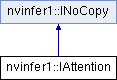
Public Member Functions | |
| bool | setNormalizationOperation (AttentionNormalizationOp op) noexcept |
| Set the normalization operation for the attention. More... | |
| AttentionNormalizationOp | getNormalizationOperation () const noexcept |
| Get the normalization operation for the attention. More... | |
| bool | setMask (ITensor &mask) noexcept |
| Set whether a mask will be used for the normalization operation. More... | |
| ITensor * | getMask () noexcept |
| Get the optional mask in attention. More... | |
| TRT_DEPRECATED bool | setCausal (bool isCausal) noexcept |
| Set whether the attention will run a causal inference. Cannot be used together with setMask(). More... | |
| TRT_DEPRECATED bool | getCausal () const noexcept |
| Get whether the attention will run a causal inference. More... | |
| bool | setCausalKind (CausalMaskKind kind) noexcept |
| Set the causal mask alignment orientation for the attention. More... | |
| CausalMaskKind | getCausalKind () const noexcept |
| Get the causal mask alignment orientation for the attention. More... | |
| bool | setDecomposable (bool decomposable) noexcept |
| Set whether the attention can be decomposed to use multiple kernels if no fused kernel support found. More... | |
| bool | getDecomposable () const noexcept |
| Get whether the attention can be decomposed to use multiple kernels if no fused kernel support found. More... | |
| bool | setInput (int32_t index, ITensor &input) noexcept |
| Append or replace an input of this layer with a specific tensor. More... | |
| int32_t | getNbInputs () const noexcept |
| Get the number of inputs of IAttention. IAttention has three inputs. More... | |
| ITensor * | getInput (int32_t index) const noexcept |
| Get the IAttention input corresponding to the given index. More... | |
| int32_t | getNbOutputs () const noexcept |
| Get the number of outputs of a layer. IAttention has one output. More... | |
| ITensor * | getOutput (int32_t index) const noexcept |
| Get the IAttention output corresponding to the given index. IAttention has only one output. More... | |
| bool | setName (char const *name) noexcept |
| Set the name of the attention. More... | |
| char const * | getName () const noexcept |
| Return the name of the attention. More... | |
| bool | setNormalizationQuantizeScale (ITensor &tensor) noexcept |
| Set the quantization scale for the attention normalization output. More... | |
| ITensor * | getNormalizationQuantizeScale () const noexcept |
| Get the quantization scale for the attention normalization output. More... | |
| bool | setNormalizationQuantizeToType (DataType type) noexcept |
| Set the datatype the attention normalization is quantized to. More... | |
| DataType | getNormalizationQuantizeToType () const noexcept |
| Get the datatype the attention normalization is quantized to. More... | |
| bool | setMetadata (char const *metadata) noexcept |
| Set the metadata for IAttention. More... | |
| char const * | getMetadata () const noexcept |
| Get the metadata of IAttention. More... | |
| bool | setNbRanks (int32_t nbRanks) noexcept |
| Set the number of ranks for multi-device attention execution. More... | |
| int32_t | getNbRanks () const noexcept |
| Get the number of ranks for multi-device execution. More... | |
| TRT_NODISCARD bool | setQueryForm (AttentionIOForm form) noexcept |
| Set the query form. More... | |
| TRT_NODISCARD AttentionIOForm | getQueryForm () const noexcept |
| Get the query form. More... | |
| TRT_NODISCARD bool | setKeyValueForm (AttentionIOForm form) noexcept |
| Set the key-value form. More... | |
| TRT_NODISCARD AttentionIOForm | getKeyValueForm () const noexcept |
| Get the key-value form. More... | |
| TRT_NODISCARD bool | setQueryLengths (ITensor *lengths) noexcept |
| Set the query lengths tensor. More... | |
| TRT_NODISCARD ITensor * | getQueryLengths () const noexcept |
| Get the query lengths tensor. More... | |
| TRT_NODISCARD bool | setKeyValueLengths (ITensor *lengths) noexcept |
| Set the key-value lengths tensor. More... | |
| TRT_NODISCARD ITensor * | getKeyValueLengths () const noexcept |
| Get the key-value lengths tensor. More... | |
Protected Member Functions | |
| virtual | ~IAttention () noexcept=0 |
 Protected Member Functions inherited from nvinfer1::INoCopy Protected Member Functions inherited from nvinfer1::INoCopy | |
| INoCopy ()=default | |
| virtual | ~INoCopy ()=default |
| INoCopy (INoCopy const &other)=delete | |
| INoCopy & | operator= (INoCopy const &other)=delete |
| INoCopy (INoCopy &&other)=delete | |
| INoCopy & | operator= (INoCopy &&other)=delete |
Protected Attributes | |
| apiv::VAttention * | mImpl |
Detailed Description
Helper for constructing an attention that consumes query, key and value tensors.
An attention subgraph implicitly includes three main components, two MatrixMultiply layers known as BMM1 and BMM2, and one normalization operation which defaults to be a Softmax. By default, IAttention is not decomposable and TensorRT will try to use a single fused kernel, which may be more efficient than if the subgraph is expressed without IAttention. Setting the IAttention to decomposable=True can allow IAttention to be decomposed to use multiple kernels if no fused kernel support found.
Query Key Value Mask (optional) NormalizationQuantizeScale (optional) | | | | | | Transpose | | | | | | | | -—BMM1-— | | | | | | | *------------------------— | | | | Normalization | | | | | *---------------------------------------------— | | ----—BMM2---— | Output
The attention has the following inputs, in order of input index:
- Query contains the input query. It is a tensor of type kFLOAT, kHALF or kBF16, its shape depends on the query form.
- For query form kPADDED_BHND, shape is [batchSize, numHeadsQuery, numTokens, dimHead]
- For query form kPACKED_NHD, shape is [totalTokens, numHeadsQuery, dimHead]
- Key contains the input key. It is a tensor of type kFLOAT, kHALF or kBF16, its shape depends on the key value form.
- For key value form kPADDED_BHND, shape is [batchSize, numHeadsKeyValue, numTokens, dimHead]
- For key value form kPACKED_NHD, shape is [totalTokens, numHeadsKeyValue, dimHead]
- Value contains the input value. It is a tensor of type kFLOAT, kHALF or kBF16, its shape depends on the key value form.
- For key value form kPADDED_BHND, shape is [batchSize, numHeadsKeyValue, numTokens, dimHead]
- For key value form kPACKED_NHD, shape is [totalTokens, numHeadsKeyValue, dimHead]
- Mask (optional) contains the mask value. It is a tensor of type kBOOL or the same data type of BMM1 output. Shape is [batchSize, numHeadsQuery, numTokensQuery, numTokensKeyValue] with batchSize and numHeadsQuery broadcastable. TensorRT uses stride-based indexing to load the mask data.
- For a kBOOL mask, a True value indicates that the corresponding position is allowed to attend.
- For other data types, the mask values will be added to the BMM1 output, known as an add mask.
- NormalizationQuantizeScale (optional) contains the quantization scale for the attention normalization output. It is a tensor of type kFLOAT, kHALF or kBF16 with dimension 0 or 1.
The attention has one output:
- Output has the same shape, form, and data type as the query input.
- For query form kPADDED_BHND, output shape is [batchSize, numHeadsQuery, numTokens, dimHead]
- For query form kPACKED_NHD, output shape is [totalTokens, numHeadsQuery, dimHead]
- See also
- https://docs.nvidia.com/deeplearning/tensorrt/latest/performance/best-practices.html#multi-head-attention-fusion for the complete matrix of fused kernel support.
- Warning
- Do not inherit from this class, as doing so will break forward-compatibility of the API and ABI.
Constructor & Destructor Documentation
◆ ~IAttention()
|
inlineprotectedpure virtualdefaultnoexcept |
Member Function Documentation
◆ getCausal()
|
inlinenoexcept |
Get whether the attention will run a causal inference.
- See also
- setCausal(), getCausalKind()
- Deprecated:
- Deprecated in TensorRT 10.16. Superseded by getCausalKind.
- Returns
- True if the attention will run a causal inference, false otherwise. Default is false.
◆ getCausalKind()
|
inlinenoexcept |
Get the causal mask alignment orientation for the attention.
- See also
- setCausalKind(), CausalMaskKind
- Returns
- The causal mask alignment orientation. Default is kNONE.
◆ getDecomposable()
|
inlinenoexcept |
Get whether the attention can be decomposed to use multiple kernels if no fused kernel support found.
- Returns
- True if the attention can be decomposed to use multiple kernels by the compiler, false otherwise. Default is false.
- See also
- setDecomposable
◆ getInput()
|
inlinenoexcept |
Get the IAttention input corresponding to the given index.
- Parameters
-
index The index of the input tensor.
- Returns
- The input tensor, or nullptr if the index is out of range.
◆ getKeyValueForm()
|
inlinenoexcept |
Get the key-value form.
- Returns
- The key-value form. Default is kPADDED_BHND.
- See also
- setKeyValueForm()
- AttentionIOForm
◆ getKeyValueLengths()
|
inlinenoexcept |
Get the key-value lengths tensor.
- Returns
- The key-value lengths tensor, or nullptr if not set.
- See also
- setKeyValueLengths()
◆ getMask()
|
inlinenoexcept |
Get the optional mask in attention.
- See also
- setMask
- Returns
- The optional mask in attention, nullptr if no mask is set.
◆ getMetadata()
|
inlinenoexcept |
Get the metadata of IAttention.
- Returns
- The metadata as a null-terminated C-style string. If setMetadata() has not been called, an empty string "" will be returned as a default value.
- See also
- setMetadata()
◆ getName()
|
inlinenoexcept |
◆ getNbInputs()
|
inlinenoexcept |
Get the number of inputs of IAttention. IAttention has three inputs.
- Returns
- The number of inputs of IAttention.
◆ getNbOutputs()
|
inlinenoexcept |
Get the number of outputs of a layer. IAttention has one output.
◆ getNbRanks()
|
inlinenoexcept |
Get the number of ranks for multi-device execution.
- Returns
- The number of ranks configured for multi-device attention. Default is 1.
- See also
- setNbRanks()
◆ getNormalizationOperation()
|
inlinenoexcept |
Get the normalization operation for the attention.
- Returns
- The normalization operation for the attention. Default is kSOFTMAX.
◆ getNormalizationQuantizeScale()
|
inlinenoexcept |
Get the quantization scale for the attention normalization output.
- Returns
- The quantization scale for the attention normalization output or nullptr if no quantization scale is set.
◆ getNormalizationQuantizeToType()
|
inlinenoexcept |
Get the datatype the attention normalization is quantized to.
- Returns
- The datatype the attention normalization is quantized to. The default value is DataType::kFLOAT.
- Warning
- Must be used after normalization quantization to type is set by setNormalizationQuantizeToType.
◆ getOutput()
|
inlinenoexcept |
Get the IAttention output corresponding to the given index. IAttention has only one output.
- Parameters
-
index The index of the output tensor.
- Returns
- The indexed output tensor, or nullptr if the index is out of range.
◆ getQueryForm()
|
inlinenoexcept |
Get the query form.
- Returns
- The query form. Default is kPADDED_BHND.
- See also
- setQueryForm()
- AttentionIOForm
◆ getQueryLengths()
|
inlinenoexcept |
Get the query lengths tensor.
- Returns
- The query lengths tensor, or nullptr if not set.
- See also
- setQueryLengths()
◆ setCausal()
|
inlinenoexcept |
Set whether the attention will run a causal inference. Cannot be used together with setMask().
- Parameters
-
isCausal True to enable causal masking with kUPPER_LEFT alignment, false to disable causal masking.
- See also
- getCausal(), setCausalKind()
- Deprecated:
- Deprecated in TensorRT 10.16. Superseded by setCausalKind.
- Returns
- True if the causal inference is set successfully, false otherwise.
◆ setCausalKind()
|
inlinenoexcept |
Set the causal mask alignment orientation for the attention.
When set to kUPPER_LEFT or kLOWER_RIGHT, an implicit causal mask is applied. When set to kNONE, no causal masking is applied.
Cannot be used together with setMask(). Building with both a mask tensor and a causal orientation other than kNONE will fail validation.
- Parameters
-
kind The causal mask alignment to apply.
- See also
- getCausalKind(), CausalMaskKind
- Returns
- True if the causal mask kind is set successfully, false otherwise.
◆ setDecomposable()
|
inlinenoexcept |
Set whether the attention can be decomposed to use multiple kernels if no fused kernel support found.
- See also
- getDecomposable
- Returns
- True if the decomposable attention is set successfully, false otherwise.
◆ setInput()
|
inlinenoexcept |
Append or replace an input of this layer with a specific tensor.
- Parameters
-
index the index of the input to modify. input the new input tensor.
The indices are as follows:
Input 0 is the input query tensor. Input 1 is the input key tensor. Input 2 is the input value tensor.
- Returns
- True if the input tensor is set successfully, false otherwise.
◆ setKeyValueForm()
|
inlinenoexcept |
Set the key-value form.
Default is kPADDED_BHND.
- Parameters
-
form The key-value form.
- Returns
- True if the key-value form is set successfully, false otherwise.
- See also
- getKeyValueForm()
- AttentionIOForm
◆ setKeyValueLengths()
|
inlinenoexcept |
Set the key-value lengths tensor.
An optional tensor to specify per-batch key-value lengths. The semantics depend on the key-value form:
- When key-value form is kPADDED_BHND: contains per-batch lengths with shape [batchSize]. Each element must be <= the sequence length dimension of the KV tensor. If not set, the sequence length dimension of the KV tensor is used for all batches.
- When key-value form is kPACKED_NHD: contains cumulative token counts with shape [batchSize + 1]. The first element should be 0 and the last element equals totalTokens. The total_tokens dimension of the KV tensor must be >= the last element of this tensor. Must be set when key-value form is kPACKED_NHD.
- Warning
- When key-value form is kPACKED_NHD, providing a first element that is not 0 results in undefined behavior.
- Parameters
-
lengths A 1D tensor of type kINT32. If nullptr, clears a previously set key-value lengths tensor.
- Returns
- True if the key-value lengths tensor is set or cleared successfully, false otherwise.
- See also
- getKeyValueLengths()
◆ setMask()
|
inlinenoexcept |
Set whether a mask will be used for the normalization operation.
- Parameters
-
mask the mask tensor of type kBOOL or the same data type of BMM1 output with 4d shape broadcastable to [batchSize, numHeadsQuery, sequenceLengthQuery, sequenceLengthKeyValue]. For a kBOOL mask, a True value indicates that the corresponding position is allowed to attend. For other data types, the mask values will be added to the BMM1 output, known as an add mask.
- See also
- getMask
- Returns
- True if the mask is set successfully, false otherwise.
◆ setMetadata()
|
inlinenoexcept |
Set the metadata for IAttention.
The metadata is emitted in the JSON returned by IEngineInspector with ProfilingVerbosity set to kDETAILED.
- Parameters
-
metadata The per-layer metadata.
- Warning
- The string name must be null-terminated and be at most 4096 bytes including the terminator.
- See also
- getMetadata()
- getLayerInformation()
- Returns
- True if the metadata is set successfully, false otherwise.
◆ setName()
|
inlinenoexcept |
Set the name of the attention.
The name is used in error diagnostics. This method copies the name string.
- Warning
- The string name must be null-terminated, and be at most 4096 bytes including the terminator.
- See also
- getName()
- Returns
- True if the name is set successfully, false otherwise.
◆ setNbRanks()
|
inlinenoexcept |
Set the number of ranks for multi-device attention execution.
When nbRanks > 1, this hints attention to perform multi-device attention.
- Parameters
-
nbRanks The number of ranks. Must be >= 1.
- Returns
- True if successful, false otherwise.
- See also
- getNbRanks()
◆ setNormalizationOperation()
|
inlinenoexcept |
Set the normalization operation for the attention.
- Returns
- True if the normalization operation is set successfully, false otherwise.
◆ setNormalizationQuantizeScale()
|
inlinenoexcept |
Set the quantization scale for the attention normalization output.
- Parameters
-
tensor for quantization scale. Data type must be DataType::kFLOAT, DataType::kHALF or DataType::kBF16. Must be a 0-d or 1-d.
- Returns
- True if the quantization scale is set successfully, false otherwise.
- Warning
- Must be used together with setNormalizationQuantizeToType to set normalization output datatype to DataType::kFP8 or DataType::kINT8.
◆ setNormalizationQuantizeToType()
|
inlinenoexcept |
Set the datatype the attention normalization is quantized to.
- Parameters
-
type the datatype the attention normalization is quantized to. Must be one of DataType::kFP8, DataType::kINT8.
- Returns
- True if the quantization to type is set successfully, false otherwise.
◆ setQueryForm()
|
inlinenoexcept |
Set the query form.
Default is kPADDED_BHND.
- Parameters
-
form The query form.
- Returns
- True if the query form is set successfully, false otherwise.
- See also
- getQueryForm()
- AttentionIOForm
◆ setQueryLengths()
|
inlinenoexcept |
Set the query lengths tensor.
An optional tensor to specify the cumulative number of tokens per batch element. Must be set when query form is kPACKED_NHD. Ignored when query form is kPADDED_BHND. When set, contains cumulative token counts with shape [batchSize + 1]. The first element should be 0 and the last element equals totalTokens. The number of tokens for batch i is lengths[i + 1] - lengths[i]. The total_tokens dimension of the query tensor must be >= the last element of this tensor.
- Warning
- Providing a first element that is not 0 results in undefined behavior.
- Parameters
-
lengths A 1D tensor of type kINT32 with shape [batchSize + 1]. If nullptr, clears a previously set query lengths tensor.
- Returns
- True if the query lengths tensor is set or cleared successfully, false otherwise.
- See also
- getQueryLengths()
Member Data Documentation
◆ mImpl
|
protected |
The documentation for this class was generated from the following file: