|
| bool | setEquation (char const *equation) noexcept |
| | Set the equation. The equation is a comma-separated list of subscript labels, where each label refers to a dimension of the corresponding tensor. More...
|
| |
| char const * | getEquation () const noexcept |
| | Return the equation. More...
|
| |
| LayerType | getType () const noexcept |
| | Return the type of a layer. More...
|
| |
| void | setName (char const *name) noexcept |
| | Set the name of a layer. More...
|
| |
| char const * | getName () const noexcept |
| | Return the name of a layer. More...
|
| |
| int32_t | getNbInputs () const noexcept |
| | Get the number of inputs of a layer. More...
|
| |
| ITensor * | getInput (int32_t index) const noexcept |
| | Get the layer input corresponding to the given index. More...
|
| |
| int32_t | getNbOutputs () const noexcept |
| | Get the number of outputs of a layer. More...
|
| |
| ITensor * | getOutput (int32_t index) const noexcept |
| | Get the layer output corresponding to the given index. More...
|
| |
| void | setInput (int32_t index, ITensor &tensor) noexcept |
| | Replace an input of this layer with a specific tensor. More...
|
| |
| DataType | getOutputType (int32_t index) const noexcept |
| | get the output type of this layer More...
|
| |
| void | setMetadata (char const *metadata) noexcept |
| | Set the metadata for this layer. More...
|
| |
| char const * | getMetadata () const noexcept |
| | Get the metadata of the layer. More...
|
| |
| bool | setNbRanks (int32_t nbRanks) noexcept |
| | Set the number of ranks for multi-device execution. More...
|
| |
| int32_t | getNbRanks () const noexcept |
| | Get the number of ranks for multi-device execution. More...
|
| |
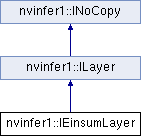
An Einsum layer in a network.
This layer implements a summation over the elements of the inputs along dimensions specified by the equation parameter, based on the Einstein summation convention. The layer can have one or more inputs of rank >= 0. All the inputs must have type DataType::kFLOAT or DataType::kHALF, not necessarily the same. There is one output of type DataType::kFLOAT. The shape of the output tensor is determined by the equation.
The equation specifies ASCII lower-case letters for each dimension in the inputs in the same order as the dimensions, separated by comma for each input. The dimensions labeled with the same subscript must match or be broadcastable. Repeated subscript labels in one input take the diagonal. Repeating a label across multiple inputs means that those axes will be multiplied. Omitting a label from the output means values along those axes will be summed. In implicit mode, the indices which appear once in the expression will be part of the output in increasing alphabetical order. In explicit mode, the output can be controlled by specifying output subscript labels by adding an arrow ('->') followed by subscripts for the output. For example, "ij,jk->ik" is equivalent to "ij,jk". Ellipsis ('...') can be used in place of subscripts to broadcast the dimensions. See the TensorRT Developer Guide for more details on equation syntax.
Many common operations can be expressed using the Einsum equation. For example: Matrix Transpose: ij->ji Sum: ij-> Matrix-Matrix Multiplication: ik,kj->ij Dot Product: i,i-> Matrix-Vector Multiplication: ik,k->i Batch Matrix Multiplication: ijk,ikl->ijl Batch Diagonal: ...ii->...i
- Warning
- Do not inherit from this class, as doing so will break forward-compatibility of the API and ABI.
 Public Member Functions inherited from nvinfer1::ILayer