

GLM-5-FP8 Disaggregated Pareto Sweep
GLM-5-FP8 Disaggregated Pareto Sweep
Experimental Spica search for a GLM-5-FP8 Pareto frontier on B200 GPUs
Experimental. These replay results characterize one software snapshot and workload. Do not treat them as production capacity guidance or a performance commitment. Spica’s search behavior and output may change without a standard deprecation period.
This experiment uses kv_load_ratio and requires an AI Configurator release that provides
aiconfigurator.sdk.memory. It fails fast before search starts in the default dynamo-planner
image, which currently retains AI Configurator 0.9.
This replay-backed sweep targets the InferenceX/SemiAnalysis (SA) GLM-5-FP8 / B200 / Dynamo with SGLang / 1k-1k / disaggregated frontier. It tests whether Spica can discover competitive deployment mappings without pinning the parallel shape or replica count.
Setup
kv_load_ratio=1 means the candidate’s estimated decode KV capacity divided by
isl + floor(osl / 2); 0 maps to concurrency 1. This makes traffic pressure comparable
across candidates with different decode shapes and replica counts.
Latest replay baseline
The replay baseline uses SA’s per-concurrency deployment mappings with the fixed AI Configurator and Dynamo mocker stack, block size 64, FP8 KV cache, and 10 requests per concurrency unit. It is the correct software baseline for this sweep; the earlier pre-fix replay curve is no longer used.
Hypervolume uses reference point (0, 0). Spica reaches 113.5% of the latest replay
baseline’s hypervolume by finding deployment mappings beyond the fixed SA mapping schedule.
Search encoding
Parallel search uses the default structured projection. Vizier models:
- total used-GPU ratio;
- prefill GPU share;
- prefill and decode GPUs-per-engine targets;
- per-role attention mode (
tpordp); - per-role MoE FFN mode (
tporep).
Each suggestion is projected onto the nearest backend-compatible, KV-feasible enumerated
configuration. Replica counts and concrete TP / DP / MoE-TP / MoE-EP fields are derived from
that valid target. parallel_configs: [] requests the full enumerated pool; a user can still
provide one config as a strict pin or several configs as a custom projection pool.
Configuration
The runnable configuration is
examples/aisimulate/spica/configs/glm5-disagg-pareto-frontier.yaml:
Result
The 80-round run completed 640 successful unique samples from 670 attempts in 12:06:56:
- 22 candidates were rejected by KV-capacity prechecks;
- 8 replay evaluations exceeded the 600-second limit;
- 0 replay evaluations crashed;
- 155 distinct concrete parallel mappings were evaluated.
The highest-throughput point reached 1788.4 output tok/s/GPU at 23.56 tok/s/user:
Representative non-dominated points:
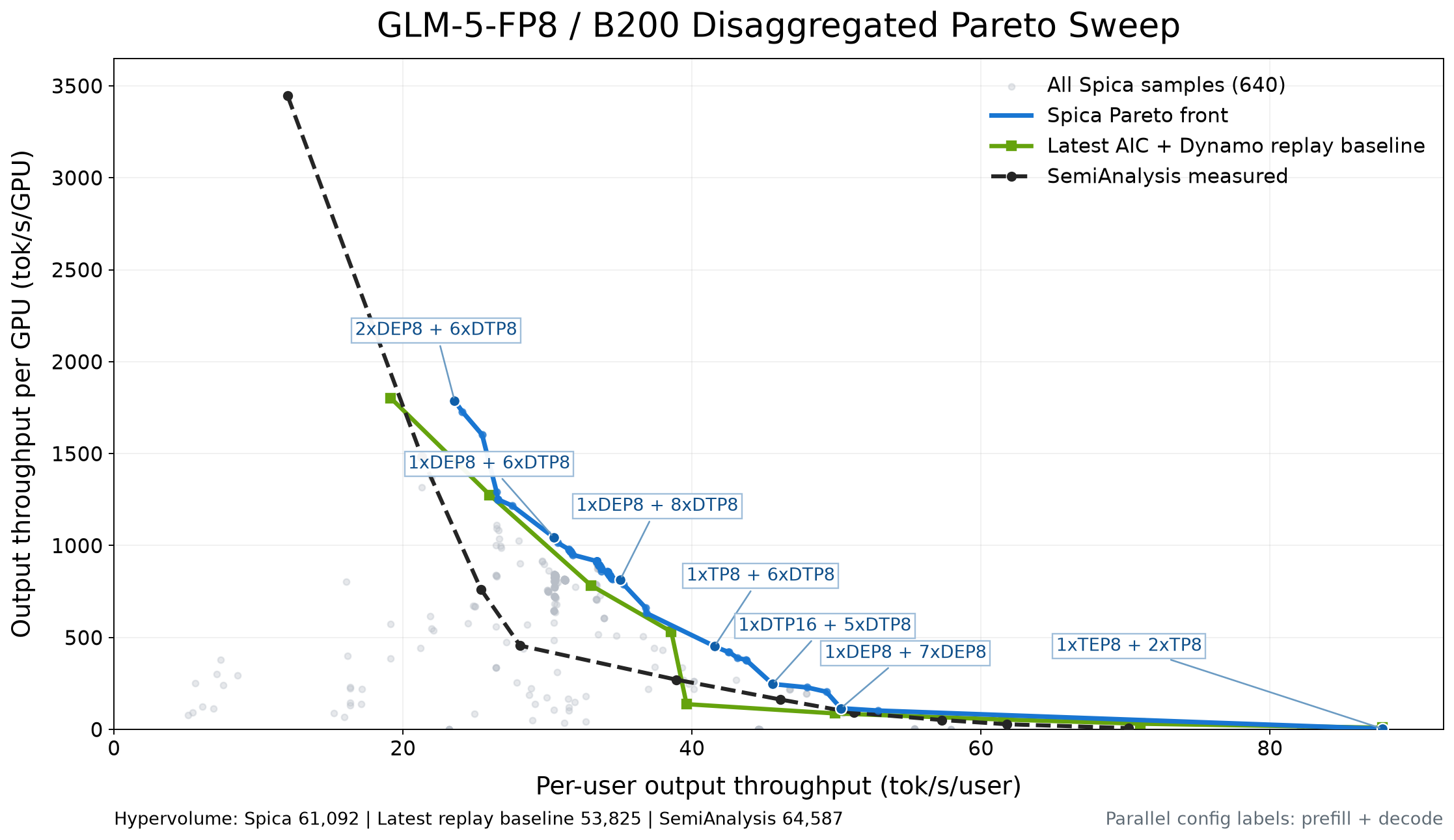
The exact Pareto filter returns 204 points because continuous load values produce many tiny tradeoffs along otherwise flat regions. The representative table and plot retain the useful shape of the frontier without treating those near-duplicates as different deployment choices.
Convergence
For this workload, 50-55 rounds is the practical quality/runtime point. The final 27 rounds after round 53 consumed about 4 hours 39 minutes for 1.05% additional hypervolume.
Reproduce
The AIConfigurator performance model needs the aic-forward-pass binding. Dynamo must include the
attention-DP KV-capacity fix so replay sees engine capacity as per-rank capacity multiplied by
attention DP and replicas.