

Architecture Overview for NVIDIA NeMo Fabric
NVIDIA NeMo Fabric uses a Python SDK backed by a Rust core to validate configuration and coordinate execution through harness adapters and environment providers. Applications supply tasks and use the results; each harness retains its own agent logic and tools.
The following diagram shows how applications, evaluation systems, and rollout platforms use NeMo Fabric to run harnesses and receive execution evidence.
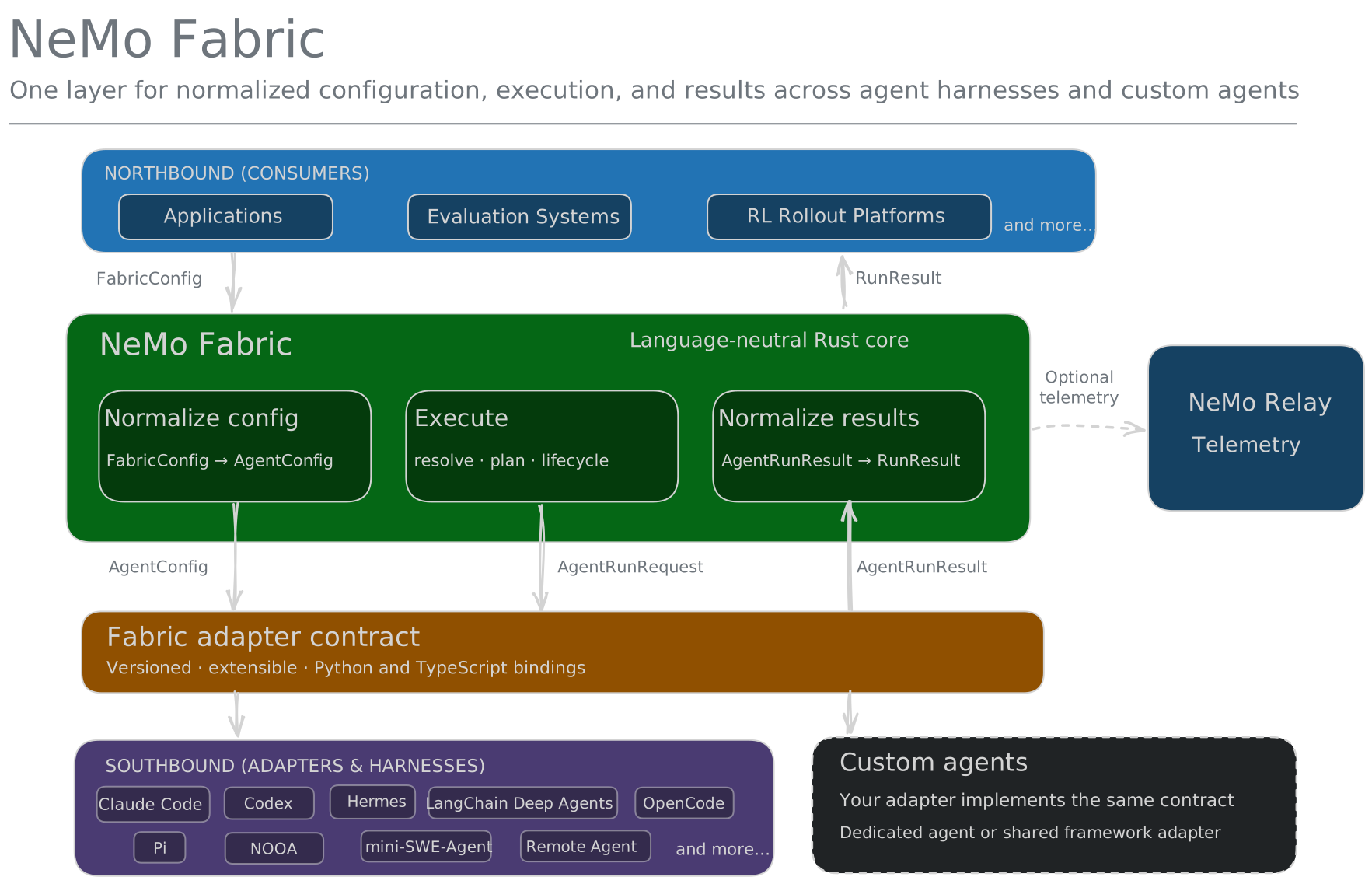
Components
The components divide responsibility as follows:
Data Flow
For example, an application asks an agent to review a code change:
- Your application submits the task by sending the review request with its selected harness, model, and workspace settings.
- NeMo Fabric validates the settings and starts the harness through its adapter.
- The harness performs the review using its own agent logic and tools.
- The adapter maps the outcome into a normalized result.
- NeMo Fabric returns the review output or failure details, plus available artifact and telemetry references.
For a single-request run, NeMo Fabric also attempts runtime cleanup before returning.
Related Topics
Use these guides to explore configuration, runtime ownership, and integration contracts: