

FP8 Quantization in NeMo RL#
This module provides a suite of tools to enable FP8 quantization for large language models. It is currently under active development.
Supported Features#
FP8 Generation#
Implements DeepSeek-style FP8 quantization using sub-channel scaling.
FP8 Training#
Uses TransformerEngine for linear layer implementation.
Supports both DeepSeek-style sub-channel scaling and per-tensor scaling.
Recommended recipe#
For Hopper GPUs we recommend using FP8 (DeepSeek-style) precision for both generation and training for best convergence and speedup
For Blackwell GPUs, FP8 (DeepSeek-style) with FP32 scaling factor is not supported in training. Currently we recommend using FP8 precision for generation and BF16 for training. We are actively exploring other recipes for better performance.
Integration with NeMo RL#
NeMo RL applies monkey patches to several core vLLM components to enable FP8 generation for reinforcement learning.
When the init_fp8 function is called, it modifies the following:
RayDistributedExecutor#
For multi-GPU inference, the executor is patched to ensure that every worker process applies the same FP8 patches before model initialization.
Quantization Utilities#
Functions within
vllm.model_executor.layers.quantizationare replaced with custom implementations that support:Power-of-2 scaling
Other custom features
Weight Loading#
A custom
load_weightsfunction performs on-the-fly quantization of model weights from higher-precision formats to FP8.
Usage#
FP8 generations are recommended to be configured with the following settings:
 loss_fn:
     # importance sampling helps improve stability
     use_importance_sampling_correction: true

 policy:
     generation:
         vllm_cfg:
             precision: 'fp8'
             # DeepGemm is much more performant than vLLM's default cutlass fp8 subchannel scaling kernels
             use_deep_gemm: true
             # Users can specify number of layers to be kept in BF16 precision in their experiments
             # and by default they are set to 0
             num_last_layers_in_bf16: 0
             num_first_layers_in_bf16: 0
             # Use FP32 scaling factors. Rounding scaling factors to the nearest pow2 may improve quantization
             # fidelity however this feature is still under research.
             pow2_weight_scaling_factors: False
             pow2_activation_scaling_factors: False
For MXFP8, quantization_ignore_patterns accepts exact module names,
substrings, and fnmatch wildcards. Matching modules remain in BF16. For
example, the following scope quantizes only Qwen3 routed experts while keeping
attention, the router, and the language-model head in BF16:
    policy:
        generation:
            vllm_cfg:
                precision: "fp8"
                is_mx: true
                quantization_ignore_patterns:
                    - model.layers.*.self_attn.*
                    - model.layers.*.mlp.gate
num_first_layers_in_bf16 and num_last_layers_in_bf16 keep complete
transformer layers in BF16. NeMo RL reads the model configuration and parameter
names, so these options do not require a model-specific model.layers or
backbone.layers prefix. The patterns above still apply to every middle layer.
For example, this Nemotron 3.5 Lightning scope keeps the first two and last six layers in BF16. In the middle layers it quantizes only the non-shared routed experts. Attention, Mamba projections, routers, shared experts, latent projections, and MTP remain in BF16:
policy:
  generation:
    vllm_cfg:
      precision: fp8
      is_mx: true
      num_first_layers_in_bf16: 2
      num_last_layers_in_bf16: 6
      quantization_ignore_patterns:
        - "*layers.*.mixer.qkv_proj"
        - "*layers.*.mixer.o_proj"
        - "*layers.*.mixer.in_proj"
        - "*layers.*.mixer.out_proj"
        - "*layers.*.mixer.up_proj"
        - "*layers.*.mixer.down_proj"
        - "*layers.*.mixer.gate"
        - "*layers.*.mixer.shared_experts.*"
        - "*layers.*.mixer.fc1_latent_proj"
        - "*layers.*.mixer.fc2_latent_proj"
        - "*mtp.*"
To quantize QKVO as well as the routed experts, remove the qkv_proj and
o_proj entries. The first two and last six layers still remain entirely in
BF16. Check the logged effective ignore list when adding a new model family;
an ignore pattern that matches no module is usually a naming error.
lm_head is always excluded from FP8 and MXFP8 quantization, even when it is
not listed in quantization_ignore_patterns in the YAML configuration.
Models with MTP layers must list their MTP module names explicitly, for example
mtp.* and language_model.mtp.*. External speculative-decoding drafts use a
separate vLLM model configuration and must configure their precision separately.
quantization_ignored_layer_kws is deprecated for MXFP8 in NeMo RL 0.8; new
MXFP8 configurations should use quantization_ignore_patterns instead.
quantization_ignore_patterns requires is_mx: true. Non-MX FP8
(precision: "fp8" without is_mx) has no pattern-based replacement yet and
must continue to use quantization_ignored_layer_kws.
Optional trainer-side MXFP8 refit#
By default, the rollout worker receives BF16 weights and quantizes them. To reduce the transfer size, enable trainer-side quantization:
policy:
  megatron_cfg:
    enabled: true
  generation:
    backend: vllm
    vllm_cfg:
      precision: fp8
      is_mx: true
      refit_prequantize: true
Use this option only with a Megatron policy and an MXFP8 vLLM rollout. The policy worker quantizes supported BF16 weights and sends E4M3 values with E8M0 scales. Other weights use their normal refit path.
For each block of 32 supported weight values, the weight payload changes from 64 BF16 bytes to 32 E4M3 bytes plus one scale byte. This count excludes transport metadata, padding, and weights that are not eligible for this option. It does not predict the end-to-end speedup.
On Blackwell, the policy worker uses FlashInfer when it is available.
Otherwise, it uses the PyTorch reference quantizer. Both paths
store scales in *_scale_from_checkpoint. NeMo RL checks the value and scale
shapes and normalizes zero scales before loading the weights.
Do not use refit_prequantize with blockwise FP8, BF16, NVFP4, sparse-delta
refit, NCCL Reshard, or the vLLM reload API. NVFP4 real-quant rollout uses a
different packed-weight refit protocol. GB200 tests check quantized-value
parity with the installed vLLM quantizer. Functional GRPO tests also check
refit in separate policy and rollout worker environments.
To train with FP8, you need to set the Megatron path and configure it using the following settings:
    policy:
        megatron_cfg:
            fp8_cfg:
                fp8: "hybrid"               # choices: [hybrid, e4m3]
                fp8_recipe: "tensorwise"    # choices: [tensorwise, blockwise, mxfp8, custom]
                fp8_param: false            # boolean value
                fp8_quantizer_factory: null # required for "custom" recipe; importable Python path e.g. package.module.quantizer_factory
Per-module Transformer Engine precision recipes#
For finer-grained Megatron training precision, point
policy.megatron_cfg.te_precision_config_file at a Megatron-LM Transformer
Engine precision recipe:
    policy:
        megatron_cfg:
            fp8_cfg:
                enabled: true
                fp8: "hybrid"
                fp8_recipe: "mxfp8"
                fp8_param: false
            te_precision_config_file: "/path/to/te_precision.yaml"
A minimal recipe that applies MXFP8 training precision to all matched modules and keeps evaluation in BF16 looks like:
configs:
  mxfp8:
    transformer_engine_config_type: TEQuantizationParams
    training_recipe: {fp8_quantization_recipe: mxfp8}
    evaluation_recipe: {}
matchers:
  all: {config: mxfp8, type: glob, pattern: "*", enabled: true}
Each matcher must set enabled: true; omitted or false enabled values are
parsed but do not match any modules. By default, a precision recipe by itself
does not enable FP8 compute in the usual training path, so keep
fp8_cfg.enabled: true when the matched modules should run under FP8 autocast.
When both fp8_cfg and te_precision_config_file are set, matched modules use
the recipe’s per-module quantization config. NeMo RL still derives sequence
padding and FP8 refit behavior from fp8_cfg, so matched FP8 recipes must use
the same fp8_quantization_recipe as fp8_cfg.fp8_recipe. Recipe
training_recipe and evaluation_recipe fields fp8_param and fp4_param
are rejected; use fp8_cfg.fp8_param for supported FP8 parameter storage.
Compatibility Note for DeepSeek-Style FP8 Training#
The TransformerEngine implementation for this recipe requires CUDA version ≥ 12.9. The current NeMo RL container uses CUDA 13.2 (via docker/Dockerfile), which satisfies this requirement. Users on older setups should check out the latest code and build the container from docker/Dockerfile (instructions).
If you are using nemo-rl before this commit, you will see the following error when trying to use fp8 training:
File "/opt/ray_venvs/nemo_rl.models.policy.workers.megatron_policy_worker.MegatronPolicyWorker/lib/python3.12/site-packages/transformer_engine/pytorch/fp8.py", line 646, in fp8_autocast
FP8GlobalStateManager.fp8_autocast_enter(
File "/opt/ray_venvs/nemo_rl.models.policy.workers.megatron_policy_worker.MegatronPolicyWorker/lib/python3.12/site-packages/transformer_engine/pytorch/fp8.py", line 465, in fp8_autocast_enter
assert fp8_block_available, reason_for_no_fp8_block
           ^^^^^^^^^^^^^^^^^^^
AssertionError: FP8 block scaled GEMM requires Hopper and CUDA >= 12.9.
Accuracy#
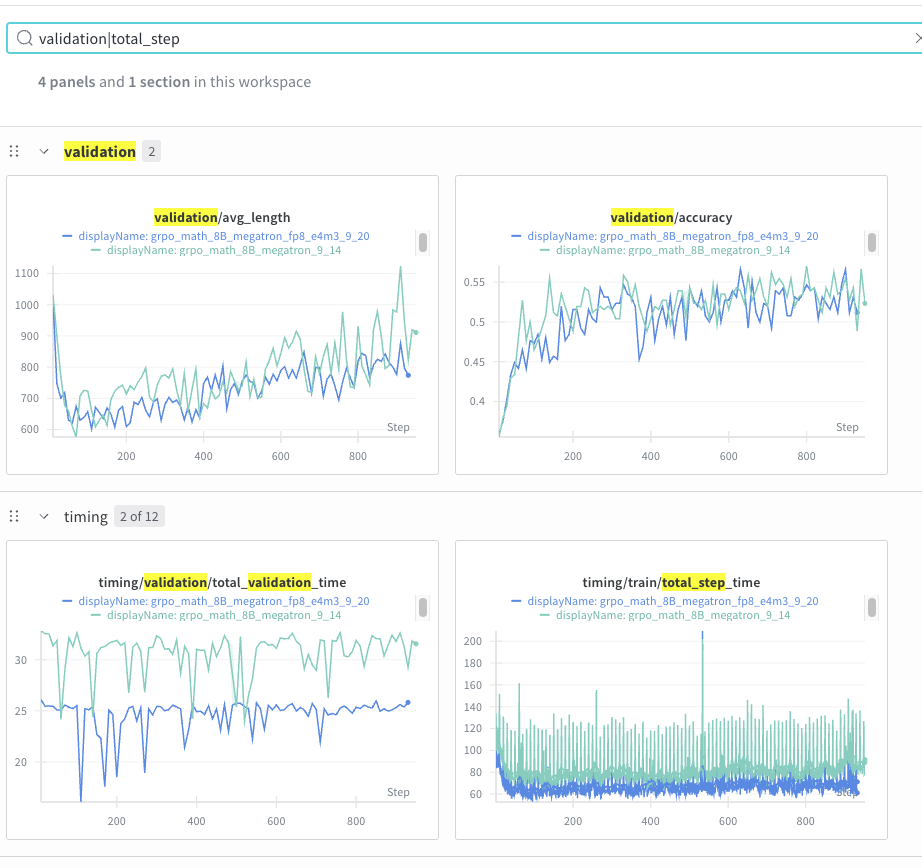
The above results are from Llama-3.1-8B-Instruct GRPO experiments. You can run them with the following example configs:
For BF16:
examples/configs/grpo_math_8B_megatron.yamlFor FP8:
examples/configs/grpo_math_8B_megatron_fp8.yaml
In the experiment in this figure, enabling FP8 rollout and training gives 15%-25% decrease in step time, and the validation accuracy curves match up to 1000 steps. Efforts are ongoing to perform longer runs and further optimize performance.