

gRPC Function Invocation
gRPC invocation executes requests against Cloud Functions functions that expose a gRPC service. gRPC functions use the gRPC proxy instead of the HTTP invocation route.
In self-hosted deployments, the gRPC route is exposed on the Gateway TCP listener. See Gateway Routing for listener and DNS configuration.
Self-hosted split or multi-cluster deployments require additional enablement before workers can reach the grpc-proxy callback endpoint. See gRPC Invocation Enablement.
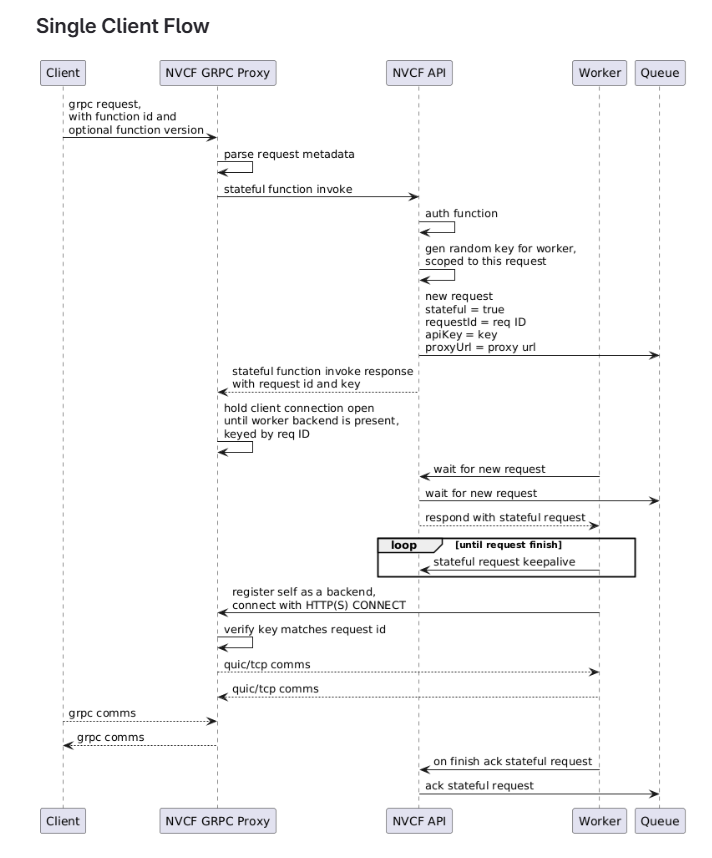
Invocation Path

Multi-Cluster View
In a global deployment, DNS selects a regional public gRPC endpoint. Each region keeps its own gRPC Proxy, NVCF API and NATS stateful request path, worker CONNECT registration, and customer gRPC service placement. The cross-cluster line shows NATS chatter for regional stateful request-path coordination when configured.

Metadata
Set these gRPC metadata values when invoking a function:
The data sent to your gRPC function is defined by the Protobuf messages your function implements. gRPC functions do not have an input request size limit.
gRPC connections stay alive for 30 seconds when idle. Close the gRPC client connection after your client is finished so function workers are not held longer than needed.
Python Example
This example uses a plaintext local or test gateway on port 10081. For a
production TLS endpoint, use grpc.secure_channel("grpc.<domain>:443", grpc.ssl_channel_credentials()).
The official gRPC term for authorization handling is
call credentials. The
example above sets the authorization metadata directly for clarity.
Connection Reuse and Streaming
The gRPC proxy pins sessions to the TCP connection to support unmodified gRPC clients that ignore cookie headers. This matters when an intermediary proxy for streaming, such as Kit streaming or Low Latency Streaming (LLS), uses HTTP/2 and reuses connections.
Do not pre-allocate streaming sessions with POST plus X-NVCF-ABSORB when a
shared HTTP/2 client can reuse one TCP connection across multiple users or
flows. Two separate requests sent over the same connection can receive the same
request ID from the proxy, which can bind different users or flows to the same
Kit pod.
Use on-demand binding through the WebSocket instead: establish the WebSocket, obtain the request ID from the proxy, and use that ID for subsequent requests.
For requirements and a sample intermediary proxy implementation, see Intermediary Proxy.
Session Resumption
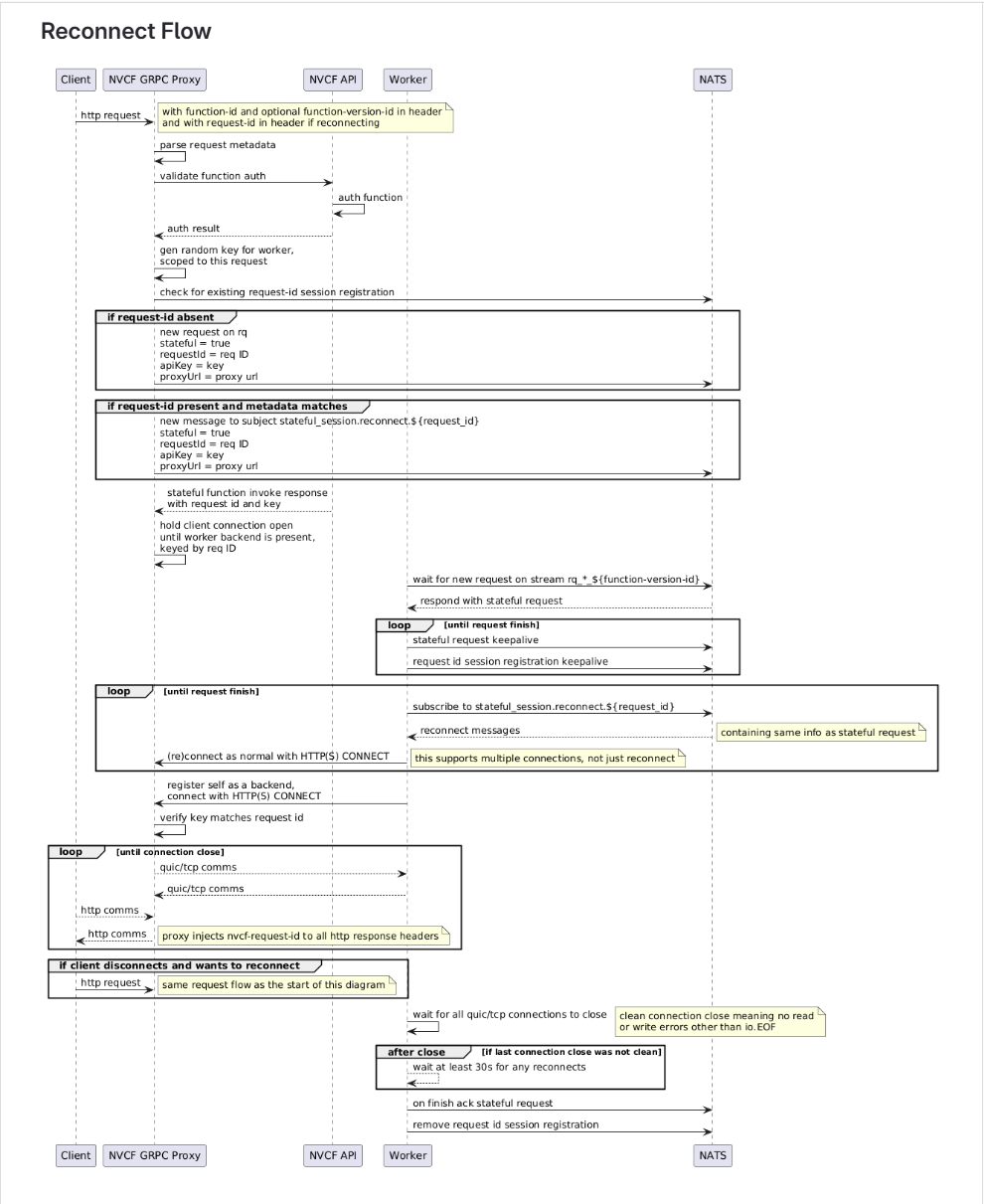
Streaming applications such as Omniverse Kit need to reconnect a client to the same worker after a brief network interruption or a deliberate pause. The gRPC proxy supports this through a request ID that identifies the stateful session bound to a specific worker.
How it works
- On the first request to a function, the proxy allocates a new session and assigns it a UUID request ID.
- The proxy returns the request ID to the client in two forms:
- An
nvcf-reqidresponse header. - A
Set-Cookieheader with the cookie namenvcf-request-id.
- An
- On subsequent requests, the client sends the request ID back to the proxy.
The proxy checks for the ID in this order:
- The
nvcf-reqidmetadata header (orSec-WebSocket-Protocolfor browser WebSocket clients). - The
nvcf-request-idcookie.
- The
- When the proxy finds a valid request ID, it routes the request to the existing worker session instead of creating a new one.
Sending the request ID
For gRPC clients, set nvcf-reqid as a metadata header. For HTTP or WebSocket
clients that cannot set custom headers, the nvcf-request-id cookie works as
a fallback.
What happens when resumption fails
If the session has expired or the worker is no longer available, the proxy
returns gRPC NotFound (grpc-status: 5) with the message “no existing session
found” and clears the nvcf-request-id cookie. The HTTP status remains 200 for
gRPC responses. This error does not indicate a control-plane problem. The
client should discard the stale request ID and reconnect without it to start a
new session.
See Troubleshooting for diagnosis steps.