

Definition, Run, and Release workflow
This reference covers output completeness, immutable attempts, release verification and SDK use. Start with the quickstart for CLI setup and the concept reference for the six public objects. ADR-17 owns the lifecycle contract; reconciliation owns current implementation and evidence.
Declare outputs
A Definition declares named outputs. Each output selects exact catalog components and a concrete target platform. Catalog components own reusable build or acquisition instructions. The compiler derives a closed, pinned build graph for each output and derives its packaging, publication route, and evidence requirements from the output and selected Environment.
The Build Digest identifies that generated graph’s logical content. Output labels and execution settings remain in their owning records. Two outputs can share a Build Digest while requiring separate producer jobs, observations and evidence; one successful output cannot satisfy a missing sibling.
The NVKE Definition directly selects nvkectl, cwe, and nvke-helm
for three outputs. The Helm output explicitly depends on the CWE image output. No reusable membership group,
criteria query, inheritance chain, or mixin sits between an output and its producers.
Deployment topology and placement are owned by the system that consumes the artifacts; Definitions and Releases contain no cluster views, deployment roles or categories.
Select an Environment
The local Environment supplies execution settings and a local registry destination. The GitHub Environment supplies the corresponding hosted-run settings. Environments own runner routes and may declare named execution classes with host platform, resource capacity, exposed capabilities, and timeout ceilings. The compiler deterministically binds a requested build to one satisfying class and records that exact route in the Plan. A class declaration is planning input, not proof that a runtime supplied the declared capacity or capability. Each execution adapter admits only its supported requirement bindings; unsupported requests fail before execution. Local direct-Packer and the explicit native ARC route retain their own admission boundaries.
Environments also own the publication namespace, credentials, and signing identity policy. Catalog sources and locks own tool versions and byte pins; Definition selects the scanner, signer, and generators by name. Output-affecting build tools remain part of build identity.
A destination or signing-setting change can change the prepared execution and generated workflow while preserving build identity. A dry-run signing mode records intended operations and never supplies a signature.
Inspect and generate
With bin/nvkr built as described in the quickstart, inspect the three-output NVKE example:
For saved generated Plans, run plan --plan <path> prints the required outputs and instructions;
--pretty provides an indented display view. run graph exports complete linked producer/artifact graphs,
and run diff explains changes between canonical Plans. See Plan and graph inspection.
Generation writes provider files and their commit manifest from the same admitted inputs. This example
uses a temporary root: the repository’s committed bundle selects M2, not the three-output Definition.
The matching --check invocation regenerates in memory and fails if generated files differ:
Use the M2 instructions to regenerate the committed bundle. Generated CI defaults to generic hosted runners; ADR-18 separately admits the explicit native ARC disk route. Publication and signing belong to the GitHub v1 lane. Generation does not prove provider execution.
Run and verify
Inspect a local attempt without creating its workspace or executing nodes:
The dry-run remains pending with no observed outputs. Actual execution uses an explicit attempt name under the
selected attempts root; the default root is .nvkr/runs. The attempts root must be a clean repository-relative
path under .nvkr. Publication is a separately enabled operation. The
implementation record distinguishes contract tests from external execution.
Choose local Run presentation
run local --ui=auto selects a terminal dashboard only with interactive standard
input/output, a usable terminal and no nonempty CI environment variable.
Pipes, redirected output, CI auto mode and --ui=plain
retain scrolling output. The dashboard lists required named outputs, selected
producer operations and dependencies, observation counts and bounded public
activity. Producer completion and fresh activity do not establish output
observation, finalization, release verification or runtime health.
Choose --ui=tui explicitly to require an interactive dashboard; incompatible
terminal/JSON choices fail before input or execution work. --no-color or a
nonempty NO_COLOR selects monochrome presentation with terminal-default colors.
NVKR and nvke-demo share a dark blue canvas, pale text and cyan pane titles and
focus borders. A tab strip identifies Outputs, Details and Activity; named frames
distinguish their contents. Tab
or 1/2/3 changes panes, arrows navigate the focused pane, Enter opens details,
Esc goes back, / searches output names, f changes the filter and ? shows help.
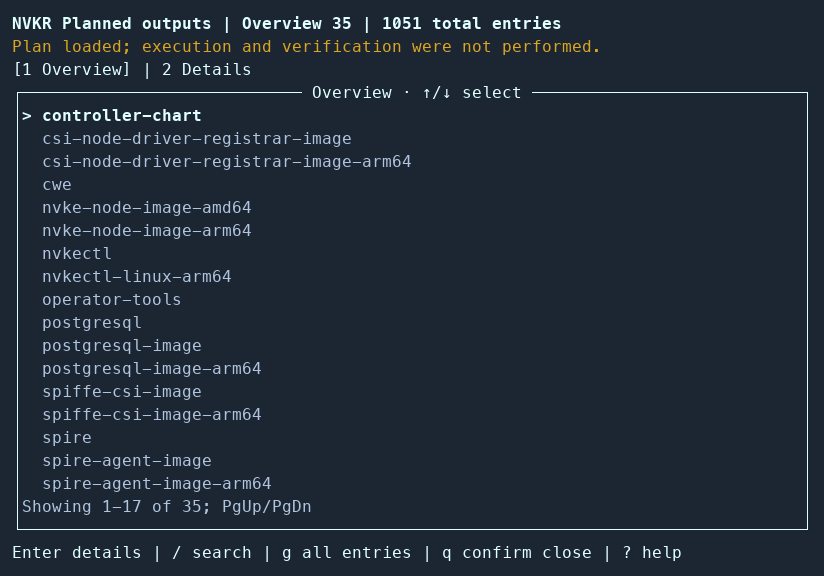
The initial screen uses one row per output. Details and Activity open when
selected; a wide terminal pairs the list with Details only after inspection is
requested. Selection stays bound to the same named output while execution updates. Activity scrolling pauses following new
entries; End resumes it. On a small terminal the view uses one pane at a time.
During a live Run, q opens a cancellation confirmation. Press y to cancel; n, Esc or Enter keeps the Run open. Ctrl+C requests cancellation immediately. Cancellation waits for owned work to stop. Esc otherwise navigates. The dashboard has no force-exit or implicit deployment cleanup action. A successful or failed command restores the terminal and returns to the shell with its original owning outcome; a reporting failure can separately fail the command. A complete retained Run with incomplete cleanup keeps its observed outputs while returning the coded failure.
While the dashboard is open, a shared memory buffer retains the last 128 KiB of producer stdout and stderr. If the command fails, the captured bytes are replayed to ordinary stderr after terminal restoration, owned-work joining and the safe final summary. Recovered presenter/worker panic diagnostics use the same private bounded sink. A marker identifies truncation. Raw producer text never enters the safe dashboard panes. This failure replay does not create a durable general-purpose log; successful Run output is not replayed. Existing Packer diagnostic retention is separate.
run local --json emits one deterministic, safe final-result document on stdout
under nvkr.dev/local-run-result/v1. It includes frozen required outputs, observed
membership, status, lane, code, exit status and record/cleanup availability.
Producer diagnostics go to stderr. It omits private paths, transport references
and raw failure messages; it is a description, not a resumable Run or verification
receipt. Existing run plan --json still emits exact canonical Plan bytes.
Auto presentation stays plain for --dry-run. Explicit --dry-run --ui=tui first
admits the normal dry-run, then opens a static read-only view; it executes no
producers and creates no attempt. Closing that view does not cancel another Run.
Browse public command results
The following public commands accept --ui=tui and --no-color: Definition validation
and inspection; Run planning, graph, comparison, inspection, generation and local
execution; producer resolution; all catalog inspection and maintenance commands;
and Release inspection, browsing, export, pulling and verification. Other than the interactive
local Run default described above, commands default to --ui=plain and keep their
existing text, canonical JSON or diagram output. On commands with a result
browser, --ui=auto selects it when the terminal is eligible. Explicit JSON output
and --ui=tui are incompatible and fail before input, network or write work.
validate, run check-artifacts and run qualify retain canonical machine-readable diagnostics and do not offer
presentation flags.
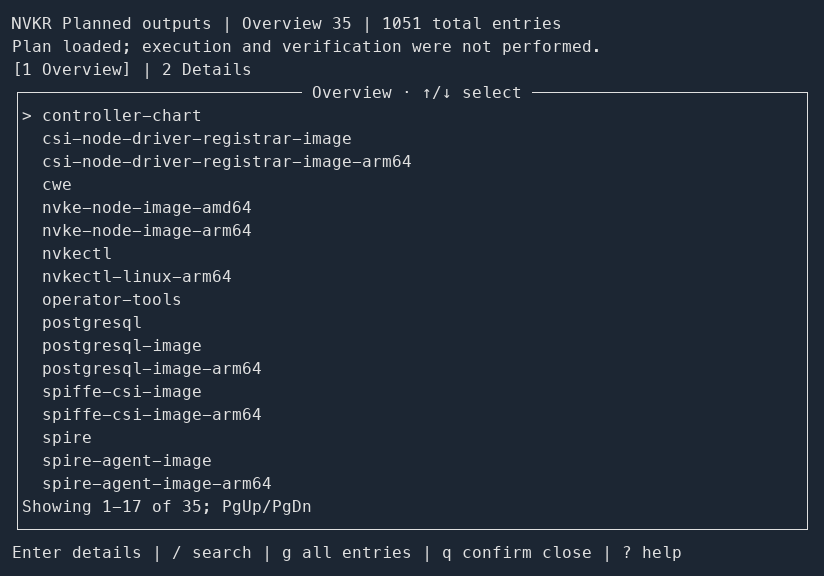
Graph and release browsers start with an output overview when their supplied
results also contain internal nodes or evidence entries. Press g to toggle all
supplied entries; / searches the complete supplied set. Producer-only graph
views keep their supplied producers. The default list uses one row per entry,
with readable output names; repeated static states are omitted. Full digests and command context live in
Details.
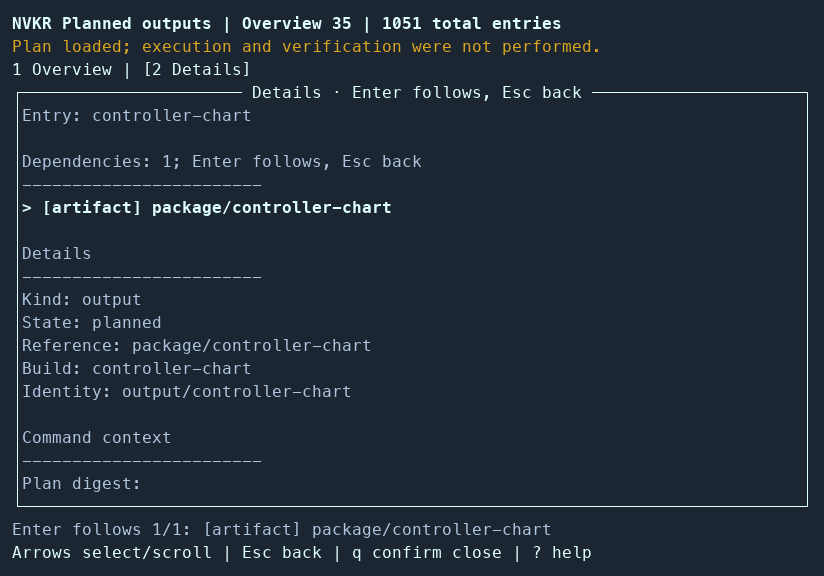
Results and Details show projected names, identities, counts and dependencies;
/ searches names and f cycles the available All, Changed and Failed filters.
Static views offer Activity only when activity is supplied; live Runs retain it.
Tab cycles the available panes, and 1/2/3 selects a pane when available.
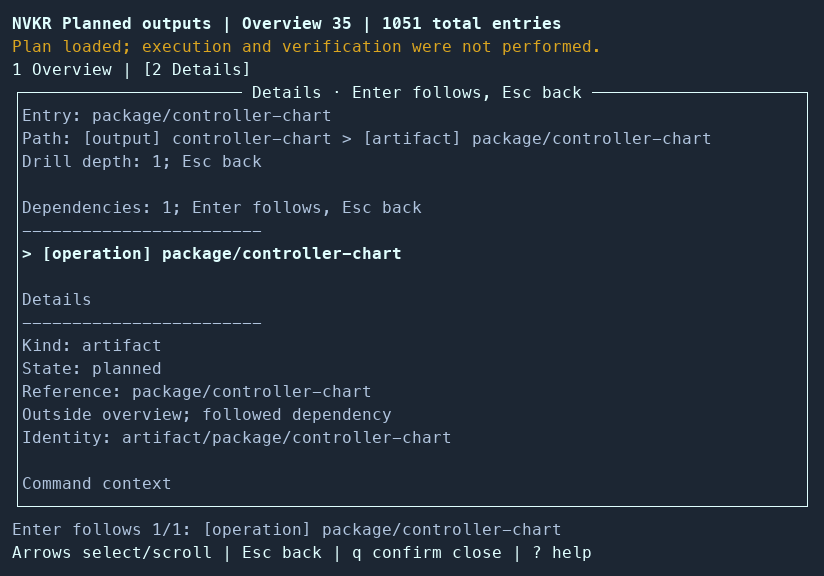
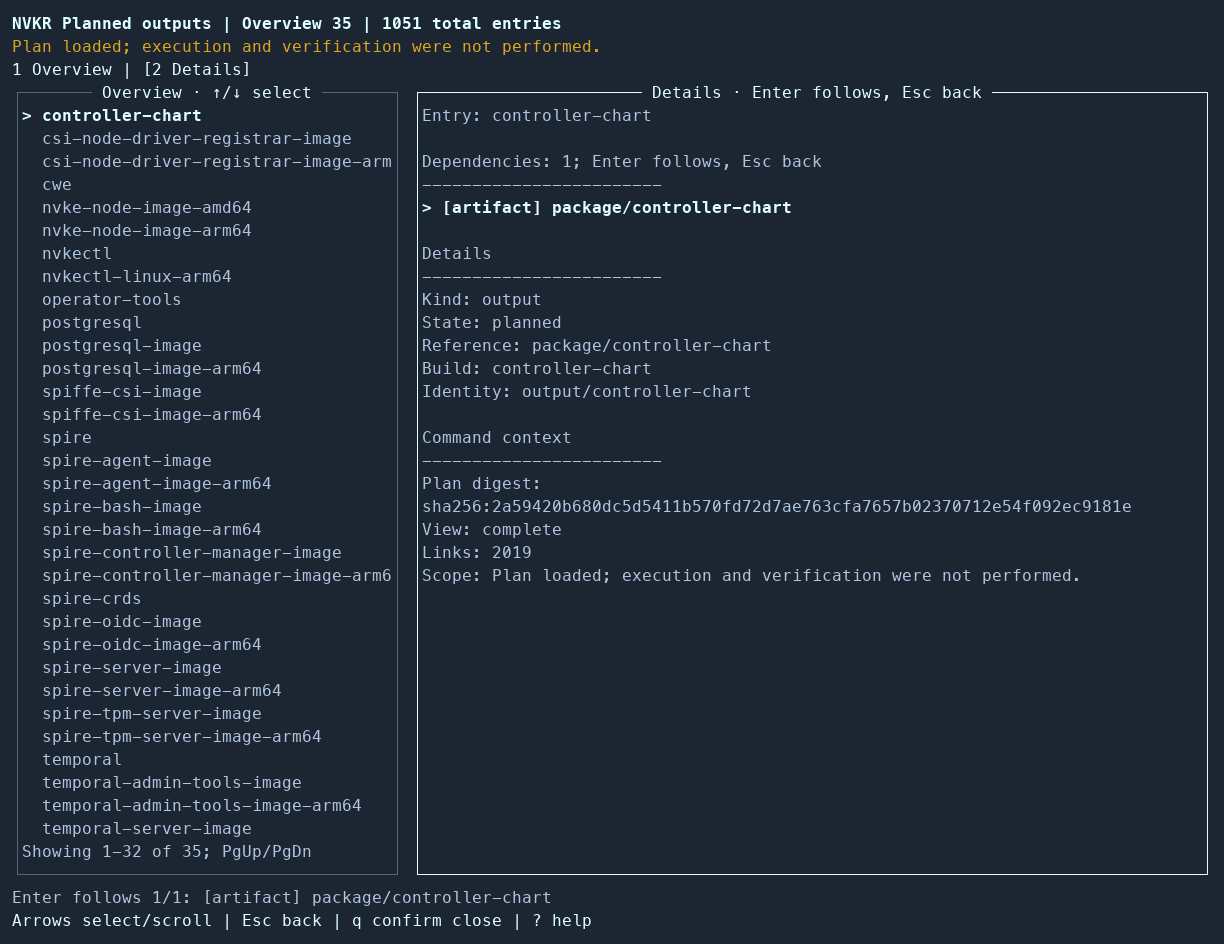
Details group navigable dependencies before item metadata and command context.
A path shows each drill-down step; Esc returns to the exact previous selection.
A pinned hint
identifies the dependency Enter will follow even when its row is scrolled away.
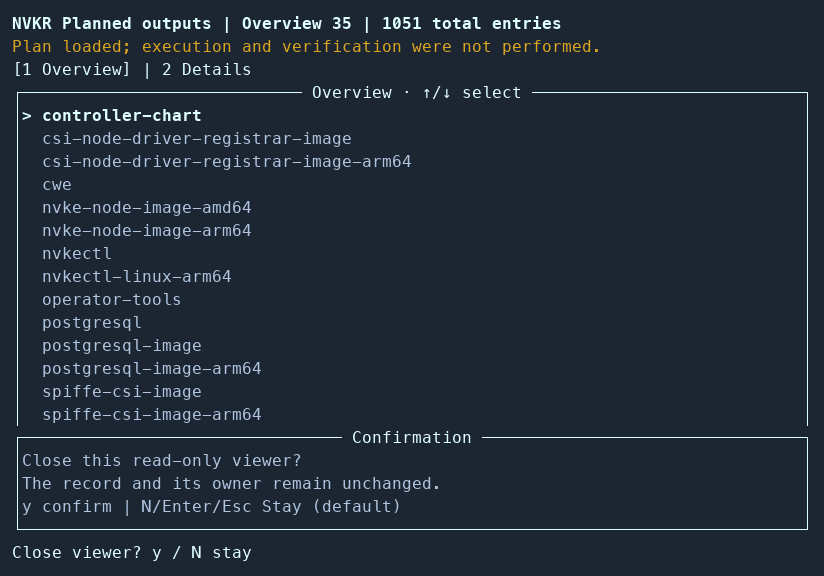
Enter follows an available dependency and Esc returns. q asks before
closing; y closes, while n, Esc or Enter stays. Small terminals use one pane.
Below 40 columns or 12 rows, browsing pauses until the terminal is resized;
close confirmation and Ctrl+C remain available.
The result browser opens after the command’s existing operation finishes. Catalog maintenance and generation retain their normal write/check behavior; closing the browser neither repeats nor undoes it. Ctrl+C closes this read-only browser and preserves the completed operation’s owning result. Verification results reflect only the owning verifier’s accepted lane and scope. Authenticity results explicitly state that signatures and evidence were authenticated while payload integrity was not checked; artifact rows describe authenticated publisher metadata. Release browsing checks metadata; local Release inspection additionally checks closure membership and payload integrity. Neither operation authenticates signatures or consumer policy. Differences still return status 3 when requested. Raw changed values, source URLs, private paths, signer expressions and error messages are excluded from safe result panes; use existing plain output for the complete machine or diagram representation. Hidden execution and CI helpers keep their existing interface.
Dashboard screenshots
These controlled Plan views show the shared NVKR/NVKE demo styling; they do not represent executed producers or human usability acceptance.
Inspect a recorded attempt
Inspection defaults to plain output. The bounded lifecycle-owned loader rejects
symlinks in every path component, malformed canonical bytes, inconsistent named
output metadata, unavailable qualified lanes and an attempt name that does not
match its containing directory. Use a physical path (for example, start from
pwd -P); macOS /tmp is a symlink, so use its physical /private/tmp path.
A missing directory or record returns a coded verification failure. A disk marker
without a record cannot distinguish unfinished live work from interruption; no
interrupted Run is inferred. A present record describes its sibling disk-commit
marker separately, without performing cleanup.
q asks before closing a read-only viewer; y or Ctrl+C closes it, while n, Esc or
Enter keeps it open. Closure does not execute, change a record, or perform cleanup.
Stored observations establish no current payload availability, signature
verification or health; file modification times are not live freshness. The SDK
exposes the same detached description through Client.InspectRun.
For a completed local disk-image output, lifecycle retains the exact observed QCOW2 as
<attempts-root>/<attempt>/outputs/<output-name>.qcow2 and prints that path. The file is read-only, is committed
only after held-source digest/size revalidation and successful Run binding, and remains local unqualified output.
An attempt transaction prevents an interrupted disk/record pair from being treated as complete. It is not an OCI
or object-store publication and the caller cannot redirect it outside the immutable attempt workspace. Marker
removal plus attempt-directory sync is the durable success point; after successful rollback, errors before it
record failure.
A Run records one attempt against frozen inputs and expected output slots. Execution must match independently observed package contents to those slots, including selected build identities and exact component membership. An omitted or conflicting output cannot make the Run complete. Once execution has prepared an attempt, its failure record retains the required outputs; that record cannot be deserialized into release authority. Hosted finalization also requires a running finalizer and its generated helper. A bootstrap failure, unavailable runner, or interrupted artifact transfer can prevent the Run record from being produced at all. Consult the provider’s job state in that case; a missing record is never evidence of success.
A Release supplies one pinned reference to immutable selected artifacts and evidence. Consumer verification takes that reference and a Verification Policy and authenticates the complete selected closure. The policy names the accepted evidence lane and identities. Qualified authorization, v1 pipeline evidence, and dry-run descriptions remain distinct. Unsupported authority adapters return a coded capability error.
The policy explicitly selects what acceptance means. authenticity checks signed membership, the root and
every required output’s signatures and production provenance, and required signed SBOMs without downloading
artifact payload layers. artifact-publication checks the selected payload bytes as well as evidence.
Full v1 release acceptance adds qualification and revocation requirements. Each result retains its scope;
an unavailable stronger scope never falls back to weaker verification.
For disk outputs, VerificationPolicy.minimumDiskEvidence is included in the policy digest. Pipeline-attested
verification defaults to build-provenance-v1, accepting signed producer/material evidence without an inspected
disk inventory. Use --minimum-disk-evidence strict to require inspected evidence. The
SDK exposes DiskEvidenceStrict and DiskEvidenceBuildProvenance. Qualified verification defaults to strict
and cannot opt into the producer-only mode. Authenticity enforces the same minimum against signed evidence
and metadata; it does not inspect or re-hash the disk.
The CLI expresses build-evidence acceptance as --scope artifact-publication. On Linux, with a pinned cosign
executable and an existing signed publication in a public registry, the consumer invocation is:
To authenticate release evidence without downloading artifact payloads, change the scope to authenticity:
The result reports payloadIntegrityVerified: false. It authenticates the complete metadata/evidence
closure, including each required output and SBOM bundle, but cannot authorize payload export or exact-input
matching. --definition, --environment, and --plan are rejected with this scope before external work.
Stock verification remains Linux-only with the same pinned cosign requirement.
An independent consumer can additionally require the publication to realize
exact authored and compiled inputs under artifact-publication by supplying all three paths:
The three inputs are admitted together before signature or registry work. A successful response includes a package-issued exact-input description bound to the publication subject, consumer policy, and its Definition, Environment, Plan and content digests. This narrows what the consumer accepted; it does not grant a stronger lane, full Release scope, qualification, or deployment acceptance. The Plan is generated pipeline state; an unreadable or undecodable Plan reports pipeline drift, while a decoded Plan that fails validation preserves its validation error rather than being reclassified by the command adapter.
For artifact-publication without the three exact-input flags, release verify writes the verified Release
description directly:
With all three exact-input flags, the output is a wrapper containing that same
verified Release description and the defensive exact-input description:
Artifact entries retain their type-specific optional fields, such as disk for
disk-image outputs. Exact-input mode changes only the top-level JSON shape; it does
not replace or weaken the verified Release description. The opaque receipt remains
live and process-local and is never serialized by the CLI.
RELEASE_REF is a registry reference pinned with @sha256:…; the identity and issuer belong to the
consumer’s trusted build policy. Signature and production-attestation verification are both required by this
scope. Authenticity separately requires these checks for the root and every required named output, along
with cryptographic SBOM verification. The SDK retains a live, policy-bound capability until closed.
The stock verifier remains Linux-only, and unit tests do not establish live signing-service
acceptance. Full v1 release scope (--scope release) and qualified acceptance remain capability-gated.
The scoped consumer and exact output/content bindings have positive and negative contracts. Full v1 release acceptance still requires its deferred qualification, membership, and revocation adapters; the scoped result cannot substitute for them. The ADR-04 stock-cosign consumer contract remains independent of the convenience NVKR reader.
Authenticate an M3 candidate
On Linux, nvkr run check-artifacts checks the already-published bytes against one exact producing Run
attempt and an independently selected trust policy:
Replace OWNER/REPO, ID and N with the intended Run and attempt. An attempt is mandatory; the command
never selects the latest retry implicitly. Configure the trusted producer and verifier once in
qualification.yaml, then reuse that policy across approved Runs:
The zero digest is a placeholder, not an accepted executable pin. The verifier defaults to cosign on
PATH; optional cosign.path selects another executable, with relative paths resolved beside the policy.
Its bytes must match the independent digest. Neither the producer’s Environment nor downloaded files can
select consumer trust. The optional --workspace defaults to .nvkr/qualification.
NVKR_GITHUB_TOKEN supplies GitHub read credentials; private registry reads use NVKR_REGISTRY,
NVKR_REGISTRY_USER and NVKR_REGISTRY_PASSWORD. This check needs no qualification signing credentials
or identity token. macOS rejects it before input or network work.
The source owner discovers the commit from GitHub’s exact attempt endpoint, checks successful completion,
approved repository and workflow, and the repository’s actual default branch. It then downloads the single
nvkr-qualification-ID-N artifact for that attempt. Direct HTTPS access to api.github.com and approved
artifact download endpoints is required. The owned transport ignores proxy environment variables; an
admitted artifact download location receives a fresh request without GitHub API credentials.
Generated production real-signing per-output-v1 workflows save one handoff.json after complete finalization. It contains the
original Plan, the compiler-read Definition and Environment, base and output-specific catalogs, overlays,
registries, locks, patches and directory facts, plus the original predicate bytes keyed by the root and every
delivered payload reference. The collector joins bounded aggregate metadata and saved output-route records
without reading payload packages. The handoff contains no consumer policy. Development, unsigned, dry-run and legacy aggregate workflows do not produce it;
an older Run without a complete handoff fails instead of rebuilding or reconstructing missing evidence.
Legacy aggregate builds/publication remain available, but they lack invocation-bound release metadata and
the per-output route records needed for M3 qualification; direct qualification rejects that capability before publication work.
The lifecycle owner recompiles the captured authored bytes with their original logical paths and requires
the exact original Plan identity. Authored reads have no checkout fallback. Catalog-owned authentication
of pinned upstream Git trees remains required and may use its existing credentials and bounded network
access; this is not offline compilation. Unknown fields, duplicate keys, noncanonical encodings, unsafe
paths, incomplete inputs and oversized transport fail closed. The handoff is descriptive generated
transport, not proof that any artifact passed. lifecycle.Consumer.CheckQualification still verifies the
complete publication, original predicates, signatures, subjects and input bindings.
For programmatic use, lifecycle.CheckQualificationRun owns Run selection, policy loading and handoff
retrieval. lifecycle.CheckQualificationHandoff borrows a provider-issued source receipt. The existing
lifecycle.CheckQualificationFiles adapter remains available for explicit saved-file diagnostics; normal
CLI use does not require those files or separately entered source-commit fields.
All three adapters scope explicit registry pull credentials to the independently configured canonical
ConsumerOptions.Credential.Registry host (the corresponding runtime credential for Run/handoff calls).
A candidate or Environment cannot choose that destination; missing or mismatched hosts fail before
registry access. Anonymous pulls and registry-scoped credential keychains remain available.
At the consumer API boundary, source and Plan validation precede adapter-capability checks. A request with both malformed inputs and unavailable adapters reports the input error first. Neither case reaches registry or signature-verification I/O.
Every selected output is checked for schema/membership, exact Run and inputs, signed evidence, build
signature/provenance, applicable payload pins and any authored embedded declarations. Failed checks return coded
diagnostics; only a complete passing set produces an opaque ArtifactCheckReceipt. Its description is
defensive data and grants no authority. A successful receipt retains the verified publication and a frozen
Plan until closed. Closure revokes all shallow copies, cancels and joins registered operations, then releases
held payload bytes. This lifetime does not itself authorize smoke execution. The direct consumer and handoff
methods borrow the caller’s source Run receipt, whose closure also revokes the check receipt. The Run and
file adapters transfer their internally created source owner to the returned receipt and close it with that
receipt.
If the source is revoked during verification, the final source check refuses receipt issuance. Each output
then includes a separate failed source-lifetime diagnostic and an overall failure; completed signature,
pin and other artifact checks keep their actual results. This extra diagnostic appears only on final
source-admission failure. Successful reports retain the six artifact checks above. Always inspect the
returned error or command exit status; diagnostic data alone never proves receipt issuance.
Payload digests remain distinct from OCI delivery-container subjects, and disk results explicitly retain
producer-only scope without content inspection.
An incomplete evidence traversal is labeled as a failure of the complete publication in every output’s signed-evidence diagnostic. Output-specific signature failures remain visible alongside that global failure; no output receives a passing evidence verdict merely because its own signature check did not fail.
Qualification requires the root and every output predicate to name that exact source attempt. When output metadata records publication origin, both preparation and signing invocations must also match. Earlier-attempt publication reuse remains available to the existing publication retry protocol, but cannot satisfy this MVP qualification gate. Earlier bytes are never relabeled as produced by the current attempt. The CLI writes check diagnostics and returns the stable failure code; its serialized output cannot restore a live receipt or grant qualification signing authority.
The pinned embedded declaration
profile is optional for source producers; no producer must supply it. Omission yields not-applicable.
Any authored declaration must match its referenced pinned upstream metadata, and a missing, invalid or
disagreeing reference fails. The check reads
raw source metadata; it does not apply patches, configuration or material substitutions and cannot establish
effective customized or installed composition. Source, patch, configuration and material identity/provenance
checks remain required. The maintained candidate needs no new upstream component manifests.
Delivered-tool smoke still requires the complete native worker results described below. An A receipt alone cannot sign evidence or authorize release. Local tests do not establish real hosted signing or complete-set consumer acceptance. Reconciliation records contract coverage and the outstanding hosted signing, exact-input candidate and consumer acceptance evidence.
Publish qualification evidence
Hosted qualification uses one command:
The generated workflow supplies its environment and credentials. The command discovers its source only
from the authenticated workflow_run event, verifies the source’s exact successful attempt, and downloads
its original handoff. There are no source-commit, candidate-file, verdict-file or skip-smoke flags.
A manually dispatched qualifier or the source build’s own identity is rejected.
Add --qualification-policy qualification.yaml to the normal run generate invocation to generate the
qualifier and its native smoke worker alongside the producer. The worker is a generated reusable GitHub
Actions workflow; the operator does not write or maintain a separate worker implementation. The maintained
candidate supplies inputs/policies/nvke-qualification.yaml and emits .github/workflows/nvkr-qualify.yml
and .github/workflows/nvkr-smoke.yml. The same invocation with --check compares
all owned bytes without writing. The separately owned qualification manifest records both workflow files;
hand edits and unowned files are not silently overwritten. The worker is a fixed same-repository reusable
workflow at the caller’s exact commit. It is generated plumbing, not another operator command to configure
for each Run. Before candidate or signing work, both commands check the trusted checkout against that
manifest and the full loaded policy; policy or workflow drift requires regeneration.
The independent policy extends the artifact-check policy with these decisions:
The maintained-candidate policy contains concrete verifier/native-image pins and exact output scope. Review those independent trust selections with the generated workflows before merge. Other Definitions need their own matching scope and native pins; the candidate policy is not a wildcard approval. The trust policy belongs to the operator, not the producing Run. Concrete configuration does not establish organizational approval or successful hosted execution.
For hosted generation, replace the earlier single cosign.digest field with cosign.platformDigests;
using both is rejected. Map keys are exactly linux/amd64 and linux/arm64. Set cosign.version to the
approved stable vX.Y.Z download locator and leave cosign.path absent or cosign. Images must cover exactly
the executable platforms selected by the Definition. An AMD64-only product generates one worker. An
ARM64-only product still needs an AMD64 cosign pin because the final signer runs on AMD64. The maintained
candidate selects both platforms. Generation validates all tool profiles, versions and non-tool membership
against the Plan before writing either workflow; missing or extra scope is an error.
smoke.nonToolOutputs is a list of output, kind, components and reason records. The admitted pairs
are kind: oci with reason: deployment-image, and kind: apt-repository with
reason: package-repository. Each record must match the complete named output’s component set. The
candidate policy contains all 25 OCI records, alongside three profiles covering its four native
tool invocations. It contains no Helm/disk exemptions because those formats have a fixed non-tool rule.
For a mixed bundle, smoke.nonToolMembers accepts records with output, member and
reason: runtime-assets-archive. Each must select a source-built tarball producer in that exact
output; the delivered member must have no executable mode bits. Sibling tools still require their
fixed profiles, and each executable output must contain at least one tool. The archive remains
subject to artifact and provenance checks. This does not assert that its contents contain no tools.
Missing, extra, duplicate and tool-overlapping member rules fail closed.
Use independently approved native images containing /bin/sh, cat, wc, sha256sum, chmod and
/usr/bin/env. They must have no declared volumes or extra inherited environment. The payload environment
is fixed to PATH=/usr/bin:/bin, HOME=/work, TMPDIR=/work, LC_ALL=C, TZ=UTC and
CLUSTERCTL_DISABLE_VERSIONCHECK=true. The last setting disables clusterctl’s optional network update
check after its version command; version/source checks and network isolation remain required. Image configuration
must not add or conflict with it. Builder images and pins are not automatically trusted smoke images.
The generated route also requires a GitHub-signing producer, its generated source workflow, and GHCR
publication under the same repository owner with the existing github:GITHUB_TOKEN credential reference.
The fixed profiles include nvkectl-version-json, helm-version, kubectl-client-version-json,
kind-version, clusterctl-version-json, oras-version, nicosim-version-json and
nicosim-patched-version-json. NICoSim profiles require exact version, source commit and platform,
with clean for unpatched inputs or patched for declared authenticated patch inputs. Dirty or unknown
tree stamps fail. Expected versions and source commits come from the authenticated frozen Plan. The policy cannot supply a
replacement expected version or arbitrary executable arguments. Every member of every executable bundle
must be covered. OCI deployment-image and APT package-repository exemptions require exact membership;
there is no wildcard exemption for an artifact format. Disk and Helm outputs use their explicit non-tool
format rule. Disk content remains uninspected.
Each native worker independently performs artifact checks, streams the held delivered member into a network-disabled nonroot container, checks its native ELF identity and version response, and joins cleanup before signing its report. The payload receives no credentials, host mounts, daemon socket or inherited host environment. The worker can read artifacts and sign its own report; it cannot publish qualification attestations. Its generated upload contains exactly four files under an attempt-specific artifact name.
A failed worker report lists every known native member: completed checks retain their actual pass result,
the failed attempt is marked fail, and checks never reached are not-evaluated with a coded reason.
Cleanup or revocation can fail the overall report even after all member checks passed. These diagnostics
cannot be signed as successful evidence. If the final job cannot authenticate the delivered smoke set,
every artifact receives a failed delivered-tool-smoke-authentication verdict while its genuine artifact
check results remain intact; this does not claim the payload itself was executed and failed.
After workers complete with success or failure, the final job repeats artifact checks and attempts to authenticate the complete smoke set. This produces refusal diagnostics when a worker failed. Canceled, skipped or untrusted source invocations do not enter this final job. Publication still requires successful worker jobs from the exact current attempt and verifies each report’s signature, worker certificate SAN and GitHub issuer. The same verified leaf must bind the top-level workflow, workflow commit and exact Run attempt. It then recomputes the complete expected member set and compares the full independent policy, payload identities, native images, expected versions and observed results. A missing architecture, missing member, wrong identity, reused attempt or failed check prevents signing.
qualification.PublishTriggeredRun owns this orchestration. The lower-level publisher consumes live A,
B and invocation receipts; serialized reports cannot restore them. The old qualification.PublishFiles
publishing adapter returns a capability error before I/O; saved-file artifact diagnostics remain available
through lifecycle.CheckQualificationFiles.
The canonical predicate uses schema and URI nvkr.dev/qualification-evidence/v2 and
https://nvkr.dev/qualification-evidence/v2, with typed family nvkr.qualification-evidence. Version 2
requires the full smoke policy and member-level worker evidence. It also binds the complete artifact-check
report, source and qualifier identities, input identities, per-output verdicts and external-suite status.
Every selected output receives the same complete-set predicate under its own exact subject. An
outside-MVP suite is not-evaluated, never passed. Independent consumption
explains distinct builder/qualifier trust and complete-set rejection requirements. Requiring an external suite fails before provider or
artifact work until authenticated integration exists.
The publisher collects all results before signing and rechecks receipt lifetimes before constructing the signer, each attachment and successful return. An operational failure can leave earlier attachments; the command returns a failure code and retains those subjects in its diagnostics. Their presence does not establish successful qualification or release authorization.
The maintained candidate’s reviewed policy and generated workflows may merge before real acceptance runs. After merge, a fresh complete producer attempt must provide its original exact-attempt handoff; the hosted worker/qualifier and independent consumer then exercise positive and negative cases. These observations remain unproved and are required before production-readiness claims. Local native-container, race and protocol tests do not establish GitHub’s actual reusable-job names, OIDC claims, production attachment/read-back or independent complete-set consumer acceptance. Merge does not waive any runtime verification; reconciliation records their scope and status.
Use the SDK
Configure the client with tool and registry settings once, then pass a reference and policy for each Release. The accepted identity and issuer belong only to the policy. This example uses a public registry:
Use AuthenticateRelease with an authenticity policy for the metadata/evidence-only operation. It returns
a distinct closeable AuthenticatedRelease; its description records that payload integrity is unchecked.
It exposes no payload export or exact-input receipt and cannot be passed as a fully verified Release.
The returned Release is a description of the accepted contents. Its serialized form does not recreate the live verified capability. Verification still requires the supported platform, pinned tool, and evidence described above; compiling this example does not exercise those external dependencies.
Inspect internal records when needed
Plans and artifact graphs explain execution dependencies. Required/observed membership explains completeness. Typed evidence explains reproduction, compatibility, conformance, or qualification claims for exact subjects. Clearance and publication roots explain authorization and transport. These records are useful diagnostic views; normal product authors do not construct and join them manually.
Maintained inputs under inputs/ use Definition and Environment; teaching selections live in docs/examples/. Superseded factory authoring APIs
and their migration fixtures are removed; backward compatibility is not a requirement.
The direct-output model uses Definition v5, catalog v3 and producer IR v4. Generated Run Plans use v5; Run and Release use v4. Older recipe layouts and cluster/placement fields
are rejected before work. Current migration checks and maintained-input build evidence are tracked in reconciliation;
historical Runs retain the authoring and wire contracts exercised at the time.