Clemson University#
AetherEdge: Intelligent MEC Task Offloading#
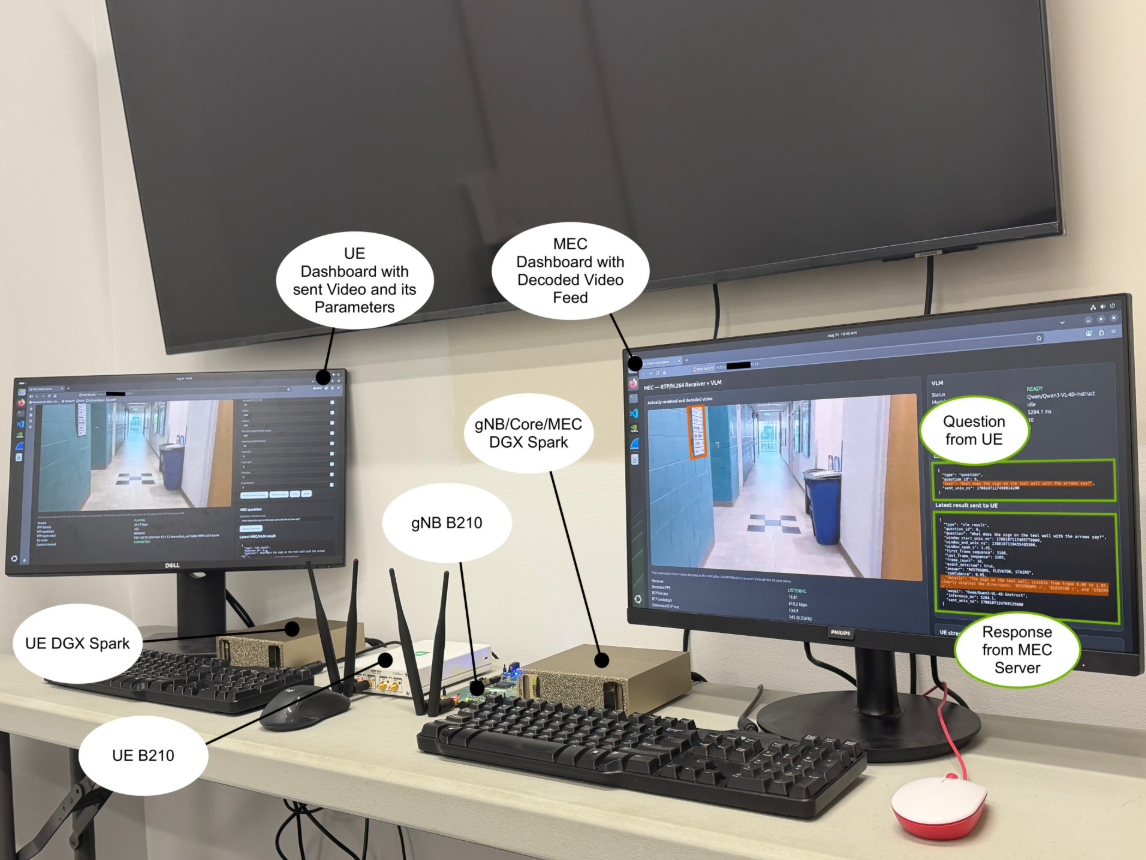
Clemson University’s Intelligent Systems and Wireless Networking (IS-WiN) Laboratory is developing AetherEdge, a live 5G mobile edge computing (MEC) platform for intelligent, radio-aware task offloading. The testbed integrates NVIDIA DGX Spark systems, Ettus USRP B210 radios, an OpenAirInterface (OAI) 5G Core and software UE, and an NVIDIA Sionna Research Kit-based gNB operating with a Split 8 radio interface. A GPU-accelerated MEC application is connected through the 5G N6 data network.
AetherEdge demonstrates multimodal edge AI over a live 5G user plane. The UE streams low-latency H.264 video using RTP while transmitting natural-language queries over WebSocket. At the MEC, Qwen3-VL processes a sliding temporal window of decoded frames and returns structured temporal responses to the UE.
Initial experiments highlight the strong coupling between RAN resource allocation and edge-AI latency. A representative YOLO workload executes in approximately 7.5 ms on DGX Spark, while client-visible latency decreases from more than 4 seconds with 24 PRBs to approximately 700-750 ms with 51 PRBs, showing that radio-resource availability can dominate interactive edge-AI latency.
The next phase will close the loop between the MEC application and RAN. E2SM-KPM telemetry from a FlexRIC xApp will provide real-time network observations to an intelligent offloading controller, following with E2SM-RC RAN control and NVIDIA Aerial dApps using the E3 interface for increasingly fine-grained, low-latency coordination between AI workloads and radio resources.
This initiative is part of Clemson’s broader AI-RAN research program, supported by the NVIDIA Academic Grant Program and NVIDIA 6G Developer Program. Clemson is also expanding the platform with an NVIDIA DGX Station based on the GB300 platform and Keysight O-RAN and 5G NR RAN-emulation capabilities. This next-stage testbed will transition the current Split 8 experiments toward an NVIDIA Aerial CUDA-Accelerated RAN with O-RAN Split 7.2x, providing a pathway from rapid software-defined experimentation to GPU-accelerated, real-time AI-RAN research.