

gRPC Server Behavior#
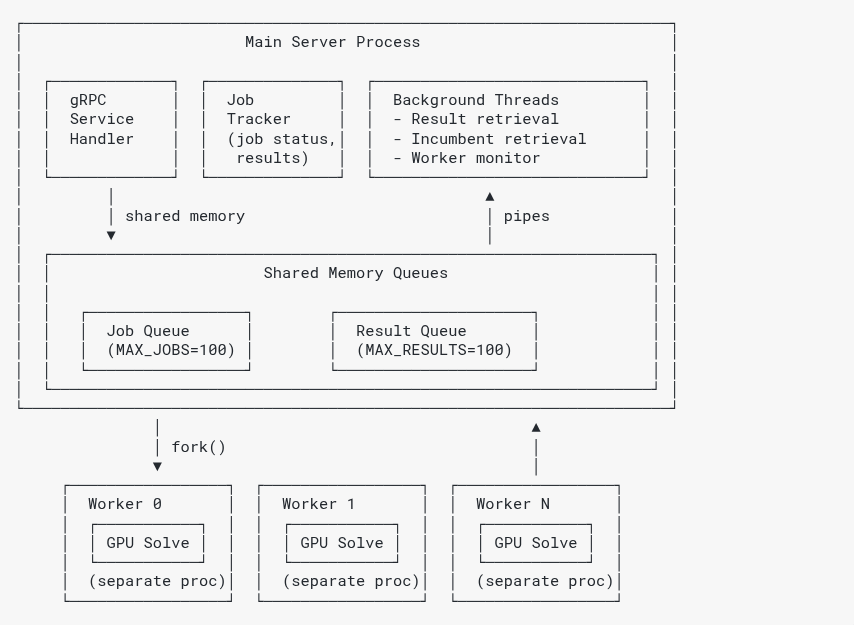
NVIDIA cuOpt’s cuopt_grpc_server uses one main process (gRPC front end, job tracking, background threads) and worker processes that run GPU solves. That layout gives isolation between jobs and optional parallelism when you set multiple workers. LP/MIP jobs can use chunked transfer for a problem or result larger than one gRPC message, and they can stream solver logs. A routing job is sent and returned as a single message, and the routing client does not stream logs.
Implementation details (IPC layout, C++ source map, chunked transfer internals) live in the contributor reference: cpp/docs/grpc-server-architecture.md in the NVIDIA cuOpt repository.
Process Model#
Job Lifecycle (Summary)#
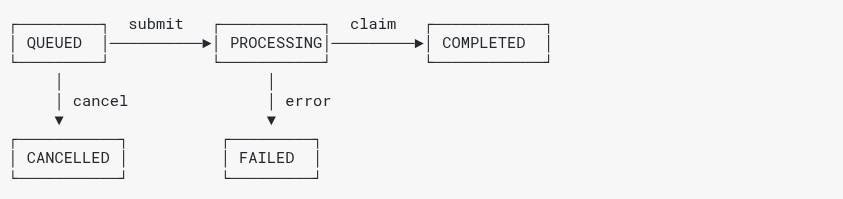
Submit → the server assigns a job id and queues work. Process → a worker pulls the problem, solves on the GPU, and streams the result back. Retrieve → the client uses status and result RPCs. An LP/MIP result larger than the gRPC message limit uses chunked download. A routing result is one message. See gRPC API (reference) for RPC names.
Job States#
Logs, Capacity, and Workers#
| Topic | Detail |
|---|---|
| Log files | Per-job files under /tmp/cuopt_logs/job_<job_id>.log. LP/MIP solver logs are written there and tailed by log streaming. Routing does not write solver logs or stream them. |
| Capacity | Up to 100 in-flight jobs (queued + processing). Completed results stay until DeleteResult (no fixed result cap). |
| Workers | Recommended: 1 worker process per GPU. Higher values are possible depending on the problems being solved but there is no specific guidance at this time. |
Fault Tolerance and Cancellation#
If a worker process crashes, jobs it was running are marked FAILED; the server can spawn replacement workers (see contributor doc for details).
CancelJobcancels queued jobs immediately (the worker skips them). If the solver has already started, the worker process is killed and the job is marked CANCELLED; a replacement worker is spawned automatically.Ctrl-C / SIGTERM cancels active jobs, kills worker processes, and shuts the server down without waiting for an in-flight solve to finish.
DeleteResultalso cancels a queued or running job (same kill/skip behavior asCancelJob), then removes all server-side state for thatjob_id.
Further Reading#
Advanced configuration —
cuopt_grpc_servercommand-line flags, TLS, Docker (CUOPT_SERVER_TYPE,CUOPT_GRPC_ARGS), and client environment variables.gRPC API (reference) —
CuOptRemoteServiceRPC overview.Contributor reference —
cpp/docs/grpc-server-architecture.mdin the repository (IPC, source files, streaming, threading).