NVIDIA Requirements for AI Clouds v2.2

View as Markdown
Archived version

This page preserves version 2.2. For current requirements, see version 2.4.

VersionDateDescription of Change
2.1Feb 26, 2026Initial version
2.2April 10, 2026Update to v2.2

Purpose and Intent

This document serves three main purposes:

  1. Setting requirements for NVIDIA Cloud Partners (NCPs) delivering GPU capacity to NVIDIA
    This is the primary requirements document from NVIDIA to any NCP providing NVIDIA GPU/AI compute and software services. These requirements cover the full stack of AI cloud infrastructure services and operations needed to run NVIDIA DGX Cloud, expanding on the NVIDIA hardware reference design.\
  2. Providing a reference set of requirements for the industry
    NVIDIA is publishing this document openly so that NCPs, GPU datacenter operators, and AI practitioners can use it as a reference for the capabilities a large GPU consumer requires\
  3. Defining NVIDIA’s service delivery expectations
    NVIDIA expects services to be delivered as Generally Available to all — not bespoke implementations built for NVIDIA alone. NVIDIA expects operational excellence, transparent communication, and proactive engagement from all partners.

NVIDIA will consider additional services that an NCP offers or plans to offer beyond what is described here.

Service Delivery SLAs

NCPs should be able to demonstrate ability to meet below SLA by category and operational requirements to be considered for offtake.

Services Delivery Timelines

The NCP must demonstrate API readiness, transport establishment at least 12 weeks ahead of GPU delivery, and the ability to provide Dev capacity (CPU nodes only) with the API integrated 6 weeks prior to GPU and cluster delivery.

One key request is for early access to ancillary compute nodes to act as the Data Mover function. This will help us pre-position data into the data center for use when GPUs are available. Access to Data Mover compute (and target storage) should be available ~2 weeks ahead of GPU cluster delivery.

SLA and SLO

Managed K8s

  • Control Plane SLA target: Financially-backed 99.95%+ uptime for production.

Storage

  • Performance (QoS): Must provision needed throughput requested for minimum bandwidth and IOPS.\
  • Home Directory Storage:\
    • Availability: Over 99% availability for unplanned incidents. Exclusive of scheduled maintenance.\
    • Durability: Over 99.99% for any FS less than 1 PB\
  • High Speed Storage Service Requirements:\
    • Availability (SLO): Must meet 99.99% availability in a 30-day rolling SLO exclusive of maintenance\
  • High-Speed Storage Filesystem Requirements\
    • End to End Availability: Over 99.5% uptime per PB\
    • Durability: Over 99.999% durability per PB annually

Operational Requirements

  • Dedicated Technical specialist/engineer available to NVIDIA\
  • Slack channel monitored by technical specialist / engineer\
  • 24x7 support available per partner standard incident severity procedures\
  • Service impacting incidents, planned, and unplanned maintenance events are communicated to NVIDIA.\
  • For planned maintenance, NVIDIA can schedule maintenance windows via APIs / console tools - avoiding unexpected outages + the ability for NVIDIA to provide feedback.\
  • NCP to remediate critical vulnerabilities in a timely manner while providing transparent disclosures of any issues

Telemetry Delivery Method

NCP shall deliver all required telemetry, including metrics and logs, in a manner that allows for ingestion into DGX Cloud systems. The preferred methodology is natively via the OpenTelemetry Protocol with a latency of no longer than 120 seconds.

Exemplar Cloud Workload Performance

NVIDIA Exemplar Cloud seeks to improve performance per TCO with hardware and software recipes, references, tools, and capabilities. Run the latest publicly available release from https://github.com/NVIDIA/dgxc-benchmarking (Always pick the latest release version from the GH repo) to be successfully completed on 1 uniform HW cluster type. Please run all the workloads for a given release and share the results in the template below.

Test IDFeatureMin SizeDescription
BM01Benchmarking for exemplar cloud512 GPU clusterAchieve within 5% of an NVIDIA provided target performance number

Compute and Network Provisioning

This section outlines the requirements for provisioning compute and network. Compute instances can be provided as either Bare Metal instances (via BMaaS) or Virtual Machines (via VMaaS) to support the NVIDIA DGX Cloud engagement. All operations must be controlled via a fully documented and secure API, gRPC or REST preferred. All systems are expected to scale and perform at scale.

General, Compute and Lifecycle Management

Req IDTest Details (Legend)Requirement AreaDescription
CNP01BM: #49, #52, #53, #57, #106, #108, #105, VM: #42, #45, #46, #47, #50, #110, #111, TBD-topoAPI/CLI AccessDGXC must have API or CLI access to the NCP provisioning system for: (1) Node lifecycle management (create, update, delete, list, or manage power states (reboot, on/off power cycle); (2) Network configuration; (3) Inventory and topology discovery; (4) security configuration (users, service accounts, groups, roles); (5) Maintenance and operations (see later section) (storage discussed in storage section)
CNP02INFODeclarative Resource InterfacesFor resources requiring multiple steps and a workflow, please provide the appropriate mechanism. A terraform provider is preferred. E.g. automating filesystem provisioning
CNP03TBD-topoNVLink-Aware AllocationFor NVL72 the API must support NVLink domain-aware allocation
CNP04BM: #51 VM: #45Resource StatesMust support clear resource (e.g. instance, network) states where applicable. For example, provisioning, running, degraded, maintenance required, stopping, stopped, terminating, terminated.
CNP05VM: #112 TBD-tagTaggingSupport for user-defined tags/labels and cloud-init metadata on instances.
CNP06TBD-consoleConsole AccessSerial console access is required (read-only sufficient, interactive preferred).Serial console output shall be logged and be available for historic queries (at least 1 month retention).
CNP07INFOIf VMaaS present: # VMs/NodeGPU Nodes: no more than one VM per Node General Purpose CPU Nodes: More than one per node, with ability to select via memory/core count shape.
CNP08addStable IdentifiersAll resources (e.g. nodes, switches) must have a stable and persistent ID that does not change during the lifespan, even when it goes offline for a service event. VMs must also have a stable identifier.
CNP09TBDFirmwareBetween tenants, all firmware must be brought to a known good state, all firmware must be cryptographically signed and attested during boot.
CNP10addRemote ManagementPlatform management solutions (e.g., BMC) must support Redfish over TLS (Disable IPMI).

Boot Process and Disks

Req IDTest Details (Legend)Requirement AreaDescription
BOOT01#38, #39, #4 , #43, #44, #58, add-k8sImage Deployment & UpdatesAPI-driven workflow allowing DGXC to deploy, update, and manage vendor-provided or custom disk images via bare-metal, VM, or k8s node pool provisioning.
BOOT02BM: #107 VM: #113Access to Instance Metadata from Guest OSSupport for cloud-init and instance metadata discovery via link-local addresses or virtual devices.
BOOT03#104, #40Custom Disk ImagesSupport for tenant created custom OS images (either of: raw, qcow2, etc). API calls: get, list, create, delete. Images should be accessible across all tenant projects/clusters/environments.
BOOT04TBDNode Local StorageGPU and CPU nodes support access to node local storage (NVMe / SSD) for use as scratch storage or for caching services

SDN and Virtual Networking

This section covers the virtual networking requirements. Physical transport and network are discussed later in the document.\

Req IDTest Details (Legend)Requirement AreaDescription
SDN01#11, #12, #13, #14: #115 #116Virtual NetworkingFull API/CLI lifecycle management (Create, Read, Update, Delete, List) for software-defined private networks. Must support non-conflicting BYOIP (including 7.0.0.0/8) and stable private IP allocations. Applicable to all types of resource nodes (CPU, GPU, Storage, etc).
SDN02TBDSecurity GroupsSupport for VPC-style security groups (or equivalent), including IP/CIDR-based allow and deny rules. Must define scope/application at workload, node, service (e.g. K8s API Service) and subnet/tenant levels.
SDN03addSecurity OperationsFull API/CLI capabilities to Create, Read, Update, and Delete security groups, including defined audit processes
SDN04#16, #17, #18Tenant IsolationHard logical or physical network segmentation for out-of-band management (BMC), user traffic, and storage-specific operations.
SDN05#117Floating/Movable IPAbility to automatically or API-driven switch a floating private IP between nodes via API within <10 seconds without requiring an instance reboot.
SDN06#118Localized DNSSupport for tenant-defined localized DNS configuration to enable internal domain resolution to private endpoints (e.g. storage endpoints)
SDN07#119VPC PeeringSupport for cross-virtual-network connectivity with full bandwidth and no “hairpin” routing.
SDN08INFOStorage Mesh ConnectivityThe virtual network (from SDN01) must provide unrestricted L3 routing between all storage hosts, enabling full-mesh, all-to-all communication across different subnet (w/o going thru a gateway)
SDN09INFOObservabilityThe platform shall provide comprehensive logging for network infrastructure, including hardware faults, latency/performance fluctuations, and a detailed audit trail of all configuration changes to network filtering rules.

Kubernetes As a Service (KaaS) Requirements

Kubernetes Conformance, Versioning, & Compliance

Req IDTest Details (Legend)Requirement AreaDescription
K8S01TBDCertified VersionsCertified Upstream Versions: Official CNCF-certified versions only; no proprietary forks.
K8S02INFOVersion UpdatesSupport the three most recent minor releases (in the maintenance window); new minor versions must be available within 4-6 weeks of the upstream release; automated control plane security patching.
K8S03INFOEOL PolicyDefined notification periods for version deprecation.
K8S04INFOKubernetes Security ResponseMust participate in the Kubernetes Security Response Committee (SRC) process. Must be able to: Responsibly disclose any discovered vulnerabilities to the Kubernetes SRC Receive and respond to embargo notifications from the SRC Patch disclosed vulnerabilities in the managed service during embargo prior to public disclosure and in compliance with direction provided from the Kubernetes SRC ensuring that the patching process does not violate embargo or SRC guidance.

Kubernetes Operational Excellence

Req IDTest Details (Legend)Requirement AreaDescription
K8S05#2, #5, #6Lifecycle Management - Control PlaneAPI/CLI for CRUD provisioning; <30 min control plane bring-up. Strong preference for terraform provider.
K8S06addLifecycle Management - Node PoolAPI/CLI for CRUD provisioning ( e.g., create node pool, update node pool, delete node pool, scale a node pool to a target count). Strong preference for terraform provider. Must be able to specify node type (specific CPU or GPU instance type) Ability to specify default node labels and node taints within a node pool when a node joins the cluster.
K8S07API Server MetricsShare API Server metrics in a Prometheus scrapable format to allow NVIDIA to measure API Server SLO
K8S8INFOVersioningProvider-managed control plane upgrade processes.
K8S9INFOZero-Downtime UpgradesMinor version control plane updates without app downtime or maintenance windows.
K8S10TBDNode UpgradesUser-initiated rolling updates respecting disruption budgets.
K8S11INFOHA Control PlaneRedundant architecture with etcd separation.
K8S12INFOBackup & Disaster RecoverySupported recovery within defined RPO/RTO; needs to be auditable & testable
K8S13INFOKubernetes Security ResponseParticipate in Kubernetes security response & disclosure process; provide CVE patches prior to public disclosure (https://github.com/kubernetes/committee-security-response)

Robust K8s Security

Req IDTest Details (Legend)Requirement AreaDescription
K8S14TBDControl Plane IsolationPer-tenant k8s control plane nodes must be separate from worker nodes and outside of the tenant cluster/VPC.
K8S15TBDAccess ControlsCluster endpoint must provide network access controls.
K8S16TBDIAM IntegrationKubernetes Service Accounts shall integrate with the platform IAM system to enable workloads to assume platform-managed identities and roles with appropriate scopes.
K8S17TBDService AccountsKubernetes shall support standard Service Accounts and projected tokens as the workload identity mechanism, including an OIDC issuer for federation.
K8S18Public OIDC EndpointThe cluster must be able to support OIDC-based workload identity via a cluster-specific OIDC Issuer endpoint
K8S19INFOEncryptionAt-rest encryption for etcd and secrets
K8S20addLoggingAbility to view or export Kubernetes control plane logs (apiserver, kcm).

Kubernetes Component and Extension Requirements

Req IDTest Details (Legend)Requirement AreaDescription
K8S21addAPI ExtensionsMandatory support for CRDs and Validating/Mutating Admission Controllers.
K8S22addCNIStandard compliance; supports Network Policies; IPv4/IPv6 dual-stack desired. Preference for Calico.
K8S23addCSINCP provides CSI Driver installable by NVIDIA (Helm or Kustomize) for Block, shared FS, and NFS Support for static and dynamic provisioning, snapshots, and resizing via PVs and PVCs. CSI credentials are tenant cluster scoped (no cross cluster) APIs to query storage usage against overall cluster quota with per PVC/Volume usage to manage utilization across PVCs Vendor provided storage kernel modules and tools provided via (1) installed by CSI driver, (2) pre-installed in NCP provided machine image or (3) installable packages provided
K8S24TBDDRAEnabled Dynamic Resource Allocation (DRA) regardless of upstream feature status (Beta/GA). Some DRA features require enabling feature gates for the control plane, in case our customers want to run AI workload with new DRA features
K8S25addOperator SupportSupport standard operator-based management of hardware accelerators and associated drivers. Provider-default accelerator operators and drivers shall be replaceable or overridable to allow installation of tenant-required operator and driver versions (e.g., GPU Operator, Network Operator).

Kubernetes Functionality

Req IDTest Details (Legend)Requirement AreaDescription
K8S26addClustersSupport multiple clusters in the same tenancy; support multiple clusters in the same VPC.
K8S27addManaged CP (CP Pinning)Pin Control Plane instances to handle a particular load-limit
K8S28PerformanceMeet the standard Kubernetes performance test certified up to 5000 nodes (or to the maximum size of the cluster, whichever is smaller). Managed Kubernetes Control Plane SLO and Performance meets or better than the Kubernetes standards results.

Security and Identity Management

Identity & Access Management (IAM)

Req IDTest Details (Legend)Requirement AreaDescription
SEC01addAuthenticationUsers: Support standards-based user authentication via OIDC for platform and tenant-facing services, and validate OIDC-issued tokens including signature, issuer, audience, expiration, and required claims for identity and authorization decisions.
SEC02addAuthenticationIn-Cluster Workloads/Nodes: Support authenticated in-cluster identities for workloads and nodes, using short-lived credentials or tokens
SEC03addAuthenticationExternal Services: Support authentication of out of cluster service accounts for service-to-service access. Must support credential-based access, including long-lived credentials where required.
SEC04addINFOAuthorization (RBAC)
SEC05INFOIdentity / Directory ServicesThe platform shall integrate with an LDAP (RFC2307bis) directory service such that users identities and group membership can be resolved by dependent services for authentication and authorization decisions (e.g. storage - POSIX-based access control )
SEC06INFOWorkload/Service IdentitySupport standard workload, service, and node security identities, including OIDC-based identity federation and Kubernetes Service Accounts where applicable.
SEC07INFOAdmin InterfacesAll administrative interfaces—whether UI, CLI, or API—must be protected by Multi-Factor Authentication (e.g. kubectl)
SEC08addAudit LogsAudit logs must be generated and retained for all security-relevant events, including management and control plane API calls, authentication events, and authorization decisions. Audit logs shall be retained for a minimum of 30 days and accessible to authorized platform operators.

Cryptography and Key Management

Req IDTest Details (Legend)Requirement AreaDescription
SEC09addINFOKey & Certificate Lifecycle
SEC10addKey UsageThe platform shall support use of managed keys and certificates across platform services for encryption, authentication, and signing.

Network Isolation & Encryption

Req IDTest Details (Legend)Requirement AreaDescription
SEC11addTenancy ModelHard physical or logical isolation for network, data, and compute. Separation of control planes and tenants is mandatory. This includes separation of storage resources.
SEC12addBMC SecurityOut-of-band management (BMC) must be on a dedicated, restricted network (physically separate or VLAN/VRF-isolated). Direct access from the public internet or general corporate networks must be blocked, and only accessed via a hardened bastion (jumphost) server.
SEC13addNetwork Traffic EncryptionEncryption and mutual authentication (mTLS or equivalent) for all east-west and north-south network traffic

Edge Network Security

Req IDTest Details (Legend)Requirement AreaDescription
SEC14INFOPrivate AccessNo public internet access by default; all API endpoints (e.g. K8s API Server) must be restricted via firewall/private link.
SEC15INFOEdge Network Security PolicyAll traffic must be filtered via Security Groups and/or user customizable ACLs using 5-tuple rules.
SEC16INFOEnforcementNCP must specify the enforcement technology (e.g., Hardware firewalls, SDN, DPUs/SmartNICs) and its specific placement in the packet path.
SEC17INFOThreat Intelligence & ScaleAbility to subscribe to GeoIP threat & Embargo feeds and import them into security groups. NCP should share the max supported records/rules.
SEC18INFOMACSec protection links:Protect links between NCP Data Center and NVIDIA POP & Object store.

Hardware Security & Compliance

Req IDTest Details (Legend)Requirement AreaDescription
SEC19INFOSOC 2SOC2 type 1 or better is required covering Security, Availability, and Confidentiality across all services and DC infrastructure
SEC20INFOAt-Rest Data ProtectionMandatory encryption of all data at rest (e.g. local NVMe/SSD, network-attached storage) via Self-Encrypted Drives (SED).
SEC21addData SanitizationData sanitization must be performed between tenants or on a hardware replacement, including cryptographic erase of all data drives between tenants; sanitization/wipe of any persistent or volatile memory including SRAM/GPU memory; resetting of TPM and BIOS
SEC22INFORoot of Trust + Secure Boot.Mandatory support across all platforms for Hardware Root of Trust mechanisms (TPM 2.0). The platform must enable UEFI OS Secure Boot w/ TPM 2.0.

Breakfix Requirements

The NCP must provide a specific “Breakfix API” to support fleet reliability. Any node-level remediation must not impact other parts of the tenancy; specifically, NVLink must be re-configured properly to take a node out of the tenancy.

The API must enable the following actions:

Req IDTest Details (Legend)Requirement AreaDescription
BFX01addBreakfix LifecycleCompute: Power-cycle individual nodes or reset a VM instance. GPU: Reset GPUs on an individual node (as needed - k8s) Maintenance: Return/Report an individual node and a rack to the Provider for maintenance Cordon: Mark a node as unschedulable for new workloads (but finish existing) Replace: Request a host-replacement when health thresholds are breached
BFX02Breakfix EventsQuery for any upcoming/current maintenance events for a node or rack Query for any retirement notices for a node/rack. Query for historical / status information for equipment repair. Event information should include: ticket open date ticket update date ticket close date Hardware Stable Identifier (e.g., node ID) Hardware category/type impacted (e.g., GPU, fan, interconnect) Maintenance/Error/fault description (some short description of the issue) Action: Categorization of action (e.g. repairs done on faulty GPUs to resolve the fault) Provider Account ID ticket ID Node Handover Date (Date when the node was deployed in Production)
BFX03DiagnosticsIdentify serial numbers of installed hardware (chassis, baseboard, network adapters, CPU, GPU, etc). Obfuscated but stable identifiers are also OK. Inspect firmware versions of compute nodes and NV switch trays.

Telemetry Requirements

The telemetry requirements are comprised of two core components that require alignment between DGX Cloud and the NCP:

  1. Delivery Method: How telemetry will be delivered by NCP to DGX Cloud for ingestion\
  2. Telemetry Scope: What telemetry the NCP will deliver to DGX Cloud

Delivery Method
NCP shall deliver all required telemetry, including metrics and logs, in a manner that allows for ingestion into DGX Cloud systems. The preferred methodology is natively via the OpenTelemetry Protocol with a latency of no longer than 120 seconds.

Telemetry Scope
DGX Cloud will provide the NCP with a detailed specification document with the required metrics and logs. Upon receipt, the NCP shall be required to provide a formal written response detailing the following:

  • Confirmation of its ability to deliver the specified metrics and logs.\
  • Projected timelines for delivery.\
  • Specific technical details, including metric names, label names, and label values.

Network Telemetry
The NCP shall provide network telemetry across the following domains:

  • North-South (Front-End) Network (client-facing and external interconnects)\
  • East-West (Back-end) Network (GPU/GPU interconnects)\
  • Management Network (control plane and orchestration traffic)\
  • NVSwitch Fabric (intra-node GPU switching, applicable for only GB200 and beyond clusters)\
  • Host Network (NIC-level and server connectivity)

Logs
DGX Cloud will require the NCP to provide logs from various network technologies, including but not limited to:

  1. Fabric Manager logs for the NVLink domain (where applicable)\
  2. Subnet Manager logs for the NVLink domain (where applicable)\
  3. VPC Flow logs (all ingress/egress traffic)\
  4. UFM Event logs\
  5. General Switch Logs\
  6. Switch syslogs\
  7. Switch kernel logs\
  8. BMC SEL logs\
  9. syslogs

Storage Requirements

NCP must provide shared storage solutions (where applicable) that are manageable via standard APIs and UI, including auditing rights for NVIDIA access.

Home Directory Storage

  • Quota Feature: Configurable filesystem-wide limit, default user/gid quota settings, and per uid/gid overrides.\
  • Accounting: Usage accounting for uid/gids must be available when the feature is enabled.
Req IDTest Details (Legend)Requirement AreaDescription
DIR01INFOFile Service uid/gid Quota featureConfigurable filesystem-wide limit, default user/gid quota settings, and per uid/gid overrides available. Usage accounting for uid/gids when the feature is enabled.
DIR02INFOMust be NFS storageNVIDIA requires NFSv4 protocol shared storage to work Access control based on DLs requires POSIX

High-Speed Storage Service Requirements

Req IDTest Details (Legend)Requirement AreaDescription
HSS01addProvisioning APIsStorage provisioning may be via vendor portal/API or NCP portal/API.
HSS02INFOPerformanceMust provision needed throughput requested for minimum bandwidth and IOPS.
HSS03INFOIntegrationK8s: CSI support Breakfix API required to report storage issues
HSS04INFOQuota SupportAbility for quota limits to be set on specific user workloads / volumes
HSS05INFOUpgrade, MaintenanceProvider / NCP initiates desired maintenance. NVIDIA can schedule actual maintenance and can defer maintenance up to 2 weeks. Upgrades should be non-disruptive.
HSS06INFORDMA Memory ProtectionStorage systems using RDMA must enforce memory protection via authorization keys for both local and remote access

High-Speed Storage Filesystem Requirements

Req IDTest Details (Legend)Requirement AreaDescription
HSS07INFOParallel High Speed FilesystemParallel or multi-path high-speed filesystem that supports scaling to thousands of simultaneous clients while sustaining requested performance.
HSS08INFOSingle File System SizeIt must be possible to allocate a file system of at least 1 PiB even if the initial request is less. Growing to > 10PiB as cluster size increases. This hard requirement may be higher for a specific site and if so will be communicated via the ancillary services document.
HSS09INFOMultiple Filesystems (Fungible Total Capacity)Can have >1 filesystem within our total capacity. Minimal file system size <= 50 TiB.
HSS10INFOFilesystem ExpansionLive file system expansion is supported, in terms of capacity, inodes, IO performance, and metadata operations performance. Performance should scale linearly with capacity.
HSS11INFOClientAbility to describe your client: In-Kernel, userspace, or bare-metal client installation requirements. Support integration with client kernels / OS used by NVIDIA, as needed. DKMS-enabled packages available for Ubuntu 20.04, 22.04, and 24.04-based operating systems. ARM64 versions compatible with GB200-ready kernels are mandatory, e.g. Linux 6.8.x. Managed Storage Service Provider will provide client configuration best practices and configuration guidelines for filesystem options and kernel module configuration to reliably achieve optimal performance on ARM and x86_64-based clients.
HSS12INFOQuota (User, Project & Group)Must support soft and hard quotas - uid / gid / project(directory)-id quotas with enforcement.
HSS13INFORoot-squashNvidia needs to be able to enable or disable and manage root-squash at any time.
HSS14INFOflockIt must be possible to mount the file system with flock.
HSS15INFOAbility to Audit ChangesEnable Nvidia to have access to changelog data for filesystem auditing and detailed user operations tracking. Tracking by uid/gid, create files, create dirs, rename files, rename dirs, delete files, delete dirs
HSS16INFOHAAll services are required to tolerate any critical component failure in the backend and provide continued client access to all storage services in such cases.
HSS17INFOMulti-Node CoherencyOne second or less for client attribute and dentry cache updates/invalidates
HSS18INFOClient MultipathingClients must have multipathing to all storage servers

Data Movement Systems Requirements

The Data Movement system is used to copy data from an external data source (NVIDIA, other Cloud, etc) to the NCP data center.

Req IDTest Details (Legend)Requirement AreaDescription
DMS01addDedicated K8s ClusterProvider managed k8s cluster (or ability to stand up our own) for Data Mover stack available ahead of the GPU cluster bringup to pre-stage data
DMS02INFOData Mover Nodes (CPU)Dedicated CPU nodes for running data mover - needs high performance networking (exact quantity will be communicated via ancillary services doc)
DMS03INFOAccess to Same GPU StorageSame filesystem as mounted on GPU nodes mounted on the Data Mover nodes (or ability to mount the same filesystem via CSI)
DMS04INFOAccess to NVIDIA Corp NetDedicate link (as described in network transport) to NVIDIA corp net, preferably with vpn, but otherwise with stable IP for allowlisting
DMS05addStable Egress IPStable IP to IP allowlist access to Nvidia services. (e.g. similar to NAT Gateway)

DGXC-Managed Storage System Deployment

For scenarios where the storage system software will be deployed and managed by DGXC rather than the NCP, the following requirements apply. These requirements enable DGXC to operate storage systems (such as high-speed parallel filesystems, capacity object storage, or block storage) using NCP-provided infrastructure while maintaining operational control.

Host Provisioning and Lifecycle

Req IDTest Details (Legend)Requirement AreaDescription
STG01INFOOperating System SupportNCP must support a workflow that allows DGXC storage operators to integrate vendor-provided or storage-specific operating system images via bare-metal or VM provisioning for storage servers. The workflow must: (a) Allow DGXC to deploy custom OS images (e.g., vendor-enhanced kernels for Lustre, Rocky Linux, Ubuntu 20.04/22.04/24.04).
STG02addDrive Sanitization PolicyCryptographically erase data drive contents between storage system tenants with full attestation of host firmware. Must support an optional flag to skip drive sanitization during break/fix flows (e.g., power supply replacement) where tenancy does not change. Critical hardware component replacements may require sanitization without override, this is inclusive of GPU / CPU node local storage
STG03INFOStable IP AssignmentStorage nodes must support static IP addressing that remains stable during host lifecycle operations and does not reset between maintenance events.
STG04INFOOut-of-Band Failure DetectionNCP must provide the ability to detect system failures out-of-band, including device, network, memory, and drive failures, enabling DGXC to proactively respond to hardware issues.
STG05INFOTopology ObservabilityNCP must provide visibility into failure domains to enable DGXC to provision storage nodes with physical diversity. Storage systems must be able to provision nodes that purposefully span failure domains for resilience.
STG06INFOBlueField/DPU SupportFor storage systems utilizing BlueField-based architectures, the host provisioning system must support lifecycle management and specific configuration requirements for BlueField “JBOF” systems that export NVMe-oF to hosts.

Network Transport and Fabric Visibility

Backend Switch Fabric API

The purpose of this API is to expose sufficient information about the cluster’s network topology to enable efficient scheduling, placement, and optimization of multi-node GPU workloads. Understanding the network hierarchy between compute instances and switches, as well as both intra- and inter-node NVLink domains, is essential for minimizing communication latency and maximizing throughput. Thus, this applies to North-South, East-West, and NVLink networks (not MGMT). See the appendix for a DGXC recommended reference implementation.

Req IDTest Details (Legend)Requirement AreaDescription
NET01INFOBackend Switch Fabric APIFor each compute node, the API must provide visibility into the backend network switches connecting the node to the core. Identification: Each switch must be identified by a unique, stable identifier. A “switch” may represent a physical switch or a logical connectivity domain. Structure: API may be gRPC or REST. Response structure may include multiple nodes (pagination expected). Topology: Switch info can be returned as an ordered array of IDs (e.g., leaf, spine, core) or separate fields for each tier
NET02INFONVLink Domain APIRequirement: For compute nodes supporting NVLink (e.g., GB200, GB300, Vera Rubin), the API shall return the unique identifier of the NVLink domain associated with each node. Implementation: Can be a separate API method or part of the Backend Switch Fabric API.

Transport and Networking requirements

Non-Conflicting IP Space Allocation for the DGXC Cluster

Purpose:
Ensure DGXC GPU clusters deployed in NCP can access the NVIDIA DGXC/CorpIT network directly via routing exchange. DGXC Cluster IP address must be non-conflicting with existing NVIDIA private IP space.

Req IDTest Details (Legend)Requirement AreaDescription
NET03addNon-Conflicting IP Space Allocation for the DGXC ClusterBring Your Own IP (BYOIP): NCP shall support the ability for NVIDIA to bring and allocate its own IP private address space for DGXC GPU clusters. Stable IP: NCP shall provide a possibility to create static IP allocations that persist across instance restarts and re-creations. That includes floating IP allocations. DoD space: NCP shall support allocation and use of the 7.0.0.0/8 IPv4 address space for DGXC GPU cluster deployments. This IP space shall be considered equivalent to RFC1918 addresses Routing Support: NCP must support advertising and routing of BYOIP prefixes within the NCP environment and across interconnects (Private Cloud Interconnect, IPSec, etc.)

Connection to NVIDIA CorpIT Network

Purpose:
Provide connection from DGXC GPU clusters within NCP to NVIDIA CorpIT for internal Command & Control and admin access.
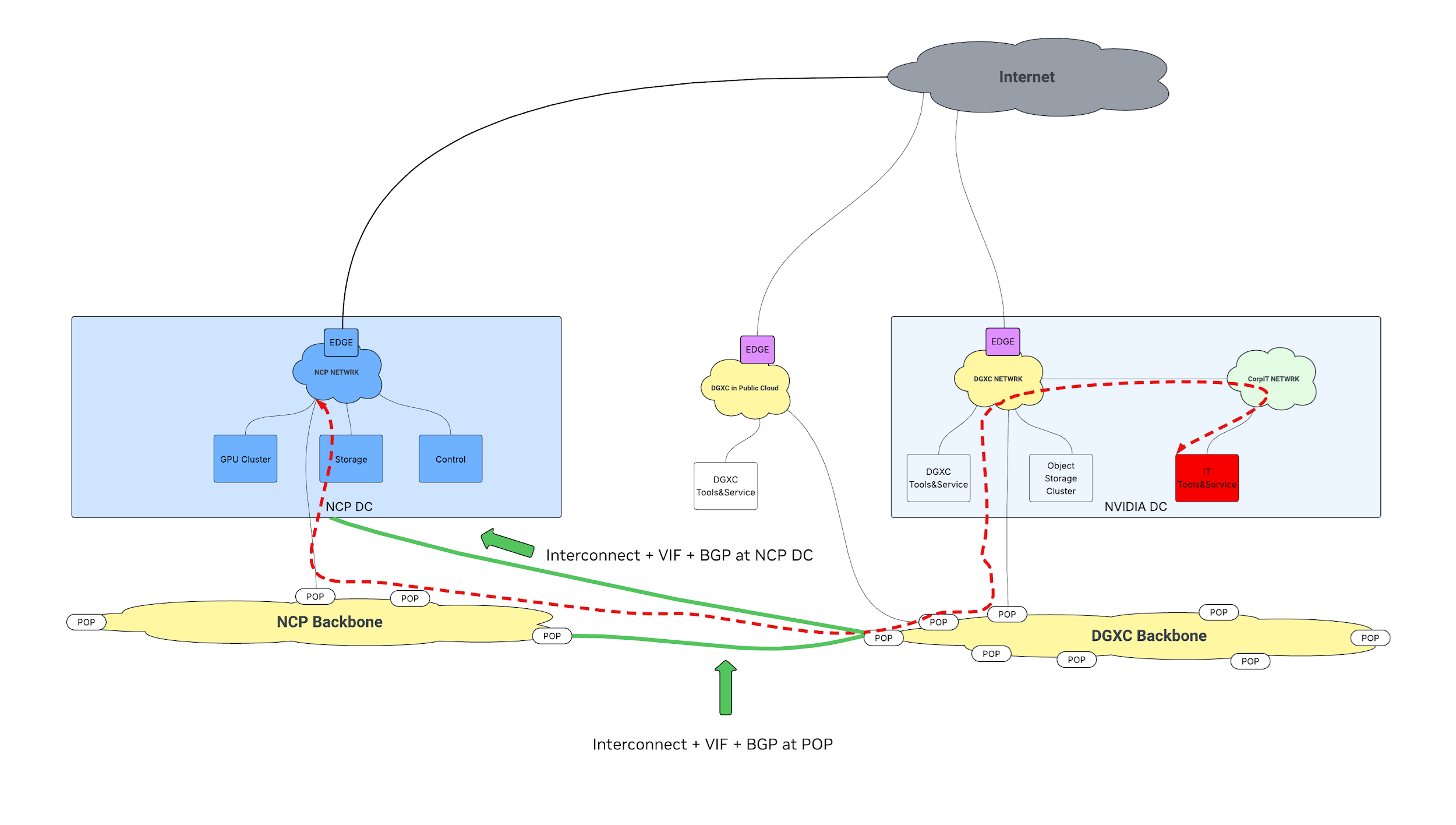
Req IDTest Details (Legend)Requirement AreaDescription
NET04INFOConnection to NVIDIA CorpIT NetworkBandwidth: Low bandwidth (Up to 10Gbps). Transport: Private Cloud interconnect + VIF + BGP (preferred for better performance/security). DGXC will establish connectivity to NCP through a mutually agreed Point of Presence (POP) using Private Cloud Interconnect, functionally equivalent to AWS Direct Connect, GCP Dedicated Interconnect, Azure ExpressRoute, and OCI FastConnect. Connectivity will be provisioned with a Virtual Interface (VIF) and routing established via BGP. The interconnect will be used to exchange private IP space (RFC1918, as well as 7.0.0.0/8) between DGXC and NCP.

Corporate network connectivity diagram

Figure: Private Cloud interconnect + VIF + BGP for CorpIT access

Connection to DGXC Storage

Purpose:
Enable high-bandwidth, end to end MACsec-encrypted (fail-closed) access between the DGXC GPU clusters within NCP and NVIDIA DGXC on-premises object storage for large-scale data movement.
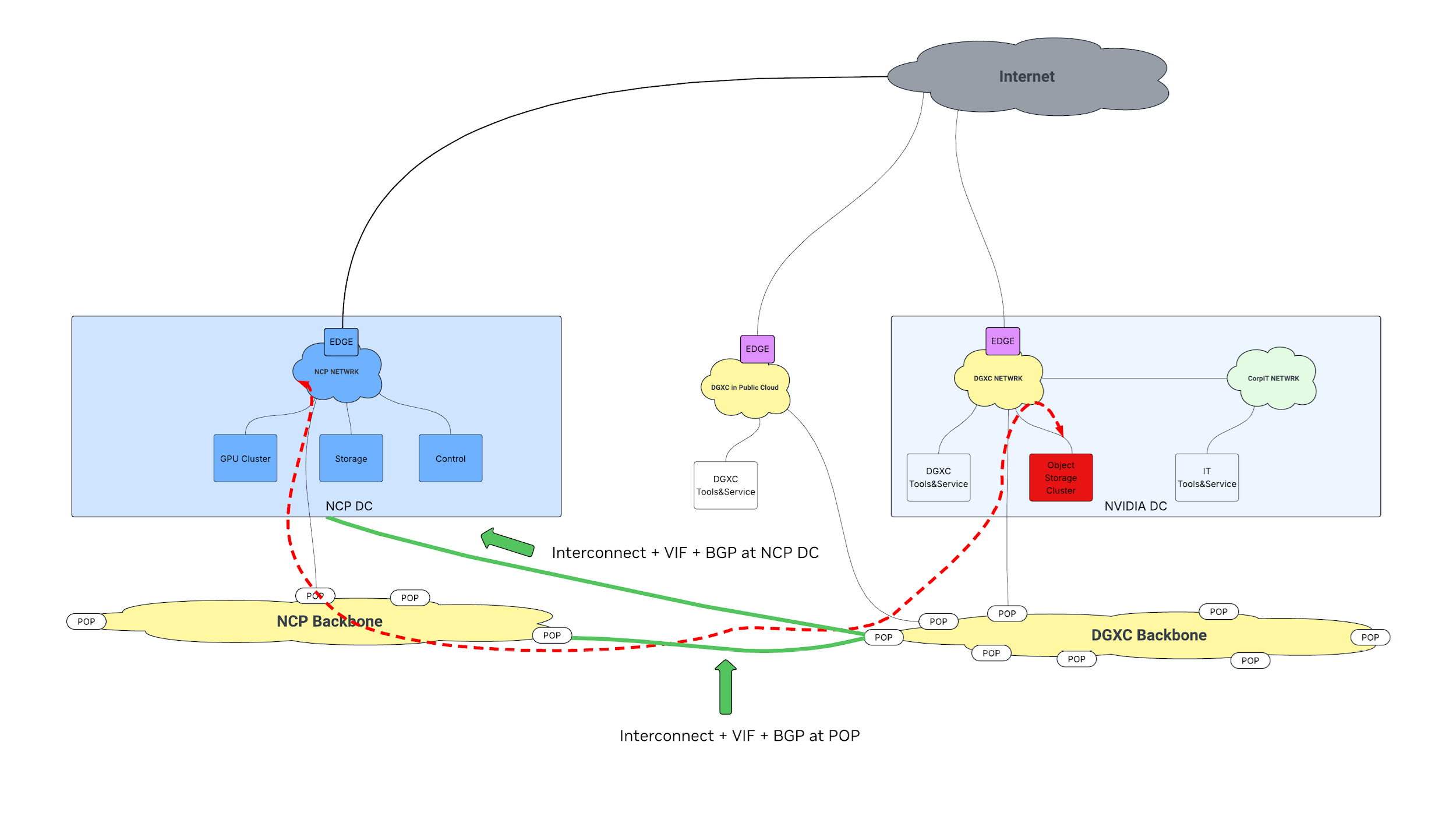
Req IDTest Details (Legend)Requirement AreaDescription
NET05INFOConnection to DGXC StorageTransport: Private Cloud interconnect + VIF + BGP (preferred for better performance/security). DGXC will establish connectivity to NCP through a mutually agreed Point of Presence (POP) using Private Cloud Interconnect, functionally equivalent to AWS Direct Connect, GCP Dedicated Interconnect, Azure ExpressRoute, and OCI FastConnect. Connectivity will be provisioned with a Virtual Interface (VIF) and routing established via BGP. The interconnect will be used to exchange private IP space (RFC1918, as well as 7.0.0.0/8) between DGXC and NCP.

Storage connectivity diagram

Cluster Local Internet Access

Purpose:
Provide general Internet access from DGXC GPU clusters within NCP to Internet, including NVIDIA DGXC hosted services on third-party public cloud services.
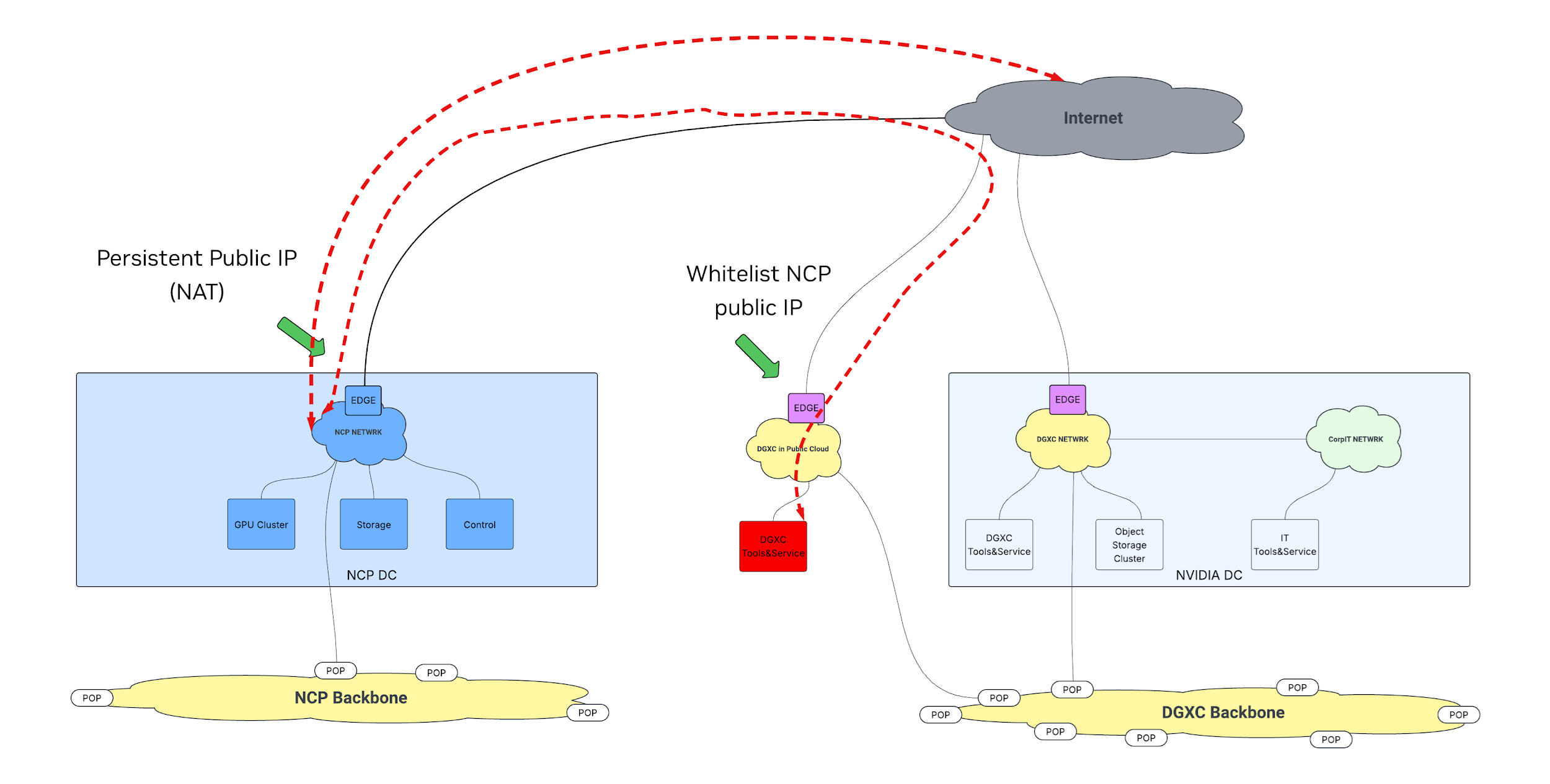
Req IDTest Details (Legend)Requirement AreaDescription
NET06INFOCluster Local Internet AccessCluster Internet access: Egress NAT IPs should be a static pool dedicated to only Nvidia Cluster/Tenancy/VPC. These persistent IP addresses must be used exclusively for DGXC traffic and shall not be shared with or carry traffic from other NCP tenants. Availability: Must support redundant upstream paths to ensure connectivity under failure.

Internet access diagram
Figure: Public internet for DGXC hosted Services access

Capacity and Fleet Management

This section defines the essential metrics required for standardized monitoring and reporting of fleet health in partner engagements to support operations and contractual SLAs.

Req IDTest Details (Legend)Requirement AreaDescription
CAP01INFOGovernance metricsRequired Governance Metrics The core metrics needed to track fleet health are: Delivered: Nodes/GPUs provisioned and available to NVIDIA, allocated to a specific account/project/tenant. Healthy: Nodes/GPUs functioning and meeting SLA requirements, allocated to a specific account/project/tenant. Reserved: Resources allocated to a specific account/project/tenant. Total Active/In-Use: Nodes/GPUs currently in use within a specific account/project/tenant.
CAP02addResource Governance API MetricsThe Resource Governance API must return the following information for each node: Node ID (Unique identifier for a GPU node) Health State (Healthy/Unhealthy classification) Instance ID (Identifier for virtual workload) Creation Timestamp (Time workload/node was created) Hardware Type (Descriptor for the hardware model) GPU Count (Number of GPUs per node) Top-levelAccount/ID (Identifier for the top-level organization/account) Sub-LevelProject/ID (Identifier for the nested project/sub-account) In Use (True/False status indicating if the GPU Node is turned on and in use) Region (Region of the data center where nodes are deployed)
CAP03addResource Discovery APIsIt is not acceptable to have capacity be “handed” to DGXC through a phone, slack or email message. For example, when cluster first comes online, nodes/racks are likely being handed off weekly (or more frequently). Instead, please provide the following mechanism (and we can poll): Programmatic Capacity Discovery: All newly delivered capacity must be discoverable via a centralized API. This “Resource Index” must provide a resource stable identifier and some information on why it’s being provided (e.g. capacity fulfillment on gb300 project, break-fix / RMA return to cluster, etc)
CAP04INFOLogical Compartmentalization & Resource IsolationTo ensure performance consistency and security, the NCP must support strict logical and physical isolation of NVIDIA’s reserved capacity. Capacity Reservations: A mechanism to logically group and “pin” a set of resources (compute, network, storage) to accounts (or equivalent constructs) in an NVIDIA tenancy Atomic Allocation: Support for reserving a “topology block” as a single unit, ensuring all resources in that block share identical performance characteristics and security boundaries.
CAP05INFOUnified Health & Lifecycle APIsNVIDIA requires a “single source of truth” for the health of both physical hosts and logical compute primitives. Per-Host Health: Real-time API access to the health bits of physical hardware (GPU state, thermal status, memory health). Primitive-Level Status: Health aggregation at the cluster, nodegroup, or reservation level to identify broad infrastructure failures (e.g., a spine switch failure affecting a whole block).

Appendix

This section contains links to reference documents and implementation guides to provide additional details if NCPs need them.

Test Legend

As a part of the AI Cloud-Ready Initiative, a validation suite is provided on GitHub, containing a set of tests that can be run to evaluate an environment against the provided requirements and specifications.

The Test Details column in the following sections contains four options:

### - Github Test reference
TBD - item on the github roadmap
add - item to be added into the roadmap
INFO - a requirement which is either not testable or currently won’t be tested from the test repo.

Implementation Guidance

Reference documents provide additional information on implementing some of the above requirements.

  1. Network Topology Discovery: https://github.com/NVIDIA/topograph\
  2. Exemplar Cloud Website: https://www.nvidia.com/en-us/data-center/ai-cloud-performance/\
  3. Kubernetes Security guidance : https://github.com/kubernetes/committee-security-response

Other Feature Considerations (Not Required)

  1. Disk Cloning: Disk cloning capability (for network-attached block devices). It should be possible to clone a disk even on a running instance.