SGLang Sidecar
Experimental. The sidecars and their deployment examples are experimental. Manifests, flags, and behavior may change without notice.
dynamo-sglang-sidecar connects a Dynamo worker to SGLang’s native gRPC
server. See Sidecar Backends
for the architecture.
For the best and latest support, use the upstream SGLang nightly image,
which carries the latest gRPC server updates: lmsysorg/sglang:dev.
Support Matrix
Launch Locally
See lib/sidecar/sglang/launch/
for all topologies. For example, aggregated serving on one GPU:
In a second terminal:
Deploy on Kubernetes
See lib/sidecar/sglang/deploy/
for all manifests. For example, aggregated serving:
Before applying, replace <your-registry>/dynamo-sidecar in the manifest with a
sidecar image and create the hf-token-secret
Secret that the manifest reads.
Multinode deployments require backendFramework: sglang and complete leader and
worker role PodTemplates. The templates own the native engine commands and
sidecar placement. See the TP example and
attention-DP example. Attention-DP requires SGLang 0.5.22 or later and a Dynamo sidecar
with matching attention-DP metadata support. Engine-failure KV recovery remains
incomplete and is tracked in DEP #14897.
Migrate an existing DGD to multinode sidecars
The multinode examples use DYNAMO_RANK and DYNAMO_LEADER_ADDRESS. The operator
injects these variables only into DGDs originally created by operator 1.6.0 or
later. Upgrading the operator or switching to sidecar mode does not enable them
for older DGDs.
For a DGD created before operator 1.6.0, choose one of these options:
- Delete and recreate the DGD after upgrading the operator, then use the examples with their existing topology arguments.
- Keep the DGD and replace the
--node-rankand--dist-init-addrarguments in themaincontainer of both the leader and worker role templates with the provider-specific arguments below.
For Grove, use these arguments. The group-wide pod index requires Grove
v0.1.0-alpha.15 or later and matching CRDs.
Here, sglangworker is the example component name, SGLangWorker, in lowercase.
Replace it with your component name in lowercase if you rename the component.
For LeaderWorkerSet, use these arguments:
Kubernetes expands these variable references in container arguments. No shell wrapper is needed.
Topologies
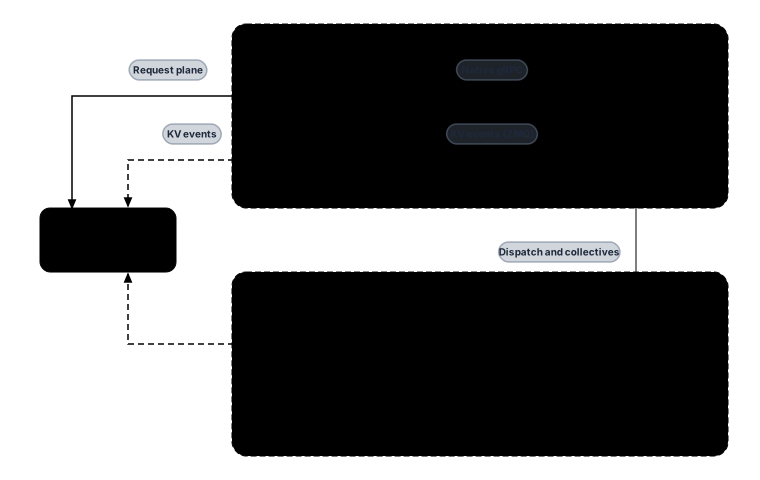
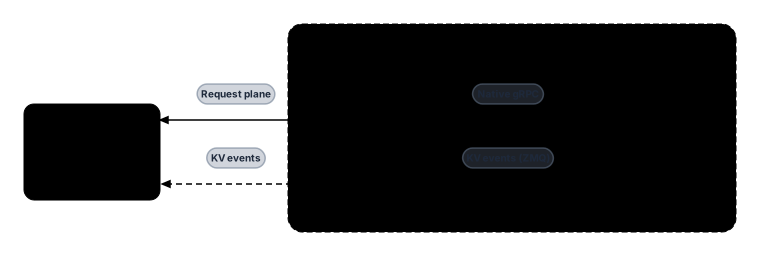
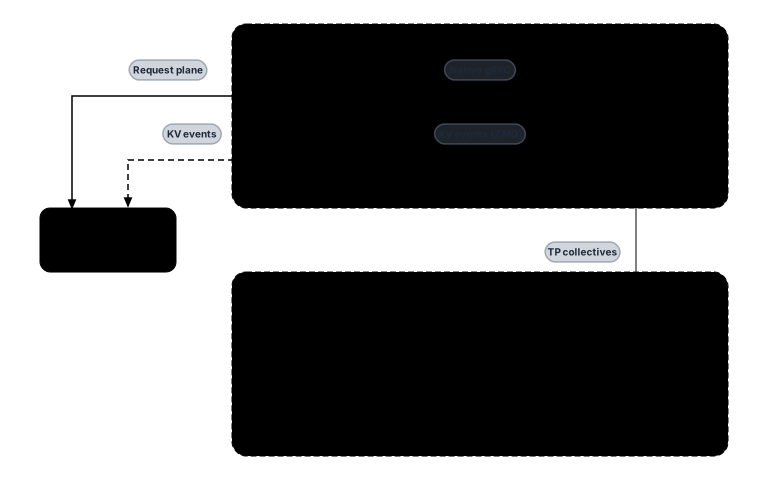
The frontend reaches each sidecar over Dynamo’s request, discovery, and event planes; the sidecar reaches the engine over its native gRPC API. Dashed arrows carry KV events.
Single-Node TP
One engine on one node, with one sidecar.
Multi-Node TP
One engine spans two nodes. Only the leader node has a sidecar; the follower node holds the remaining TP ranks.
Multi-Node DP
The leader sidecar registers every DP rank and serves all requests; SGLang dispatches each one to the right scheduler. The follower sidecar accepts no requests and relays its node’s KV events directly to the frontend.