

Microsoft Azure Reference Implementation#
The cloud reference implementation uses Microsoft Azure as the managed workspace substrate for Secure Agent Workspace. Each user receives a single-user Azure Linux VM, provisioned on demand in a dedicated untrusted virtual network and accessed through enterprise SSO and a trusted access broker. The local endpoint remains a presentation surface; agent execution and enterprise-tool access occur inside the VM boundary, which is ephemeral — one user per VM, demolished after use.
This implementation is intended for enterprises that need a cloud-native deployment of agent workspaces on Microsoft Azure that keeps a simple containment posture — the VM is the sandbox — realized with Azure-native primitives (Azure Virtual Network, Azure Firewall Premium, NAT Gateway V2, Workload Identity Federation, Microsoft Entra ID, Azure Key Vault, Azure Compute Gallery).
The Phase I and Phase II subsections below project the same maturity progression onto Microsoft Azure. The baseline control surface is taken as given; each subsection names only the Azure-specific primitives — Azure resource types, identity flows, network controls — that realize each control on this substrate. Phase II (in-VM runtime-enforced agent policy) adds in-runtime enforcement at the tool-call boundary on the same Azure-native footprint; v1 ships Phase I — the VM boundary plus an egress allow-list carry the load — and Phase II follows.
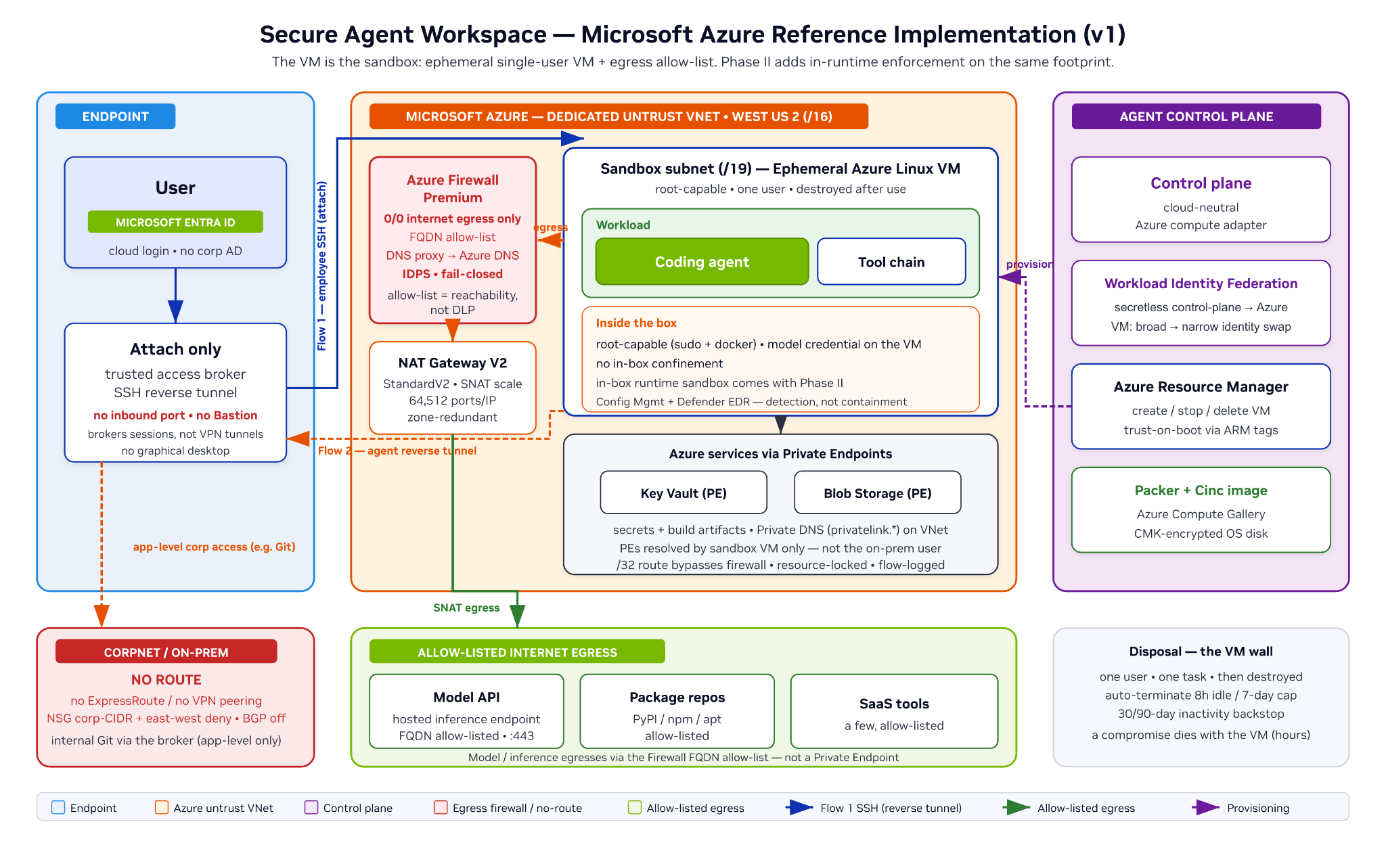
Figure 11 Secure Agent Workspace — Microsoft Azure Reference Implementation (v1). The VM is the sandbox: ephemeral single-user VM + egress allow-list. Phase II adds in-runtime enforcement on the same footprint.#
The Azure v1 topology. An ephemeral single-user Azure Linux VM in a dedicated untrust VNet reaches only an Azure Firewall Premium egress allow-list (fail-closed, via NAT Gateway V2) and Azure services over Private Endpoints; the user attaches over a trusted-access-broker SSH reverse tunnel with no inbound path; the control plane provisions secretlessly via Workload Identity Federation with trust-on-boot ARM tags; and there is no route to corp (BGP propagation disabled). The VM is the sandbox in v1 — Phase II adds in-VM runtime enforcement (runtime sandbox, credential proxy, routed inference, signed policy) on the same Azure-native footprint.
Reference Shape#
The baseline v1 deployment consists of:
Azure Virtual Machines running Azure Linux, one per user, ephemeral and disposable. Each VM is a single-user workspace, thrown away after use — “the VM is the sandbox.” The agent runs root-capable inside its own VM (sudo + docker, no in-box confinement); the VM boundary plus the egress allow-list are the load-bearing controls.
Cloud-neutral control plane with an Azure compute adapter behind a cloud-neutral interface, added without disturbing existing cloud paths (strangler refactor). ARM VM lifecycle is restart-safe — long-running-operation polling resumes after a worker restart, so no duplicate or orphaned VMs.
Dedicated untrust VNet (separate subscription preferred), region West US 2 for v1, holding a /19 sandbox subnet (~8,187 usable addresses) and a /26 AzureFirewallSubnet, wrapped in a /16 reservation as growth runway. Hub/spoke is permitted only against an untrust hub, never the trusted corporate hub.
Trusted access broker providing the inbound SSH path into the workspace and the outbound reverse tunnel for app-level corp access — the broker agent dials out (reverse tunnel), so there is no inbound door; the same tunnel is how the agent reaches the internal source-control service. No public IP, no inbound path, no Azure Bastion, no graphical desktop (headless / SSH-only).
Network boundary controls using Azure-native primitives: a route table (UDR) directing 0.0.0.0/0 through the firewall’s private IP with gateway/BGP route propagation disabled (the single highest-impact control — corp prefixes learned over ExpressRoute would otherwise win on longest-prefix-match and bypass the firewall); NSG deny on corp CIDRs, east-west and direct :53, no public/corp inbound, as defense-in-depth; Azure Firewall Premium (L7 FQDN/app rules with SNI, L3/4 network rules, DNS proxy, IDPS in alert/detect mode, with TLS inspection as a Phase II toggle); and NAT Gateway V2 (StandardV2), zone-redundant on the firewall subnet, for SNAT capacity at fleet scale.
Agent runtime inside the VM, running root-capable on Azure Linux. No in-box agent confinement in v1; Phase II adds a kernel-level in-box runtime sandbox (OpenShell), on the same footprint.
Image catalog built with Packer (azure-arm) + Cinc from shared configuration-management cookbooks, published to Azure Compute Gallery, headless, with OS disks encrypted under a customer-managed encryption key and the golden image rebuilt on a schedule and for critical CVEs.
Logging of Azure Firewall allow/deny events plus NSG / VNet flow logs (the latter keeping Private-Endpoint and east-west traffic observable even where it bypasses the firewall logs by design), emitted to Azure Monitor / Log Analytics, Microsoft Sentinel, or the enterprise SIEM.
Identity and Provisioning Model#
Azure identity has two distinct trust planes — control-plane→Azure for provisioning, and VM→Azure at runtime:
Control-plane→Azure: Workload Identity Federation (secretless). The control plane proves its identity to Azure ARM via a federated token exchange — no stored credential ever sits on a control-plane host.
VM→Azure: two shared, fixed-scope managed identities with a broad→narrow swap. Each VM gets a broad bootstrap identity used only during setup, swapped to a narrow runtime identity before any agent code runs (an instance-profile-style broad→narrow swap). Two shared identities per role, not per-VM — a per-VM identity would exhaust Azure’s ~4,000 role-assignments-per-subscription cap well before the fleet reaches target scale.
Trust-on-boot via ARM tags. The control plane never calls into the private VM; readiness and identity signals return as ARM tags on the VM resource. Inbound access into the VM is broker-mediated SSH only.
Login via Microsoft Entra ID — cloud-native, with no corporate-AD dependency. Corporate AD / SSSD is the regular-desktop path, not the sandbox’s.
GA fleet planning — multi-subscription sharding. Fixed per-subscription Azure caps (~980 resource groups, 4,000 role-assignments, ~2,500–5,000 VMs per subscription per region) mean the full fleet spans multiple subscriptions, each with its own untrust VNet under one non-overlapping /16 IPAM reservation, each egressing through the firewall. The reservation and peering model are designed for sharding from day one.
Phase I: Deployable Managed VM Controls#
Phase I is the v1 Azure deployment — deployable today with standard Azure primitives and standard enterprise operations practices.
Controls include:
One ephemeral Azure VM per user (auto-terminate at 8 hours idle for interactive, 7-day cap for auto-runs, with a 30/90-day inactivity backstop).
Approved golden images only — built with Packer + Cinc, published to Azure Compute Gallery, OS disk encrypted with a customer-managed encryption key.
Workspace lifecycle through the cloud-neutral control plane (Azure compute adapter), trust-on-boot via ARM tags.
Microsoft Entra ID login with broker-mediated SSH; no public IP, no inbound path, no Azure Bastion.
Default-deny network egress through Azure Firewall Premium against the egress allow-list (owned day-to-day by the platform team), fail-closed (if the firewall is down the sandbox cannot reach the model — safer than failing open).
Dedicated untrust VNet with gateway/BGP route propagation disabled and NSG corp-CIDR / east-west deny, so there is no route to the corporate network.
NAT Gateway V2 (StandardV2) for SNAT at fleet scale; Azure Key Vault and Blob Storage reached over Private Endpoints locked to the sandbox.
Azure Firewall allow/deny logs and NSG / VNet flow logs to Azure Monitor / Log Analytics, Microsoft Sentinel, or the enterprise SIEM.
In this phase, containment lives in the two walls the design names: the VM (one user, one task, then destroyed) and the door (a single fail-closed firewall with a short, reviewed allow-list, no inbound path, and no route to corp). The Azure egress allow-list is a reachability control, not data-loss prevention — data could still leave through an already-allowed service such as a code-hosting or package-registry service.
Phase II: Runtime-Enforced Agent Policy on Azure#
Phase II adds an in-VM runtime enforcement layer beneath the VM boundary, so containment no longer rests on the VM wall and the egress allow-list alone. v1 establishes Phase I — the VM is the sandbox: the agent runs root-capable inside the VM (sudo + docker), with the VM boundary plus the egress allow-list as the containment. Phase II then adds, on the same Azure-native footprint, an in-runtime policy layer (NVIDIA OpenShell or equivalent) that enforces a signed policy bundle at the tool-call boundary:
In-box agent confinement / runtime sandbox. A kernel-level sandbox inside the VM confines all agent operations — shell, hooks, MCP servers, skills — with filesystem and process scope restricted to the workspace, so the agent no longer runs unconfined as root-in-VM.
Credential / egress proxy. A layer separate from the agent injects per-service authorization at egress and keeps raw secrets out of the agent process — the agent holds only short-lived, scoped capabilities. Deny-by-default egress is enforced in-runtime, not only at the network boundary. In v1 the user’s own model access lives on the short-lived VM; Phase II moves it behind the proxy.
Routed inference. Model calls are brokered to approved endpoints under the same capability rule, so credentials never reach the agent.
TLS inspection of model traffic. An optional toggle on Azure Firewall Premium that brings deep packet inspection inline.
Signed policy and controlled release. Policy is authored centrally, signed, distributed to the workspace, verified on load, and enforced per tool call; the agent cannot widen its own scope or policy.
Phase II is additive — it does not replace Phase I. It brings the agent’s runtime behavior under enforcement at the actual tool-call boundary, below the prompt layer, rather than relying on the VM wall and egress allow-list alone.
Storage and Key Management Notes#
Azure storage and secret handling for the sandbox follow a few load-bearing rules:
Bootstrap secrets in Azure Key Vault, build artifacts in Azure Blob Storage, both reached over Private Endpoints + Private DNS so traffic stays on Azure’s private backbone.
Lock every Private-Endpoint resource to the sandbox (resource-level firewall allowing only the Private Endpoint) so the private path cannot be repurposed for exfiltration.
A Private Endpoint injects a /32 route more specific than the 0.0.0.0/0 → firewall UDR, so its traffic bypasses (and is not logged by) the firewall by design — account for it with resource-level locks, correct Private DNS zones, and NSG / VNet flow logs so the traffic stays observable.
Customer-managed encryption keys for OS disks.
DNS through the firewall DNS proxy; all :53 forced through the proxy (NSG-deny direct outbound 53). Corp names clean-fail rather than silently hang; no blanket corporate DNS forwarder in v1.
Allow the Azure platform IP 168.63.129.16 for platform health / DNS / IMDS, but verify at go-live that it does not become a direct :53 bypass.
Operating Invariants#
The Azure implementation should preserve these invariants:
The endpoint attaches over broker-mediated SSH; it does not execute autonomous work.
The Azure VM is the user’s single-user, ephemeral workspace and the primary isolation boundary — one VM per user, deleted when the task is done.
The control plane never calls into the private VM; readiness and identity signals return as ARM tags (trust-on-boot). The agent cannot grant itself broader Azure permissions because the runtime managed identity carries deliberately minimal, fixed scope, locked down before any agent code runs.
Bootstrap secrets live in Azure Key Vault, reached over a Private Endpoint. In v1 the user’s own model login does sit on the VM (bounded to that one user’s own model access on a short-lived VM); a Phase II credential / egress proxy would remove it from the box.
Workspace state is disposable; the agent’s app-level corp access is over the broker’s reverse tunnel — there is no corp-routable network from the VM.
The egress firewall is fail-closed: if it is down, sandboxes cannot reach the model — a deliberate availability choice in favor of containment.
Containment resets by disposal: each VM is one user, one task, then destroyed (auto-terminate at 8h idle / 7-day cap), so a compromise dies with the VM, usually within hours.
Why This Matters#
Microsoft Azure gives enterprises a cloud-native path to host single-user agent workspaces on infrastructure they already operate, with a simple containment posture — the VM is the sandbox, egress is allow-listed, the control plane is secretless, and there is no inbound path or route to corp. The v1 deployment realizes that posture with Azure-native primitives; Phase II then adds in-runtime enforcement at the tool-call boundary (in-box containment / OpenShell, a credential / egress proxy, routed inference, signed policy, TLS inspection), on the same Azure-native footprint.
The result is a practical Azure-native Secure Agent Workspace pattern: ephemeral single-user VMs for isolation, Azure Firewall Premium and NAT Gateway V2 for egress, Workload Identity Federation for secretless provisioning, Microsoft Entra ID and a trusted access broker for access, and Azure Compute Gallery for image governance — with Phase II adding in-runtime enforcement at the tool-call boundary (in-box containment, a credential / egress proxy, routed inference, signed policy, TLS inspection) on the same footprint.