
2. Technical Specifications and Protocols#
2.1. Transport Layer: Dynamic Connection (DC)#
The current implementation of cuObject requires Dynamic Connection (DC) transport. Unlike Reliable Connections (RC), DC transport does not require pre establishing connections between every client and server pair.
- Scalability
Clients do not need knowledge of the storage server topology or object distribution.
- Resource Efficiency
Connections are established only when required for data transport, preserving NIC resources.
- Protocol Support
DC works over InfiniBand and RoCEv2.
2.2. RDMA enabled GET and PUT workflow#
To negotiate the RDMA transfer within a standard S3 HTTP request, cuObject uses custom header tags.
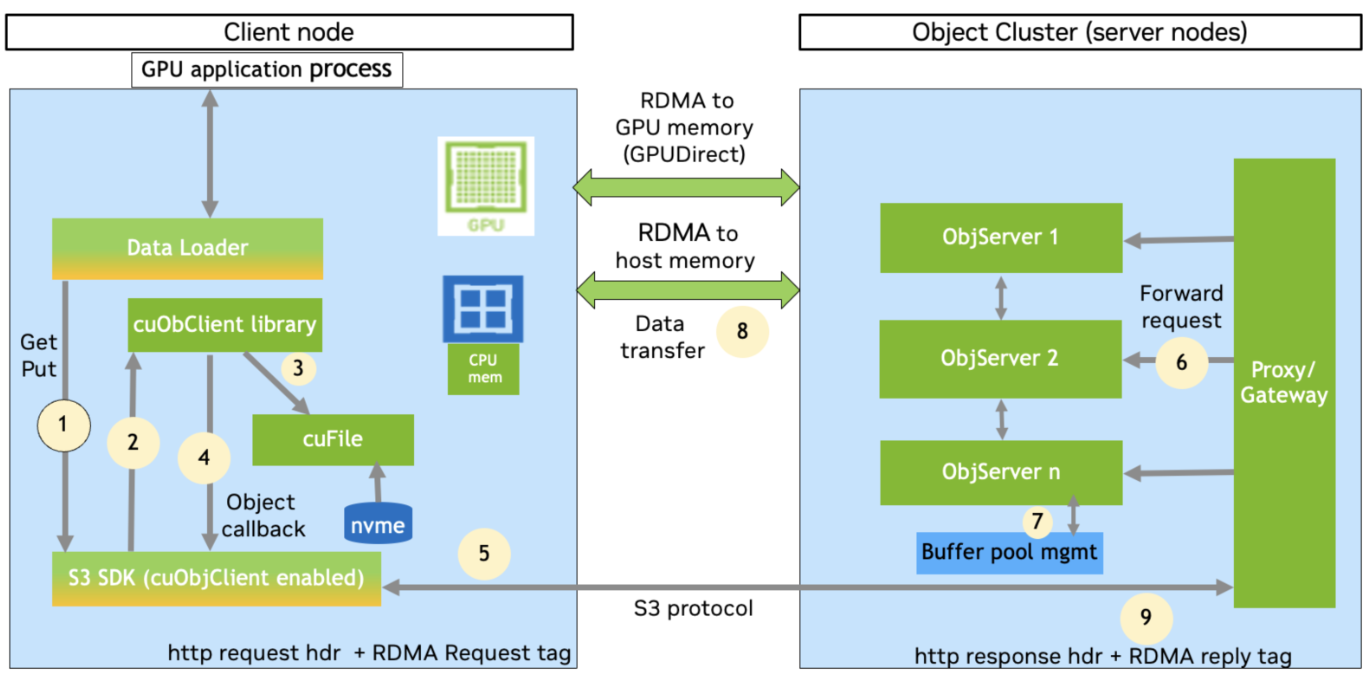
Figure 2.1 The x-amz-rdma-token protocol in cuObject#
- Request tag
The client sends
x-amz-rdma-tokencontaining RDMA metadata (for example,00007f7c...) to the proxy or gateway.- Reply tag
If the transfer is successfully offloaded to RDMA, the proxy responds with
x-amz-rdma-reply.
2.3. Data Flow Sequence (GET and PUT operation)#
Client: GPU application or data loader library issues an HTTP GET or PUT through an S3 SDK.
The S3 SDK checks for RDMA support, registers the memory, and initiates the GET or PUT request.
The cuObject client library checks request validity, selects an optimal NIC, and performs memory registration.
The cuObject client library performs a callback with the RDMA tag and context.
The S3 SDK resumes the operation and sends the RDMA tag (for example,
x-amz-rdma-token) to the storage gateway or endpoint.Gateway: parses the tag and, if enabled, instructs specific data nodes to transfer data using RDMA.
Data nodes allocate a local buffer and register it for RDMA using cuObject server APIs.
The cuObject server APIs synchronously or asynchronously perform IO using the local buffer and remote RDMA tag. The library establishes a DC connection with the client and pushes or pulls the data via RDMA (
RDMA_WRITEorRDMA_READ) directly to or from the client GPU or system memory.Gateway returns HTTP status
200 OKonce the RDMA transfer is complete. An RDMA reply tag (for example,x-amz-rdma-reply) is sent to inform the RDMA status.