

Collective GEMMs in Tensor Sequence Parallelism
TL;DR — Tensor-sequence parallelism leaves an all-gather and a reduce-scatter exposed at every layer boundary, so GPUs idle while they wait on communication. Collective GEMMs fuse each collective with the GEMM next to it and chunk both along the sequence dimension, letting the multiply work on the tokens that have already arrived. In MaxText this is two configuration flags, and it raises training throughput by 61% on Llama3-70B and 49% on Llama3-405B over an FSDP + TP baseline.
Introduction
Training large language models at scale requires distributing work across many GPUs. But distribution comes at a cost: GPUs must constantly communicate to stay synchronized, and every moment spent waiting on communication is a moment not spent on compute. Tensor-sequence parallelism is one of the leading strategies for scaling dense models across large GPU clusters, but its reliance on exposed collective operations limits GPU utilization.
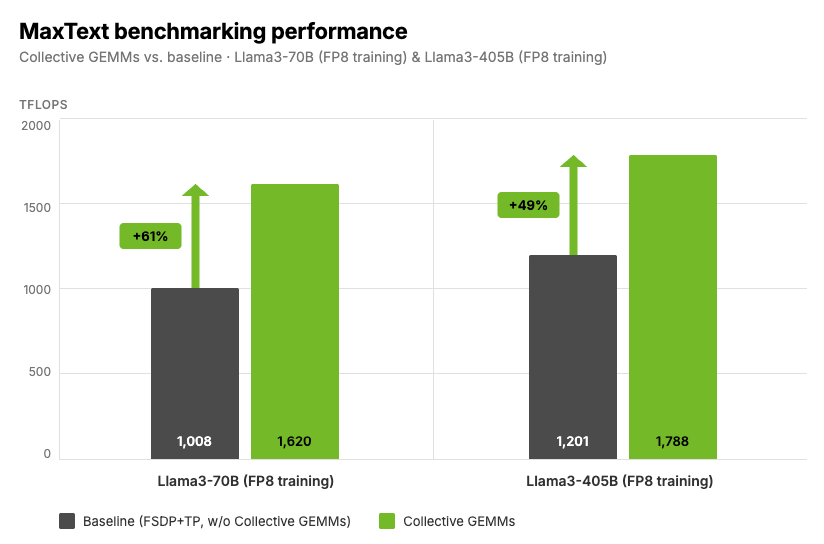
Collective GEMMs address this directly by overlapping communication and compute. Collective GEMMs on MaxText deliver 1008 → 1620 TFLOPS on Llama3-70B and 1201 → 1788 TFLOPS on Llama3-405B, a 61% and 49% speedup over an FSDP + TP baseline, respectively. In this blog, we talk about the technical details of collective GEMM operations in MaxText and how you can easily enable this on your models.
What is tensor-sequence parallelism (TPSP)?
Background: distributed training
A distributed training step divides into compute and communication.
Compute is dominated by GEMMs (Y = XW), where W holds learned weights and X, Y are activations. The forward pass moves through these GEMMs to compute attention and MLP outputs; the backward pass runs them again to produce gradients.
Communication is the cost of splitting that work. No single GPU can hold all the model state and activations at scale, so they are sharded across multiple GPUs. Optimizing that movement is what determines training efficiency.
Tensor parallelism
Tensor parallelism splits the weight matrices (W) of each linear layer across GPUs. Within a transformer layer, this applies inside the attention block and the MLP block — the dotted green regions in Figure 1. Each region pairs a column-wise split with a row-wise one: W_qkv and the MLP up-projection are split along their output dimension (column-wise split), W_o and W_down along their input dimension (row-wise split). The row-wise split leaves each GPU holding only a partial sum of the output Y, so it must be exchanged across the tensor-parallel group before the next GEMM can run. This introduces two communication operations, f and f̄, at the boundary of every attention and MLP block [1].

Figure 1. Tensor parallelism in a transformer layer. Regions in the attention block and the MLP block are each sharded across the tensor-parallel group: weights are split across GPUs, and so are the activations produced inside the block. Two collectives connect the regions: f is a no-op in the forward pass and an all-reduce in the backward pass, f̄ the reverse. Diagram adapted from Korthikanti et al. [1].
Sequence parallelism
Tensor parallelism only covers operations that have a weight matrix to shard. LayerNorm, dropout, and residual additions do not, so under tensor parallelism alone they run redundantly on a full replicated copy of the activations [1]. Sequence parallelism shards those regions along the sequence dimension instead, so each GPU works on a local slice of tokens. The same tensor-parallel group is resharded on a different axis at each boundary, so the all-reduce at the block output becomes a reduce-scatter, paired with an all-gather before the next GEMM.
Tensor parallelism and sequence parallelism combined
Tensor-sequence parallelism is tensor parallelism and sequence parallelism combined on the same group of GPUs. In tensor-sequence parallelism, these two strategies alternate through each transformer layer, connected by reduce-scatter and all-gather collectives that transition activations between the two sharding regimes. The result is that both weight memory and activation memory scale with the number of GPUs, enabling strong-scaling of dense models to large GPU counts without the memory walls that limit data parallelism alone.

Figure 2. Tensor-sequence parallelism in the same transformer layer. The regions alternate. Inside the tensor-parallel regions, the weight matrices are split across the group and the activations they produce are split on the hidden dimension. Inside the sequence-parallel regions sit LayerNorm, dropout, and the residual additions, which have no weight matrix to shard; because each operates on one token at a time, the activations are split along the sequence dimension instead. The same GPUs serve both regimes, and g and ḡ convert between them: g is an all-gather in the forward pass and a reduce-scatter in the backward, ḡ the reverse. Diagram adapted from Korthikanti et al. [1].
The problem with TPSP: exposed collectives reduce GPU utilization
The fundamental challenge with TPSP is that the reduce-scatter and all-gather collectives sitting at each layer boundary (g and ḡ in Figure 2) are exposed — meaning compute must wait for communication to finish before it can proceed. Before a GEMM can begin, the all-gather must complete so that every GPU has the full activation tensor. After the GEMM, the reduce-scatter must complete before the next layer’s sequence-parallel operations can start. On large clusters with many GPUs, these collectives become increasingly expensive as more devices participate in the synchronization.
The result is that GPUs sit idle during communication, directly reducing utilization and throughput. If the GEMM could begin processing the portions of the activation that have already arrived, rather than waiting for the full tensor, we can make communication more efficient. This is the core idea behind collective GEMMs.
Collective GEMMs (CGEMM)

Figure 3. Collective GEMM operations: all-gather g + GEMM, and GEMM + reduce-scatter ḡ. Chunking gives the all-gather end a head start with no tail, so it hides fully; the reduce-scatter end has neither, so a head and a tail remain exposed.
Ordinarily, the collective and the GEMM are separate operations that run one after the other: the all-gather g finishes moving the whole tensor, then the GEMM starts multiplying. A collective GEMM fuses them into one operation and cuts both into chunks — slices of the tensor along the sequence dimension, a subset of the tokens each — so the multiply can work on the chunks that have already arrived while the rest are still in flight.
All-gather g + GEMM, at the start of a region. The all-gather sits before the GEMM, so ordinarily the GEMM would wait for it. But each GPU already holds its own token chunk, so it can start multiplying that chunk the moment the all-gather is issued, while the other t−1 chunks are still in flight. As each remote chunk lands, the GEMM runs on it. The gathered dimension is tokens, so every chunk produces a distinct set of output rows and results are written straight into their place in the output, with no accumulation needed.
GEMM + reduce-scatter ḡ, at the end of a region. The reduce-scatter sits after the GEMM, so there is nothing to send until some compute is done. The row-wise GEMM produces a partial sum covering every token range, so it can be computed one range at a time. As soon as the rows for the first range are finished, those rows can be summed across the group and delivered to the GPU that owns them, while the rows for the next range are still being computed.
Choosing the chunk count
CGEMM requires splitting the work into chunks — slices of the tensor. More chunks mean finer-grained overlap and less exposed tail. However, a GEMM chunk that is too small cannot fill the tensor cores, so there is not enough work to hide memory latency, and the kernel spends its time on launch and setup rather than math. A transfer that is too small runs into the same problem on the network: fixed per-message overhead stops being amortized, so effective bandwidth drops. Past some point those two losses exceed what the overlap saves. The target is a boundary that costs roughly max(compute, communication) instead of their sum.
MaxText + TransformerEngine: collective GEMM integration
MaxText is an open-source LLM framework written entirely in Python and JAX, designed for training, fine-tuning, and scaling large models on both GPUs and TPUs.
MaxText integrates collective GEMMs through its TransformerEngine quantization path. Rather than scheduling the all-gather and GEMM as sequential operations, the collective GEMM implementation tiles both the collective and the matrix multiply along the same dimension, allowing each tile’s communication and compute to overlap. This is implemented inside MaxText’s quantization layer and is exposed to users through a single configuration flag.
Enabling collective GEMMs in MaxText
Two flags control the behavior:
Supported quantization recipes are:
How it works under the hood
MaxText’s quantizations.py inspects the mesh axes of each GEMM call at runtime to determine which collective op to use. The logic is straightforward — the sharding axis names tell it whether an all-gather or reduce-scatter is needed:
This means the overlap policy applies symmetrically to the all-gather before the GEMM and the reduce-scatter after it. With MLP_ONLY, only the two MLP GEMMs per layer are overlapped. With FULL, all four GEMMs per transformer layer — QKV projection, output projection, and both MLP linears — are overlapped.
The collective op set is then passed directly into TransformerEngine’s dense call:
The full TransformerEngine JAX examples, including multi-process launch scripts and tests across BF16, FP8, and MXFP8, are available at examples/jax/collective_gemm/.
Results
The baseline here is FSDP combined with tensor parallelism, with collective GEMM overlap disabled — not an FSDP-only configuration. This distinction matters when comparing against previously published numbers: adding tensor parallelism is precisely what introduces the exposed collectives described above, so it costs throughput before any of it is recovered by overlap. Figures measured on FSDP-only configurations are therefore not directly comparable to either column.
Conclusion
Collective GEMMs in MaxText, powered by TransformerEngine, make communication-compute overlap accessible via two configuration flags. This eliminates the exposed collectives that limit GPU utilization in tensor-sequence parallel training. Collective GEMMs on MaxText deliver 1008 → 1620 TFLOPS on Llama3-70B and 1201 → 1788 TFLOPS on Llama3-405B, a 61% and 49% speedup over an FSDP + TP baseline, respectively. As models and clusters continue to scale, hiding collective latency behind useful compute becomes essential, and this integration makes that straightforward to enable.
Acknowledgements
We would like to thank the TransformerEngine and XLA teams at NVIDIA and the MaxText team at Google, whose efforts made this integration possible.
References
[1] V. Korthikanti et al., “Reducing Activation Recomputation in Large Transformer Models,” arXiv:2205.05198.
- TransformerEngine JAX collective GEMM examples — runnable examples with multi-process launch scripts and tests across BF16, FP8, and MXFP8.
- NVIDIA TransformerEngine — the library that provides the fused collective GEMM used here.
- MaxText — the open-source JAX LLM framework this integration targets.
- JAX Toolbox containers — prebuilt JAX and MaxText images to reproduce these runs.
- NCCL collective operations — background on all-gather and reduce-scatter.