
Fine-Tune Mistral Medium 3.5 VLM#
Introduction#
Mistral Medium 3.5 is Mistral AI’s new flagship model. It is a 128B dense transformer that merges Mistral Medium 3.1, Magistral Medium, and Devstral 2 into a single checkpoint with a configurable reasoning mode, supports a 256k-token context window, and serves the default model in Mistral Vibe and Le Chat.
The model ships natively in FP8, which combined with its dense (non-MoE) layout makes it materially smaller to deploy than comparably-capable MoE systems — full inference fits in a single H200 node or 2 × H100 nodes, and the recipe in this guide fine-tunes the full VLM end-to-end on 8 × H100 nodes (64 GPUs).
Architecture at a glance
88 Ministral-3 decoder layers (hidden 12288, 96 attention heads, 8 KV heads, GQA), llama-style RoPE + RMSNorm + SwiGLU MLP.
Dense — no MoE routing. Compactness vs. MoE peers translates directly into smaller per-GPU memory and easier multi-node sharding.
Pixtral vision tower + multi-modal projector for image inputs.
FP8 on disk; dequantized to BF16 per local TP shard inside the standard DCP load path.
This guide walks you through fine-tuning Mistral Medium 3.5 on a medical Visual Question Answering task using NVIDIA NeMo AutoModel. You will learn how to prepare the dataset, launch training on a Slurm cluster, and inspect the results.
To set up your environment to run NeMo AutoModel, follow the installation guide.
Data#
MedPix-VQA Dataset#
We use the MedPix-VQA dataset, a comprehensive medical Visual Question Answering dataset containing radiological images paired with question-answer pairs for medical image interpretation.
20,500 total examples (85% train / 15% validation)
Columns:
image_id,mode,case_id,question,answer
For a full walkthrough of how MedPix-VQA is preprocessed and integrated into NeMo AutoModel — including the chat-template conversion and collate functions — see the Multi-Modal Dataset Guide.
Launch Training#
We provide a ready-to-use recipe at
examples/vlm_finetune/mistral3p5/mistral3p5_128b_medpix.yaml.
This recipe is configured for 8 nodes × 8 H100-80GB GPUs (64 GPUs total)
with TP=8, PP=8, DP=1. The vision tower and multi-modal projector are
frozen by default and only the Ministral-3 language model is trained;
flip freeze_config.freeze_vision_tower: false to train the vision
side as well.
NeMo AutoModel supports several ways to launch training — via the
AutoModel CLI with Slurm, interactive sessions, torchrun, and more.
For full details on all launch options (Slurm batch jobs, multi-node
configuration, environment variables, etc.), see the
Run on a Cluster
guide.
Before you start:
Hugging Face applies rate limits on downloads. We recommend cloning the model repository to your local filesystem beforehand.
Ensure your Hugging Face cache (
HF_HOME) is configured and that the dataset is already cached locally.To enable Weights & Biases logging, set your
WANDB_API_KEYand configure thewandbsection in the YAML file.
Training Results#
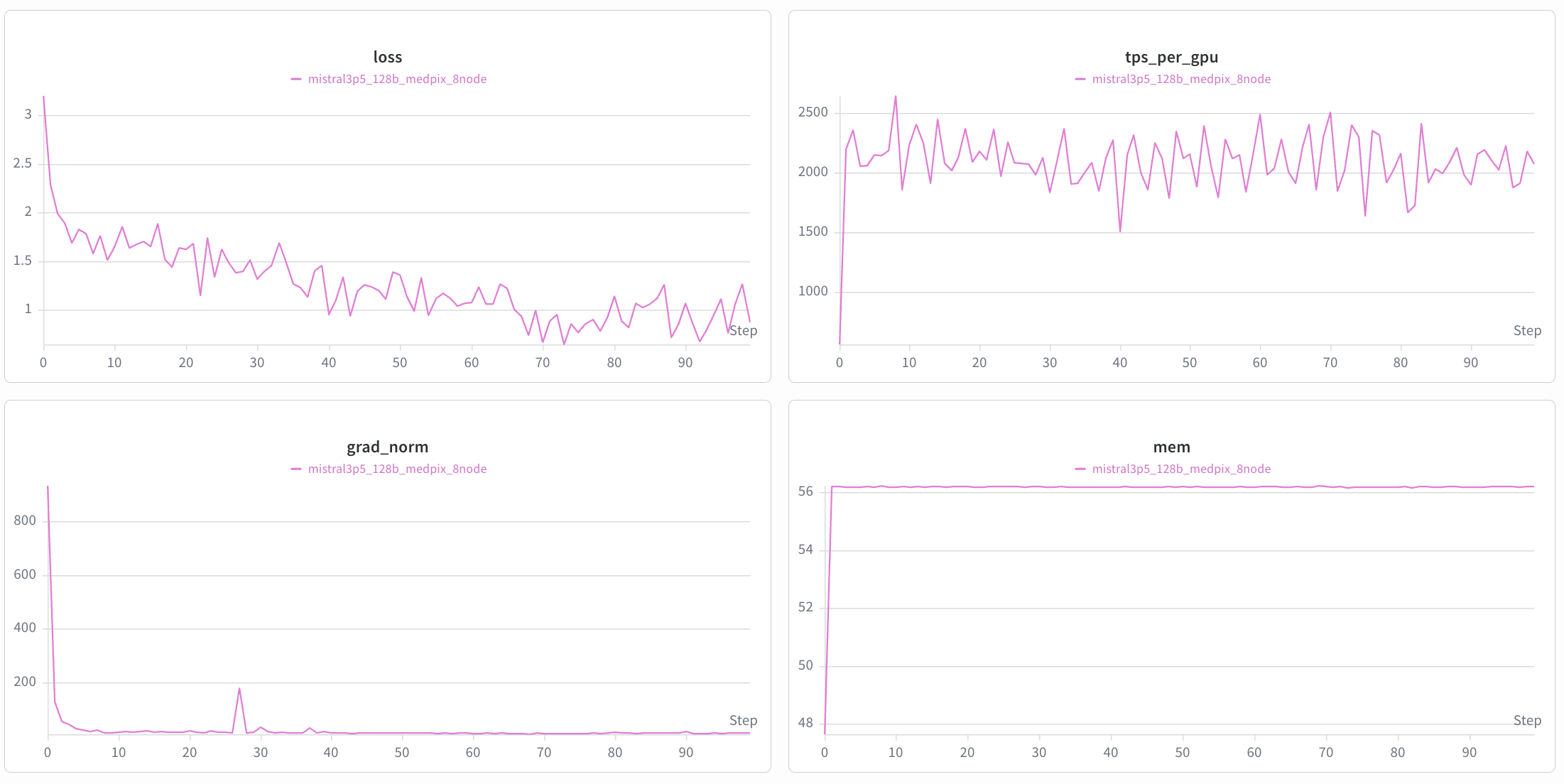
The recipe produces a healthy initial loss aligned with the HF
reference forward on matched samples. On MedPix-VQA the first
optimizer step lands around per-token loss 3.2 and grad-norm
~930 (clipped to max_grad_norm=1.0), descending past 1.8 within
a handful of steps. The HF reference forward (single-sample, FP8
dequantize on-load) on the same first batch produces per-token loss
3.47, confirming the distributed forward is numerically
equivalent within bf16 + TP-reduction tolerance.
The training loss curves for Mistral Medium 3.5 fine-tuned on MedPix-VQA are shown below.