

Comparing optimizer updates: warmup and spike response#
This notebook visualizes the per-step parameter update produced by Muon, SOAP, REKLS, LaProp, and the reference AdamW in two regimes:
Per-step trajectory at a single gradient scale — how quickly each optimizer reaches its steady-state update magnitude.
Spike response — how each optimizer reacts to a single gradient that is 1000× the normal scale, and how many steps it takes to recover.
Setup:
A single 2-D parameter of shape
(128, 64)is initialized once and cloned per optimizer/run.Each run feeds the parameter a sequence of i.i.d. Gaussian gradients.
After every step we record the update, defined as
p_before - p_after(the negative oflr * effective_update).All optimizers use
lr = 1.0,weight_decay = 0.0so the recorded value is the raw per-step update.
What to look for:
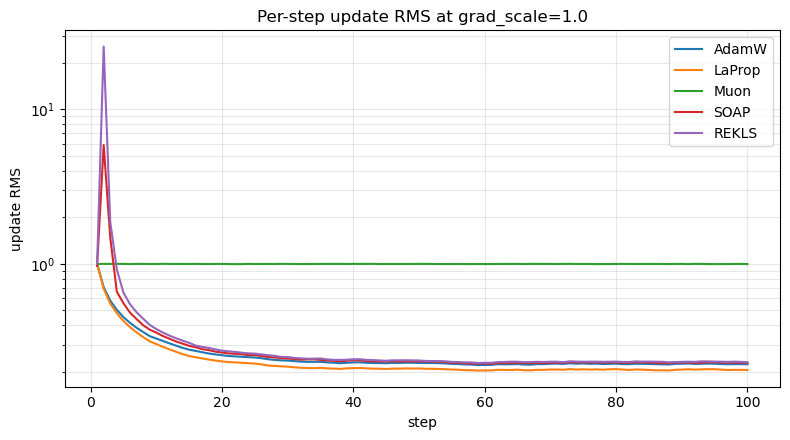
AdamW: update RMS saturates to roughly
lrregardless of gradient scale — Adam normalizes by the running second moment, behaving like a signed gradient at steady state.LaProp: saturates to ~
lrlike AdamW (it also normalizes by the running second moment, but does so on the gradient before the first-moment EMA). Configured here withβ₂ = 0.65(vs0.95for AdamW) so its second-moment EMA forgets a spike in ~3 steps instead of ~20 — spike recovery is therefore much faster.Muon: the update is an orthogonal matrix times a shape-dependent constant. Its spectral norm is determined entirely by
scale_mode, not by the gradient magnitude.SOAP / REKLS: Adam-like in the eigenbasis of the gradient covariance. Update RMS is similar to AdamW once the Kronecker factors warm up, but the singular-value spectrum is shaped by the preconditioner.
Dependencies beyond the repo: matplotlib (install with uv pip install matplotlib or pip install matplotlib).
import os
import matplotlib.pyplot as plt
import numpy as np
import torch

from emerging_optimizers.orthogonalized_optimizers.muon import Muon
from emerging_optimizers.scalar_optimizers.laprop import LaProp
from emerging_optimizers.legacy_soap.rekls import REKLS
from emerging_optimizers.legacy_soap.soap import SOAP

device = torch.device("cuda" if torch.cuda.is_available() else "cpu")
# device = "cpu"
dtype = torch.float32
print(f"device={device}")

# os.environ["TORCH_ALLOW_TF32_CUBLAS_OVERRIDE"] = "0"
device=cuda
PARAM_SHAPE = (128, 64)
N_STEPS = 100
SEED = 0

"""
All optimizers share lr=1.0 and weight_decay=0.0 so the recorded update is the raw
update before learning-rate scaling.

Beta choices:
  - AdamW / SOAP / REKLS: betas=(0.9, 0.95) — same second-moment time constant for
    apples-to-apples comparison.
  - LaProp: betas=(0.9, 0.65) — deliberately shorter beta2 so its `v` forgets a spike
    quickly. Steady-state behavior is similar to AdamW; spike recovery is much faster
    because the inflated `v` decays in ~3 steps (vs ~20 at beta2=0.95).
  - Muon: momentum=0.95 (analogous to beta1 of the Adam-like optimizers).
"""
LR = 1.0


def make_optimizers(param: torch.Tensor) -> dict[str, torch.optim.Optimizer]:
    return {
        "AdamW": torch.optim.AdamW([param], lr=LR, betas=(0.9, 0.95), eps=1e-8, weight_decay=0.0),
        "LaProp": LaProp([param], lr=LR, betas=(0.9, 0.65), eps=1e-8, weight_decay=0.0),
        "Muon": Muon([param], lr=LR, momentum=0.95, weight_decay=0.0),
        "SOAP": SOAP([param], lr=LR, betas=(0.9, 0.95), shampoo_beta=0.95, weight_decay=0.0, fp32_matmul_prec="highest", use_kl_shampoo=True),
        "REKLS": REKLS([param], lr=LR, betas=(0.9, 0.95), shampoo_beta=0.95, weight_decay=0.0),
    }


OPTIMIZER_NAMES = list(make_optimizers(torch.zeros(PARAM_SHAPE, device=device)).keys())
print("Optimizers:", OPTIMIZER_NAMES)
Optimizers: ['AdamW', 'LaProp', 'Muon', 'SOAP', 'REKLS']
def run_optimizer(
    optimizer_name: str,
    grad_scale: float,
    n_steps: int = N_STEPS,
    shape: tuple[int, int] = PARAM_SHAPE,
    seed: int = SEED,
) -> torch.Tensor:
    """Drive `optimizer_name` with i.i.d. Gaussian gradients of std=`grad_scale` and return the per-step updates.

    The same `seed` is used for every optimizer, so they all see the exact same gradient sequence.
    The returned tensor has shape `(n_steps, *shape)` and contains `p_before - p_after` per step.
    """
    g = torch.Generator(device=device).manual_seed(seed)

    param = torch.zeros(shape, device=device, dtype=dtype, requires_grad=True)
    opt = make_optimizers(param)[optimizer_name]

    updates = torch.empty((n_steps, *shape), device=device, dtype=dtype)
    for i in range(n_steps):
        with torch.no_grad():
            grad = torch.randn(shape, device=device, dtype=dtype, generator=g) * grad_scale
        param.grad = grad
        p_before = param.detach().clone()
        opt.step()
        updates[i] = p_before - param.detach()
    return updates.cpu()


# Sanity check: a single short run.
_smoke = run_optimizer("Muon", grad_scale=1.0, n_steps=5)
print("smoke updates shape:", tuple(_smoke.shape))
smoke updates shape: (5, 128, 64)
Per-step update trajectory#
Drive every optimizer with the same i.i.d. Gaussian gradients (std = 1, same seed across optimizers) and record the per-step update. (All five optimizers are scale-invariant to the gradient magnitude in steady state — sweeping over magnitudes would just produce overlapping curves at the same value, so we run only at grad_scale = 1.0 here.)
WARMUP = 30
TRAJECTORY_SCALE = 1.0


def update_rms(u: torch.Tensor) -> torch.Tensor:
    # u shape: (n_steps, m, n) → per-step RMS over the (m, n) elements.
    return u.flatten(1).square().mean(dim=1).sqrt()


def update_spectral_norm(u: torch.Tensor) -> torch.Tensor:
    # Largest singular value per step.
    return torch.linalg.matrix_norm(u, ord=2)


# trajectory_updates[name] is a tensor of shape (N_STEPS, *PARAM_SHAPE) on CPU.
trajectory_updates: dict[str, torch.Tensor] = {}
for name in OPTIMIZER_NAMES:
    trajectory_updates[name] = run_optimizer(name, grad_scale=TRAJECTORY_SCALE)
    print(f"finished {name}")
finished AdamW
finished LaProp
finished Muon
finished SOAP
finished REKLS
fig, ax = plt.subplots(figsize=(8, 4.5))
for name in OPTIMIZER_NAMES:
    rms_traj = update_rms(trajectory_updates[name]).numpy()
    ax.plot(np.arange(1, N_STEPS + 1), rms_traj, label=name)

ax.set_yscale("log")
ax.set_xlabel("step")
ax.set_ylabel("update RMS")
ax.set_title(f"Per-step update RMS at grad_scale={TRAJECTORY_SCALE}")
ax.grid(True, which="both", alpha=0.3)
ax.legend()
fig.tight_layout()
plt.show()
Sudden gradient spike — sweep over spike timing and magnitude#
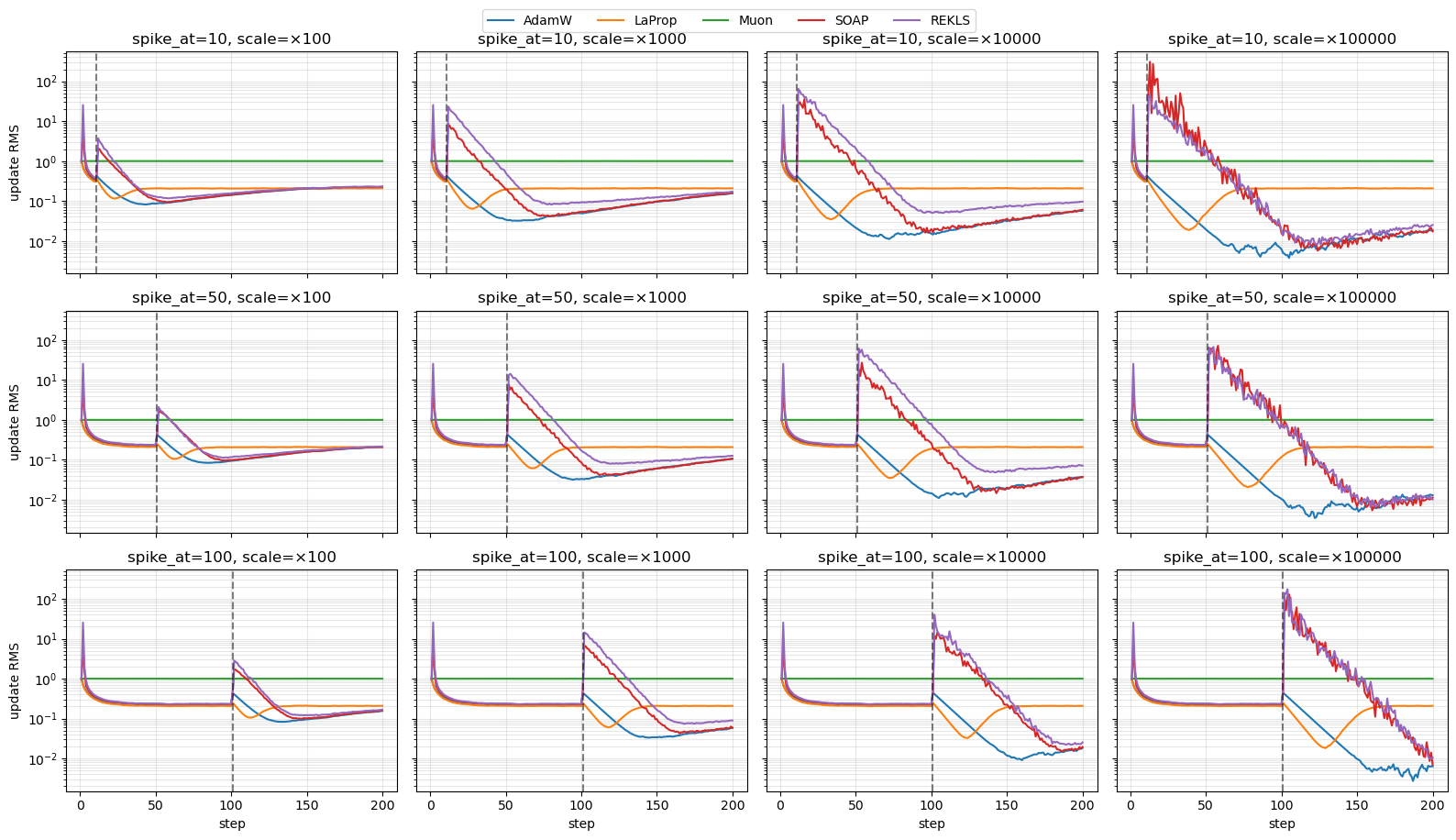
Inject a single anomalously large gradient on step spike_at (one of {10, 50, 100} — covering during warmup, just past warmup, and deep in steady state), at magnitudes spanning SPIKE_SCALE ∈ {1e2, 1e3, 1e4, 1e5}. Continue with normal randn() gradients for the rest of the run and watch how each optimizer recovers.
Predictions:
AdamW / LaProp: the spike step produces a large update because
exp_avg_sqlags the gradient. After absorbing the spike intoexp_avg_sq, the denominator stays inflated by~SPIKE_SCALE, suppressing subsequent updates untilexp_avg_sqdecays back over~1/(1 - β₂)steps. Larger spikes take proportionally longer to forget.Muon: orthogonalization removes the magnitude entirely, so the spike’s effect on the update size should be ≈ none, regardless of scale or timing.
SOAP / REKLS: both the Kronecker factors (
L,R) and the inner Adam’sexp_avg_sqingest the spike, so recovery depends onshampoo_betaandβ₂. Recovery time should grow with spike magnitude. Spiking during warmup (spike_at=10) may behave differently from spiking in steady state since the factors haven’t fully accumulated yet.
SPIKE_AT_LIST = [10, 50, 100]
SPIKE_SCALES = [1e2, 1e3, 1e4, 1e5]
SPIKE_TOTAL_STEPS = 200
NORMAL_SCALE = 1.0


def run_with_spike(
    optimizer_name: str,
    spike_at: int,
    spike_scale: float,
    normal_scale: float = NORMAL_SCALE,
    n_steps: int = SPIKE_TOTAL_STEPS,
    shape: tuple[int, int] = PARAM_SHAPE,
    seed: int = SEED,
) -> torch.Tensor:
    """Same driver as `run_optimizer`, except step `spike_at` uses `spike_scale × normal_scale` instead of `normal_scale`."""
    g = torch.Generator(device=device).manual_seed(seed)

    param = torch.zeros(shape, device=device, dtype=dtype, requires_grad=True)
    opt = make_optimizers(param)[optimizer_name]

    updates = torch.empty((n_steps, *shape), device=device, dtype=dtype)
    for i in range(n_steps):
        scale = spike_scale * normal_scale if i == spike_at else normal_scale
        with torch.no_grad():
            grad = torch.randn(shape, device=device, dtype=dtype, generator=g) * scale
        param.grad = grad
        p_before = param.detach().clone()
        opt.step()
        updates[i] = p_before - param.detach()
    return updates.cpu()


# spike_results[(spike_at, spike_scale)][name] is a tensor of shape (SPIKE_TOTAL_STEPS, *PARAM_SHAPE).
spike_results: dict[tuple[int, float], dict[str, torch.Tensor]] = {}
for spike_at in SPIKE_AT_LIST:
    for spike_scale in SPIKE_SCALES:
        spike_results[(spike_at, spike_scale)] = {}
        for name in OPTIMIZER_NAMES:
            spike_results[(spike_at, spike_scale)][name] = run_with_spike(name, spike_at, spike_scale)
    print(f"finished spike_at={spike_at}")
finished spike_at=10
finished spike_at=50
finished spike_at=100
fig, axes = plt.subplots(len(SPIKE_AT_LIST), len(SPIKE_SCALES), figsize=(16, 9), sharex=True, sharey=True)
steps_x = np.arange(1, SPIKE_TOTAL_STEPS + 1)

for i, spike_at in enumerate(SPIKE_AT_LIST):
    for j, spike_scale in enumerate(SPIKE_SCALES):
        ax = axes[i, j]
        for name in OPTIMIZER_NAMES:
            rms = update_rms(spike_results[(spike_at, spike_scale)][name]).numpy()
            ax.plot(steps_x, rms, label=name)
        ax.axvline(spike_at + 1, color="k", linestyle="--", alpha=0.5)
        ax.set_yscale("log")
        ax.set_title(f"spike_at={spike_at}, scale=×{spike_scale:g}")
        ax.grid(True, which="both", alpha=0.3)
        if i == len(SPIKE_AT_LIST) - 1:
            ax.set_xlabel("step")
        if j == 0:
            ax.set_ylabel("update RMS")

handles, labels = axes[0, 0].get_legend_handles_labels()
fig.legend(handles, labels, loc="upper center", ncol=len(OPTIMIZER_NAMES), bbox_to_anchor=(0.5, 1.02))
fig.tight_layout()
plt.show()
Recovery summary#
For each (optimizer, spike_at, spike_scale) cell, report the number of steps after the spike before the update RMS returns within 10% of the post-spike steady-state RMS (mean of the last 30 steps of the trajectory). Using the post-spike steady state as the reference makes the metric meaningful even when the spike happens during warmup, where the pre-spike “steady-state” isn’t yet established.
TOLERANCE = 0.10
STEADY_WINDOW = 30  # last N steps of trajectory used to define post-spike steady-state RMS


def recovery_steps(rms_traj: np.ndarray, spike_at: int) -> int | str:
    target = rms_traj[-STEADY_WINDOW:].mean()
    post = rms_traj[spike_at + 1 :]
    within = np.where(np.abs(post - target) <= TOLERANCE * target)[0]
    return int(within[0]) + 1 if len(within) else f">{len(post)}"


header_scales = "  ".join(f"{s:>8.0e}" for s in SPIKE_SCALES)
print("Recovery time (steps after spike to return within 10% of post-spike steady-state RMS):")
print(f"  {'optimizer':<8}  {'spike_at':>8}  {header_scales}")
print("  " + "-" * (10 + 10 + len(header_scales)))
for name in OPTIMIZER_NAMES:
    for k, spike_at in enumerate(SPIKE_AT_LIST):
        cells = []
        for spike_scale in SPIKE_SCALES:
            rms = update_rms(spike_results[(spike_at, spike_scale)][name]).numpy()
            cells.append(f"{recovery_steps(rms, spike_at):>8}")
        opt_label = name if k == 0 else ""
        print(f"  {opt_label:<8}  {spike_at:>8}  " + "  ".join(cells))
    print()
Recovery time (steps after spike to return within 10% of post-spike steady-state RMS):
  optimizer  spike_at     1e+02     1e+03     1e+04     1e+05
  ----------------------------------------------------------
  AdamW           10         7        13        26        41
                  50         9        19        33        46
                 100        15        28        44        56

  LaProp          10         4         4         4         4
                  50         1         1         1         1
                 100         1         1         1         1

  Muon            10         1         1         1         1
                  50         1         1         1         1
                 100         1         1         1         1

  SOAP            10        25        43        68        89
                  50        27        48        74        96
                 100        32        56        77        80

  REKLS           10        26        51        72       148
                  50        26        54        77        98
                 100        33        59        80        81
Takeaways#
AdamW is approximately scale-invariant in steady state, but a 1000× spike is not free: the spike step itself produces a large update because
exp_avg_sqlags the gradient, and the inflatedexp_avg_sqthen suppresses subsequent updates until it decays back over~1/(1 - β₂)steps. Recovery time scales roughly logarithmically with spike magnitude.LaProp with the short
β₂ = 0.65used here recovers in essentially one step at steady-state spikes (and ~4 steps if the spike lands during warmup). With matchingβ₂ = 0.95it would behave similarly to AdamW. The shorter second-moment time constant is the only knob doing the work — LaProp’s pre-normalize-then-momentum order doesn’t help much by itself.Muon is exactly scale-invariant after the Newton–Schulz iteration: orthogonalization throws away the gradient’s magnitude, leaving only the shape-dependent scaling factor (
spectralmode →sqrt(max(m, n))). The 1000× spike barely registers in the update RMS, though it can rotate the momentum-driven update direction for a few steps.SOAP / REKLS are scale-invariant in steady state (Adam runs in the preconditioned space), but the singular-value spectrum of the update is flatter than AdamW’s because of the Kronecker-factored preconditioner. A gradient spike pollutes both the Kronecker factors and the inner Adam second moment, so they take roughly
1/(1 - shampoo_beta)steps to forget it. On CUDA, thefp32_matmul_prec="highest"workaround (or the targeted fix inupdate_kronecker_factors_kl_shampoo) is required to avoid TF32-induced divergence under high-magnitude spikes; seepreconditioner-eigenbasis-spike.ipynbfor the diagnostic.