


Realtime API Reference#
Overview#
Riva Realtime Server provides a WebSocket-based API for real-time speech processing (ASR - Automatic Speech Recognition). This API allows you to stream audio data and receive real-time transcription results.
The speaker limit depends on the ASR profile. Nemotron ASR Streaming uses the eight-speaker Sortformer model, while Parakeet CTC and Parakeet RNNT use the four-speaker model. The examples on this page use the Nemotron ASR Streaming limit of eight.
Reference#
The WebSocket server provides real-time communication capabilities for transcription services. To establish a connection, clients must connect to the WebSocket endpoint with the required query parameter.
Transcription Sessions Endpoint#
The transcription sessions endpoint allows you to create transcription sessions.
Base URL:
http://<address>:9000
Endpoint:
/v1/realtime/transcription_sessions
Method: POST
Mint API Key Authentication#
This endpoint issues the short-lived client_secret that authenticates the WebSocket handshake, so it is the boundary you protect with a long-lived secret. Enforcement is controlled server-side by the REALTIME_AUTH_MINT_API_KEY environment variable:
Key set on the server: every request must present the same key, using either an
Authorization: Bearer <key>or anX-API-Key: <key>header. The server compares the value in constant time. Missing or incorrect credentials return401 Unauthorizedwith aWWW-Authenticate: Bearer realm="riva-realtime-mint"response header.Key unset on the server (default): the endpoint is unauthenticated.
curl -X POST http://localhost:9000/v1/realtime/transcription_sessions \
    -H "Authorization: Bearer $REALTIME_AUTH_MINT_API_KEY"
Warning
REALTIME_AUTH_MINT_API_KEY is a backend-only secret. Only your session-brokering service should hold it; never ship it to a browser or embed it in a client application. Browsers authenticate the WebSocket handshake with the short-lived client_secret.value that this endpoint returns, described in Ephemeral Token Authentication.
Response: Returns the initial default transcription session configuration.
{
  "id": "sess_<uuid4>",
  "object": "realtime.transcription_session",
  "modalities": ["text"],
  "input_audio_format": "pcm16",
  "input_audio_transcription":
  {
      "language": "en-US",
      "model": "conformer",
      "prompt": ""
  },
  "input_audio_params":
  {
      "sample_rate_hz": 16000,
      "num_channels": 1
  },
  "recognition_config":
  {
      "max_alternatives": 1,
      "enable_automatic_punctuation": false,
      "enable_word_time_offsets": false,
      "enable_profanity_filter": false,
      "enable_verbatim_transcripts": false
  },
  "speaker_diarization":
  {
      "enable_speaker_diarization": false,
      "max_speaker_count": 8
  },
  "word_boosting":
  {
      "enable_word_boosting": false,
      "word_boosting_list": []
  },
  "endpointing_config":
  {
      "start_history": 0,
      "start_threshold": 0,
      "stop_history": 0,
      "stop_threshold": 0,
      "stop_history_eou": 0,
      "stop_threshold_eou": 0
  },
  "client_secret": {
    "value": "<uuid4>",
    "expires_at": 1753872000
  }
}
The client_secret field is an object that carries the ephemeral token for the WebSocket handshake, or null when the server does not mint tokens. value is the single-use token to present on the handshake, and expires_at is the Unix timestamp at which it expires, 60 seconds after it is minted.
Parameters#
Parameter |
Type |
Required |
Description |
Default |
|---|---|---|---|---|
id |
string |
No |
Session identifier |
auto-generated (“sess_ |
object |
string |
Yes |
Object type identifier |
“realtime.transcription_session” |
modalities |
array |
Yes |
List of supported modalities |
[“text”] |
input_audio_format |
string |
Yes |
Audio format. Currently only “pcm16” supported |
“pcm16” |
input_audio_transcription.language |
string |
No |
Transcription language |
“en-US” |
input_audio_transcription.model |
string |
No |
ASR model to use |
“conformer” |
input_audio_transcription.prompt |
string |
No |
Optional prompt for transcription |
“” |
input_audio_params.sample_rate_hz |
integer |
No |
Audio sample rate in Hz |
16000 |
input_audio_params.num_channels |
integer |
No |
Number of audio channels |
1 |
recognition_config.max_alternatives |
integer |
No |
Maximum number of recognition alternatives |
1 |
recognition_config.enable_automatic_punctuation |
boolean |
No |
Enable automatic punctuation |
false |
recognition_config.enable_word_time_offsets |
boolean |
No |
Enable word-level timing information |
false |
recognition_config.enable_profanity_filter |
boolean |
No |
Enable profanity filtering |
false |
recognition_config.enable_verbatim_transcripts |
boolean |
No |
Enable verbatim transcription |
false |
speaker_diarization.enable_speaker_diarization |
boolean |
No |
Enable speaker diarization |
false |
speaker_diarization.max_speaker_count |
integer |
No |
Upper bound on the number of speakers to detect. Use 1 through 8 for Nemotron ASR Streaming or 1 through 4 for Parakeet. |
Model capacity |
word_boosting.enable_word_boosting |
boolean |
No |
Enable word boosting |
false |
word_boosting.word_boosting_list |
array |
No |
List of words to boost |
[] |
endpointing_config.start_history |
integer |
No |
Start history for endpointing |
0 |
endpointing_config.start_threshold |
integer |
No |
Start threshold for endpointing |
0 |
endpointing_config.stop_history |
integer |
No |
Stop history for endpointing |
0 |
endpointing_config.stop_threshold |
integer |
No |
Stop threshold for endpointing |
0 |
endpointing_config.stop_history_eou |
integer |
No |
Stop history for end-of-utterance |
0 |
endpointing_config.stop_threshold_eou |
integer |
No |
Stop threshold for end-of-utterance |
0 |
client_secret |
object | null |
No |
Ephemeral WebSocket token object ( |
null |
client_secret.value |
string |
No |
Single-use token presented on the WebSocket handshake |
— |
client_secret.expires_at |
integer |
No |
Unix timestamp when the token expires (60 seconds after mint) |
— |
WebSocket Connection Details#
Base URL:
ws://<address>:9000
Endpoint:
/v1/realtime
Required Query Parameter:
intent=transcription
Ephemeral Token Authentication#
The handshake is authenticated with the client_secret.value returned by the transcription sessions endpoint. The token travels on the Sec-WebSocket-Protocol header, where the client offers two subprotocol entries:
Sec-WebSocket-Protocol: realtime, realtime-token.<client_secret.value>
The server validates the realtime-token.<value> entry and echoes back only the plain realtime identifier, so the secret never appears in a response header. This is also what makes the flow work from a browser, which cannot set arbitrary headers on a WebSocket upgrade but can supply a subprotocol list:
new WebSocket(
  "wss://localhost:9000/v1/realtime?intent=transcription",
  ["realtime", `realtime-token.${clientSecret}`]
);
Whether a token is required is controlled server-side by the REALTIME_AUTH_REQUIRE_TOKEN environment variable:
REALTIME_AUTH_REQUIRE_TOKEN=true: every handshake must present a valid, unused, unexpired token. This is the recommended posture for any deployment reachable from an untrusted network.Unset or
false(default): handshakes without a token are accepted, preserving compatibility with client fleets that predate the token flow.
Important
A token that is presented is always validated, even when REALTIME_AUTH_REQUIRE_TOKEN is false. The flag controls whether an absent token is tolerated, not whether a supplied token is checked.
Tokens are single-use, expire 60 seconds after they are minted, and are bound to the intent they were minted for, so a token from the transcription endpoint cannot be used on a synthesize connection.
The following conditions close the connection with code 1008 (Policy Violation):
Condition |
Cause |
|---|---|
Missing token |
|
Invalid token |
The token is unknown, expired, or was already consumed |
Intent mismatch |
The token was minted for a different intent |
Unsafe subprotocol offer |
A token entry was offered without a non-token carrier entry such as |
Note
The last condition is rejected deliberately. With no non-token entry available to echo, the server would have to return the token itself in the Sec-WebSocket-Protocol response header, exposing it to browser developer tools, HAR captures, and any reverse proxy that records response headers.
URL query-string tokens (?token=<value>) are never accepted, regardless of the flag, because they routinely end up in reverse-proxy and load-balancer access logs, a category of exposure that request-header values do not share.
Example Connection URL#
Here is a complete example for connecting to the WebSocket server:
ws://localhost:9000/v1/realtime?intent=transcription
The client_secret.value is supplied in the Sec-WebSocket-Protocol handshake header, never in the URL.
Connection Requirements#
To establish a connection, the WebSocket client must include the intent query parameter in the URL, specifying a supported value. At present, the only valid intent is “transcription”. The server listens on port 9000 by default and uses the standard WebSocket protocol (ws://). If the intent parameter is missing or invalid, the server will close the connection and return WebSocket code 1008 (Policy Violation).
When the server runs with REALTIME_AUTH_REQUIRE_TOKEN=true, the client must additionally present a valid ephemeral client_secret.value on the Sec-WebSocket-Protocol header, as described in Ephemeral Token Authentication. Connections that omit the token, or that supply an invalid, expired, or already-used one, are closed with the same 1008 code.
Usage Notes#
Clients should support WebSocket connections and maintain the connection for the entire duration of the transcription session. It is important to implement proper error handling and reconnection logic within the client to ensure a robust and reliable experience.
Because tokens are single-use and expire 60 seconds after they are minted, clients should request a fresh client_secret immediately before opening each socket rather than caching one for reuse. Reconnect logic needs its own mint call. The server never writes the raw token value to its application logs, and because the token is carried on a request header rather than in the URL, it also stays out of reverse-proxy and load-balancer access logs that record URLs but not header values.
Health Check Endpoint#
The health check endpoint provides a way to verify the server’s operational status.
Endpoint:
/v1/health
Method: GET
Response:
{
  "status": "ok"
}
Status Codes:
200 OK: Server is healthy and ready to accept connections503 Service Unavailable: Server is not ready to accept connections
Use Cases:
Pre-flight check before establishing WebSocket connections
Load balancer health monitoring
System status monitoring
Events#
WebSocket Events#
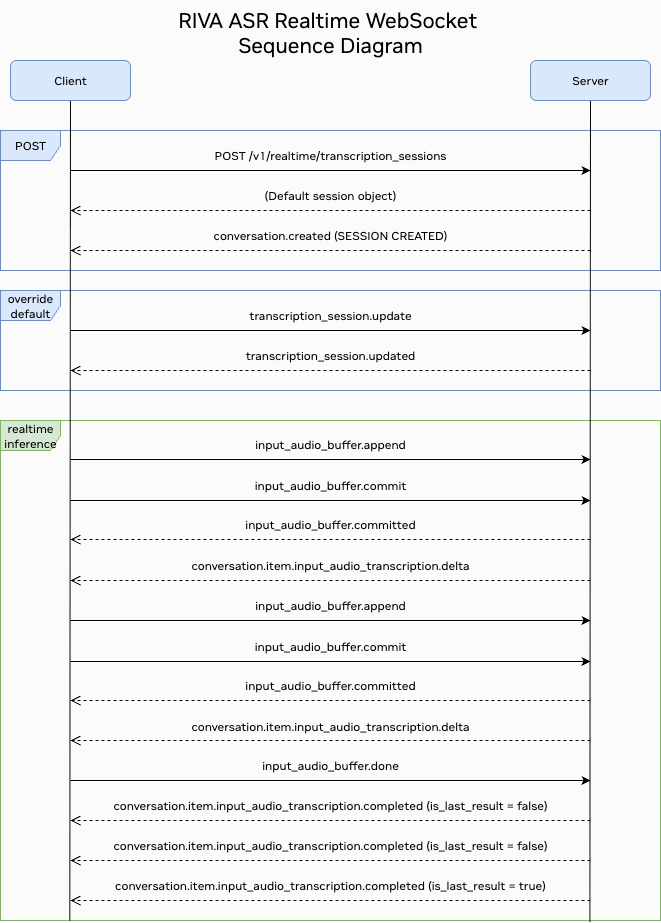
The realtime server uses a WebSocket-based event system for communication between clients and the server. Events are JSON messages that follow a specific format and are used to handle various operations like session management, audio processing, and transcription.
Each event has:
A unique
event_idfor trackingA
typefield indicating the event typeAdditional fields specific to the event type
Events are categorized into:
Client Events: Events sent from client to server
Session management (create, update)
Audio buffer operations (append, commit)
Server Events: Events sent from server to client
Session responses (created, updated)
Transcription results (delta, completed, failed)
Error notifications
Status updates
The server validates all incoming events and sends appropriate error messages for:
Invalid event formats
Unsupported features
Message size limits
Server errors
Client Events#
Events that can be sent from the client to the server.
List of Client Events#
Event Type |
Description |
|---|---|
|
Updates session configuration |
|
Sends audio data for processing |
|
Commits the current audio buffer |
|
Clears the audio bytes in the buffer |
|
Tells the server that the client is done sending audio data |
transcription_session.update#
Send this event to update a transcription session.
{
    "event_id" : "event_<uuid4>",
    "session":
    {
        "modalities": ["text"],
        "input_audio_format": "pcm16",
        "input_audio_transcription":
        {
            "language": "en-US",
            "model": "conformer",
            "prompt": ""
        },
        "input_audio_params":
        {
            "sample_rate_hz": 16000,
            "num_channels": 1
        },
        "recognition_config":
        {
            "max_alternatives": 1,
            "enable_automatic_punctuation": false,
            "enable_word_time_offsets": false,
            "enable_profanity_filter": false,
            "enable_verbatim_transcripts": false
        },
        "speaker_diarization":
        {
            "enable_speaker_diarization": false,
            "max_speaker_count": 8
        },
        "word_boosting":
        {
            "enable_word_boosting": false,
            "word_boosting_list": []
        },
        "endpointing_config":
        {
            "start_history": 0,
            "start_threshold": 0,
            "stop_history": 0,
            "stop_threshold": 0,
            "stop_history_eou": 0,
            "stop_threshold_eou": 0
        }
    },
    "type": "transcription_session.update"
}
Parameters#
Parameter |
Type |
Required |
Description |
Default |
|---|---|---|---|---|
event_id |
string |
No |
Event identifier |
auto-generated (“conv_uuid4”) |
type |
string |
Yes |
Event type |
“transcription_session.update” |
session.modalities |
array |
Yes |
List of supported modalities |
[“text”] |
session.input_audio_format |
string |
Yes |
Audio format. Currently only “pcm16” is supported |
“pcm16” |
session.input_audio_transcription.language |
string |
No |
Transcription language |
“en-US” |
session.input_audio_transcription.model |
string |
No |
ASR model to use |
“conformer” |
session.input_audio_transcription.prompt |
string |
No |
Optional prompt for transcription |
“” |
session.input_audio_params.sample_rate_hz |
integer |
No |
Audio sample rate in Hz |
16000 |
session.input_audio_params.num_channels |
integer |
No |
Number of audio channels |
1 |
session.recognition_config.max_alternatives |
integer |
No |
Maximum number of recognition alternatives |
1 |
session.recognition_config.enable_automatic_punctuation |
boolean |
No |
Enable automatic punctuation |
false |
session.recognition_config.enable_word_time_offsets |
boolean |
No |
Enable word-level timing information |
false |
session.recognition_config.enable_profanity_filter |
boolean |
No |
Enable profanity filtering |
false |
session.recognition_config.enable_verbatim_transcripts |
boolean |
No |
Enable verbatim transcription |
false |
session.speaker_diarization.enable_speaker_diarization |
boolean |
No |
Enable speaker diarization |
false |
session.speaker_diarization.max_speaker_count |
integer |
No |
Upper bound on the number of speakers to detect. Use 1 through 8 for Nemotron ASR Streaming or 1 through 4 for Parakeet. |
Model capacity |
session.word_boosting.enable_word_boosting |
boolean |
No |
Enable word boosting |
false |
session.word_boosting.word_boosting_list |
array |
No |
List of words to boost |
[] |
session.endpointing_config.start_history |
integer |
No |
Start history for endpointing |
0 |
session.endpointing_config.start_threshold |
integer |
No |
Start threshold for endpointing |
0 |
session.endpointing_config.stop_history |
integer |
No |
Stop history for endpointing |
0 |
session.endpointing_config.stop_threshold |
integer |
No |
Stop threshold for endpointing |
0 |
session.endpointing_config.stop_history_eou |
integer |
No |
Stop history for end-of-utterance |
0 |
session.endpointing_config.stop_threshold_eou |
integer |
No |
Stop threshold for end-of-utterance |
0 |
input_audio_buffer.append#
Sends audio data to the server for processing.
{
  "event_id": "event_0000",
  "type": "input_audio_buffer.append",
  "audio": "<Base64EncodedAudioData>"
}
Parameters#
Parameter |
Type |
Required |
Description |
Default |
|---|---|---|---|---|
event_id |
string |
No |
Optional event identifier |
event_0000 |
type |
string |
Yes |
Event type |
“input_audio_buffer.append” |
audio |
string |
Yes |
Base64-encoded audio data. Maximum size: 15MB |
- |
input_audio_buffer.commit#
Commits the current audio buffer for processing.
{
  "event_id": "event_0000",
  "type": "input_audio_buffer.commit"
}
Parameters#
Parameter |
Type |
Required |
Description |
Default |
|---|---|---|---|---|
event_id |
string |
No |
Optional event identifier |
event_0000 |
type |
string |
Yes |
Event type |
“input_audio_buffer.commit” |
input_audio_buffer.done#
Tells the server that the client is done sending audio data and wants to stop the inference processing. This event triggers the server to process any remaining audio chunks in the buffer and then stop the inference task.
Note
This parameter is mandatory for audio file processing.
{
    "event_id": "event_0000",
    "type": "input_audio_buffer.done"
}
Parameters#
Parameter |
Type |
Required |
Description |
Default |
|---|---|---|---|---|
event_id |
string |
No |
Optional event identifier |
event_0000 |
type |
string |
Yes |
Event type |
“input_audio_buffer.done” |
input_audio_buffer.clear#
Clears the current audio buffer.
{
  "event_id": "event_0000",
  "type": "input_audio_buffer.clear"
}
Parameters#
Parameter |
Type |
Required |
Description |
Default |
|---|---|---|---|---|
event_id |
string |
No |
Optional event identifier |
event_0000 |
type |
string |
Yes |
Event type |
“input_audio_buffer.clear” |
Server Events#
These are events emitted from the server to the client.
List of Server Events#
Event Type |
Description |
|---|---|
|
Returned when a conversation is created |
|
Sent when session configuration is updated |
|
Returned when an input audio buffer is committed |
|
Returned when the input audio buffer is cleared |
|
Sent when new transcription results are available |
|
Sent when new transcription results are available |
|
Sent when transcription fails |
|
Sent when an error occurs |
conversation.created#
Returned when a conversation session is created.
{
    "event_id": "event_<uuid4>",
    "type": "conversation.created",
    "conversation": {
        "id": "conv_<uuid4>",
        "object": "realtime.conversation"
    }
}
Parameters#
Parameter |
Type |
Required |
Description |
Default |
|---|---|---|---|---|
event_id |
string |
No |
Optional event identifier |
auto-generated (“event_uuid4”) |
type |
string |
Yes |
Event type |
“conversation.created” |
conversation.id |
string |
Yes |
The unique ID of the conversation |
auto-generated (“conv_uuid4”) |
conversation.object |
string |
Yes |
Must be ‘realtime.conversation’ |
“realtime.conversation” |
transcription_session.updated#
Returned when a transcription session is updated.
{
    "event_id" : "event_<uuid4>",
    "session":
    {
        "modalities": ["text"],
        "input_audio_format": "pcm16",
        "input_audio_transcription":
        {
            "language": "en-US",
            "model": "conformer",
            "prompt": ""
        },
        "input_audio_params":
        {
            "sample_rate_hz": 16000,
            "num_channels": 1
        },
        "recognition_config":
        {
            "max_alternatives": 1,
            "enable_automatic_punctuation": false,
            "enable_word_time_offsets": false,
            "enable_profanity_filter": false,
            "enable_verbatim_transcripts": false
        },
        "speaker_diarization":
        {
            "enable_speaker_diarization": false,
            "max_speaker_count": 8
        },
        "word_boosting":
        {
            "enable_word_boosting": false,
            "word_boosting_list": []
        },
        "endpointing_config":
        {
            "start_history": 0,
            "start_threshold": 0,
            "stop_history": 0,
            "stop_threshold": 0,
            "stop_history_eou": 0,
            "stop_threshold_eou": 0
        }
    },
    "type": "transcription_session.updated"
}
Parameters#
Parameter |
Type |
Required |
Description |
Default |
|---|---|---|---|---|
event_id |
string |
No |
Event identifier |
auto-generated (“event_ |
type |
string |
Yes |
Event type |
“transcription_session.updated” |
session.modalities |
array |
Yes |
List of supported modalities |
[“text”] |
session.input_audio_format |
string |
Yes |
Audio format. Currently only “pcm16” supported |
“pcm16” |
session.input_audio_transcription.language |
string |
No |
Transcription language |
“en-US” |
session.input_audio_transcription.model |
string |
No |
ASR model to use |
“conformer” |
session.input_audio_transcription.prompt |
string |
No |
Optional prompt for transcription |
“” |
session.input_audio_params.sample_rate_hz |
integer |
No |
Audio sample rate in Hz |
16000 |
session.input_audio_params.num_channels |
integer |
No |
Number of audio channels |
1 |
session.recognition_config.max_alternatives |
integer |
No |
Maximum number of recognition alternatives |
1 |
session.recognition_config.enable_automatic_punctuation |
boolean |
No |
Enable automatic punctuation |
false |
session.recognition_config.enable_word_time_offsets |
boolean |
No |
Enable word-level timing information |
false |
session.recognition_config.enable_profanity_filter |
boolean |
No |
Enable profanity filtering |
false |
session.recognition_config.enable_verbatim_transcripts |
boolean |
No |
Enable verbatim transcription |
false |
session.speaker_diarization.enable_speaker_diarization |
boolean |
No |
Enable speaker diarization |
false |
session.speaker_diarization.max_speaker_count |
integer |
No |
Upper bound on the number of speakers to detect. Use 1 through 8 for Nemotron ASR Streaming or 1 through 4 for Parakeet. |
Model capacity |
session.word_boosting.enable_word_boosting |
boolean |
No |
Enable word boosting |
false |
session.word_boosting.word_boosting_list |
array |
No |
List of words to boost |
[] |
session.endpointing_config.start_history |
integer |
No |
Start history for endpointing |
0 |
session.endpointing_config.start_threshold |
integer |
No |
Start threshold for endpointing |
0 |
session.endpointing_config.stop_history |
integer |
No |
Stop history for endpointing |
0 |
session.endpointing_config.stop_threshold |
integer |
No |
Stop threshold for endpointing |
0 |
session.endpointing_config.stop_history_eou |
integer |
No |
Stop history for end-of-utterance |
0 |
session.endpointing_config.stop_threshold_eou |
integer |
No |
Stop threshold for end-of-utterance |
0 |
input_audio_buffer.committed#
Returned when an input audio buffer is committed. At the same time, the buffer is sent for inference.
{
    "event_id" : "event_0000",
    "type": "input_audio_buffer.committed",
    "previous_item_id": "msg_0000",
    "item_id": "msg_0001"
}
Parameters#
Parameter |
Type |
Required |
Description |
Default |
|---|---|---|---|---|
event_id |
string |
No |
Optional event identifier |
event_0000 |
type |
string |
Yes |
Event type |
“input_audio_buffer.committed” |
previous_item_id |
string |
No |
ID of the preceding item |
msg_0000 |
item_id |
string |
No |
ID of the current item |
msg_0001 |
input_audio_buffer.cleared#
Returned when the input audio buffer is cleared.
{
    "event_id": "event_0000",
    "type": "input_audio_buffer.cleared"
}
Parameters#
Parameter |
Type |
Required |
Description |
Default |
|---|---|---|---|---|
event_id |
string |
No |
Optional event identifier |
event_0000 |
type |
string |
Yes |
Event type |
“input_audio_buffer.cleared” |
conversation.item.input_audio_transcription.delta#
Returned transcription text, when response received from gRPC server
{
    "event_id": "event_0000",
    "type": "conversation.item.input_audio_transcription.delta",
    "item_id": "item_001",
    "content_index": 0,
    "delta": "Hello"
}
Parameters#
Parameter |
Type |
Required |
Description |
Default |
|---|---|---|---|---|
event_id |
string |
No |
Optional event identifier |
event_0000 |
type |
string |
Yes |
Event type |
“conversation.item.input_audio_transcription.delta” |
item_id |
string |
No |
Optional item identifier |
item_0000 |
content_index |
integer |
No |
The index of the content part |
0 |
delta |
string |
Yes |
Transcription result in streaming mode |
“” |
conversation.item.input_audio_transcription.completed#
Returns transcription text when a response is received from the gRPC server.
{
    "event_id": "event_0000",
    "type": "conversation.item.input_audio_transcription.completed",
    "item_id": "msg_0000",
    "content_index": 0,
    "transcript": "Hello, how are you?",
    "words_info": {
        "words": [
            {
                "word": "Hello",
                "start_time": 0.0,
                "end_time": 1.0,
                "confidence": 0.95,
                "speaker_tag": 0
            }
        ]
    },
    "vad_states": {
        "vad_states": [
            {
                "timestamp": 0.0,
                "prob": 0.5
            }
        ]
    },
    "is_last_result": false,
    "usage": {
        "type": "duration",
        "seconds": 4.0
    }
}
Parameters#
Parameter |
Type |
Required |
Description |
Default |
|---|---|---|---|---|
event_id |
string |
No |
Optional event identifier |
event_0000 |
type |
string |
Yes |
Event type |
“conversation.item.input_audio_transcription.completed” |
item_id |
string |
Yes |
The ID of the item |
msg_0000 |
content_index |
integer |
Yes |
The index of the content part |
0 |
transcript |
string |
Yes |
The complete transcribed text |
- |
words_info |
object |
No |
Word-level information container |
- |
words_info.words |
array |
No |
Array of word objects with timing and confidence |
[] |
words_info.words[].word |
string |
Yes |
The transcribed word |
- |
words_info.words[].start_time |
float |
Yes |
Start time of the word in seconds |
- |
words_info.words[].end_time |
float |
Yes |
End time of the word in seconds |
- |
words_info.words[].confidence |
float |
Yes |
Confidence score for the word (0.0-1.0) |
- |
words_info.words[].speaker_tag |
integer |
Yes |
Speaker identifier for diarization |
0 |
vad_states |
object |
No |
Voice Activity Detection states container |
- |
vad_states.vad_states |
array |
No |
Array of VAD state objects |
[] |
vad_states.vad_states[].timestamp |
float |
Yes |
Timestamp in seconds |
- |
vad_states.vad_states[].prob |
float |
Yes |
VAD probability (0.0-1.0) |
- |
is_last_result |
boolean |
No |
Indicates if this is the final transcription result for the audio stream |
false |
usage |
object |
Yes |
Cumulative processed audio usage at this completion. The terminal result contains the total. |
{“type”: “duration”, “seconds”: 0.0} |
usage.type |
string |
Yes |
Usage accounting type. |
“duration” |
usage.seconds |
float |
Yes |
Cumulative processed audio duration in seconds. |
0.0 |
conversation.item.input_audio_transcription.failed#
Returned when a transcription request fails.
{
    "event_id": "event_0000",
    "type": "conversation.item.input_audio_transcription.failed",
    "item_id": "msg_0000",
    "content_index": 0,
    "error": {
        "type": "transcription_error",
        "code": "audio_unintelligible",
        "message": "The audio could not be transcribed.",
        "param": null
    }
}
Parameters#
Parameter |
Type |
Required |
Description |
|---|---|---|---|
event_id |
string |
No |
Optional event identifier |
type |
string |
Yes |
Must be ‘conversation.item.input_audio_transcription.failed’ |
item_id |
string |
Yes |
The ID of the user message item |
content_index |
integer |
Yes |
The index of the content part |
error.type |
string |
Yes |
The type of error |
error.code |
string |
Yes |
Error code |
error.message |
string |
Yes |
A human-readable error message |
error.param |
string |
No |
Parameter related to the error, if any |
error#
Returned when an error occurs.
{
    "event_id": "<auto_generated>",
    "type": "error",
    "error": {
        "type": "invalid_request_error",
        "code": "invalid_event",
        "message": "The 'type' field is missing.",
        "param": null
    }
}
Parameters#
Parameter |
Type |
Required |
Description |
|---|---|---|---|
event_id |
string |
No |
Optional event identifier |
type |
string |
Yes |
Must be ‘error’ |
error.type |
string |
Yes |
The type of error |
error.code |
string |
Yes |
Error code |
error.message |
string |
Yes |
A human-readable error message |
error.param |
string |
No |
Parameter related to the error, if any |
Configuration#
Server Parameters#
Parameter |
Default Value |
Description |
|---|---|---|
expiration_timeout_secs |
3600 |
Session expiration timeout in seconds (1 hour) |
inactivity_timeout_secs |
60 |
Inactivity timeout in seconds |
max_connections |
10000 |
Maximum number of concurrent connections |
max_message_size |
10485760 |
Maximum message size in bytes (10MB) |
input_min_chunk_seconds |
0.08 |
Minimum audio chunk size for processing |
Authentication Environment Variables#
Variable |
Type |
Default |
Description |
|---|---|---|---|
|
string |
unset |
Static key required on |
|
boolean |
|
Require an ephemeral |
Boolean values accept 1, true, yes, or on, case-insensitively. Both variables take precedence over the server configuration file, so you can change the authentication posture at docker run time without rebuilding the image. The 60-second token lifetime is fixed and cannot be configured through the environment.
The two variables are independent, which gives four postures:
|
|
Behavior |
Suitable for |
|---|---|---|---|
unset |
|
Anyone can mint a session and connect anonymously |
Local development on a trusted network |
set |
|
Minting requires the key; sockets still accept anonymous clients |
Migrating an existing client fleet incrementally |
unset |
|
Sockets require a token, but anyone can mint one |
Blocking anonymous sockets without a broker in place |
set |
|
Minting requires the key and sockets require a fresh token |
Production and browser-facing deployments |
Launching the NIM with Authentication Enabled#
Pass both variables with -e flags alongside the standard runtime parameters described in Runtime Parameters for Speech NIM Containers. Refer to the ASR support matrix to choose the values for CONTAINER_ID and NIM_TAGS_SELECTOR, and to Run Your First NVIDIA Speech NIM Microservice for Automatic Speech Recognition for a full deployment walkthrough.
The following example enables both tiers, the recommended posture for a deployment reachable from an untrusted network:
export CONTAINER_ID=parakeet-1-1b-ctc-en-us
export NIM_TAGS_SELECTOR="name=parakeet-1-1b-ctc-en-us,mode=all"

# Long-lived secret, held only by your session-brokering backend.
export REALTIME_AUTH_MINT_API_KEY=$(openssl rand -hex 32)

docker run -it --rm --name=$CONTAINER_ID \
    --runtime=nvidia \
    --gpus '"device=0"' \
    --shm-size=8GB \
    -e NGC_API_KEY \
    -e NIM_TAGS_SELECTOR \
    -e NIM_HTTP_API_PORT=9000 \
    -e NIM_GRPC_API_PORT=50051 \
    -e REALTIME_AUTH_REQUIRE_TOKEN=true \
    -e REALTIME_AUTH_MINT_API_KEY \
    -p 9000:9000 \
    -p 50051:50051 \
    nvcr.io/nim/nvidia/$CONTAINER_ID:latest
Note
Passing -e REALTIME_AUTH_MINT_API_KEY without a value makes Docker inherit it from your shell, which keeps the secret out of your shell history and the host process list. The value is still visible via docker inspect, so on orchestrated deployments prefer a Kubernetes secret or an equivalent secret store over a literal value in a manifest.
To verify the deployment end to end, mint a session with the backend key and then open the socket with the returned token inside the 60-second window:
export TOKEN=$(curl -sS -X POST http://localhost:9000/v1/realtime/transcription_sessions \
    -H "Authorization: Bearer $REALTIME_AUTH_MINT_API_KEY" \
    | python3 -c 'import json, sys; print(json.load(sys.stdin)["client_secret"]["value"])')

python3 - <<'PY'
import asyncio, os, websockets

async def main():
    token = os.environ["TOKEN"]
    async with websockets.connect(
        "ws://localhost:9000/v1/realtime?intent=transcription",
        subprotocols=["realtime", f"realtime-token.{token}"],
    ) as ws:
        print("connected, negotiated subprotocol:", ws.subprotocol)

asyncio.run(main())
PY
A successful run prints realtime as the negotiated subprotocol, confirming that the server accepted the token without echoing it back.
Error Handling#
The realtime server implements comprehensive error handling for various scenarios:
WebSocket Error Codes#
Code |
Description |
Action |
|---|---|---|
1000 |
Normal closure |
Connection closed normally |
1008 |
Policy violation |
Invalid intent, failed authentication, or unsupported operation |
1011 |
Internal error |
Server encountered an error |
1013 |
Try again later |
Server temporarily unavailable |
Common Error Scenarios#
Invalid Intent: Connection closed with code 1008 if intent is missing or unsupported
Message Size Limits: Errors returned for messages exceeding 10MB limit
Audio Data Issues: Validation errors for malformed or unsupported audio formats
Session Timeout: Connections closed after inactivity timeout (60 seconds default)
Server Overload: Connection refused when max connections (100) is reached
Missing or Invalid Token: Connection closed with code 1008 when
REALTIME_AUTH_REQUIRE_TOKEN=trueand no token is offered, or when the supplied token is unknown, expired, already consumed, or minted for a different intentUnauthorized Mint Request:
401 Unauthorizedreturned whenREALTIME_AUTH_MINT_API_KEYis set on the server and the request presents no key or the wrong one
Authentication failures on the mint endpoint are HTTP rather than WebSocket errors, and return 401 Unauthorized with a WWW-Authenticate: Bearer realm="riva-realtime-mint" header.
Error Response Format#
All errors follow the standard error event format:
{
    "event_id": "event_0000",
    "type": "error",
    "error": {
        "type": "error_type",
        "code": "error_code",
        "message": "Human-readable error message",
        "param": "Additional parameter if applicable"
    }
}
Client Development Resources#
For building realtime WebSocket clients in Python, refer to the NVIDIA Riva Python Clients repository.
Quick Start#
git clone https://github.com/nvidia-riva/python-clients.git
pip install -r requirements.txt
python scripts/asr/realtime_asr_client.py --help
See the repository for complete examples and API documentation.