

Deployment Model
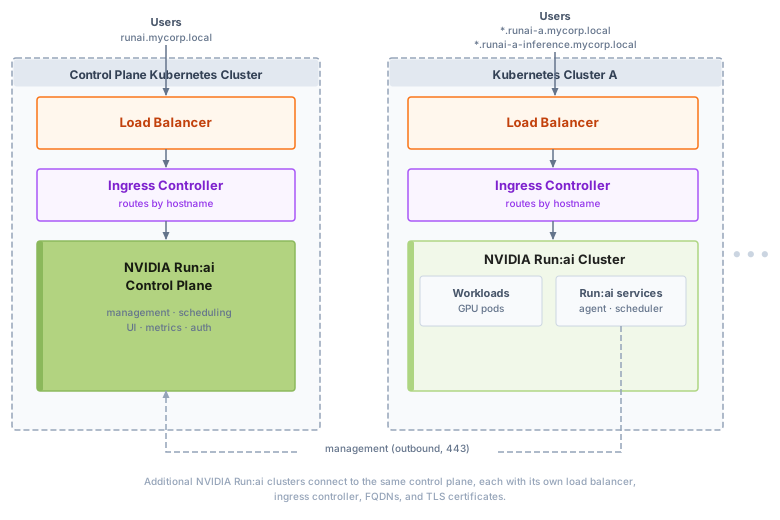
The NVIDIA Run:ai control plane and every tenant’s NVIDIA Run:ai cluster are always deployed on separate Kubernetes clusters: the control plane runs on its own dedicated Kubernetes cluster, managed by the host organization, and each tenant’s NVIDIA Run:ai cluster runs on its own separate Kubernetes cluster. Each tenant cluster requires its own load balancer, ingress controller, FQDNs, and TLS certificates.
Connectivity
NVIDIA Run:ai multi-tenant involves two distinct traffic flows, each with its own connectivity requirements:
- Management traffic (outbound) - Each tenant’s NVIDIA Run:ai cluster services initiate the connection to the control plane FQDN (for example,
tenant-a.runai.hostorg.com) over HTTPS (port 443). In restricted networks, allow outbound HTTPS from each tenant cluster’s nodes to the control plane FQDN. - User access traffic (inbound) - Users and clients require inbound access to:
- The NVIDIA Run:ai control plane, for UI and API access, per tenant.
- Each tenant’s NVIDIA Run:ai cluster, for access to workspaces, training, and inference workloads exposed through that cluster’s load balancer and ingress controller.
Each tenant cluster must be reachable by its own users - this is why the load balancer, ingress controller, and cluster-specific FQDNs and TLS certificates are required per tenant cluster. The control plane’s wildcard domain and certificate are provisioned once, covering every tenant.
The following diagram shows the traffic flows across the control plane and tenant clusters:
Infrastructure by Component
Use the tables below to determine how many of each networking, DNS, and TLS component to provision before you begin installation.
- Single - One component, provisioned once for the control plane, covering every tenant.
- Per tenant cluster - One component required for each tenant cluster.
For setup instructions, see Networking Setup.
Load Balancer and Ingress
Kubernetes
OpenShift
OpenShift ships with a pre-installed router that serves as both load balancer and ingress controller, so no separate installation is required. This applies to tenant clusters running on OpenShift.
DNS
1 Required only if inference workloads are exposed externally.
TLS Certificates
Kubernetes
1 Required only if inference workloads are exposed externally.
OpenShift
This applies to tenant clusters running on OpenShift.