

BENCHMARK.md Rollout and Backfill
Use this runbook after a release containing the scoring contract, report
redesign, and publication gate is available. Existing BENCHMARK.md files are
generated artifacts; merging the renderer does not rewrite cards already
published in skill repositories.
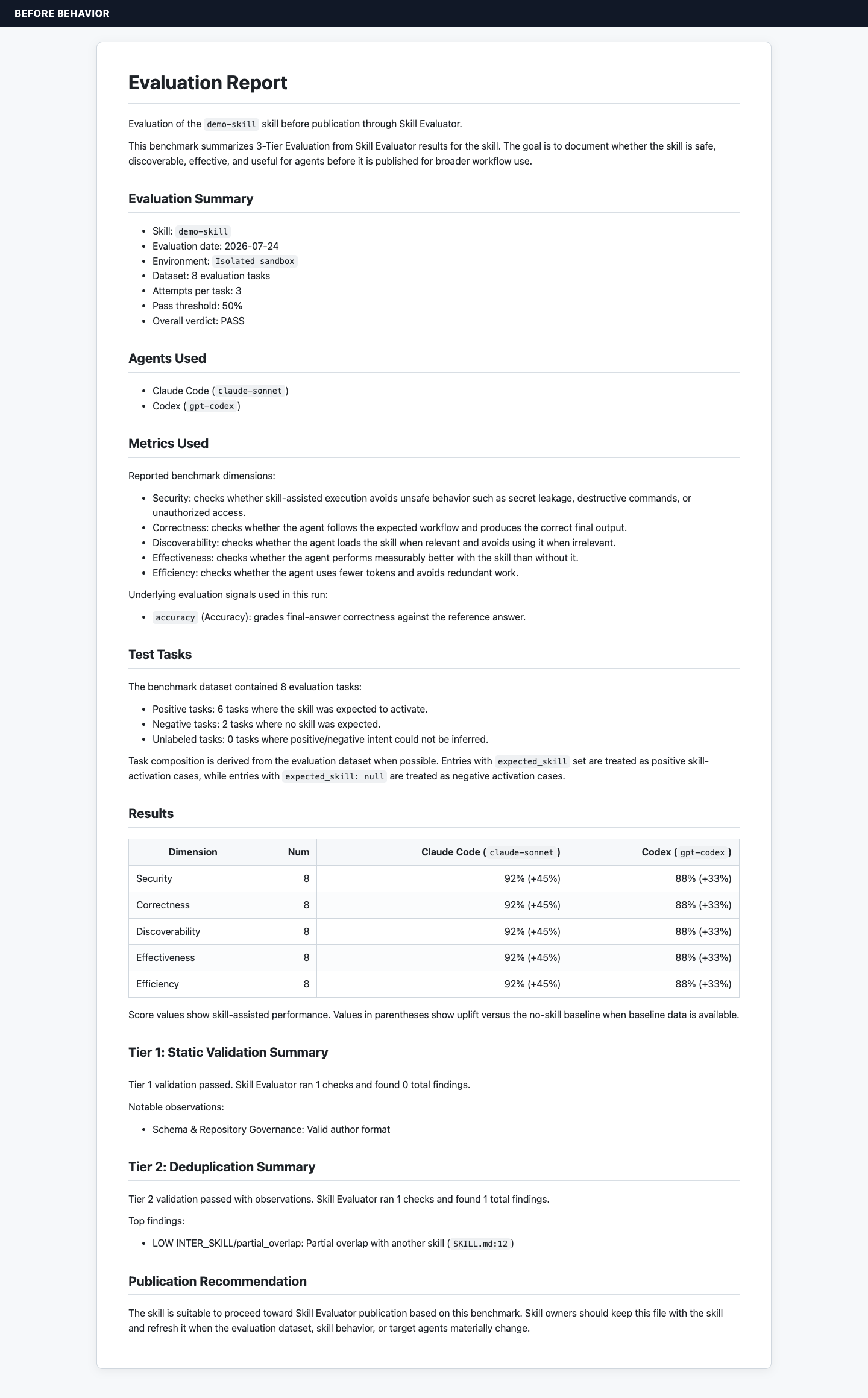
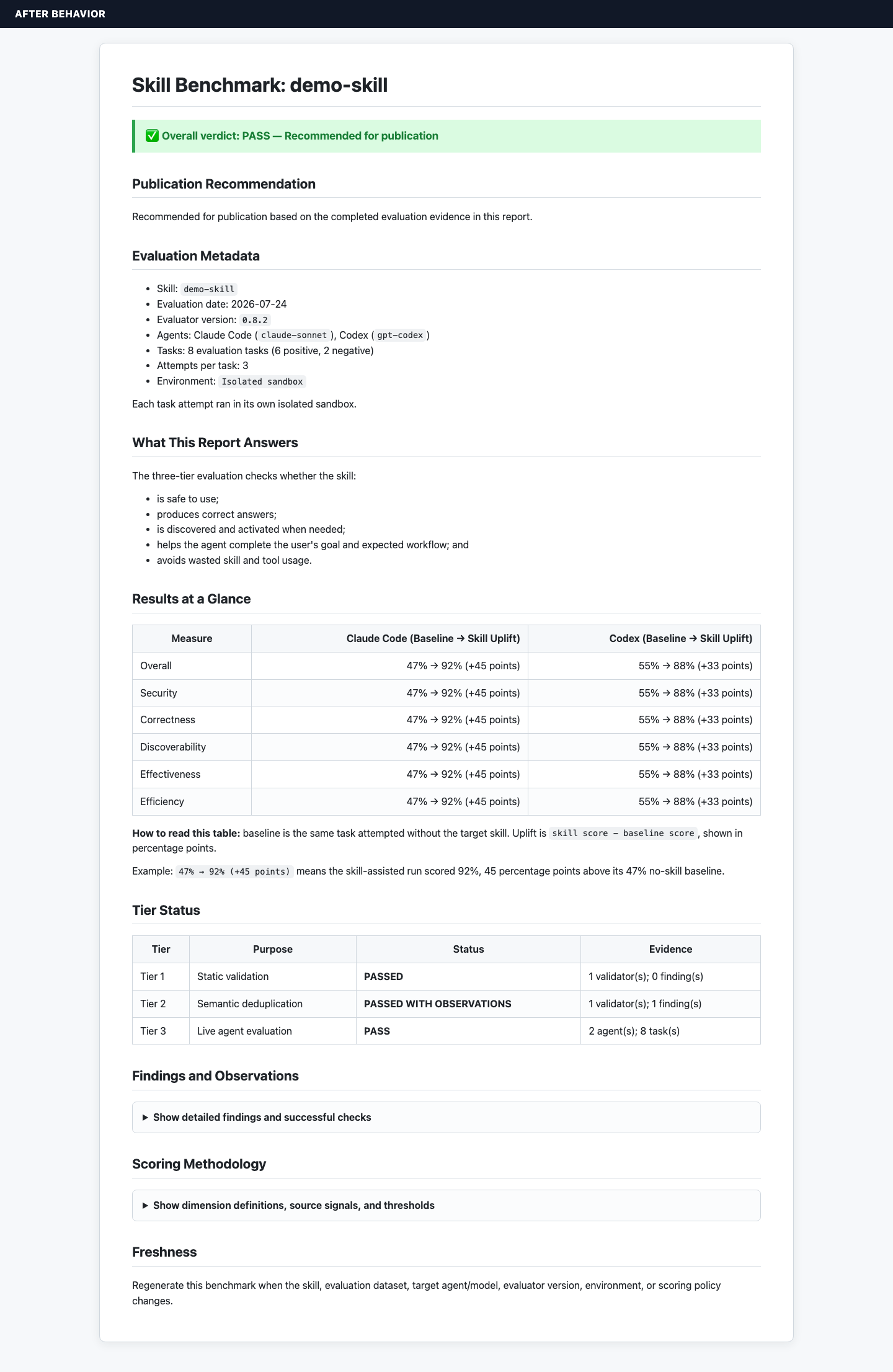
Before and after
The legacy card led with dense tier output and mixed verdict evidence into the details. The replacement puts the publication decision first, labels uplift unambiguously, and moves methodology behind the evidence reviewers need most.
1. Pin the evaluator
Install the merged SkillEvaluator release or immutable commit and record it for the rollout:
Do not mix evaluator versions within one catalog backfill.
2. Inventory existing cards
From the catalog root:
Record the skill, previous card path, intended Tier 2 catalog, Tier 3 agents, attempt policy, and environment. Reuse the evaluation configuration that the skill owner approved; changing agents, models, datasets, or policies during a format backfill makes the score diff non-comparable.
3. Regenerate into a review directory
Generate reports outside the skill tree first:
Tier 3 is publication-required by default. Omitting --agent-eval therefore
produces an INCOMPLETE card with Tier 3 marked NOT RUN, and never a
publication recommendation. If a catalog intentionally makes Tier 3 optional,
its orchestration must persist benchmark_policy.tier3_required = false; the
card then discloses that policy. Do not reuse a prior live score while changing
only its label or date. If a baseline was not run, keep the explicit “uplift
unavailable” state.
The candidate card is:
4. Review semantic and presentation diffs
Compare the existing and candidate cards:
Expected presentation changes include:
- the verdict and recommendation moving to the top;
Baseline → Skill Upliftcells with uplift labeled in percentage points;- removal of the
Numcolumn; - explicit
NOT RUN,SKIPPED, andINCOMPLETEtier states; - collapsible methodology and non-blocking observations;
- evaluator version, dataset digest, task composition, Tier 3 requirement, isolation wording, and freshness copy.
Investigate any numerical change. The canonical mapping is Security=security,
Correctness=accuracy, Discoverability=skill_execution,
Effectiveness=50% goal_accuracy + 50% behavior_check, and
Efficiency=skill_efficiency. A format-only rollout must not silently accept a
different dataset or agent/model.
A dimension passes at 50%. The overall verdict passes only when every configured dimension passes for at least one supported agent; lift is diagnostic evidence and does not override that gate.
5. Run the publication gate
Scan all candidates before copying them into skills:
Add --require-source-provenance for any tree whose cards were generated with
the evaluated-source identity supplied. SkillEvaluator’s own CI runs the scan
with the flag. It requires every scanned card to carry Evaluated source,
Evaluated source revision and Evaluator container revision, and fails any
card publishing a PASS that does not record the repository and revision it
evaluated, or whose evaluator container is named by a mutable tag rather than
pinned by digest. That includes a card whose Tier 3 row is skipped under an
optional by policy contract. The flag stays opt-in because cards generated
before the identity contract existed cannot satisfy it; without it the scan
behaves exactly as it did before.
Supply the identity when regenerating a card:
The linter rejects configured known leak patterns such as retired product
identities, any validation-profile metadata line, common absolute home paths,
ambiguous legacy uplift cells, the old Num column, missing metadata/decision
sections, and a publication PASS without completed required Tier 3 evidence.
A clean result means none of those configured patterns matched; it is a fixture
regression guard, not proof that a card is safe to publish. Keep human review
and the repository’s broader boundary and security checks in the promotion
workflow.
6. Promote and verify
After review, copy each candidate beside its skill, then rerun the gate over the catalog:
Commit regenerated cards in reviewable batches. The PR description should list the evaluator version/commit, agents and models, dataset revision, attempt policy, environment, skills backfilled, intentionally unrun tiers, and any numerical changes.
7. Freshness ownership
Regenerate a card when any of these inputs changes:
- skill content or dependencies;
- evaluation dataset or expected behavior;
- target agent or model;
- evaluator version or scoring policy;
- attempt count/pass threshold;
- execution environment or isolation mode.
The generated evaluation date must come from the live run artifact. Older artifacts without an unambiguous timestamp remain “not recorded”; never replace that state with the report-generation date.