

2. Reference PUSCH Receiver#
A step-by-step PUSCH receiver walkthrough that:
loads pipeline input data from a test vector (TV)
calls each block individually
shows plots along the way
Prerequisites: uv (already installed inside container)
Time: ~5-10 minutes
The pipeline is divided into two parts:
(Steps 3-8) PUSCH Inner Receiver pipeline blocks: Channel Estimation, Equalization and Soft Demapping.
(Steps 9-10) PUSCH Outer Receiver blocks: Descramble, Derate, LDPC decoding, and CRC.
Step 1: Import Dependencies#
Import the required packages from the RAN Python environment. These were installed when the docs environment was set up via CMake.
[ ]:
import sys

from tutorial_utils import get_project_root, is_running_in_docker

# Ensure running inside Docker container
if not is_running_in_docker():
    print("\n❌ This notebook must be run inside the Docker container.")
    print(
        "\nPlease refer to the User Guide for instructions on running "
        "tutorial notebooks in the Docker container."
    )
    sys.exit(1)

PROJECT_ROOT = get_project_root()

# Path to ran python package: aerial-framework/ran/py
ran_py_path = PROJECT_ROOT / "ran" / "py"

print("✅ RAN package is available from docs environment")
print("✅ Step 1 complete: Dependencies imported")
✅ RAN package is available from docs environment
✅ Step 1 complete: Dependencies imported
Step 2: Import & Load Test Vector Data#
The default TV contains everything needed to run the pipeline blocks as in the tests. The data inside the TV was obtained from NVIDIA Aerial 5GModel, a MATLAB implementation of 5G PHY layer, functionally matching MATLAB’s 5G Toolbox.
[ ]:
from pprint import pprint

import matplotlib.pyplot as plt
import numpy as np

from ran.constants import SC_PER_PRB
from ran.phy.numpy import pusch
from ran.utils import hdf5_load

tv_dir = ran_py_path.parent / "test_data"
tv_name = "TVnr_7204_cuPHY_simple.h5"
tv_path = tv_dir / tv_name

# Load PUSCH Inputs (dictionary)
inputs = hdf5_load(tv_path)
with np.printoptions(edgeitems=2):  # show 2 items at the start/end of each dimension
    pprint(inputs)
print("✅ Step 2 complete: Test vector data loaded")
{'bgn': 1,
 'c': 38,
 'energy': 2.0,
 'f': 8,
 'g': 340704,
 'i_ls': 2,
 'k': 8448,
 'k_prime': 8440,
 'layer2ue': array([0]),
 'max_num_itr_cbs': 7,
 'n_dmrs_id': 0,
 'n_f': 3276,
 'n_id': 0,
 'n_prb': 273,
 'n_rnti': 0,
 'n_t': 14,
 'n_ue': 1,
 'nl': 1,
 'nref': 0,
 'nv_parity': 4,
 'port_idx': array([0]),
 'qam_bits': 8,
 'rv_idx': 0,
 'rww_regularizer_val': 1e-08,
 'slot_number': 0,
 'start_prb': 0,
 'sym_idx_data': array([ 0,  1,  3,  4,  5,  6,  7,  8,  9, 10, 11, 12, 13]),
 'sym_idx_dmrs': array([2]),
 'vec_scid': array([0]),
 'xtf': array([[[ 0.09002686-0.21643066j, -0.12756348-0.20129395j,
          0.19348145-0.11785889j,  0.10418701-0.22106934j],
        [ 0.50292969-0.70507812j, -0.30224609-0.80078125j,
          0.80859375-0.25366211j,  0.53417969-0.6640625j ],
        ...,
        [ 1.28710938-0.18566895j,  0.55957031-1.17480469j,
          1.15332031+0.60058594j,  1.30273438-0.13098145j],
        [ 0.59570312-1.01660156j, -0.51025391-1.05371094j,
          1.078125  -0.48095703j,  0.62695312-0.99365234j]],

       [[ 0.94433594-0.49462891j,  0.121521  -1.05859375j,
          1.04785156+0.15075684j,  0.97021484-0.44702148j],
        [ 0.96289062-0.27514648j,  0.29736328-0.94628906j,
          0.94140625+0.33691406j,  0.96582031-0.23547363j],
        ...,
        [-1.16992188+0.296875j  , -0.39819336+1.14257812j,
         -1.12402344-0.44238281j, -1.1875    +0.22937012j],
        [-0.90576172-0.68505859j, -1.08886719+0.36889648j,
         -0.32714844-1.11230469j, -0.88427734-0.73535156j]],

       ...,

       [[ 0.3046875 -0.23669434j, -0.02391052-0.37866211j,
          0.390625  -0.01244354j,  0.3215332 -0.22375488j],
        [-0.49658203+0.69189453j,  0.29296875+0.80078125j,
         -0.79443359+0.26782227j, -0.52929688+0.66015625j],
        ...,
        [ 0.05465698-0.65917969j, -0.50488281-0.41601562j,
          0.43603516-0.48193359j,  0.09832764-0.66503906j],
        [-0.95361328+0.28857422j, -0.30004883+0.95361328j,
         -0.94189453-0.33935547j, -0.97509766+0.23571777j]],

       [[-0.84570312+0.16320801j, -0.32666016+0.81396484j,
         -0.79296875-0.3605957j , -0.87060547+0.12371826j],
        [ 0.22839355+0.09051514j,  0.20129395-0.1348877j ,
          0.11297607+0.20275879j,  0.23425293+0.11810303j],
        ...,
        [ 1.015625  +0.36547852j,  0.87402344-0.625j     ,
          0.58349609+0.88330078j,  0.98144531+0.42724609j],
        [-0.51513672+0.47290039j,  0.11297607+0.69677734j,
         -0.68457031+0.0758667j , -0.53125   +0.43896484j]]]),
 'zc': 384}
✅ Step 2 complete: Test vector data loaded
Step 3: RE Demapping#
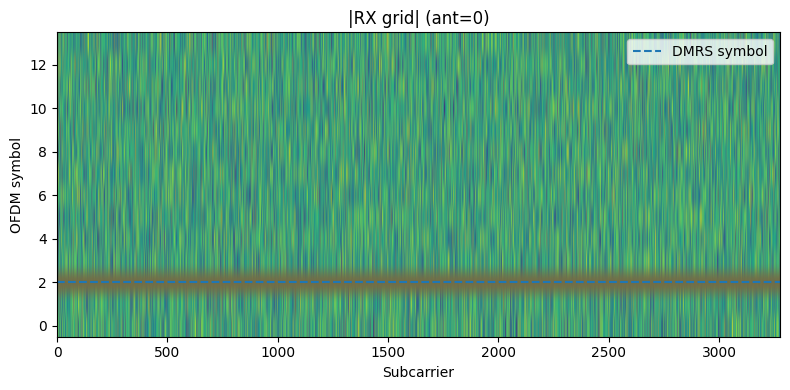
The first operation is extracting the Data and the Demodulation Reference Signal (DMRS) REs.
[ ]:
# Split RX grid into PRB band and DMRS/DATA symbol sets
rx_grid = inputs["xtf"]  # (n_f, n_t, n_ant)
n_f_start = SC_PER_PRB * inputs["start_prb"]
n_f_end = n_f_start + SC_PER_PRB * inputs["n_prb"]
freq_slice = slice(n_f_start, n_f_end)

dmrs_sym = rx_grid[freq_slice, inputs["sym_idx_dmrs"], :]  # (nf, n_dmrs, n_ant)
data_sym = rx_grid[freq_slice, inputs["sym_idx_data"], :]  # (nf, n_data, n_ant)
print("✅ Step 3 complete: RE demapping finished")
[ ]:
# Plot RX grid (ant=0)
nf, nt, nant = rx_grid.shape
plt.figure(figsize=(8, 4))
plt.imshow(np.abs(rx_grid[:, :, 0]).T, aspect="auto", origin="lower")
plt.title("|RX grid| (ant=0)")
plt.xlabel("Subcarrier")
plt.ylabel("OFDM symbol")

# Overlay DMRS and DATA symbol indices
for s in np.atleast_1d(inputs["sym_idx_dmrs"]):
    plt.axhline(y=s, linestyle="--", label="DMRS symbol")
plt.legend()
plt.tight_layout()
plt.show()
Step 4: DMRS Generation, Extraction & Channel Estimation#
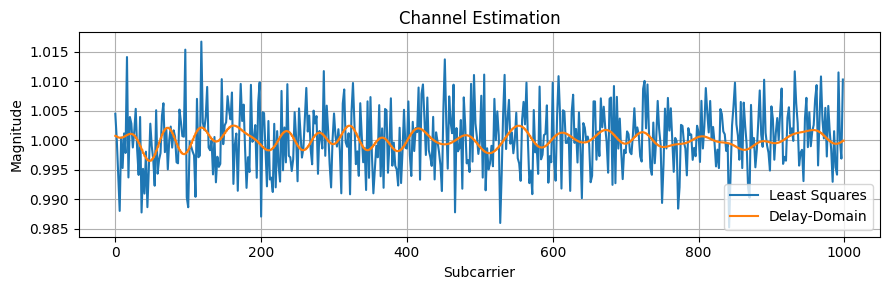
Next, we generate the DMRS symbols that were sent by the transmitter (x_dmrs), and extract the received DMRS symbols from the RX grid REs (y_dmrs). Using x_dmrs and y_dmrs, we can estimate the channel (h_est).
[ ]:
# DMRS symbol generation (gold sequence + QPSK mapping)
r_dmrs, _ = pusch.gen_dmrs_sym(
    slot_number=inputs["slot_number"],
    n_f=rx_grid.shape[0],
    n_dmrs_id=inputs["n_dmrs_id"],
    sym_idx_dmrs=inputs["sym_idx_dmrs"],
)

# Compute Transmitted DMRS (Symbols -> Orthogonal Cover Codes -> Scrambling)
x_dmrs = pusch.embed_dmrs_ul(
    r_dmrs=r_dmrs,
    nl=inputs["nl"],
    port_idx=inputs["port_idx"],
    vec_scid=inputs["vec_scid"],
    energy=inputs["energy"],
)
# Extract Received DMRS REs from RX grid
y_dmrs = pusch.extract_raw_dmrs_type_1(
    xtf_band_dmrs=dmrs_sym,
    nl=inputs["nl"],
    port_idx=inputs["port_idx"],
)

# Least Squares Channel Estimation
h_est_ls = pusch.channel_est_ls(x_dmrs=x_dmrs / 2, y_dmrs=y_dmrs)  # (6*n_prb, n_layers, n_ant)

# Delay-domain Channel Estimation (w/ truncation + interpolation)
h_est = pusch.channel_est_dd(
    x_dmrs=x_dmrs / 2, y_dmrs=y_dmrs
)  # (12*n_prb, n_layers, n_ant, n_dmrs)
[ ]:
# Plot Channel Estimation Comparison
plt.figure(figsize=(9, 3))
n_sc = 1000  # number of subcarriers to plot
x = np.arange(n_sc)
h = h_est[:n_sc, 0, 0, 0]  # single layer, single antenna, single dmrs symbol
h_ls = h_est_ls[: n_sc // 2, 0, 0]  # LS only on even subcarriers
plt.plot(x[::2], np.abs(h_ls), label="LS")
plt.plot(x, np.abs(h), label="DD")
plt.title("Channel Estimation")
plt.xlabel("Subcarrier")
plt.ylabel("Magnitude")
plt.legend(["Least Squares", "Delay-Domain"])
plt.tight_layout()
plt.grid()
plt.show()
print("✅ Step 4 complete: DMRS generation and channel estimation finished")
✅ Step 4 complete: DMRS generation and channel estimation finished
Step 5: Noise/Interference Covariance Estimation#
Next, we need to estimate the contribution of noise and interference in the received signal to perform the MMSE-IRC equalization in the next step. We compute the covariance matrix of the noise and interference (n_cov).
[ ]:
n_cov, mean_noise_var = pusch.estimate_covariance(
    xtf_band_dmrs=dmrs_sym,
    x_dmrs=x_dmrs,
    h_est_band_dmrs=h_est,
    rww_regularizer_val=inputs["rww_regularizer_val"],
)  # (n_ant, n_ant, n_prb, n_pos)
print("✅ Step 5 complete: Noise/interference covariance estimated")
Step 6: Pre-equalization Metrics: Noise, RSRP, SINR, RSSI#
Using the estimated channel and covariance, we can estimate the noise variance, RSRP, and SINR.
[ ]:
# Measure RSSI based on DMRS REs
dmrs_rssi_db, dmrs_rssi_reported_db = pusch.measure_rssi(xtf_band_dmrs=dmrs_sym)

# Estimate Noise, RSRP, SINR
noise_db, rsrp_db, sinr_db = pusch.noise_rsrp_sinr_db(
    mean_noise_var=mean_noise_var,
    h_est=h_est,
    layer2ue=inputs["layer2ue"],
    n_ue=inputs["n_ue"],
)
print("✅ Step 6 complete: Pre-equalization metrics computed")
Step 7: Equalization and Post-Equalization Metrics#
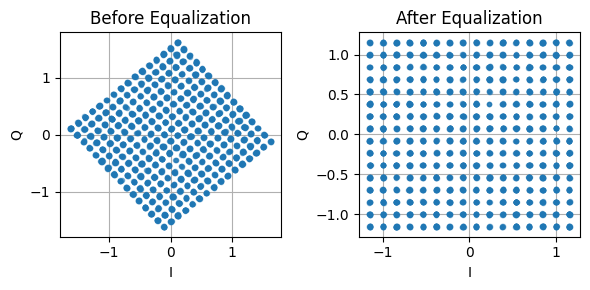
Now, the data symbols (data_sym) are equalized using the estimated channel (h_est) and the noise/interference covariance (n_cov).
Additional metrics are computed after equalization, like the post-equalization noise variance and SINR. These metrics can be useful for Layer 2 processing.
[ ]:
# 1) Equalization (MMSE-IRC)
x_est, ree = pusch.equalize(
    h_est=h_est,
    noise_intf_cov=n_cov,
    xtf_data=data_sym,
)

# 2) Post-Equalization Metrics (Noise, SINR)
post_noise_db, post_sinr_db = pusch.post_eq_noisevar_sinr(
    ree=ree,
    layer2ue=inputs["layer2ue"],
    n_ue=inputs["n_ue"],
)
[ ]:
# Plot Equalization Results (one antenna, one data symbol)
x_raw = data_sym[:, 0, 0]  # complex REs before equalization
x_eq = x_est[:, 0, 0]  # complex symbols after equalization
fig, axs = plt.subplots(1, 2, figsize=(6, 3), tight_layout=True)
axs[0].plot(x_raw.real, x_raw.imag, ".", alpha=0.5)
axs[0].set_title("Before Equalization")
axs[1].plot(x_eq.real, x_eq.imag, ".", alpha=0.5)
axs[1].set_title("After Equalization")
for a in axs:
    a.set_xlabel("I")
    a.set_ylabel("Q")
    a.grid()
print("✅ Step 7 complete: Equalization and post-equalization metrics computed")
✅ Step 7 complete: Equalization and post-equalization metrics computed
Step 8: Soft Demapping#
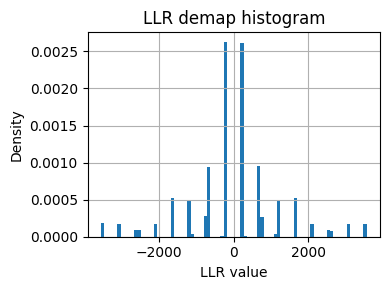
Based on the equalized symbols (x_est), determine the log-likelihood ratios (LLRs) for each bit.
[ ]:
# Soft demap the equalized symbols to obtain the Log-Likelihood Ratios (LLRs)
llr_demap = pusch.soft_demapper(
    x=x_est,
    ree=ree,
    qam_bits=inputs["qam_bits"],
)  # (bits_per_sym, n_layer, n_tone, n_sym)
[ ]:
# Plot LLR histogram
plt.figure(figsize=(4, 3))
plt.hist(llr_demap.ravel(), bins=80, density=True)
plt.title("LLR demap histogram")
plt.xlabel("LLR value")
plt.ylabel("Density")
plt.tight_layout()
plt.grid()
plt.show()
print("✅ Step 8 complete: Soft demapping finished")
✅ Step 8 complete: Soft demapping finished
[ ]:
# Print intermediate checks
print("Intermediate checks:")
pprint(
    {
        "noiseVardB": noise_db,  # noise variance in dB
        "rsrpdB": rsrp_db,  # RSRP in dB
        "sinrdB": sinr_db,  # SINR in dB
        "postEqNoiseVardB": post_noise_db,  # post-equalization noise variance in dB
        "postEqSinrdB": post_sinr_db,  # post-equalization SINR in dB
        "dmrsRssiDb": dmrs_rssi_db,  # per-antenna RSSI in dB
        "dmrsRssiReportedDb": dmrs_rssi_reported_db,  # aggregated RSSI in dB
    }
)
Intermediate checks:
{'dmrsRssiDb': array([[35.15462438, 35.15348961, 35.15122565, 35.15431664]]),
 'dmrsRssiReportedDb': 41.17401418808193,
 'noiseVardB': array([-39.62617382]),
 'postEqNoiseVardB': array([[-40.]]),
 'postEqSinrdB': array([[40.]]),
 'rsrpdB': array([[-0.00044649]]),
 'sinrdB': array([[39.62572733]])}
Step 9: Outer receiver pipeline: Descramble, Derate, LDPC, CB concat, CRC#
The remaining blocks handle the decoding of the transport block (TB) payload.
[ ]:
# Descramble the LLRs
llr_descr = pusch.descramble_bits(
    llrseq=llr_demap.ravel(order="F"),
    n_id=inputs["n_id"],
    n_rnti=inputs["n_rnti"],
)

# De-rate match the codeblocks
derate_cbs, nv_parity, derate_cbs_idxs, derate_cbs_sizes = pusch.derate_match(
    llr_descr=llr_descr,
    bgn=inputs["bgn"],
    c=inputs["c"],
    qam_bits=inputs["qam_bits"],
    k=inputs["k"],
    f=inputs["f"],
    k_prime=inputs["k_prime"],
    zc=inputs["zc"],
    nl=inputs["nl"],
    rv_idx=inputs["rv_idx"],
    nref=inputs["nref"],
    g=inputs["g"],
)

# LDPC decode the codeblocks
tb_cbs_est, num_itr = pusch.ldpc_decode(
    derate_cbs=derate_cbs,
    nv_parity=nv_parity,
    zc=inputs["zc"],
    c=inputs["c"],
    bgn=inputs["bgn"],
    i_ls=inputs["i_ls"],
    max_num_itr_cbs=inputs["max_num_itr_cbs"],
)

# Concatenate the codeblocks into a single transport block
tb_crc_est_vec, cb_err = pusch.codeblock_concatenation(
    tb_cbs_est=tb_cbs_est,
    c=inputs["c"],
    k_prime=inputs["k_prime"],
)

# CRC decode the complete transport block
tb_est, tb_err = pusch.crc_decode(tb_crc_est=tb_crc_est_vec)
[ ]:
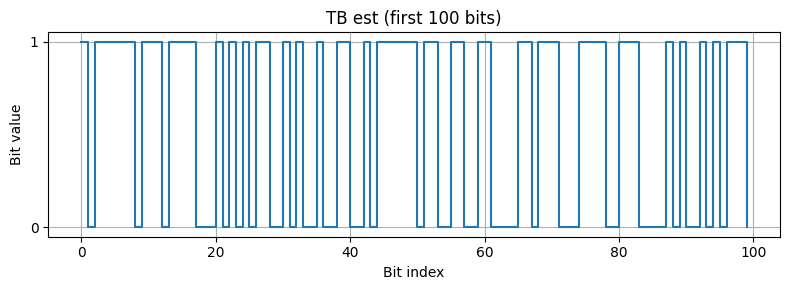
# Plot first n_bits bits of the payload (tb_est)
n_bits = 100
plt.figure(figsize=(8, 3))
plt.step(range(n_bits), tb_est[:n_bits], where="post")
plt.title(f"TB est (first {n_bits} bits)")
plt.xlabel("Bit index")
plt.ylabel("Bit value")
plt.yticks([0, 1])
plt.tight_layout()
plt.grid()
plt.show()
print("✅ Step 9 complete: Outer receiver pipeline finished")
✅ Step 9 complete: Outer receiver pipeline finished
[ ]:
# Print high-level outer receiver statistics
stats = {
    "num_codeblocks": int(inputs["c"]),
    "total_llr_bits": llr_demap.size,
    "avg_ldpc_iterations_per_cb": float(np.mean(num_itr)),
    "codeblock_crc_errors": int(np.sum(cb_err)),
    "tb_payload_bits": tb_est.size,  # payload + CRCs
    "tb_crc_bits": tb_crc_est_vec.size - tb_est.size,
    "tb_crc_errors": int(tb_err),
    "effective_code_rate": round(float(tb_est.size / llr_demap.size), 3),
    "avg_payload_bits_per_cb": round(float(tb_est.size / inputs["c"]), 3),
}

pprint(stats)
{'avg_ldpc_iterations_per_cb': 7.0,
 'avg_payload_bits_per_cb': 8415.368,
 'codeblock_crc_errors': 0,
 'effective_code_rate': 0.939,
 'num_codeblocks': 38,
 'tb_crc_bits': 24,
 'tb_crc_errors': 0,
 'tb_payload_bits': 319784,
 'total_llr_bits': 340704}
Step 10: Full receiver pipeline#
The complete receiver pipeline can be run with a single call.
[ ]:
outputs = pusch.pusch_rx(inputs)  # full receiver pipeline (inner + outer)

# Validate full pipeline vs. step-by-step outputs
sinr_match = np.allclose(sinr_db, outputs["sinrdB"])
llr_match = np.allclose(llr_demap, outputs["LLR_demap"])
payload_match = np.allclose(tb_est, outputs["Tb_est"])
if sinr_match and llr_match and payload_match:
    print("✅ Full pipeline matches step-by-step results.")
print("✅ Step 10 complete: Full receiver pipeline verified")
✅ Full pipeline matches step-by-step results.
✅ Step 10 complete: Full receiver pipeline verified
Next Steps#
Convert the inner receiver to JAX and compile it to a TRT engine. See next tutorial.
Explore#
NumPy pipeline:
ran/py/src/ran/phy/numpyJAX pipeline:
ran/py/src/ran/phy/jaxTutorials:
docs/tutorials/
Troubleshooting#
Not running in Docker? This notebook must be run inside the Docker container. See the User Guide for instructions on running tutorial notebooks in the Docker container.
RAN package import fails? Ensure the docs Python environment is set up:
uv run ./scripts/setup_python_env.py setup docs --extras dev ran_mlir_trt(or ran_base if MLIR-TRT is disabled)Missing ipynb notebook? Run
uv run ./scripts/setup_python_env.py jupytext_convert docsto convert the notebooks to ipynb files. Execute from the top-level aerial-framework directory. The notebook files are generated indocs/tutorials/generated/.Cannot serve notebook? Run
uv run jupyter-lab --notebook-dir=docs/tutorials/generatedto serve the notebooks. Execute from the top-level aerial-framework directory. The link to jupyterlab is displayed in the terminal.