

NVIDIA BioNeMo Inference Runtime
About BioNeMo Inference Runtime
NVIDIA BioNeMo Inference Runtime (BioIR) is NVIDIA’s Python library for accelerating biomolecular structure model inference on NVIDIA GPUs. It provides biology-aware PyTorch modules, GPU kernels, and graph optimizations for architecture-specific operations. These operations include Evoformer stacks and triangle operations 1, and Pairformer stacks, attention with pair bias (pairwise attention), diffusion transformers, and atom-level modules 2.
General-purpose inference stacks do not fully optimize these specialized operations. BioIR is designed for foundation-model developers and machine learning researchers who create or modify biomolecular architectures. It improves model-execution throughput and reduces GPU memory pressure while preserving a Python development workflow.
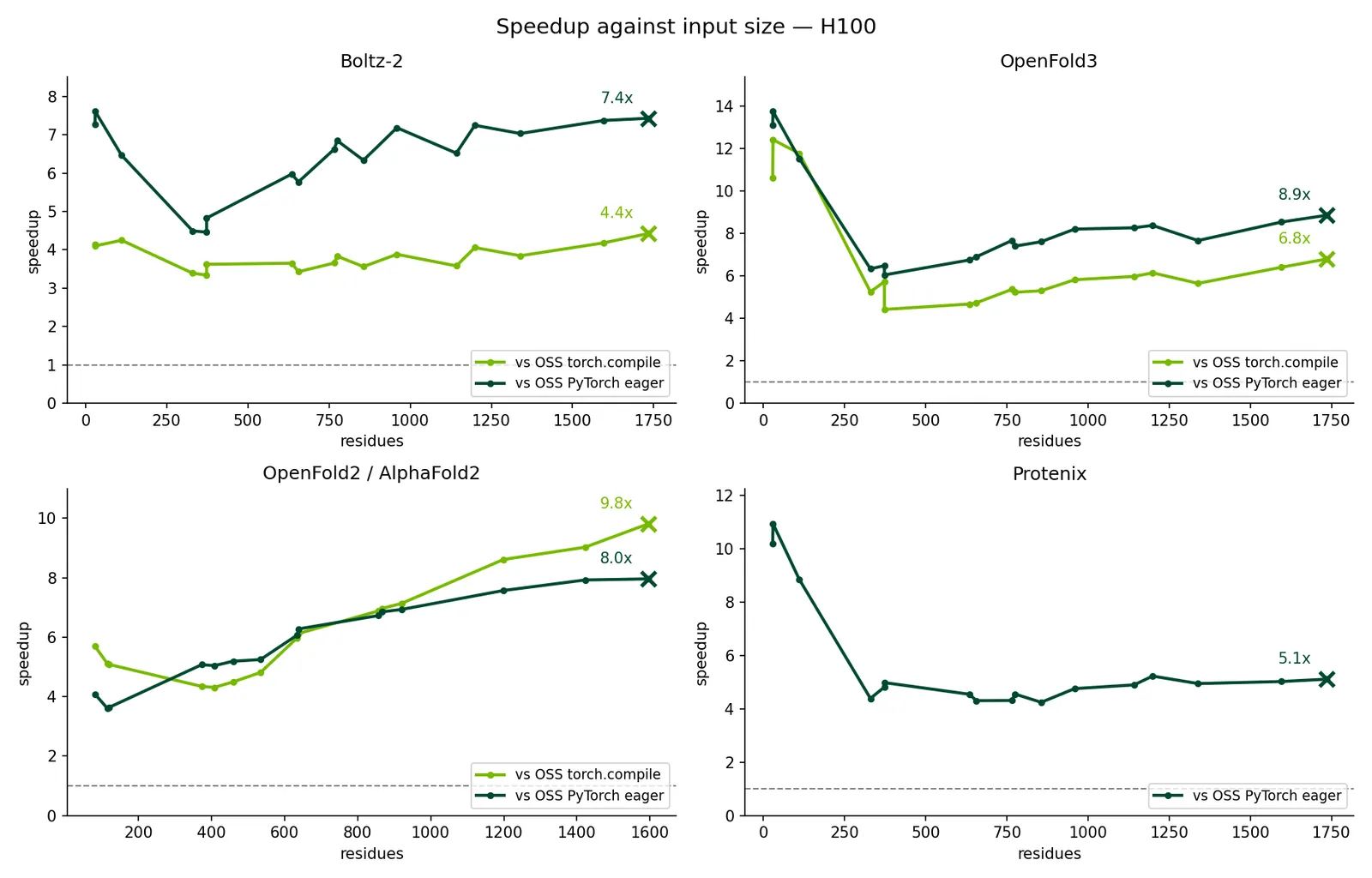
The following chart shows how BioIR speedup changes with input size on an NVIDIA H100 GPU.
Disclaimer
BioIR is in a Beta state, may not be fully functional, may contain errors or design flaws, and may be changed at any time without notice. We appreciate your feedback to improve and iterate on our products.
Key Capabilities
BioIR provides the following key capabilities:
-
Architected on PyTorch: A BioIR model remains an ordinary
torch.nn.Module. No engine build, export step, or separate build artifact sits between a checkpoint and a forward pass. You can inspect tensors and use standard Python stack traces. Plain configuration fields select optimized layers, with documented PyTorch fallbacks for supported paths. -
Built for biomolecular architectures: BioIR applies optimizations at three levels: kernels, modules and layers, and the end-to-end pipeline. Custom CuTeDSL kernels and CUDA graphs use NVIDIA GPU capabilities to accelerate structure-prediction patterns and supported modules. Pipeline orchestration overlaps data loading, featurization, and output writing with the GPU forward pass. Refer to how BioIR accelerates.
-
Lower GPU memory pressure: Fused kernels reduce intermediate materialization. Output-row chunking bounds peak activations for
O(N^2)pair tensors. Precomputed masks avoid rebuilding the same attention data in every layer. Refer to where the memory savings come from. -
Supported hardware and models: BioIR supports mixed FP32 and BF16 execution across data center and workstation GPUs. Six are qualified for this release; the rest of the matrix runs but is not part of that set. The support matrix lists model keys, input coverage, GPU architectures, and fused-kernel availability.
Choose How to Use BioIR
BioIR supports two inference workflows:
- Run a supported model end to end. Run OpenFold2, AlphaFold2, OpenFold3, Boltz-1, or Boltz-2 through the complete prediction pipeline.
- Accelerate a custom model. Keep your architecture and replace matching components with optimized BioIR modules, such as a Pairformer stack or diffusion transformer 2.
Your custom model does not need to belong to a supported end-to-end family. It only needs to contain a module that BioIR optimizes. Refer to the two inference workflows for implementation details, and to Accelerate a Custom Model for the step-by-step swap.
Choose an Executor
For large batches of independent inputs, use the Ray executor to improve end-to-end throughput. Ray streams inputs through independently scalable preprocessing, GPU inference, and output-writing stages, so CPU work on one batch can run while GPUs process another. The inference stage assigns one complete model replica to each GPU, which lets available GPUs process different inputs concurrently.
Ray does not split one prediction across multiple GPUs or reduce its individual latency. Use the serial executor for debugging and per-request timing.
Refer to Ray multi-GPU replicas for configuration details.
The following diagram shows how the Ray executor processes independent inputs across CPU stages and complete GPU model replicas.
Target Workloads
BioIR targets large-scale structure inference workloads.
- High-throughput protein design — generate and evaluate large candidate sets with hybrid generative and folding models.
- Synthetic data generation — produce structures in bulk for self-distillation, retraining, and fine-tuning.
- Folding-based scoring filters — screen and rank generative output by structural plausibility before committing to wet-lab work.
- Structure prediction alongside docking — supplement early-stage protein-ligand and protein-protein screening with structure predictions.
BioIR accelerates the GPU model-execution layer. It does not accelerate database search, MSA generation, experimental data preparation, or the remaining design-to-lab workflow. End-to-end gains still depend on how much time remains in the model forward pass after preprocess.
Related proteome-scale structure prediction work is described in:
- How to Accelerate Protein Structure Prediction at Proteome Scale
- AlphaFold Database expands to proteome-scale quaternary structures.
Start Here
The notice and disclaimer applies to separately downloaded dependencies, model checkpoints, and metadata.
Notice and Disclaimer
The following notice applies to separately downloaded components, including runtime dependencies, model checkpoints, and chemical metadata.
NOTICE AND DISCLAIMER: This software automatically retrieves, accesses or interacts with external materials. Those retrieved materials are not distributed with this software and are governed solely by separate terms, conditions and licenses. You are solely responsible for finding, reviewing and complying with all applicable terms, conditions, and licenses, and for verifying the security, integrity and suitability of any retrieved materials for your specific use case. This software is provided “AS IS”, without warranty of any kind. The author makes no representations or warranties regarding any retrieved materials, and assumes no liability for any losses, damages, liabilities or legal consequences from your use or inability to use this software or any retrieved materials. Use this software and the retrieved materials at your own risk.
Footnotes
-
Jumper et al., “Highly accurate protein structure prediction with AlphaFold”, Nature 596, 583–589 (2021). ↩
-
Abramson et al., “Accurate structure prediction of biomolecular interactions with AlphaFold 3”, Nature 630, 493–500 (2024). ↩ ↩2