

Multi-GPU and Multi-Node Training
Isaac Lab supports multi-GPU and multi-node reinforcement learning. Currently, this feature is only available for RL-Games, RSL-RL and skrl libraries workflows. We are working on extending this feature to other workflows.
Multi-GPU and multi-node training is only supported on Linux. Windows support is not available at this time. This is due to limitations of the NCCL library on Windows.
Multi-GPU Training
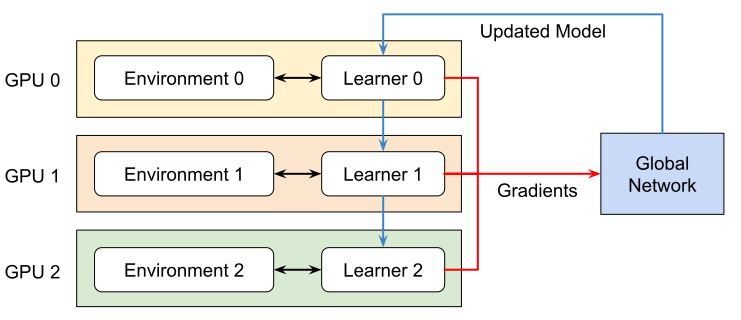
For complex reinforcement learning environments, it may be desirable to scale up training across multiple GPUs. This is possible in Isaac Lab through the use of the PyTorch distributed framework or the JAX distributed module respectively.
In PyTorch, the torch.distributed API is used to launch multiple processes of training, where the number of
processes must be equal to or less than the number of GPUs available. Each process runs on
a dedicated GPU and launches its own instance of Isaac Sim and the Isaac Lab environment.
Each process collects its own rollouts during the training process and has its own copy of the policy
network. During training, gradients are aggregated across the processes and broadcasted back to the process
at the end of the epoch.
In JAX, since the ML framework doesn’t automatically start multiple processes from a single program invocation, the skrl library provides a module to start them.
To train with multiple GPUs, use the following command, where --nproc_per_node represents the number of available GPUs:
rl_games
rsl_rl
skrl
Multi-Node Training
To scale up training beyond multiple GPUs on a single machine, it is also possible to train across multiple nodes. To train across multiple nodes/machines, it is required to launch an individual process on each node.
For the master node, use the following command, where --nproc_per_node represents the number of available GPUs, and
--nnodes represents the number of nodes:
rl_games
rsl_rl
skrl
Note that the port (5555) can be replaced with any other available port.
For non-master nodes, use the following command, replacing --node_rank with the index of each machine:
rl_games
rsl_rl
skrl
For more details on multi-node training with PyTorch, please visit the PyTorch documentation. For more details on multi-node training with JAX, please visit the skrl documentation and the JAX documentation.
As mentioned in the PyTorch documentation, “multi-node training is bottlenecked by inter-node communication latencies”. When this latency is high, it is possible multi-node training will perform worse than running on a single node instance.