


Fine-Grained Activation Offloading#
Contributed in collaboration with RedNote.
Fine-grained activation offloading reduces GPU memory by asynchronously transferring activations to CPU at the granularity of individual submodules within a transformer layer. Unlike layer-level offloading, it allows precise control over which activations to offload, enabling a tradeoff between memory savings and PCIe bandwidth overhead.
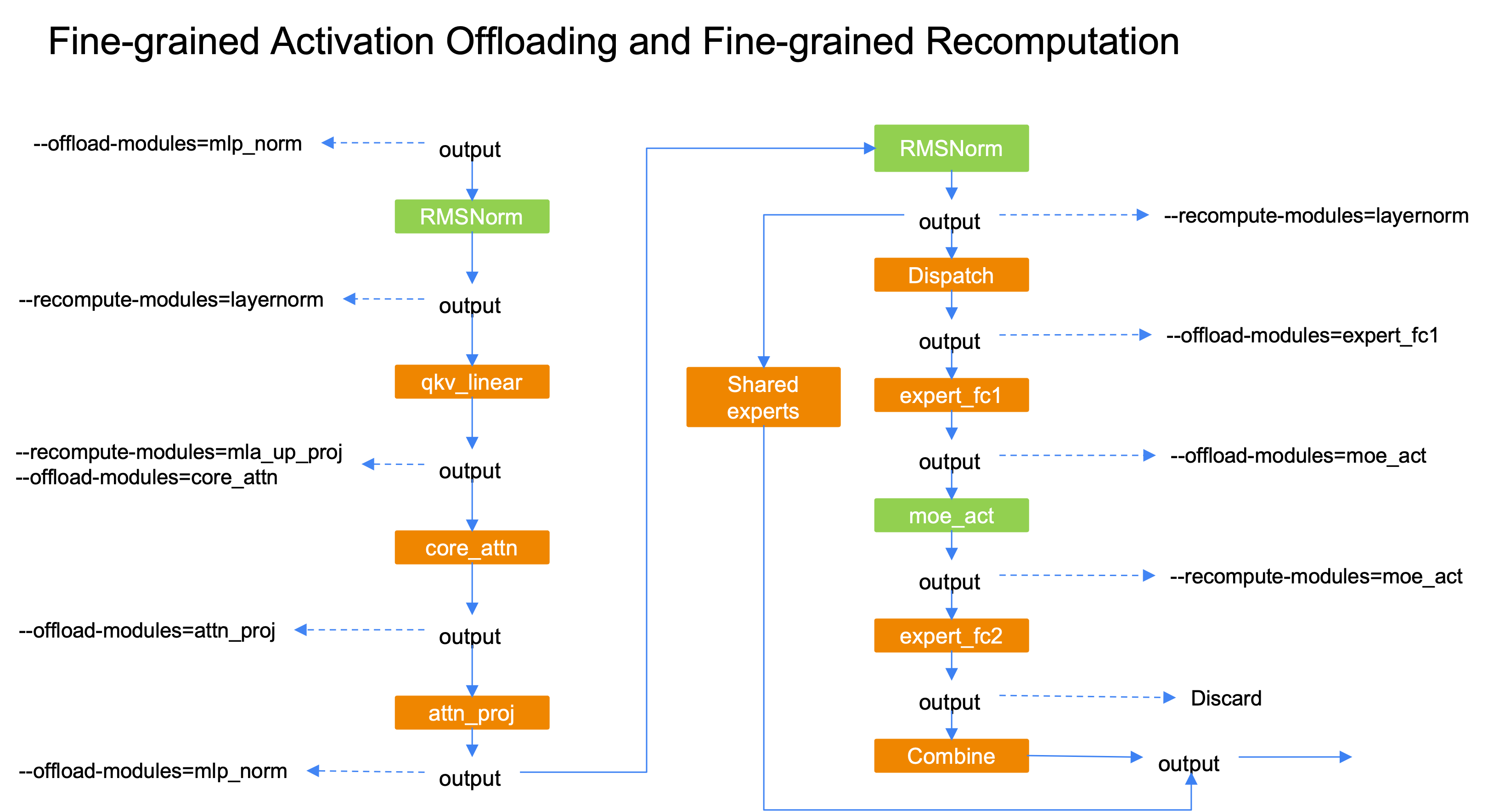
Supported offloading modules are "attn_norm", "qkv_linear", "core_attn", "attn_proj", "mlp_norm", "expert_fc1", "moe_act", "fused_group_mlp", and "shortcut_post_norm". They can be combined with fine-grained recomputation to free almost all activations for a transformer layer on the device. fused_group_mlp requires --use-transformer-engine-op-fuser and offloads the whole fused grouped MLP, so it cannot be combined with expert_fc1 or moe_act. shortcut_post_norm requires --moe-shortcut-connection.
User Guide#
Basic Usage#
# Enable fine-grained activation offloading
--fine-grained-activation-offloading

# Modules whose inputs are offloaded (refer to your training script for list or delimiter syntax).
# Choices: "attn_norm", "qkv_linear", "core_attn", "attn_proj", "mlp_norm", "expert_fc1", "moe_act", "fused_group_mlp", "shortcut_post_norm".
--offload-modules core_attn attn_proj expert_fc1
Offloadable Modules#
Each module offloads its input activation to CPU during forward and reloads it before backward:
Module |
Description |
Notes |
|---|---|---|
|
Input layernorm of attention |
Skipped if using |
|
QKV linear projection |
|
|
Core attention (softmax + matmul) |
|
|
Output projection of attention |
Must be used together with |
|
Pre-MLP layernorm |
Skipped if using |
|
First FC layer in MoE experts |
MoE models only |
|
Activation function in MoE experts |
MoE models only |
|
Whole fused grouped MLP |
Requires |
|
Shortcut post-combine normalization |
Requires |
Tuning Parameters#
# Minimum tensor size (in elements) to offload. Smaller tensors are skipped.
# Default: 1048576 (1M elements)
--min-offloaded-tensor-size 1048576

# Fraction of activations to offload, range [0, 1]. Default: 1.0
# Useful for partial offloading when PCIe bandwidth is a bottleneck.
--activation-offload-fraction 0.8

# Reduce offload amount on higher PP ranks (in bytes). Default: 0
# Higher PP ranks have fewer microbatches in flight, so offloading less
# reduces overhead without increasing peak memory.
--delta-offload-bytes-across-pp-ranks 1073741824

# Optional: cap inflight D2H offloads per offload group to N (omit or None in most setups).
# Required as a non-None non-negative integer when fine-grained activation offloading is used with
# local full-iteration CUDA graphs (full_iteration in cuda_graph_scope); see prose below.
--fine-grained-offloading-max-inflight-offloads <N>
TransformerConfig.fine_grained_offloading_max_inflight_offloads caps, per offload group (for example moe_act, qkv_linear), how many D2H copies may be in flight before a main-stream wait_event. 0 waits after each offload; larger values allow more overlap; None skips these joins.
With full-iteration CUDA graphs (local graph impl, full_iteration in cuda_graph_scope) and fine-grained activation offloading enabled, set it to a non-None integer: that path does not rely on record_stream, so explicit joins are required.
Activation Offload Fraction#
--activation-offload-fraction (TransformerConfig.activation_offload_fraction) is a fraction
over eligible offload groups, not a byte fraction and not a selector for which module names are
enabled. It is used together with --offload-modules: all module names listed in
--offload-modules still register their offload groups, and the fraction is applied once across
the combined eligible groups from all configured modules.
The manager keeps the first N% of eligible groups in forward execution order and leaves the later
groups on GPU. For example, with
--offload-modules core_attn attn_proj expert_fc1 --activation-offload-fraction 0.5, the eligible
core_attn, attn_proj, and expert_fc1 groups are considered together in execution order, and
the first 50% of that combined group list are offloaded. The fraction does not mean “offload 50% of
the activation bytes” and does not mean “offload only the first 50% of the module names”.
The fraction is applied after other eligibility filters such as min_offloaded_tensor_size, the
last-group margin used to avoid backward reload stalls, and
delta_offload_bytes_across_pp_ranks. Therefore N% is computed over the remaining eligible groups
from all configured offload modules after those filters.
CUDA Graph Integration#
Fine-grained offloading is compatible with CUDA graphs. When CUDA graph is enabled, the following constraints apply:
attn_normandmlp_normcannot be offloaded (they cross CUDA graph boundaries).cuda_graph_scopemust includeattnandmoe_router.cuda_graph_implmust betransformer_engine.Requires
torch >= 2.9.0andtransformer_engine >= 2.14.0.
# Optional: defer D2H enqueue for offloads *outside* cuda_graph_scope (MoE experts; see below)
--delay-offload-until-cuda-graph
--delay-offload-until-cuda-graph (TransformerConfig.delay_offload_until_cuda_graph)
Inside vs outside cuda_graph_scope. Offload boundaries that lie inside the captured cuda_graph_scope (for example qkv_linear, core_attn, and attn_proj when attn is in scope) are part of CUDA graph capture and replay. Their offload-related work is replayed with the graph rather than re-driven from Python each step, so they do not incur the same per-step CPU launch overhead as a purely eager path.
Boundaries that run outside the captured region still execute as normal eager PyTorch each forward—for the recommended MoE setup, that includes expert compute after a graphed moe_router (e.g. offloading expert_fc1 / moe_act). For those groups, each group_offload would otherwise submit D2H work from the host as soon as the forward hits the commit point.
What this flag does. It only affects offload commits that are explicitly wired with delayed group commit (currently the MoE expert path: expert_fc1, moe_act). Around each layer’s TransformerEngine CUDA graph replay, the offload manager enters replay mode; delayed commits enqueue (callback, group name, forced tensors) instead of launching D2H immediately, then flush_delayed_groups runs after that graph replay returns and issues the queued D2H copies in forward order, without changing the offload/reload semantics.
When this actually buys time (EP A2A after replay). The benefit assumes a real CPU/GPU synchronization gap right after graph replay—in the usual MoE training layout, expert parallel (EP) all-to-all and related dispatch follows the graphed moe_router region. That A2A path typically needs the host to coordinate collectives and to sync with the GPU (e.g. wait for graph work to finish or for communication staging), so the CPU is not fully overlapped with useful launch work during that interval. Scheduling flush_delayed_groups immediately after cudaGraphLaunch returns uses that window to issue D2H copies from the host: the enqueue cost is largely hidden in slack that EP A2A would already incur. If there were no such post-replay sync (or expert work were fully captured inside the graph with no host-visible gap), deferring commits would not provide the same “free” host time.
Behavioral notes
Does not replace or “delay” attention-side offloads inside the graphed
attnregion; those are not on the delayed path in the implementation.Warmup and non-replay forwards still commit delayed-eligible groups immediately (no replay-mode deferral).
Must be used together with fine-grained activation offloading and CUDA graph under the same rules as this section (TE
cuda_graph_impl, scope includingattnandmoe_router, etc.).Stream ordering between the graph compute path and
d2h_streamstill uses the existing events (forward_record/backward_record); this option only changes when eligible D2H work is submitted from the host.
Combining with Fine-Grained Recomputation#
Offloading and recomputation are complementary:
Use recomputation for lightweight modules (e.g., layernorm, activation functions) with negligible compute overhead.
Use offloading for heavy modules (e.g., core_attn, expert_fc1) where recomputation would be too costly.
--recompute-granularity selective
--recompute-modules layernorm moe_act
--fine-grained-activation-offloading
--offload-modules core_attn attn_proj expert_fc1
Compatibility#
Feature |
Supported |
|---|---|
PP / Interleaved PP / PP=1 |
Yes |
Fine-grained recomputation |
Yes |
FP8 training |
Yes |
MTP (Multi-Token Prediction) |
Yes |
Mixed dense & MoE layers |
Yes |
A2A overlap (EP) |
Yes |
CUDA Graph (TE impl) |
Yes |
How It Works#
Architecture Overview#
The implementation consists of three layers:
PipelineOffloadManager(singleton): Global coordinator that manages CUDA streams, CPU tensor pools, and chunk lifecycle across pipeline stages.ChunkOffloadHandler: Per-microbatch handler that tracks tensor groups, executes D2H/H2D transfers, and decides which groups to actually offload.FineGrainedActivationOffloadingInterface: Lightweight interface used by transformer modules (attention, MoE, etc.) to mark offload boundaries.
Offload/Reload Flow#
Forward pass (Layer N):                    Backward pass (Layer N):
┌─────────────────────┐                    ┌───────────────────────┐
│ group_start(input)  │─── register ──►    │                       │
│                     │    tensor group    │ group_commit_backward │
│ module.forward()    │                    │   wait H2D complete   │
│                     │                    │   pop tensors from    │
│ group_offload(out)  │─── D2H async ──►   │   CPU → GPU           │
│   on d2h_stream     │    to pinned CPU   │   on h2d_stream       │
└─────────────────────┘                    └───────────────────────┘
group_start: Registers a new tensor group and hooks intosaved_tensors_hooksto interceptsave_for_backward.Forward execution: All tensors saved by autograd within the group are captured.
group_offload: Triggers asynchronous D2H copy on a dedicated CUDA stream (d2h_stream), optionally releases GPU storage of input tensors.Backward: Before the group’s backward, tensors are reloaded from CPU to GPU on
h2d_stream, and the compute stream waits for the transfer to complete.
Warmup and Adaptive Offloading#
The first training iteration serves as a warmup phase where the manager records tensor groups, their sizes, and the execution order. After warmup, a post_warmup_callback runs to:
Reserve margin: The last N groups (by deduplication count) are kept on GPU to avoid reload blocking the compute stream.
Apply PP rank delta: Higher PP ranks offload fewer bytes (controlled by
delta_offload_bytes_across_pp_ranks).Apply fraction: Only the first N% of the remaining eligible groups are offloaded across all configured modules (controlled by
activation_offload_fraction).Print summary table: An ASCII table of per-rank offload bytes is printed for debugging.
CPU Tensor Pool#
A ‘OffloadTensorPool(on CPU with pinned memory) caches allocated tensors by(shape, dtype). This avoids repeated cudaMallocHost/cudaFreeHost` calls and reduces D2H latency after the first iteration.
CUDA Graph Support#
When offloading interacts with CUDA graphs:
A dedicated
cuda_graph_streamruns the captured computation, whiled2h_streamoverlaps D2H transfers for regions that are inside the graph capture.During CUDA graph warmup, offloading is disabled (
pre_warmup_hook/post_warmup_hook).The
delay_offload_until_cuda_graphoption defers D2H launches until graph replay, utilizing the CPU idle time duringcudaGraphLaunchto issue offload commands with near-zero CPU overhead.