

Fine-Tuning DiffusionGemma with NeMo AutoModel#
Introduction#
DiffusionGemma is a block-diffusion language model. Unlike an autoregressive (AR) model that generates one token at a time left-to-right, a block-diffusion model fills in a block of response tokens (a “canvas”) by iteratively denoising it: the canvas starts as noise and is refined over several passes, conditioned on the prompt.
This guide covers supervised fine-tuning (SFT) of the DiffusionGemma 26B-A4B model (a Mixture-of-Experts model with 26B total / ~4B active parameters) in NeMo AutoModel, with both full fine-tuning and LoRA.
The released checkpoint is available on the Hugging Face Hub:
google/diffusiongemma-26B-A4B-it.
Workflow overview#
Step |
What you do |
|---|---|
1. Install |
Install NeMo AutoModel (pip or container) |
2. Configure |
Pick an example YAML (full SFT or LoRA) and set your dataset |
3. Train |
Launch with |
4. Inspect |
Read the training/diffusion loss curves |
Model Overview#
DiffusionGemma couples a causal encoder with a bidirectional decoder:
Encoder reads the clean prompt + response sequence with causal attention.
Decoder denoises the canvas — the response region — with bidirectional (block-causal) attention, predicting the clean token at every canvas position.
Key training mechanics, all handled by the DiffusionGemmaSFTRecipe:
Uniform-random corruption. For each example a corruption level
t ~ U(eps, 1)is sampled; supervised canvas positions are independently replaced with uniform random vocabulary tokens (there is no[MASK]token). The model learns to recover the clean token at every supervised canvas position.Self-conditioning. The decoder optionally conditions on its own previous prediction, mixed in per example during training.
Frozen router. The MoE router is kept frozen during SFT; experts and dense layers are trained (full SFT) or adapted via LoRA.
Single-turn SFT. The loss supervises the final response turn; multi-turn histories are masked.
The recipe runs with FSDP2 + expert parallelism (EP=8) and mixed precision (fp32 master weights, bf16 compute), with a canvas length of 256.
Launch Training#
DiffusionGemma SFT runs on a single 8-GPU node (EP=8). Two example configs are provided
under examples/dllm_sft/:
Config |
Description |
|---|---|
Full fine-tune on GSM8K |
|
LoRA fine-tune |
Both pull the checkpoint from the Hugging Face Hub
(google/diffusiongemma-26B-A4B-it) automatically. GSM8K is consumed in OpenAI
chat-messages format, so generate the JSONL once before launching:
python examples/dllm_sft/prep_gsm8k.py # writes ./gsm8k_chat_train.jsonl
Full SFT:
torchrun --standalone --nproc-per-node=8 \
    examples/dllm_sft/finetune.py \
    -c examples/dllm_sft/diffusion_gemma_sft.yaml
LoRA:
torchrun --standalone --nproc-per-node=8 \
    examples/dllm_sft/finetune.py \
    -c examples/dllm_sft/diffusion_gemma_lora.yaml
Training Results#
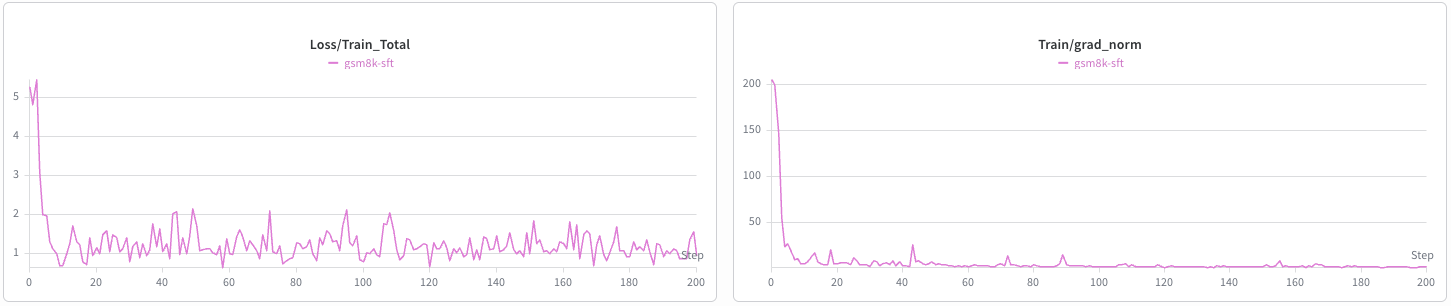
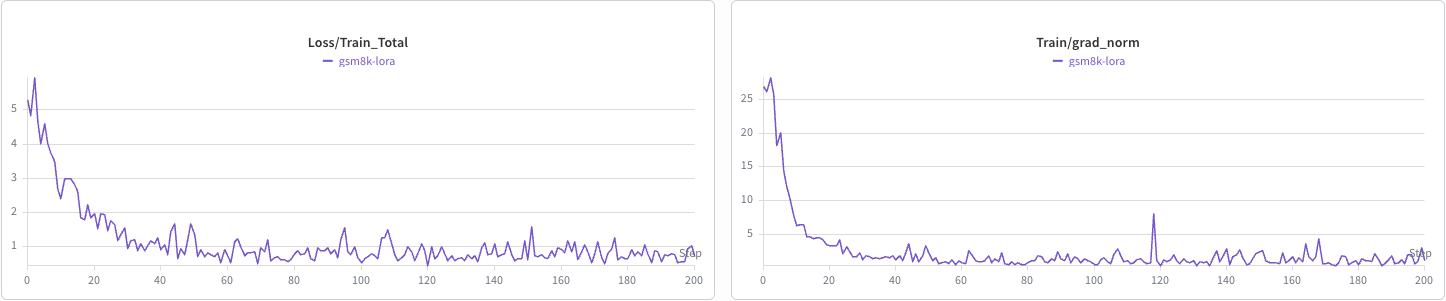
The SFT and LoRA training curves on GSM8K (first 200 steps) are shown below.
SFT
LoRA
Requirements#
Note: This recipe requires
transformers >= 5.11.0— theDiffusionGemmamodel was only added totransformersin 5.11, so earlier versions can’t load the checkpoint. Please install a compatibletransformersversion in your environment before running this recipe.