

Qwen3.5#
This page collects NeMo RL guidance for Qwen3.5 LLM and VLM post-training. Use it to choose a starting recipe and understand Qwen3.5-specific setup.
When to Use This Page#
Use this page when training or evaluating Qwen3.5 models, including:
Qwen/Qwen3.5-9B-BaseQwen/Qwen3.5-35B-A3B-Base(MoE; LLM and VLM)Qwen/Qwen3.5-397B-A17B(MoE)
For family-wide Qwen guidance, see the Qwen family hub. For the full list of supported models, see Model Support.
Support Status#
Model support is tracked in two stages:
Stage |
Meaning |
|---|---|
Functionally Ready |
Runnable end-to-end and numerically validated with an initial training run. |
Long-Run Convergence Validated |
Trains stably over a full-length run with a healthy, reproducible reward curve. |
The Qwen3.5 family is supported on both the Megatron (MCore) and AutoModel (DTensor) backends. The specific configurations shipped as example recipes below are the ones that have been Long-Run Convergence Validated. Other variants and configurations are runnable but have not all been validated for long-run convergence.
What’s Supported#
Model |
Modality |
Training backend |
Parallelism |
Inference |
|---|---|---|---|---|
|
LLM (dense) |
Megatron |
TP |
vLLM |
|
LLM (MoE) |
Megatron |
TP + EP + PP + CP |
vLLM |
|
LLM (MoE) |
AutoModel (DTensor) |
EP + CP |
vLLM |
|
VLM (MoE) |
Megatron |
TP + EP + PP + CP |
vLLM |
|
VLM (MoE) |
AutoModel (DTensor) |
EP |
vLLM |
|
LLM (MoE) |
Megatron |
TP + EP + PP + CP |
vLLM |
Notes on backends and parallelism:
Megatron (MCore) supports the full parallelism set for Qwen3.5 MoE — Tensor Parallel (TP), Expert Parallel (EP), Pipeline Parallel (PP), and Context Parallel (CP) for longer sequences — on both the LLM and the VLM (see #2312 for CP).
AutoModel (DTensor) supports Expert Parallel (EP), and Context Parallel for the MoE LLM only; CP on AutoModel requires the TE backend and
flash-linear-attention. Dense Qwen3.5 and the VLM do not support Context Parallel on AutoModel (setcp_size = 1). Seeflash-linear-attentionPerformance.
Example Recipes#
The recipes below are example starting points. Recipe YAML files under
examples/configs/recipes/ are the source of truth; check the YAML file for the
authoritative settings.
Model |
Modality |
Algorithm |
Backend |
Scale |
Recipe |
|---|---|---|---|---|---|
Qwen3.5-9B-Base |
LLM |
GRPO |
Megatron |
1n8g |
|
Qwen3.5-9B-Base |
LLM |
GRPO |
Megatron |
1n8g |
|
Qwen3.5-35B-A3B-Base |
LLM |
GRPO |
Megatron |
2n8g |
|
Qwen3.5-35B-A3B-Base |
LLM |
GRPO |
Megatron |
2n8g |
|
Qwen3.5-35B-A3B-Base |
LLM |
GRPO |
Megatron |
4n4g |
|
Qwen3.5-35B-A3B-Base |
LLM |
GRPO |
Megatron |
6n4g |
|
Qwen3.5-35B-A3B-Base |
LLM |
GRPO |
AutoModel |
2n8g |
|
Qwen3.5-35B-A3B-Base |
LLM |
GRPO |
AutoModel |
4n8g |
|
Qwen3.5-397B-A17B |
LLM |
GRPO |
Megatron |
32n8g |
|
Qwen3.5-35B-A3B-Base |
VLM |
GRPO |
Megatron |
2n8g |
|
Qwen3.5-35B-A3B-Base |
VLM |
GRPO |
AutoModel |
2n8g |
Note
Qwen3.5 thinking-mode and long-reasoning runs need a large generation budget. If
policy.generation.max_new_tokens (and the matching policy.max_total_sequence_length
or policy.generation.vllm_cfg.max_model_len) are too small, the reasoning trace might
be truncated before the final answer, and evaluation accuracy might appear near zero
even when training metrics look normal. Use max_new_tokens >= 8192 for reasoning
tasks. See #2725.
Choose a Recipe#
Small LLM Smoke Run#
Use the 9B Megatron recipe to validate the setup, launch mechanics, logging, and checkpointing.
uv run examples/run_grpo.py \
  --config examples/configs/recipes/llm/grpo-qwen3.5-9b-1n8g-megatron.yaml
35B-A3B GRPO (Megatron or AutoModel)#
Select the backend you want to validate. Both backends support Context Parallel for the 35B-A3B LLM; Megatron additionally supports Tensor Parallel.
# Megatron (EP16 TP2 CP2)
uv run examples/run_grpo.py \
  --config examples/configs/recipes/llm/grpo-qwen3.5-35ba3b-2n8g-megatron-ep16tp2cp2.yaml

# AutoModel (EP16)
uv run examples/run_grpo.py \
  --config examples/configs/recipes/llm/grpo-qwen3.5-35ba3b-2n8g-automodel-ep16.yaml
For long-reasoning tasks, override the generation length explicitly:
uv run examples/run_grpo.py \
  --config examples/configs/recipes/llm/grpo-qwen3.5-35ba3b-2n8g-megatron-ep16tp2cp2.yaml \
  policy.max_total_sequence_length=9216 \
  policy.generation.max_new_tokens=8192 \
  policy.generation.vllm_cfg.max_model_len=9216
Long-Reasoning GRPO (Ready Out of the Box)#
The 4n8g grpo-qwen3.5-35ba3b-dapo-4n8g-automodel recipe already sets
max_new_tokens: 8192 and max_total_sequence_length: 9216, and serves as a
suitable starting point for long-reasoning runs.
uv run examples/run_grpo.py \
  --config examples/configs/recipes/llm/grpo-qwen3.5-35ba3b-dapo-4n8g-automodel.yaml \
  grpo.use_dynamic_sampling=true \
  grpo.batch_multiplier=3 \
  grpo.max_val_samples=960 \
  grpo.val_batch_size=960
100-Step Long-Run Results#
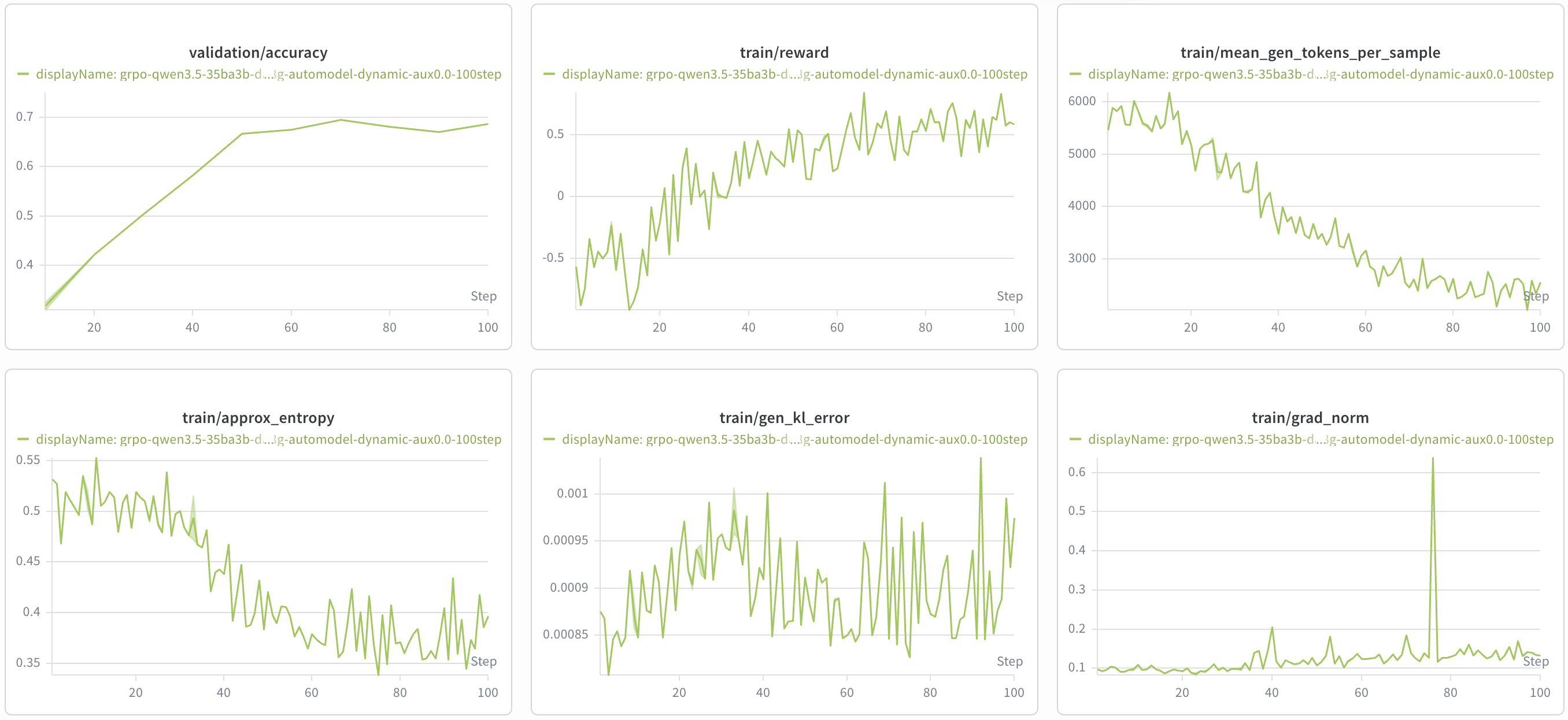
This recipe was validated for long-run convergence with a 100-step run on 4 nodes
(32 GPUs), using the command above: dynamic sampling enabled and the MoE router
auxiliary loss disabled (router_aux_loss_coef=0.0). Disabling the auxiliary loss
matters: the AutoModel backend reads router_aux_loss_coef from the Hugging Face
config (Qwen3.5 default: 0.001) and silently injects the MoE load-balancing
gradient into the router during RL training, which conflicts with the policy
objective and severely degrades accuracy. Since
#3169, the shipped Qwen3.5 AutoModel
recipes set router_aux_loss_coef: 0.0 in their hf_config_overrides, so no
manual override is needed.
The run shows healthy convergence behavior:
Validation accuracy climbs from ~0.33 to ~0.69.
Training reward rises steadily from about -0.7 to about 0.5–0.6.
Mean generated tokens per sample decreases from ~5,500 to ~2,500 as the policy learns to reason more concisely within the generation budget.
Approximate entropy declines gradually without collapsing, and generation KL error and gradient norm stay low and stable throughout.
Large MoE (397B-A17B)#
The 397B-A17B Megatron recipe targets 32 nodes (256 GPUs) with TP8, PP8, and EP32 and
max_new_tokens: 8192.
uv run examples/run_grpo.py \
  --config examples/configs/recipes/llm/grpo-qwen3.5-397ba17b-32n8g-megatron.v2.yaml
VLM (Geo3K)#
The VLM recipes target the Geo3K task. They train the vision tower according to their
freeze_config (see Model Quirks).
uv run examples/run_grpo.py \
  --config examples/configs/recipes/vlm/vlm_grpo-qwen3.5-35ba3b-geo3k-2n8g-megatron-ep16.yaml
FP8 Rollout and Training#
Two recipes run Qwen3.5 with FP8 on both sides — blockwise FP8 vLLM rollouts
(DeepGEMM) and blockwise FP8 Megatron training (Transformer Engine):
grpo-qwen3.5-9b-1n8g-megatron-fp8.yaml
and
grpo-qwen3.5-35ba3b-2n8g-megatron-ep16tp2-fp8.yaml.
General FP8 background lives in FP8 Quantization; the notes
below are the Qwen3.5-specific sharp edges.
For BF16 Megatron training with grouped-MoE MXFP8 rollouts and the FlashInfer
TRTLLM MoE backend, use
grpo-qwen3.5-35ba3b-4n4g-megatron-ep16tp2-mxfp8-trtllm.yaml.
The recurring 20-step GB200 test checks reward, finite loss, and rollout-versus-
training log-prob parity after each refit.
Block Layout and Shape Constraints#
Weights are quantized in
[128, 128]blocks (e4m3) with one fp32weight_scale_invper block; activations are quantized in per-token groups of 128. Any tensor that is fed to an FP8 GEMM must have dimensions divisible by 128 — tensors that don’t fit must be excluded (next section).Both recipes train with sequence packing, but Qwen3.5 packs sequences inside the model (
delegate_pack_to_model) rather than in the data pipeline, which bypasses the packing path’s automatic FP8 padding of packed microbatches. The recipes therefore setpolicy.make_sequence_length_divisible_by(16 for the 35B recipe, 32 for the 9B recipe =8 x TP, which also covers the wgrad token dim) so every tensor-parallel shard of a packed bin meets the FP8 GEMM dimension requirements. (The 9B recipe enables packing explicitly; its bf16 parent trains unpacked.)The KV cache stays bf16 in these recipes (
kv_cache_dtypeis left atauto).
Weights That Must Stay in bf16#
The recipes exclude four keyword groups via
policy.generation.vllm_cfg.quantization_ignored_layer_kws:
quantization_ignored_layer_kws:
  - linear_attn.conv1d    # GDN conv kernel: last dim is 4, not a 128-block GEMM
  - linear_attn.in_proj_a # GDN projections whose shapes don't align to the
  - linear_attn.in_proj_b # 128x128 block grid
  - visual                # vision tower: intermediate_size 4304 = 16 x 269
Two things are easy to get wrong here:
visualmust be excluded even for text-only training. Qwen3.5-Base checkpoints use the VL architecture, and vLLM profiles VL models with a dummy multimodal forward at engine init. With a quantized vision tower the job crashes before the first step withthe last dimension of x 4304 must be divisible by group_size 128.Excluded layers are built unquantized inside vLLM, and the refit path detects that and streams them through as bf16 automatically — this also covers whole expert layers excluded via
num_first_layers_in_bf16/num_last_layers_in_bf16.lm_head, embeddings, and the MoE router are never quantized by design.
Training-Side Settings That Matter#
fp8_cfg:fp8: e4m3,fp8_recipe: blockwise,fp8_param: false, withNVTE_FP8_BLOCK_SCALING_FP32_SCALES: "1"inmegatron_cfg.env_vars.use_precision_aware_optimizer: falseandmoe_router_dtype: fp32.freeze_configfreezes the vision tower — required for text-only training on the VL architecture (see Model Quirks).
Expected Numerics#
train/gen_kl_error (vLLM FP8 rollout logprobs vs Megatron logprobs) measured
on the verification runs: 35B ~0.0024 over the first 20 steps, drifting to
~0.0031 mean / 0.0050 max over 126 steps; 9B ~0.0014 first-20, ~0.0018 over 586
steps. The nightly thresholds (0.004 / 0.003 on the 20-step mean) are set from
these; if you see values well above them, suspect a broken refit rather than
FP8 noise.
Limitations#
Dense Qwen3.5 MXFP8 rollout has not yet completed recurring end-to-end validation.
flash-linear-attention Performance#
Qwen3.5 relies on flash-linear-attention (FLA) and causal-conv1d kernels for
full speed. There are two distinct cases:
Performance fallback on AutoModel and DTensor. Several
nemo-automodelkernels dispatch to FLA if it is importable and otherwise fall back to slower PyTorch implementations. Without FLA, Qwen3.5 (dense or MoE) trains roughly two times slower on the AutoModel path, without raising an error. The-megatronrecipes use Megatron Core kernels directly and are not affected. See #2722 and #2324.Hard requirement for AutoModel Qwen3.5 MoE and Context Parallel. When
context_parallel_size > 1for a Qwen3.5 MoE model on the AutoModel backend, NeMo RL requires FLA and raisesImportErrorif it is missing (see theimport flaguard in thenemo_rl/models/automodel/setup.pyfile). Context Parallel on AutoModel applies to the MoE LLM only and also requires the TE backend; neither dense Qwen3.5 nor the VLM supports Context Parallel on AutoModel (setcp_size = 1).
Note
Starting with the v0.7.0 release container, FLA is installed in the AutoModel
worker virtual environment by default: the automodel extra depends on
nemo-automodel[moe], which includes flash-linear-attention and
causal-conv1d (see Automodel#1894,
previously tracked on the NeMo RL side by #2324).
No manual installation is needed.