

External View
Deployment Model
RMS ships as a Helm chart (helm/) that installs a single-replica Deployment
of the rms-api-server container, a ClusterIP Service in front of it, the
configuration and certificate material the container mounts, and an optional
PostgreSQL connection for the firmware catalog.

The Deployment is not pinned to a node. Its Pod is schedulable onto any node in
the cluster, and Kubernetes places the one replica on whichever node satisfies
the (optional) apiServer.affinity constraints. Everything else in the
diagram - the config ConfigMap, the API-server TLS Secret, the
switch/client mTLS Secrets, and the firmware volume - is mounted into that
Pod, and Postgres is reached over the network using a Service.
Scalability
RMS scales horizontally at the site controller level, not at the replica level. A data center runs many site controllers, each responsible for a slice of the racks on the floor, and each site controller deploys its own independent instance of RMS.
Nothing in the chart or the service ties instances together:
- The chart installs into its own namespace (
namespace: rack-managerby default, overridable per install), so two site controllers can run the same chart without colliding. - RMS has no cluster-wide registry or peer discovery. The rack map is built
lazily from the requests an instance receives -
RackManager::with_rack_for_nodeinserts a rack into its in-memory registry the first time a client addresses it - so an instance only ever knows about the racks its own clients target. - Even if persisted in a shared database, the firmware apply history and catalog does not identify the instance of RMS that stored it.
Adding capacity therefore means adding site controllers and their RMS instances, and partitioning racks between them. Two RMS instances must not manage the same rack: they would not see each other’s jobs or power-operation locks (see below).
Fault tolerance
apiServer.replicaCount defaults to 1, and that is the supported
configuration. RMS inherits Kubernetes’ recovery behavior, but it is not
highly available:
What Kubernetes provides today
- Crash recovery. If the container exits, the kubelet restarts it under the Deployment’s restart policy.
- Node failure recovery. If the node hosting the Pod is lost, the Deployment controller reschedules the Pod onto another node - which is why the diagram draws the Deployment spanning every node.
- Controlled rollout. The Pod template carries a
checksum/configannotation over the renderedconfig.toml, so ahelm upgradethat changes configuration rolls the Deployment; RMS reads the mounted file only once at startup. - Durable firmware catalog. The firmware bundle catalog and its apply
history live in Postgres (
rack_firmwareand the apply-history table from0001_rack_firmware.sql), so they survive a Pod restart.
What is lost on restart
The orchestrator’s runtime state is in-process memory, not Postgres:
- The rack registry is a
RwLock<HashMap<String, Arc<ManagedRack>>>owned byRackManager. - Job state is a
RwLock<JobStore>insideJobRegistry, bounded bymax_tracked_jobs(default 10,000) with terminal jobs evicted afterterminal_job_ttl_seconds(default 24h).
A restart therefore drops every tracked job, including in-flight ones. Work already dispatched to hardware - a firmware update running on a BMC, an image install on a switch - continues on the device, but RMS loses the handle to it: clients polling a job ID from before the restart get nothing back, and must re-issue the operation and re-poll to resynchronize with hardware state.
There are also no liveness or readiness probes on the rms-api-server
container (only the standalone Postgres StatefulSet defines them), so a wedged
process that has not exited is not detected or restarted automatically.
Why more than one replica is not supported
Raising replicaCount above 1 would not give high availability; it would give
two independent, mutually blind instances of the same service:
- Jobs are per-process. The
Serviceload-balances across Pods, so a client that starts a job on one replica may poll a replica that has never heard of that job ID. - Mutual exclusion is per-process. Rack safety interlocks are in-memory
primitives - the per-rack
power_operation_lock(tokio::sync::Mutex) that serializes power operations, and theRwLockguarding each rack’s node state. A second replica has its own copies, so both could drive conflicting operations against the same rack. - There is no leader election or shared job store. The chart installs no lease, and the persistence layer stores only firmware objects and apply history. No shared state is stored that a second replica could use to observe the first one’s jobs.
- Firmware storage is not shared by default. With
apiServer.firmwarePersistentVolumeClaimunset, the firmware volume is ahostPathatapiServer.firmwareStoragePath(/mnt/data), which is node-local: a Pod rescheduled to another node comes up without the artifacts staged on the old one. Sites that need firmware artifacts to survive rescheduling should setfirmwarePersistentVolumeClaimto a PVC backed by storage that is reachable from every node the Pod may land on.
Summary
Northbound and southbound connections
RMS has one northbound (incoming client) interface - the RackManager gRPC
API - and several southbound (outgoing) interfaces it uses to reach hardware.
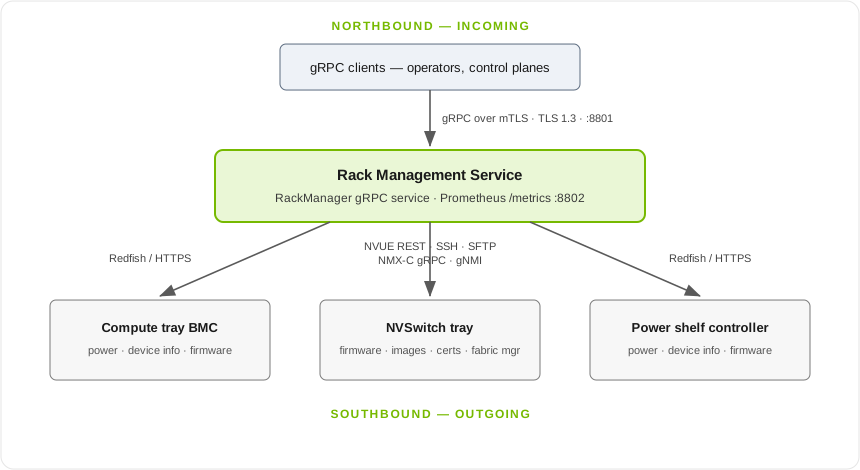
To see a more detailed internal view of RMS layers and components, see Internal View.