

Internal View
This page looks inside the service at its component layers, concurrency model, and error and credential handling. For the external interfaces and protocols, see External View.
Internal components
Internally, RMS is layered. Each layer has a single responsibility, and the node and rack layers are trait-based so new hardware can be added without touching existing code.
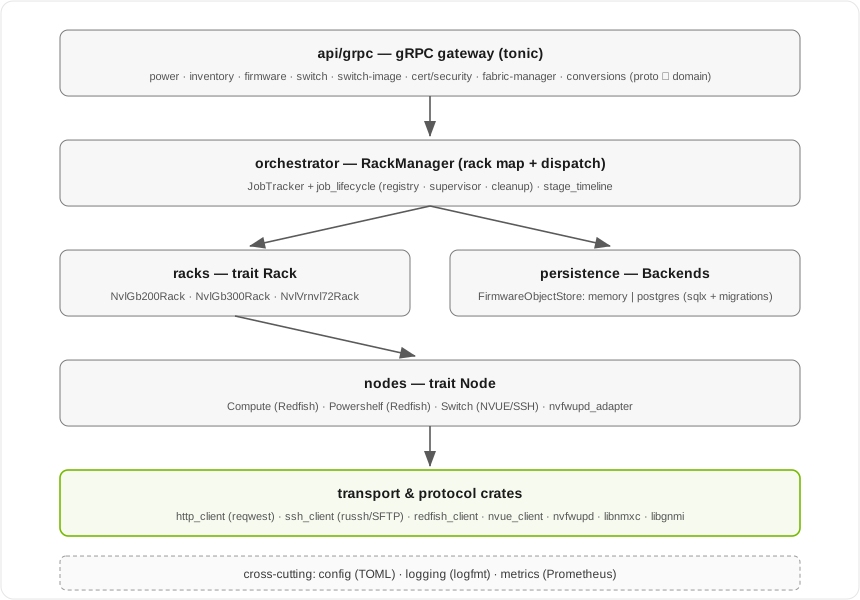
API gateway (api/grpc)
Protocol-specific entry points. The RackManager gRPC service runs on the
configured port (default 8801). Handlers translate protobuf requests and
coordinate domain or node operations. conversions.rs maps protobuf types to
and from domain types. Handler groups include power_handlers,
inventory_handlers,
firmware_handlers, switch_handlers, switch_image_handlers,
switch_attestation_handlers, switch_certificate_handlers,
switch_security_handlers, and scaleupfabricmanager_handlers. server.rs
sets up TLS/mTLS. See Operations for the RPCs.
Orchestrator (orchestrator)
RackManager owns the rack map (a tokio::sync::RwLock-protected collection) and
dispatches operations. Short operations (a power query) are awaited inline; long
operations (a firmware update or switch system-image install) are spawned as
tokio tasks and tracked by job ID.
The job tracker (job_tracker.rs, over the generic primitives in
job_lifecycle/) manages the async job lifecycle for both firmware and switch
OS-image work. It supports parent/child job hierarchies for batch operations, is
bounded by max_tracked_jobs, and evicts terminal (completed/failed) job records
after terminal_job_ttl_seconds via a background reaper. Batch workflows create
their top-level job first and dynamically attach admitted child jobs while that
job remains non-terminal. See
Operations: the async job model.
stage_timeline.rs breaks a long-running job into Stages - the smallest
measurable unit of work a job progresses through (e.g. “stage image”, “trigger
install”, “wait for target steady state”). Each Stage has an immutable
name and imperative description fixed at construction, plus a status
(queued -> running -> completed/failed/skipped), timestamps, an
opaque details payload, and a message populated only on failure. A
Stage does not carry its own job_id: every stage in a timeline belongs
to the same job, so job_id - like the node/rack a timeline’s stages
run against - is stored once, on the StageTimeline itself, rather than
duplicated per stage. A StageTimeline is built once, up front, from a job
type’s predefined, ordered Vec<Stage> (e.g.
switch_system_image_job_stages), then driven forward purely by an
internal cursor: start_current marks the stage at the
cursor running, complete_current finishes it and advances the cursor, and
fail_current finishes it as failed without advancing - a job’s failure is
always terminal, so the cursor simply stops there. Handlers never re-type a
stage’s name at each call site; they just call these cursor methods in the
same order the job actually performs its work, and to_json() serializes the
whole planned pipeline (not just the stages reached so far) for status
polling. Each of the three cursor methods also centrally logs a generic
"stage starting" / "stage completed" / "stage cancelled" / "stage failed"
event (with job_id, node, rack, stage, and, for failures,
error), so handler call sites only need to add stage-specific context
beyond that.
A stage can end up skipped in two different situations, so a handler
never has to report a no-op as if it were real work: if a stage starts but
turns out to have nothing to do (e.g. no unused partition image to clean
up), the handler calls skip_current instead of complete_current; and
when a job exits early - a stage failed, was cancelled, or a precondition
check failed before any stage started - handlers call skip_remaining
once, right before sealing the job’s terminal state, which moves every
still-queued stage to skipped. Both paths log "stage skipped" so the
timeline never shows unreached stages stuck at queued forever, or a
no-op stage misreported as completed.
Racks (racks)
Trait-based. Each rack type (NvlGb200Rack, NvlGb300Rack, NvlVrnvl72Rack)
owns a map of Arc<dyn Node> and a node factory that constructs Compute, Switch,
or Powershelf nodes from the typed node identity in a request. Adding or removing
nodes invalidates the cached rack power-on order.
Nodes (nodes)
Trait-based. Each node type encapsulates its management protocol behind the
Node trait:
- Compute (
compute_gb200_nvidia,compute_gb300_nvidia,compute_gb300_lenovo,compute_vrnvl72_nvidia) - Redfish over HTTPS. - Powershelf (
powershelf_gb200_liteon,powershelf_gb200_delta,powershelf_gb300_liteon,powershelf_gb300_delta) - Redfish over HTTPS; the Delta shelves additionally use the embedded nvfwupd workflow. - Switch (
switch_gb200_nvidia,switch_gb300_nvidia) - NVUE REST plus SSH/SFTP, including NVUE-based SPDM attestation evidence collection. NMX-C gRPC and gNMI provide fabric and telemetry operations.
Adding a new node type means implementing the Node trait - no changes to
existing code. Adding a new rack type means implementing the Rack trait with its
own node factory. See Development: adding hardware support.
The NVFWUPD adapter (nodes/nvfwupd_adapter.rs) converts RMS node
credentials, firmware requests, outcomes, task status, and activation requests
into the embedded nvfwupd workflow API. PLDM
firmware-package parsing and switch CPLD .vme extraction live in the nvfwupd
crate.
Transport and protocol crates (transport, workspace crates)
transport/http_client.rswrapsreqwestfor async Redfish/NVUE HTTP (GET, POST/PATCH JSON, multipart and raw file upload).transport/ssh_client.rs(and thetransport/ssh/module) wrapsrusshfor async SSH exec and SFTP file transfers, with per-step and overall upload timeouts.redfish_client- RMS-focused Redfish operations (power/reset, MNNVLink topology discovery, multipart firmware upload).nvue_client- the async NVUE/NVOS REST client and API models used by the switch nodes.nvfwupd- the embedded firmware-update workflow library (and standalone CLI).libnmxc- the NMX-C gRPC client and switch TLS material store for the scale-up fabric manager.libgnmi- a gNMI client for switch telemetry/config connectivity checks.
Persistence layer (persistence)
A swappable, per-domain storage abstraction. The FirmwareObjectStore trait is
implemented by both a memory backend and a postgres backend (sqlx, with
compile-time-embedded migrations); the active backend is selected at startup from
[postgres] db_url / DATABASE_URL. Only workflow data is persisted - firmware
objects, cached artifact metadata, and apply history - never rack topology. See
Development: adding a persistence domain.
Switch SPDM attestation evidence collection (see Switch management) is stateless in RMS: it holds no lock and persists nothing. The caller (NICo) owns job state, quarantine, and retry decisions.
Cross-cutting
- config - all runtime configuration is loaded from a single TOML file (via
figment/toml) and validated at startup. See Configuring RMS. - logging - structured logging in logfmt via
tracing/tracing-subscriber. - metrics - a dedicated Prometheus
/metricslistener (default8802), independent of the gRPC port, optionally served over TLS.
Concurrency and scale
RMS is designed to manage 10k+ nodes concurrently. Every I/O operation is
async: a firmware update that polls a BMC every 5 seconds does
tokio::time::sleep(5s).await between polls, yielding its worker thread to serve
other work. Thousands of concurrent firmware jobs run as lightweight async tasks
on a fixed pool of OS threads (typically the CPU core count), not thousands of
blocked threads. The process uses the mimalloc allocator for low cross-thread
contention under this fan-out workload.
Key concurrency primitives:
- Per-node serialization - each node holds a
tokio::sync::Mutexaround its transport client. Operations on different nodes run fully in parallel; operations on the same node serialize, matching the fact that a BMC processes one Redfish request at a time. - Rack map - a
tokio::sync::RwLock; find/list reads are concurrent, add/remove writes are exclusive. - Job tracking - concurrent reads of async job status; one
tokio::spawnper node in a batch (a 36-node batch is 36 async tasks sharing a handful of OS threads). - Graceful shutdown - a
CancellationTokenis propagated to all spawned tasks; onSIGINT/SIGTERMRMS drains in-flight jobs before exiting.
Error handling
All fallible operations return Result<T, RmsError>. RmsError carries an
ErrorCode that the gRPC gateway maps to a gRPC status code:
Credentials
Credentials (username/password) are passed directly in gRPC requests at
node-creation time and held on the ephemeral node using zero-on-drop secure
strings (the secrecy crate). RMS uses no external credential provider and does
not persist device credentials.