

SkillEvaluator
SkillEvaluator is an open-source, multi-tier framework for evaluating AI agent artifacts, starting with agent skills: deterministic quality gates, semantic overlap detection, synthetic eval dataset generation, and live agent evaluation.
Agent skills are folders of instructions and supporting files that extend AI agents, as defined by the Agent Skills specification. SkillEvaluator is part of the NVIDIA Verified Skills pipeline, published from the NVIDIA/skills catalog. Tier 1 integrates SkillSpector for specialized security scanning; see Installation for the security setup.
SkillEvaluator’s support level is Experimental: community-supported on a best-effort basis through GitHub Issues, with no SLA. See SUPPORT.md.
Start with a first result
Choose a deterministic quality check or an LLM-backed rubric review. Both routes
use the bundled text-analyzer skill, so you can run them before preparing your
own skill. Neither route needs Docker or an agent runtime. Set up your chosen
agent and sandbox when you move on to live Tier 3 evaluation.
Run without an LLM
Install uv and Git, then clone the repository and run the base package:
Read the score, grade, and findings in the terminal, and open
reports/first-quality/skillevaluator-quality.json for the saved result.
This checks documentation quality; measuring the skill’s effect on an agent
requires a live evaluation.
The keyless Quickstart explains the result and how to check your own skill. The full static security suite has additional scanner requirements, even though it also runs without an LLM or API key.
Use NVIDIA Build
For an LLM-backed rubric review, get an API key from NVIDIA Build, then run from the same checkout:
The llm extra installs the provider clients for this model call. The
NVIDIA Build Quickstart covers access,
outputs, and the distinction between rubric scores and observed agent behavior.
The three tiers
Each tier answers one question about your skill.
Every tier is an independent entry point — run any command directly; nothing requires running the earlier tiers first.
How a run flows
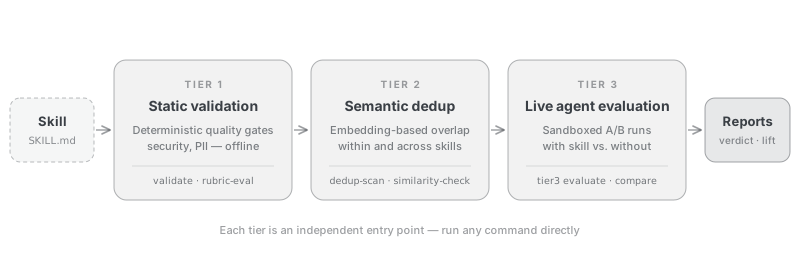
skillevaluator validate ./my-skill runs all three tiers by default, with
Tier 3 autopilot reusing an existing evaluation source or creating one starter
case when none exists. Tier 1’s deterministic gates run offline. Tier 2 and the optional Tier 1 LLM checks need a provider key, and Tier 3 adds the agent credential and a sandbox. Every run ends in reports — CLI, JSON, HTML, or Markdown.
What Tier 3 measures
- Five dimensions — Security, Correctness, Discoverability, Effectiveness, and Efficiency: human-readable scores that lead every standard grading report.
- Skill Lift — the measured difference between the with-skill and without-skill runs; the number that says whether the skill earns its place.
- pass@k — multi-attempt reliability, reported separately from the dimension scores.
How to read all three, and the on-disk results contract, live in Reports & Results.
Explore the docs
- SkillEvaluator on GitHub
- Support — best-effort, through GitHub Issues
- Security policy — report vulnerabilities privately, never in a public issue
- License — Apache-2.0