

AKS (Azure Kubernetes Service)
New in version 4.1.
Overview
Azure AKS is a managed Kubernetes service to run Kubernetes in the Azure cloud. NVIDIA AI Enterprise, the end-to-end software of the NVIDIA AI platform, is supported to run on AKS. In the cloud, Azure AKS automatically manages the availability and scalability of the Kubernetes control plane nodes responsible for scheduling containers, managing application availability, storing cluster data, and other key tasks. This guide provides details for deploying and running NVIDIA AI Enterprise on AKS clusters with GPU Accelerated nodes.
The NVIDIA Terraform Modules offer an easy way to deploy Managed Kubernetes clusters that can be supported by NVIDIA AI Enterprise when used with supported OS and GPU Operator versions.
Prerequisites
- NVIDIA Enterprise License via BYOL or a Private Offer
- Azure CLI
- Install Helm
- Azure Owner/Admin access to create AKS resources
Create Azure Kubernetes Service (AKS) Cluster
Login to Azure CLI:
Navigate to Azure Portal to find the Azure Subscription ID, Go to Subscription and you can find the Subscription ID right next to the Subscription name.
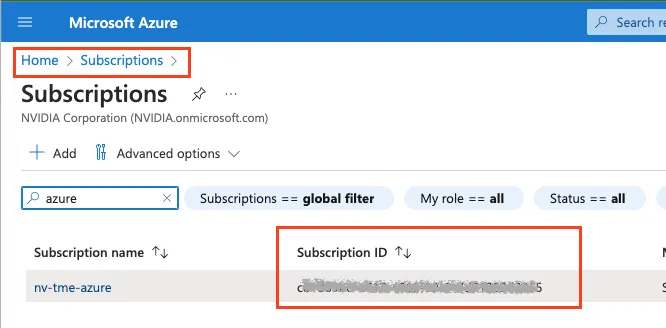
Install Azure CLI plugins which will install kubectl.
Create resource group with location where you planning to create a AKS cluster. https://learn.microsoft.com/en-us/azure/aks/availability-zones
Example:
Create AKS Cluster with updated <location> below.
In Above we choose T4 node as an example, but you choose the any NVIDIA GPU nodes as listed here, https://learn.microsoft.com/en-us/azure/virtual-machines/sizes-gpu
Verify Kubernetes Service has been created on Azure Portal.

Now get the Azure Kubernetes Cluster Credentials, Navigate to Kubernete Services and choose the cluster and you can see Connect button as shown below, when you click on Connect you will see how you can get the credentials as shown below.
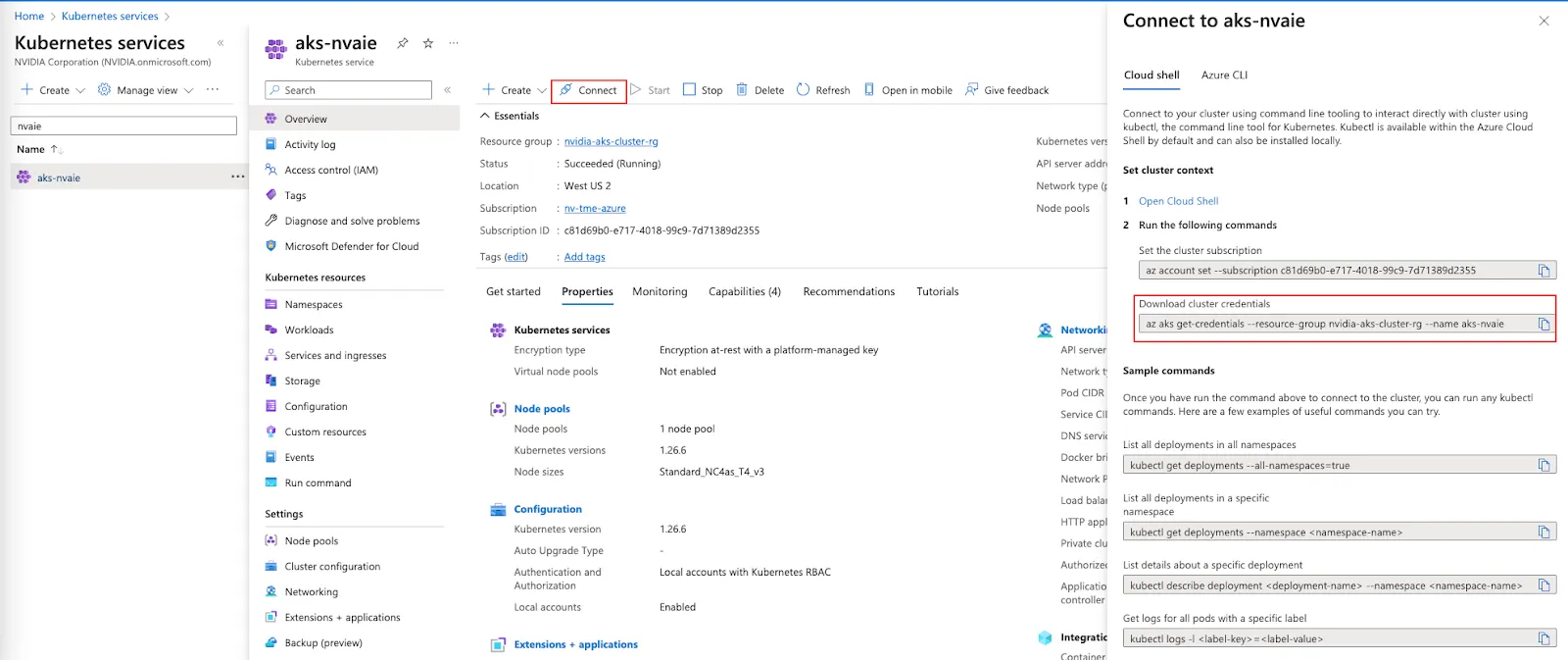
Run the below command to get the kubeconfig credentials to the local system.
Run the below command to verify the node information.
Example output result
Run the below command to verify the all pods are running:
Deploy the GPU Operator
The commands below serve as an example and will be similar, albeit slightly different, to the latest version of the GPU Operator. Please refer to the latest GPU Operator release notes for more information.
Run the below commands to create a namespace on AKS cluster.
Add the Helm repo and update with the below commands.
Create a NGC Secret with your NGC API key on “gpu-operator” namespace as per below.
Create an empty gridd.conf file, then create a configmap with NVIDIA vGPU Licence token file as per below.
Install the GPU Operator from NGC Catalog with License token and driver repository.
Verify the GPU Operator Installation
Verify the NVIDIA GPU Driver loaded with below command.
nvidia-driver-daemonset-xxxxx will be different within your own environment for the above command to verify the NVIDIA vGPU Driver.
Run Sample NVIDIA AI Enterprise Container
Container images will be similar, albeit slightly different when using the latest image. Please refer to Pulling and Running NVIDIA AI Enterprise Containers to find the latest images on NGC.
Create a docker-registry secret. This will be used in a custom yaml to pull containers from the NGC Catalog.
Create a custom yaml file to deploy an NVIDIA AI Enterprise Container and run sample training code.
Paste the below contents into the file and save.
Check the status of the pod.
View the output of the sample mnist training job.
The output will look similar to this.
Delete the AKS Cluster
Run the below command to delete the AKS cluster.