
MIG-Backed vGPU#
A Multi-Instance GPU (MIG)-backed vGPU combines MIG hardware partitioning with vGPU virtualization. Instead of sharing a full physical GPU, each vGPU runs on a dedicated GPU instance - a hardware-isolated slice of a MIG-capable GPU.
Multi-Instance GPU (MIG) technology divides a physical GPU into multiple GPU instances, each with dedicated compute cores, memory, and video engines. A MIG-backed vGPU is then created from one of these instances and assigned to a virtual machine.
This architecture provides:
Hardware-level isolation - Each vGPU has exclusive access to its GPU instance’s resources, including compute and video decode engines
True parallel execution - Workloads on different vGPUs run simultaneously on the same physical GPU without competing for shared resources
Note
NVIDIA vGPU for Compute supports MIG-Backed vGPUs on all the GPU boards that support Multi Instance GPU (MIG).
Universal MIG technology on Blackwell enables both compute and graphics workloads to be consolidated and securely isolated on the same physical GPU.
Ideal Use Cases
MIG-backed vGPUs are ideal for running multiple high-priority workloads that require guaranteed, consistent performance and strong isolation:
Multi-tenant environments - MLOps platforms, shared research clusters
Simultaneous workloads - Training, inference, video analytics, and data processing running concurrently
SLA requirements - Workloads requiring consistent performance and maximum GPU utilization
Tip
Compare all three modes in Supported vGPU Modes. For time-sliced sharing on a full GPU or within a MIG instance, see Scheduling Policies.
Supported MIG-Backed vGPU Configurations on a Single GPU#
NVIDIA vGPU supports both homogeneous and mixed MIG-backed virtual GPU configurations, and on GPUs with MIG time-slicing support, each MIG instance supports multiple time-sliced vGPU VMs.
On the NVIDIA RTX PRO 6000 Blackwell Server Edition, up to four MIG slices can be created on a single GPU. Within each MIG slice, one to three time-sliced vGPUs for Compute with 8 GB frame buffer each can be created, depending on workload requirements and user density goals. Each vGPU instance can be assigned to a separate VM, enabling up to 12 virtual machines to share a single physical GPU while benefiting from the isolation boundaries provided by MIG.
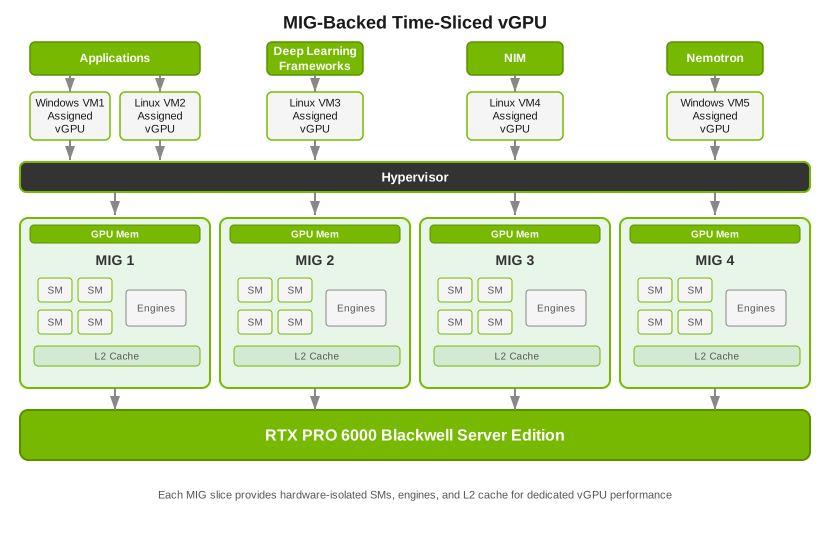
The previous figure shows how each MIG slice on the NVIDIA RTX PRO 6000 Blackwell can be time-sliced across multiple VMs, supporting up to three NVIDIA vGPU for Compute VMs per slice, to maximize user density while maintaining performance isolation through hardware-level partitioning.
Note
You can determine whether time-sliced, MIG-backed vGPUs are supported with your GPU on your chosen hypervisor by running the nvidia-smi -q command.
$ nvidia-smi -q
vGPU Device Capability
    MIG Time-Slicing                  : Supported
    MIG Time-Slicing Mode             : Enabled
If
MIG Time-Slicingis shown asSupported, the GPU supports time-sliced, MIG-backed vGPUs.If
MIG Time-Slicing Modeis shown asEnabled, your chosen hypervisor supports time-sliced, MIG-backed vGPUs on GPUs that also support this feature.
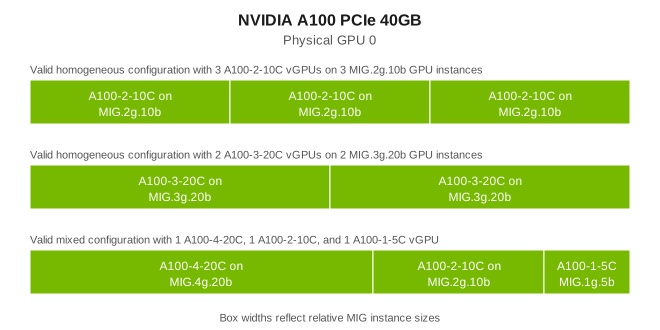
The following figure shows examples of valid homogeneous and mixed MIG-backed virtual GPU configurations on NVIDIA A100 PCIe 40 GB.
A valid homogeneous configuration with 3 A100-2-10C vGPUs on 3 MIG.2g.10b GPU instances
A valid homogeneous configuration with 2 A100-3-20C vGPUs on 3 MIG.3g.20b GPU instances
A valid mixed configuration with 1 A100-4-20C vGPU on a MIG.4g.20b GPU instance, 1 A100-2-10C vGPU on a MIG.2.10b GPU instance, and 1 A100-1-5C vGPU on a MIG.1g.5b instance