Fine-Tuning DiffusionGemma
Introduction
DiffusionGemma is a block-diffusion language model. Unlike an autoregressive (AR) model that generates one token at a time from left to right, a block-diffusion model fills in a block of response tokens (a canvas) by iteratively denoising the canvas. The canvas starts as uniform-random vocabulary tokens and is refined over several passes, conditioned on the prompt.
This guide covers Supervised Fine-Tuning (SFT) of the DiffusionGemma 26B-A4B model, which is a mixture-of-experts (MoE) model with 26B total and approximately 4B active parameters, using NeMo AutoModel with both full fine-tuning and Low-Rank Adaptation (LoRA).
The released checkpoint is available on the Hugging Face Hub:
google/diffusiongemma-26B-A4B-it.
Workflow Overview
Model Overview
DiffusionGemma combines a causal encoder and a bidirectional decoder on a shared backbone:
- Encoder: Reads the clean prompt and response sequence with causal attention and builds a read-only KV cache.
- Decoder: Denoises the response canvas. Attention is bidirectional within the selected canvas block and block-causal across blocks: each block attends to the clean prompt plus earlier clean response blocks in the encoder KV.
The DiffusionGemmaSFTRecipe implements the following training mechanics:
- Uniform-random corruption: For each example, a corruption level
is sampled (
dllm.epsdefaults to0.001). Supervised canvas positions are independently replaced with uniform random vocabulary tokens. There is no[MASK]token. - One canvas per step: The decoder still sees the full response window, but the diffusion loss is restricted to one randomly chosen response block per example.
- Flat diffusion loss: Mean cross-entropy over all supervised tokens in that selected block (corrupted and clean), with no reweighting.
- Encoder AR loss: The shared backbone is also trained as a causal LM on the clean
full sequence (
encoder_loss_weightdefaults to1.0). Total loss is diffusion CE plus encoder AR CE. - Self-conditioning: Two-pass Analog-Bits self-conditioning. Pass 1 always runs
without gradients. With probability
self_conditioning_p(default0.5), each example feeds those logits into pass 2. - Frozen router: The MoE router stays frozen. Full SFT trains experts and dense layers. LoRA adapts attention and dense-MLP linears only. The EP-sharded experts are not adapted.
- Single-turn SFT:
mask_history: truesupervises only the final response turn.
The example recipes run with Fully Sharded Data Parallel 2 (FSDP2) and expert parallelism (EP=8), mixed precision (FP32 master weights and BF16 compute), and a canvas and block size of 256.
Launch Training
DiffusionGemma SFT runs on a single eight-GPU node (EP=8). Two example configuration files
are provided in the examples/dllm_sft/ directory:
Both configurations automatically pull the checkpoint from the Hugging Face Hub
(google/diffusiongemma-26B-A4B-it). Because the GSM8K dataset is consumed in the OpenAI
chat-messages format, you must generate the JSONL file (./gsm8k_chat_train.jsonl) before
launching training:
The recipes also set chat_template to
diffusion_gemma_chat_template.jinja.
The released DiffusionGemma chat template has no Jinja generation tags, so without this
copy the supervised region would start at the model turn header and teach the model to
re-emit it.
To run full SFT:
To run LoRA:
Training Results
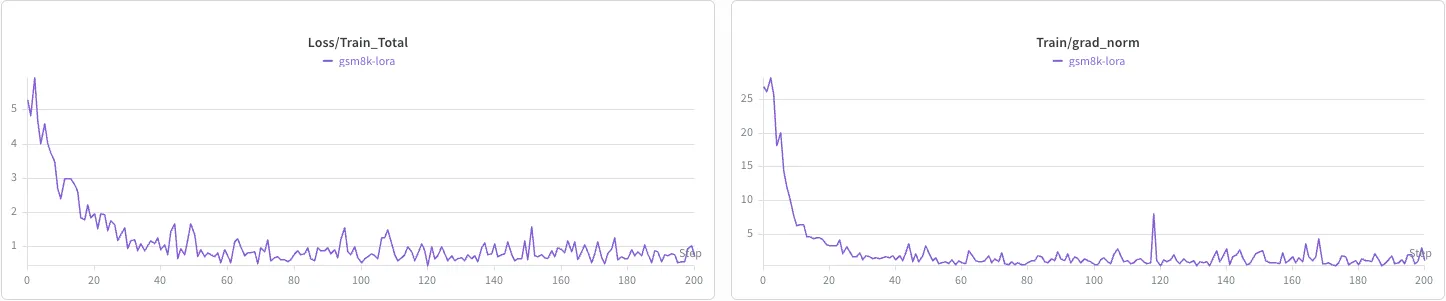
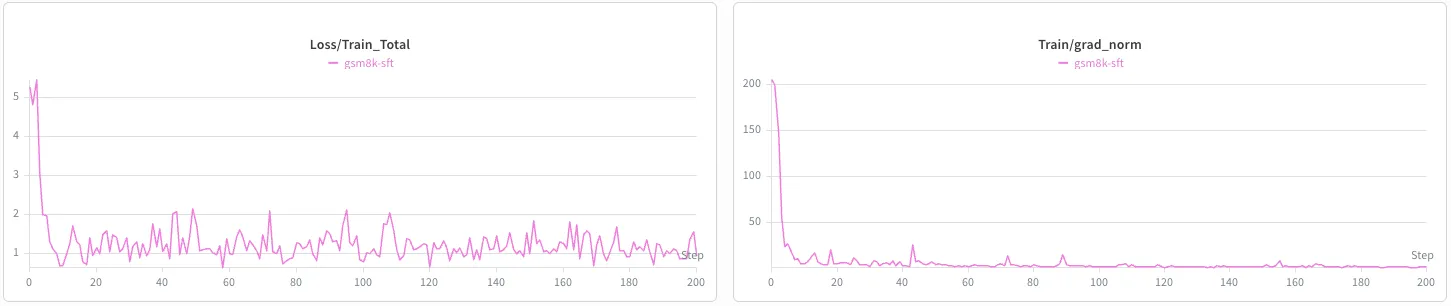
The following figures show the SFT and LoRA training curves on the GSM8K dataset for the first 200 steps.
SFT training curves:
LoRA training curves: