

somatic (Somatic Variant Caller)
somatic (Somatic Variant Caller)
Run a somatic variant workflow.
The somatic tool processes the tumor FASTQ files, and optionally normal FASTQ files and knownSites files, and generates tumor or tumor/normal analysis. The output is in VCF format.
Internally the somatic tool runs several other Parabricks tools, thereby simplifying your work flow.
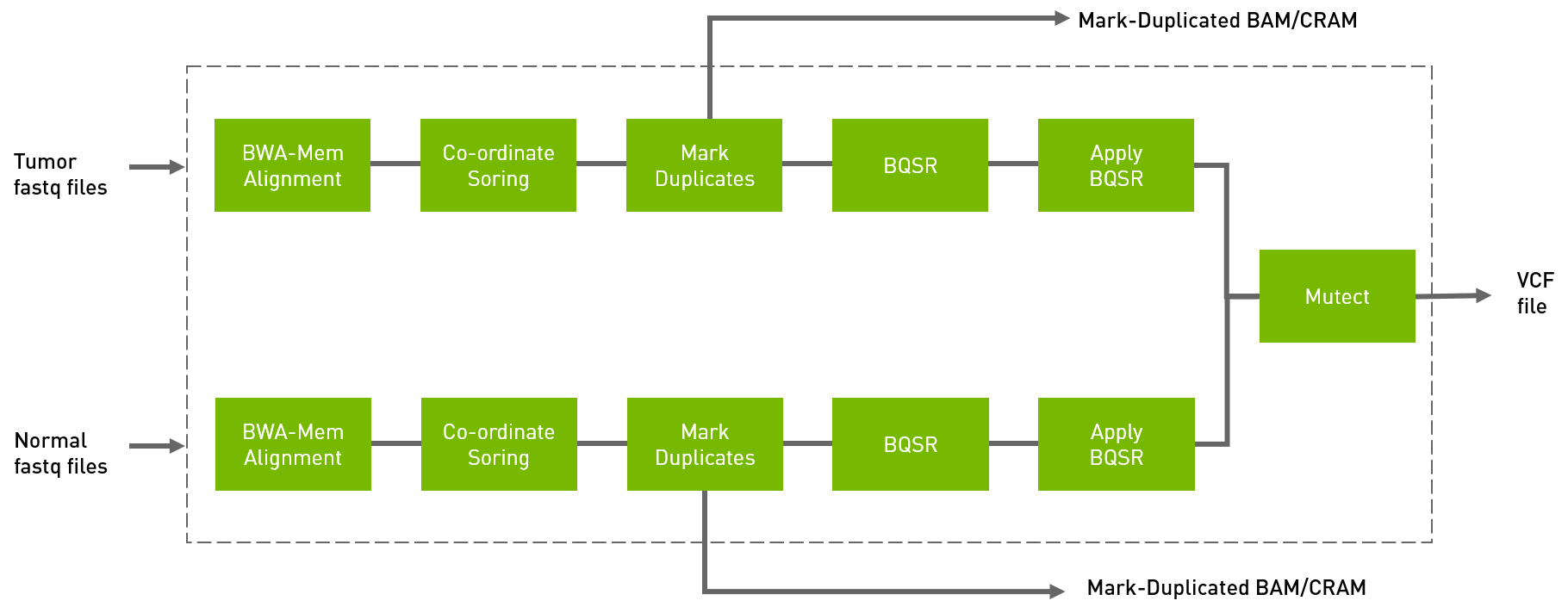
Refer to the somatic Reference section for a detailed listing of all available options.
Quick Start
1 # The command line below will run tumor-only analysis. 2 # This command assumes all the inputs are in the current working directory and all the outputs go to the same place. 3 docker run --rm --gpus all --volume $(pwd):/workdir --volume $(pwd):/outputdir \ 4 --workdir /workdir \ 5 nvcr.io/nvidia/clara/clara-parabricks:4.7.1-1 \ 6 pbrun somatic \ 7 --ref /workdir/${REFERENCE_FILE} \ 8 --in-tumor-fq /workdir/${INPUT_FASTQ_1} /workdir/${INPUT_FASTQ_2} \ 9 --bwa-options="-Y" \ 10 --out-vcf /outputdir/${OUTPUT_VCF} \ 11 --out-tumor-bam /outputdir/${OUTPUT_BAM} 12 13 # The command line below will run tumor-normal analysis. 14 # This command assumes all the inputs are in the current working directory and all the outputs go to the same place. 15 docker run --rm --gpus all --volume $(pwd):/workdir --volume $(pwd):/outputdir \ 16 --workdir /workdir \ 17 nvcr.io/nvidia/clara/clara-parabricks:4.7.1-1 \ 18 pbrun somatic \ 19 --ref /workdir/${REFERENCE_FILE} \ 20 --knownSites /workdir/${KNOWN_SITES_FILE} \ 21 --in-tumor-fq /workdir/${INPUT_TUMOR_FASTQ_1} /workdir/${INPUT_TUMOR_FASTQ_2} "@RG\tID:sm_tumor_rg1\tLB:lib1\tPL:bar\tSM:sm_tumor\tPU:sm_tumor_rg1" \ 22 --bwa-options="-Y" \ 23 --out-vcf /outputdir/${OUTPUT_VCF} \ 24 --out-tumor-bam /outputdir/${OUTPUT_TUMOR_BAM} \ 25 --out-tumor-recal-file /outputdir/${OUTPUT_RECAL_FILE} \ 26 --in-normal-fq /workdir/${INPUT_NORMAL_FASTQ_1} /workdir/${INPUT_NORMAL_FASTQ_2} "@RG\tID:sm_normal_rg1\tLB:lib1\tPL:bar\tSM:sm_normal\tPU:sm_normal_rg1" \ 27 --out-normal-bam /outputdir/${OUTPUT_NORMAL_BAM}
Compatible CPU Command
$ # The commands below will run tumor-normal analysis. $ # $ # Run bwa mem on the tumor FASTQ files then sort the BAM by coordinates. $ $ bwa mem \ > -t 32 \ > -K 10000000 \ > -Y \ > -R '@RG\tID:sample_rg1\tLB:lib1\tPL:bar\tSM:sample\tPU:sample_rg1' \ > ${REFERENCE_FILE} ${TUMOR_FASTQ_1} ${TUMOR_FASTQ_2} | \ > gatk SortSam \ > --java-options -Xmx30g \ > --MAX_RECORDS_IN_RAM 5000000 \ > -I /dev/stdin \ > -O tumor_cpu.bam \ > --SORT_ORDER coordinate $ $ # Mark duplicates. $ $ gatk MarkDuplicates \ > --java-options -Xmx30g \ > -I tumor_cpu.bam \ > -O tumor_mark_dups_cpu.bam \ > -M tumor_metrics.txt $ $ # Generate a BQSR report. $ $ gatk BaseRecalibrator \ > --java-options -Xmx30g \ > --input tumor_mark_dups_cpu.bam \ > --output ${OUTPUT_TUMOR_RECAL_FILE} \ > --known-sites ${KNOWN_SITES_FILE} \ > --reference ${REFERENCE_FILE} $ $ # Apply the BQSR report. $ $ gatk ApplyBQSR \ > --java-options -Xmx30g \ > -R ${REFERENCE_FILE} \ > -I tumor_cpu.bam \ > --bqsr-recal-file ${TUMOR_OUTPUT_RECAL_FILE} \ > -O ${OUTPUT_TUMOR_BAM} $ $ # Now repeat all the above steps, only with the normal FASTQ data. $ $ bwa mem \ > -t 32 \ > -K 10000000 \ > -Y \ > -R '@RG\tID:sample_rg1\tLB:lib1\tPL:bar\tSM:sample\tPU:sample_rg1' \ > ${REFERENCE_FILE} ${NORMAL_FASTQ_1} ${NORMAL_FASTQ_2} | \ > gatk SortSam \ > --java-options -Xmx30g \ > --MAX_RECORDS_IN_RAM 5000000 \ > -I /dev/stdin \ > -O normal_cpu.bam \ > --SORT_ORDER coordinate $ $ # Mark duplicates. $ $ gatk MarkDuplicates \ > --java-options -Xmx30g \ > -I normal_cpu.bam \ > -O normal_mark_dups_cpu.bam \ > -M normal_metrics.txt $ $ # Generate a BQSR report. $ $ gatk BaseRecalibrator \ > --java-options -Xmx30g \ > --input normal_mark_dups_cpu.bam \ > --output ${OUTPUT_NORMAL_RECAL_FILE} \ > --known-sites ${KNOWN_SITES_FILE} \ > --reference ${REFERENCE_FILE} $ $ # Apply the BQSR report. $ $ gatk ApplyBQSR \ > --java-options -Xmx30g \ > -R ${REFERENCE_FILE} \ > -I normal_cpu.bam \ > --bqsr-recal-file ${OUTPUT_NORMAL_RECAL_FILE} \ > -O ${OUTPUT_NORMAL_BAM} $ $ # Finally, run Mutect2 on the normal and tumor data. $ $ gatk Mutect2 \ > -R ${REFERENCE_FILE} \ > --input ${OUTPUT_TUMOR_BAM} \ > --tumor-sample tumor \ > --input ${OUTPUT_NORMAL_BAM} \ > --normal-sample normal \ > --output ${OUTPUT_VCF}
Options
| Type | Name | Required? | Description |
|---|---|---|---|
| I/O | --ref REF | Yes | Path to the reference file. |
| I/O | --in-tumor-fq [IN_TUMOR_FQ ...] | No | Path to the pair-ended FASTQ files followed by optional read group with quotes (Example: "@RG\\tID:foo\\tLB:lib1\\tPL:bar\\tSM:20"). The files can be in fastq or fastq.gz format. Either all sets of inputs have a read group, or none should have one, and it will be automatically added by the pipeline. This option can be repeated multiple times. Example 1: --in-tumor-fq sampleX_1_1.fastq.gz sampleX_1_2.fastq.gz --in-tumor-fq sampleX_2_1.fastq.gz sampleX_2_2.fastq.gz. Example 2: --in-tumor-fq sampleX_1_1.fastq.gz sampleX_1_2.fastq.gz "@RG ID:foo\\tLB:lib1\\tPL:bar\\tSM:sm_tumor\\tPU:unit1" --in-tumor-fq sampleX_2_1.fastq.gz sampleX_2_2.fastq.gz "@RG ID:foo2\\tLB:lib1\\tPL:bar\\tSM:sm_tumor\\tPU:unit2". For the same sample, Read Groups should have the same sample name (SM) and a different ID and PU. |
| I/O | --in-se-tumor-fq [IN_SE_TUMOR_FQ ...] | No | Path to the single-ended FASTQ file followed by an optional read group with quotes (Example: "@RG\\tID:foo\\tLB:lib1\\tPL:bar\\tSM:sample\\tPU:foo"). The file must be in fastq or fastq.gz format. Either all sets of inputs have a read group, or none should have one; if no read group is provided, one will be added automatically by the pipeline. This option can be repeated multiple times. Example 1: --in-se-tumor-fq sampleX_1.fastq.gz --in-se-tumor-fq sampleX_2.fastq.gz . Example 2: --in-se-tumor-fq sampleX_1.fastq.gz "@RG\\tID:foo\\tLB:lib1\\tPL:bar\\tSM:tumor\\tPU:unit1" --in-se-tumor-fq sampleX_2.fastq.gz "@RG\\tID:foo2\\tLB:lib1\\tPL:bar\\tSM:tumor\\tPU:unit2" . For the same sample, Read Groups should have the same sample name (SM) and a different ID and PU. |
| I/O | --in-normal-fq [IN_NORMAL_FQ ...] | No | Path to the pair-ended FASTQ files followed by an optional read group with quotes (Example: "@RG\\tID:foo\\tLB:lib1\\tPL:bar\\tSM:20"). The files must be in fastq or fastq.gz format. Either all sets of inputs have a read group, or none should have one; if no read group is provided, one will be automatically added by the pipeline. This option can be repeated multiple times. Example 1: --in-normal-fq sampleX_1_1.fastq.gz sampleX_1_2.fastq.gz --in-fq sampleX_2_1.fastq.gz sampleX_2_2.fastq.gz . Example 2: --in-normal-fq sampleX_1_1.fastq.gz sampleX_1_2.fastq.gz "@RG ID:foo\\tLB:lib1\\tPL:bar\\tSM:sm_normal\\tPU:unit1" --in-normal-fq sampleX_2_1.fastq.gz sampleX_2_2.fastq.gz "@RG ID:foo2\\tLB:lib1\\tPL:bar\\tSM:sm_normal\\tPU:unit2". For the same sample, Read Groups should have the same sample name (SM) and a different ID and PU. |
| I/O | --in-se-normal-fq [IN_SE_NORMAL_FQ ...] | No | Path to the single-ended FASTQ file followed by optional read group with quotes (Example: "@RG\\tID:foo\\tLB:lib1\\tPL:bar\\tSM:sample\\tPU:foo"). The file must be in fastq or fastq.gz format. Either all sets of inputs have a read group, or none should have one; if no read group is provided, one will be added automatically by the pipeline. This option can be repeated multiple times. Example 1: --in-se-normal-fq sampleX_1.fastq.gz --in-se-normal-fq sampleX_2.fastq.gz . Example 2: --in-se-normal-fq sampleX_1.fastq.gz "@RG\\tID:foo\\tLB:lib1\\tPL:bar\\tSM:normal\\tPU:unit1" --in-se-normal-fq sampleX_2.fastq.gz "@RG\\tID:foo2\\tLB:lib1\\tPL:bar\\tSM:normal\\tPU:unit2" . For the same sample, Read Groups should have the same sample name (SM) and a different ID and PU. |
| I/O | --knownSites KNOWNSITES | No | Path to a known indels file. The file must be in vcf.gz format. This option can be used multiple times. |
| I/O | --interval-file INTERVAL_FILE | No | Path to an interval file in one of these formats: Picard-style (.interval_list or .picard), GATK-style (.list or .intervals), or BED file (.bed). This option can be used multiple times. |
| I/O | --out-vcf OUT_VCF | Yes | Path of the VCF file after Variant Calling. (Allowed: .vcf, .vcf.gz) |
| I/O | --out-tumor-bam OUT_TUMOR_BAM | Yes | Path of the BAM file for tumor reads. |
| I/O | --out-normal-bam OUT_NORMAL_BAM | No | Path of the BAM file for normal reads. |
| I/O | --mutect-bam-output MUTECT_BAM_OUTPUT | No | File to which assembled haplotypes should be written in Mutect. If passing with --run-partition, multiple BAM files will be written. |
| I/O | --out-tumor-recal-file OUT_TUMOR_RECAL_FILE | No | Path of the report file after Base Quality Score Recalibration for tumor sample. |
| I/O | --out-normal-recal-file OUT_NORMAL_RECAL_FILE | No | Path of the report file after Base Quality Score Recalibration for normal sample. |
| I/O | --mutect-germline-resource MUTECT_GERMLINE_RESOURCE | No | Path of the vcf.gz germline resource file. Population VCF of germline sequencing containing allele fractions. |
| I/O | --mutect-alleles MUTECT_ALLELES | No | Path of the vcf.gz force-call file. The set of alleles to force-call regardless of evidence. |
| I/O | --mutect-f1r2-tar-gz MUTECT_F1R2_TAR_GZ | No | Path of the tar.gz of collecting F1R2 counts. |
| Tool | --max-read-length MAX_READ_LENGTH | No | Maximum read length/size (i.e., sequence length) used for bwa and filtering FASTQ input. (default: 480) |
| Tool | --min-read-length MIN_READ_LENGTH | No | Minimum read length/size (i.e., sequence length) used for bwa and filtering FASTQ input. (default: 1) |
| Tool | -L INTERVAL, --interval INTERVAL | No | Interval within which to call bqsr from the input reads. All intervals will have a padding of 100 to get read records, and overlapping intervals will be combined. Interval files should be passed using the --interval-file option. This option can be used multiple times (e.g. "-L chr1 -L chr2:10000 -L chr3:20000+ -L chr4:10000-20000"). |
| Tool | --bwa-options BWA_OPTIONS | No | Pass supported bwa mem options as one string. The current original bwa mem supported options are: -M, -Y, -C, -T, -B, -U, -L, -I, and -K (e.g. --bwa-options="-M -Y"). |
| Tool | --no-warnings | No | Suppress warning messages about system thread and memory usage. |
| Tool | --filter-flag FILTER_FLAG | No | Don't generate SAM entries in the output if the entry's flag's meet this criteria. Criteria: (flag & filter != 0). (default: 0) |
| Tool | --skip-multiple-hits | No | Filter SAM entries whose length of SA is not 0. |
| Tool | --align-only | No | Generate output BAM after bwa-mem. The output will not be co-ordinate sorted or duplicates will not be marked. |
| Tool | --no-markdups | No | Do not perform the Mark Duplicates step. Return BAM after sorting. |
| Tool | --markdups-single-ended-start-end | No | Mark duplicate on single-ended reads by 5' and 3' end. |
| Tool | --ignore-rg-markdups-single-ended | No | Ignore read group info in marking duplicates on single-ended reads. This option must be used with `--markdups-single-ended-start-end`. |
| Tool | --fix-mate | No | Add mate cigar (MC) and mate quality (MQ) tags to the output file. |
| Tool | --markdups-assume-sortorder-queryname | No | Assume the reads are sorted by queryname for marking duplicates. This will mark secondary, supplementary, and unmapped reads as duplicates as well. This flag will not impact variant calling while increasing processing times. |
| Tool | --markdups-picard-version-2182 | No | Assume marking duplicates to be similar to Picard version 2.18.2. |
| Tool | --monitor-usage | No | Monitor approximate CPU utilization and host memory usage during execution. |
| Tool | --optical-duplicate-pixel-distance OPTICAL_DUPLICATE_PIXEL_DISTANCE | No | The maximum offset between two duplicate clusters in order to consider them optical duplicates. Ignored if --out-duplicate-metrics is not passed. |
| Tool | -ip INTERVAL_PADDING, --interval-padding INTERVAL_PADDING | No | Amount of padding (in base pairs) to add to each interval you are including. |
| Tool | --standalone-bqsr | No | Run standalone BQSR. |
| Tool | --max-mnp-distance MAX_MNP_DISTANCE | No | Two or more phased substitutions separated by this distance or less are merged into MNPs. (default: 1) |
| Tool | --mutectcaller-options MUTECTCALLER_OPTIONS | No | Pass supported mutectcaller options as one string. The following are currently supported original mutectcaller options: -pcr-indel-model <NONE, HOSTILE, AGGRESSIVE, CONSERVATIVE>, -max-reads-per-alignment-start <int>, -A <AssemblyComplexity>, -min-dangling-branch-length <int> (e.g. --mutectcaller-options="-pcr-indel-model HOSTILE -max-reads-per-alignment-start 30"). |
| Tool | --initial-tumor-lod INITIAL_TUMOR_LOD | No | Log 10 odds threshold to consider pileup active. |
| Tool | --tumor-lod-to-emit TUMOR_LOD_TO_EMIT | No | Log 10 odds threshold to emit variant to VCF. |
| Tool | --pruning-lod-threshold PRUNING_LOD_THRESHOLD | No | Ln likelihood ratio threshold for adaptive pruning algorithm. |
| Tool | --active-probability-threshold ACTIVE_PROBABILITY_THRESHOLD | No | Minimum probability for a locus to be considered active. |
| Tool | --no-alt-contigs | No | Ignore commonly known alternate contigs. |
| Tool | --genotype-germline-sites | No | Call all apparent germline site even though they will ultimately be filtered. |
| Tool | --genotype-pon-sites | No | Call sites in the PoN even though they will ultimately be filtered. |
| Tool | --force-call-filtered-alleles | No | Force-call filtered alleles included in the resource specified by --alleles. |
| Tool | --filter-reads-too-long | No | Ignore all input BAM reads with size > 500bp. |
| Tool | --minimum-mapping-quality MINIMUM_MAPPING_QUALITY | No | Minimum mapping quality to keep (inclusive). |
| Tool | --min-base-quality-score MIN_BASE_QUALITY_SCORE | No | Minimum base quality required to consider a base for calling. |
| Tool | --f1r2-median-mq F1R2_MEDIAN_MQ | No | skip sites with median mapping quality below this value. |
| Tool | --base-quality-score-threshold BASE_QUALITY_SCORE_THRESHOLD | No | Base qualities below this threshold will be reduced to the minimum (6). |
| Tool | --normal-lod NORMAL_LOD | No | Log 10 odds threshold for calling normal variant non-germline. |
| Tool | --allow-non-unique-kmers-in-ref | No | Allow graphs that have non-unique kmers in the reference. |
| Tool | --enable-dynamic-read-disqualification-for-genotyping | No | Will enable less strict read disqualification low base quality reads. |
| Tool | --recover-all-dangling-branches | No | Recover all dangling branches. |
| Tool | --pileup-detection | No | If enabled, the variant caller will create pileup-based haplotypes in addition to the assembly-based haplotype generation. |
| Tool | --mitochondria-mode | No | Mitochondria mode sets emission and initial LODs to 0. |
| Tool | --tumor-read-group-sm TUMOR_READ_GROUP_SM | No | SM tag for read groups for tumor sample. |
| Tool | --tumor-read-group-lb TUMOR_READ_GROUP_LB | No | LB tag for read groups for tumor sample. |
| Tool | --tumor-read-group-pl TUMOR_READ_GROUP_PL | No | PL tag for read groups for tumor sample. |
| Tool | --tumor-read-group-id-prefix TUMOR_READ_GROUP_ID_PREFIX | No | Prefix for ID and PU tag for read groups for tumor sample. This prefix will be used for all pair of tumor FASTQ files in this run. The ID and PU tag will consist of this prefix and an identifier which will be unique for a pair of FASTQ files. |
| Tool | --normal-read-group-sm NORMAL_READ_GROUP_SM | No | SM tag for read groups for normal sample. |
| Tool | --normal-read-group-lb NORMAL_READ_GROUP_LB | No | LB tag for read groups for normal sample. |
| Tool | --normal-read-group-pl NORMAL_READ_GROUP_PL | No | PL tag for read groups for normal sample. |
| Tool | --normal-read-group-id-prefix NORMAL_READ_GROUP_ID_PREFIX | No | Prefix for ID and PU tags for read groups of a normal sample. This prefix will be used for all pairs of normal FASTQ files in this run. The ID and PU tags will consist of this prefix and an identifier that will be unique for a pair of FASTQ files. |
| Performance | --bwa-nstreams BWA_NSTREAMS | No | Number of streams per GPU to use; note: more streams increases device memory usage. Default is auto which will try to use an optimal amount of device memory. (default: auto) |
| Performance | --bwa-cpu-thread-pool BWA_CPU_THREAD_POOL | No | Number of threads to devote to CPU thread pool *per GPU*. (default: 16) |
| Performance | --num-cpu-threads-per-stage NUM_CPU_THREADS_PER_STAGE | No | (Same as above) Number of threads to devote to CPU thread pool *per GPU*. |
| Performance | --bwa-normalized-queue-capacity BWA_NORMALIZED_QUEUE_CAPACITY | No | Normalized capacity for alignment work queues, use a lower value if CPU memory is low; final value will be <number of GPUs> * <normalized capacity>. (default: 10) |
| Performance | --bwa-primary-cpus BWA_PRIMARY_CPUS | No | Number of primary CPU threads driving its associated thread pool. Default is auto which will use 1 primary thread with its associated thread pool per GPU. (default: auto) |
| Performance | --cigar-on-gpu | No | Run CIGAR generation on GPU. Helpful in CPU bound conditions. (default is on CPU). |
| Performance | --gpuwrite | No | Use one GPU to accelerate writing final BAM/CRAM. |
| Performance | --gpuwrite-deflate-algo GPUWRITE_DEFLATE_ALGO | No | Choose the nvCOMP DEFLATE algorithm to use with --gpuwrite. Note these options do not correspond to CPU DEFLATE options. Valid options are 1, 2, and 4. Option 1 is fastest, while options 2 and 4 have progressively lower throughput but higher compression ratios. The default value is 1 when the user does not provide an input (i.e., None). |
| Performance | --gpusort | No | Use GPUs to accelerate sorting and marking. |
| Performance | --use-gds | No | Use GPUDirect Storage (GDS) to enable a direct data path for direct memory access (DMA) transfers between GPU memory and storage. Must be used concurrently with `--gpuwrite`. Please refer to Parabricks Documentation > Best Performance for information on how to set up and use GPUDirect Storage. |
| Performance | --memory-limit MEMORY_LIMIT | No | System memory limit in GBs during sorting and postsorting. By default, the limit is half of the total system memory. (default: 62) |
| Performance | --low-memory | No | Use low memory mode; will lower the number of streams per GPU. |
| Performance | --mutect-low-memory | No | Use low memory mode in mutect caller. |
| Performance | --run-partition | No | Turn on partition mode; divides genome into multiple partitions and runs 1 process per partition. |
| Performance | --gpu-num-per-partition GPU_NUM_PER_PARTITION | No | Number of GPUs to use per partition. |
| Performance | --num-htvc-threads NUM_HTVC_THREADS | No | Number of CPU threads per GPU to use. (default: 5) |
| Runtime | --verbose | No | Enable verbose output. |
| Runtime | --x3 | No | Show full command line arguments. |
| Runtime | --logfile LOGFILE | No | Path to the log file. If not specified, messages will only be written to the standard error output. |
| Runtime | --tmp-dir TMP_DIR | No | Full path to the directory where temporary files will be stored. (default: .) |
| Runtime | --with-petagene-dir WITH_PETAGENE_DIR | No | Full path to the PetaGene installation directory. By default, this should have been installed at /opt/petagene. Use of this option also requires that the PetaLink library has been preloaded by setting the LD_PRELOAD environment variable. Optionally set the PETASUITE_REFPATH and PGCLOUD_CREDPATH environment variables that are used for data and credentials. Optionally set the PetaLinkMode environment variable that is used to further configure PetaLink, notably setting it to "+write" to enable outputting compressed BAM and .fastq files. |
| Runtime | --keep-tmp | No | Do not delete the directory storing temporary files after completion. |
| Runtime | --no-seccomp-override | No | Do not override seccomp options for docker. |
| Runtime | --version | No | View compatible software versions. |
| Runtime | --preserve-file-symlinks | No | Override default behavior to keep file symlinks intact and *not* resolve the symlink. |
| Runtime | --num-gpus NUM_GPUS | No | Number of GPUs to use for a run. (default: 1) |