

Exact Video KV Routing
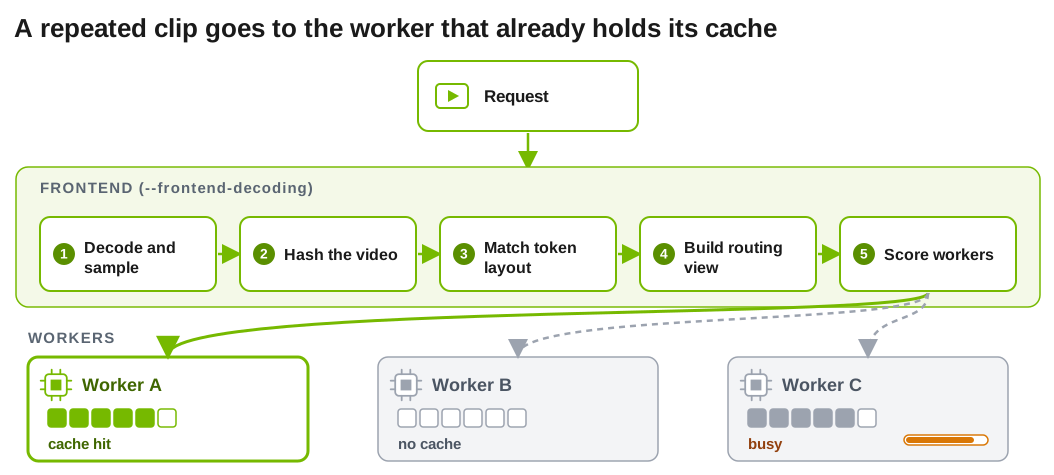
Exact video KV routing extends Multimodal KV Routing to video input. The frontend decodes and samples each video, computes a stable identity for it, and reproduces the worker’s video token layout, so the KV router can credit cached video blocks when it picks a worker.
Use it when several workers serve video requests and the same clips repeat across requests, such as several questions about one video. Exact video routing decodes and samples the video in the frontend before worker selection, so use it when the expected KV reuse offsets that frontend work.
Video inference and backend prefix-cache reuse do not require video-aware router affinity. A video response or a backend cache hit alone does not show that the router used video identity to select a worker. Exact affinity requires KV-aware routing, matching worker KV events, and eligible model, decoder, and request layouts as described below.
Video Identity and Token Layout
Exact video routing requires frontend decoding. The frontend samples the video and computes an XXH3-64 identity over the sampled RGB frames, decoded shape and data type, and video metadata such as the source frame rate and sampled timestamps. Two URLs that decode to the same sampled content and metadata receive the same identity.
Video prompt expansion is model-specific. The frontend uses a model adapter to reproduce the worker’s resize, patch, temporal grouping, delimiter, timestamp, and pruning behavior in a routing-only token sequence. At worker startup, vLLM and eligible SGLang workers report the installed processor behavior that affects this sequence. Dynamo disables exact video routing if the reported contract does not match the frontend adapter.
The selected worker receives the same per-video hash, and its KV events use that identity. This keeps the frontend’s routing blocks aligned with the blocks published by the backend without running the vision model in the frontend.
Launch
Exact video routing requires frontend decoding
(--frontend-decoding) on the worker.
vLLM
SGLang
TensorRT-LLM
DYN_MM_VIDEO_NUM_FRAMES sets the maximum number of sampled frames and defaults to 32. Keep the value the same on every worker. The frontend passes the decoded frames and sampling metadata to the selected worker, so the worker processes the same view used for routing.
Send a Video Request
The standard OpenAI chat payload uses a video_url content part:
Send the request twice to populate and then reuse the worker’s KV cache. Exact routing through the default Rust frontend supports VP8 or VP9 video in MP4, WebM, or MKV containers. SGLang provides this decoder on CUDA only. The in-tree frontend decoder does not support H.264 or H.265. Re-encode those inputs to VP9, or use a backend-supported NVDEC or software-decoder path; with backend-only decoding, video identity does not contribute to exact routing. See Video Decoding and GPU Requirements.
Verify Video Routing
The vLLM and SGLang multimodal router launchers enable routing debug logs by default. For a custom launch, set DYN_LOG=info,mm_routing=debug,dynamo_kv_router::scheduling=debug,dynamo_llm::kv_router=debug, then check for:
video routing processor availableduring worker registration. This reports model-adapter availability, not active video routing. Exact routing also requires KV router mode, frontend video decoding, and an eligible request.video routing metadata resolvedafter the frontend decodes an eligible request.[ROUTING]records withworker_id,overlap_blocks, andtotal_blocksfor each request.
Keep the text prompt fixed when comparing videos. On a backend and version that support exact video routing, a warm repeat on idle workers should select the same worker and report more overlap than the first request. A different video should not receive the first video’s full overlap. The router can still choose a less-cached worker when its combined cache-and-load cost is lower. Startup availability alone, or overlap attributable only to the shared text prefix, does not verify media-aware routing.
Without frontend video decoding, video requests use text-prefix routing even if a model adapter is available. If startup or request validation cannot prove that the frontend and worker produce the same token layout, Dynamo logs the reason and uses text-prefix routing. This routing fallback does not add a decoder: inference still requires a decode path that supports the input codec and deployment topology.
Exact Video Routing Limits
The default Rust frontend supports exact video routing for:
- vLLM Qwen3-VL and Qwen3.5 dense and mixture-of-experts models. Video pruning is not supported on this path.
- vLLM Nemotron 3 Nano Omni. The adapter reproduces temporal grouping, frame separators, dynamic resolution, and optional EVS pruning.
- Aggregated SGLang Qwen3-VL and Qwen3.5 dense and mixture-of-experts models on CUDA with
--frontend-decodingand a compatible event format.
Exact video routing falls back to text-prefix routing for unsupported models, opaque client-provided UUIDs, non-empty mm_processor_kwargs, audio in the same request, or adjacent video objects. SGLang also falls back when workers publish missing, incompatible, or different processor contracts. Nemotron uses the same <image> placeholder for image and video features, so its exact path currently supports one video-only media object per request; mixed image-and-video or multiple-video Nemotron requests fall back.