Foundations of Image Segmentation, ROS 2, and Isaac ROS#
Lecture: Foundations of Image Segmentation, ROS 2, and Isaac ROS#
Note
Overview of the Following Modules We will cover the foundational concepts necessary to understand and use image segmentation using ROS 2 and NVIDIA Isaac ROS. These prerequisites will prepare you for running an example application in the next modules, where we will test image segmentation software on pre-recorded data and later integrate it with simulation.
Image Segmentation#
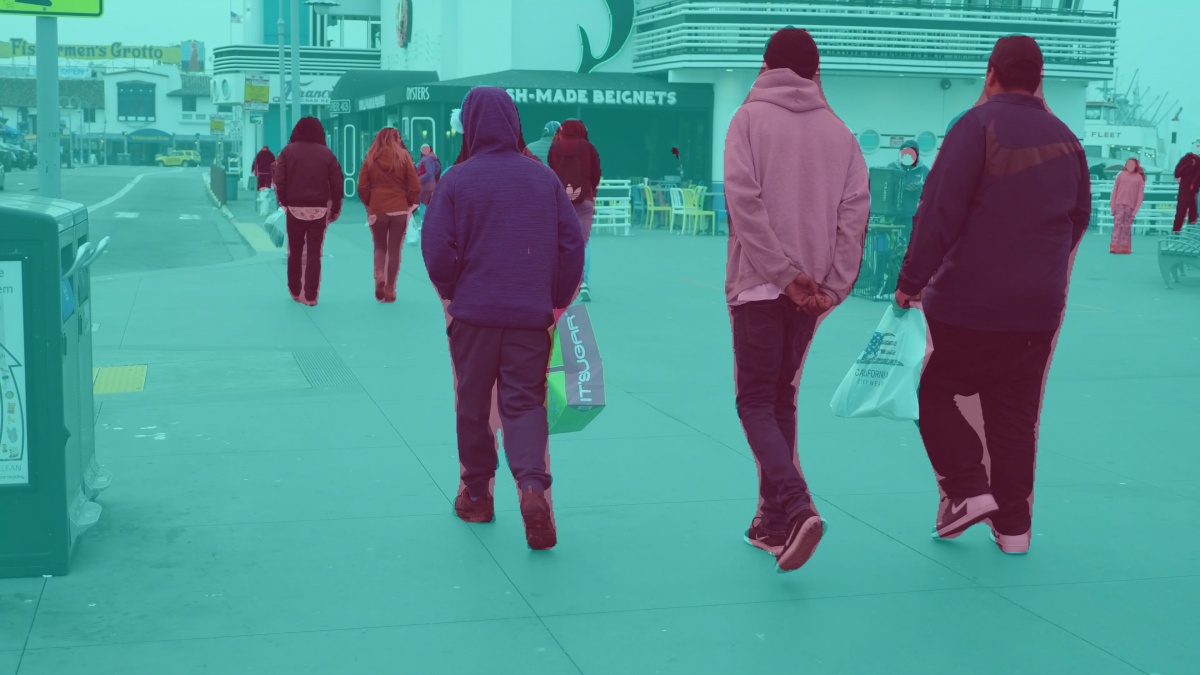
Image segmentation is the process of labeling each pixel in an image based on its object category. This allows us to determine not just what objects are present in an image but also their precise locations. We will use the PeopleSemSegNet model, a pre-trained semantic segmentation model designed to detect and segment people in images. This model outputs a mask that highlights all pixels corresponding to people, making it ideal for applications like autonomous navigation and human-robot interaction.
ROS 2#
ROS 2 is a modular software framework for robotics development. It organizes functionality into “packages” and “nodes,” which handle specific tasks such as image processing, segmentation, or object detection. These nodes communicate with one another to build complex robotic applications. While this module does not dive deeply into ROS 2, understanding its node-based structure is essential for working with Isaac ROS.
NVIDIA Isaac ROS#
Isaac ROS is a collection of GPU-accelerated ROS 2 packages designed to enhance robotics workflows. It includes tools for tasks such as object detection, AI-based inference, and image segmentation. In this module, we’ll focus on the Isaac ROS Image Segmentation package, which uses deep learning models like PeopleSemSegNet to perform pixel-level classification of images. This package enables high-performance perception systems by leveraging NVIDIA GPUs for real-time processing.#
At this point, you have a basic understanding of:
The basics of semantic image segmentation and its applications.
How ROS 2 organizes and executes robotic software using nodes and packages.
The capabilities of Isaac ROS for accelerating AI-based robotics tasks.
This knowledge will serve as the foundation for testing and validating image segmentation software in both pre-recorded data scenarios (next module) and simulated environments (later modules).
Review#
In this module, we explored the basics of image segmentation, ROS 2, and NVIDIA Isaac ROS. We learned how image segmentation labels pixels in an image for detailed analysis, how ROS 2 provides a modular framework for robotics development, and how Isaac ROS accelerates AI-based tasks like segmentation and object detection.
This foundation prepares us to test and validate robotics software using both pre-recorded data and simulated environments.
Quiz#
What is the purpose of image segmentation in robotics?
To label pixels in an image based on object categories for detailed analysis.
To classify entire images without focusing on specific regions.
To detect the distance of objects from the robot.
To reconstruct 3D maps of the environment.
Answer
A
Image segmentation divides an image into regions by labeling pixels based on object categories, enabling robots to analyze specific areas for tasks like navigation or object interaction.
Why is it important to test image segmentation software on pre-recorded data before using simulation?
To avoid using simulation altogether during development.
To ensure it works only with physical robots and not simulated environments.
To eliminate the need for further testing with simulation or hardware.
To validate its functionality and understand how it processes image data.
Answer
D
Testing image segmentation software on pre-recorded data (like rosbags) helps validate that it functions correctly and processes image data as expected before integrating it into more complex simulated environments or real-world scenarios.