

Schedule Agents with ThunderAgent
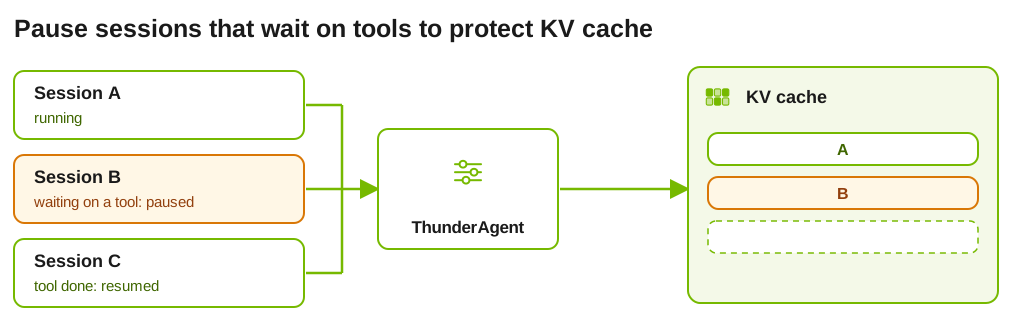
By the end of this guide, the frontend schedules each agent session as one program. It pauses sessions that are waiting on tools when KV cache is under pressure, and resumes them when there is room.
ThunderAgent is experimental. Dynamo includes a native plugin that ports the scheduler from the ThunderAgent paper (Kang et al., 2026). It runs inside the frontend and is enabled through router-policy YAML.
When to Use It
Agentic workloads (SWE-bench, browser-use, anything with a tool loop) make many short LLM calls separated by non-GPU work: docker exec, pytest, curl, waiting on a subagent. Between turns the agent’s KV cache stays resident, holding blocks while doing nothing. A request-level router (vLLM’s, SGLang’s, Dynamo’s stock KvRouter) sees each turn but not the agent behind it, which costs you two ways:
- Cache-occupancy blowup. With N agents at step K, the working set is
N × step_K_context, most of it idle between turns. The engine evicts useful blocks under pressure or refuses admission, and every next turn pays a re-prefill tax. - No tool-boundary backpressure. The router can’t defer a hot session at a natural pause point — it can only cancel in-flight requests or queue them, both worse than waiting until the agent is between turns.
If your agents run few concurrent sessions, or KV cache is never under pressure, you do not need this. Start with session affinity and priority.
Native Frontend Plugin
To implement your own admission policy, see Write an Admission Control Plugin.
Use this path for aggregated serving through dynamo.frontend. It requires a Dynamo build that includes the thunderagent builtin plugin; older wheels and images do not recognize that type. The plugin is included in the builtin catalog without a separate ThunderAgent build feature. Admission behavior remains unchanged until the plugin is selected in YAML.
Custom catalogs that already register thunderagent must remove that registration; duplicate type names fail startup.
Save the following as thunderagent.yaml:
Start the frontend against your existing aggregated workers, using the same discovery configuration as the workers:
Send a stable X-Dynamo-Session-ID on every turn of an agent’s reasoning and tool-use chain. Dynamo also accepts the native agent headers. Requests without session context pass through admission unchanged. At the end of a session, a dedicated minimal request with X-Dynamo-Session-Final: true releases the retained program state; otherwise idle retention expires it.
Select both plugin roles. The classifier owns the program table and delays admission when a session is busy or paused. When it releases a request, it supplies a preferred worker/rank. The worker selector honors that target if it is eligible, falling back to the least-loaded eligible candidate otherwise. Soft session affinity allows this repacking; hard affinity would constrain the request before the selector can move it. The Sent event records the worker actually selected.
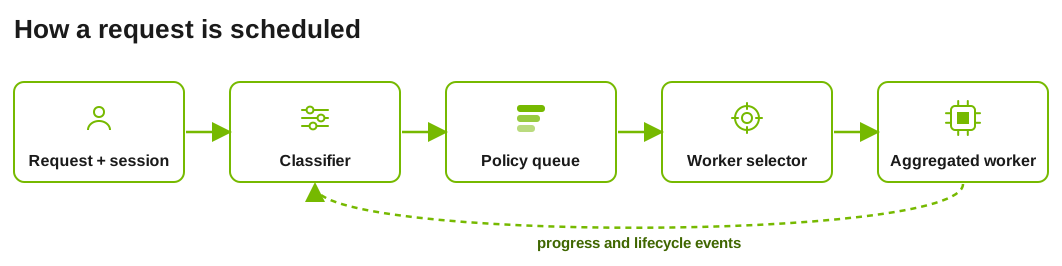
The classifier uses each worker/rank’s published GPU KV-block capacity and a logical token estimate from active and retained programs. It observes context growth during generation, then pauses and repacks programs between turns. This estimate is not physical KV occupancy and does not deduplicate shared prefixes or include host/offload capacity. Running generation is allowed to finish.
Native Plugin Parameters
Set admission parameters under request_classifier.parameters. Leave worker-selection parameters empty. Unknown parameter names and invalid values fail startup.
The default deferral timeout permits waits of roughly 30 minutes under pressure. Set client deadlines to match the workload’s acceptable wait. Router policy classes and queues still apply after classification releases a request.
Program state is local to each frontend’s router instance. This is not a cluster-wide admission budget; keep a session’s turns on the same frontend when using multiple replicas. The native plugin has been exercised with aggregated vLLM workers. Standalone EPP and disaggregated deployment guidance are outside this example.
The native plugin’s classifier and worker selector register together in Dynamo’s builtin catalog. It does not expose the Python prototype’s soft-demotion controls, priority boosts, host-cache budget, or separate status endpoints described in ThunderAgent Python Router.
Native Plugin Logs
The plugin logs its interval, deferral timeout, and tracking limit at INFO when admission is enabled. A WARN event reports the number of programs forcibly resumed after reaching the deferral timeout. These requests continue processing; they are not rejected. Timeout warnings are aggregated into one event per scheduler tick.
To see scheduler state changes, enable DEBUG for the thunderagent log target before starting the frontend:
Each changed tick reports counts of active, paused, and marked-for-pause programs, waiting requests, and tracked requests. Unchanged ticks are silent. Log snapshots use stored counts without scanning programs or requests, and log emission happens after releasing the scheduler lock.
Python Router Prototype
An older standalone Python implementation, dynamo.thunderagent_router, schedules with the same idea but runs as its own router service with different flags and observability endpoints. Use the native plugin above for new deployments. See ThunderAgent Python Router for the prototype.
Next
- Maintain session affinity explains the soft affinity mode this plugin relies on.
- Write an admission control plugin shows how to build your own policy.