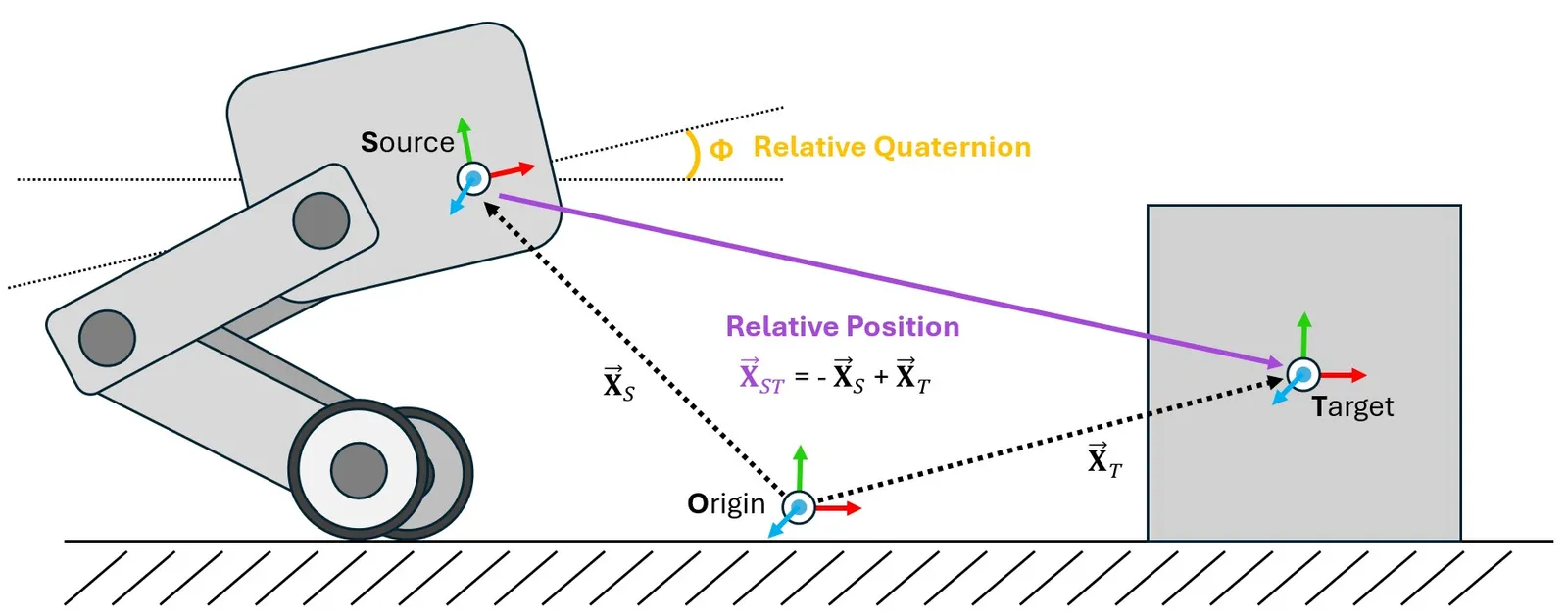
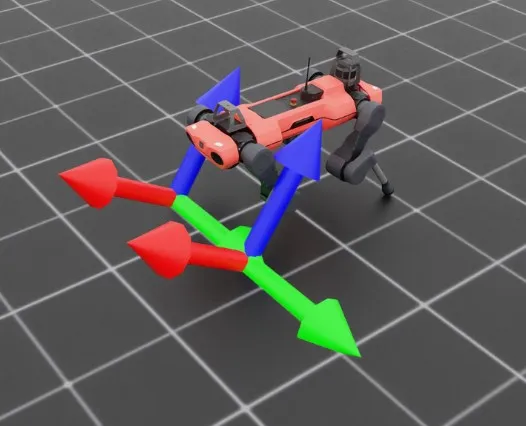
# Copyright (c) 2022-2025, The Isaac Lab Project Developers.
# All rights reserved.
#
# SPDX-License-Identifier: BSD-3-Clause
import argparse
from isaaclab.app import AppLauncher
# add argparse arguments
parser = argparse.ArgumentParser(description="Example on using the frame transformer sensor.")
parser.add_argument("--num_envs", type=int, default=1, help="Number of environments to spawn.")
# append AppLauncher cli args
AppLauncher.add_app_launcher_args(parser)
# parse the arguments
args_cli = parser.parse_args()
# launch omniverse app
app_launcher = AppLauncher(args_cli)
simulation_app = app_launcher.app
"""Rest everything follows."""
import torch
import isaaclab.sim as sim_utils
from isaaclab.assets import AssetBaseCfg, RigidObjectCfg
from isaaclab.scene import InteractiveScene, InteractiveSceneCfg
from isaaclab.sensors import FrameTransformerCfg
from isaaclab.utils import configclass
##
# Pre-defined configs
##
from isaaclab_assets.robots.anymal import ANYMAL_C_CFG # isort: skip
@configclass
class FrameTransformerSensorSceneCfg(InteractiveSceneCfg):
"""Design the scene with sensors on the robot."""
# ground plane
ground = AssetBaseCfg(prim_path="/World/defaultGroundPlane", spawn=sim_utils.GroundPlaneCfg())
# lights
dome_light = AssetBaseCfg(
prim_path="/World/Light", spawn=sim_utils.DomeLightCfg(intensity=3000.0, color=(0.75, 0.75, 0.75))
)
# robot
robot = ANYMAL_C_CFG.replace(prim_path="{ENV_REGEX_NS}/Robot")
# Rigid Object
cube = RigidObjectCfg(
prim_path="{ENV_REGEX_NS}/Cube",
spawn=sim_utils.CuboidCfg(
size=(1, 1, 1),
rigid_props=sim_utils.RigidBodyPropertiesCfg(),
mass_props=sim_utils.MassPropertiesCfg(mass=100.0),
collision_props=sim_utils.CollisionPropertiesCfg(),
physics_material=sim_utils.RigidBodyMaterialCfg(static_friction=1.0),
visual_material=sim_utils.PreviewSurfaceCfg(diffuse_color=(0.0, 1.0, 0.0), metallic=0.2),
),
init_state=RigidObjectCfg.InitialStateCfg(pos=(5, 0, 0.5)),
)
specific_transforms = FrameTransformerCfg(
prim_path="{ENV_REGEX_NS}/Robot/base",
target_frames=[
FrameTransformerCfg.FrameCfg(prim_path="{ENV_REGEX_NS}/Robot/LF_FOOT"),
FrameTransformerCfg.FrameCfg(prim_path="{ENV_REGEX_NS}/Robot/RF_FOOT"),
],
debug_vis=True,
)
cube_transform = FrameTransformerCfg(
prim_path="{ENV_REGEX_NS}/Robot/base",
target_frames=[FrameTransformerCfg.FrameCfg(prim_path="{ENV_REGEX_NS}/Cube")],
debug_vis=False,
)
robot_transforms = FrameTransformerCfg(
prim_path="{ENV_REGEX_NS}/Robot/base",
target_frames=[FrameTransformerCfg.FrameCfg(prim_path="{ENV_REGEX_NS}/Robot/.*")],
debug_vis=False,
)
def run_simulator(sim: sim_utils.SimulationContext, scene: InteractiveScene):
"""Run the simulator."""
# Define simulation stepping
sim_dt = sim.get_physics_dt()
sim_time = 0.0
count = 0
# Simulate physics
while simulation_app.is_running():
if count % 500 == 0:
# reset counter
count = 0
# reset the scene entities
# root state
# we offset the root state by the origin since the states are written in simulation world frame
# if this is not done, then the robots will be spawned at the (0, 0, 0) of the simulation world
root_state = scene["robot"].data.default_root_state.clone()
root_state[:, :3] += scene.env_origins
scene["robot"].write_root_pose_to_sim(root_state[:, :7])
scene["robot"].write_root_velocity_to_sim(root_state[:, 7:])
# set joint positions with some noise
joint_pos, joint_vel = (
scene["robot"].data.default_joint_pos.clone(),
scene["robot"].data.default_joint_vel.clone(),
)
joint_pos += torch.rand_like(joint_pos) * 0.1
scene["robot"].write_joint_state_to_sim(joint_pos, joint_vel)
# clear internal buffers
scene.reset()
print("[INFO]: Resetting robot state...")
# Apply default actions to the robot
# -- generate actions/commands
targets = scene["robot"].data.default_joint_pos
# -- apply action to the robot
scene["robot"].set_joint_position_target(targets)
# -- write data to sim
scene.write_data_to_sim()
# perform step
sim.step()
# update sim-time
sim_time += sim_dt
count += 1
# update buffers
scene.update(sim_dt)
# print information from the sensors
print("-------------------------------")
print(scene["specific_transforms"])
print("relative transforms:", scene["specific_transforms"].data.target_pos_source)
print("relative orientations:", scene["specific_transforms"].data.target_quat_source)
print("-------------------------------")
print(scene["cube_transform"])
print("relative transform:", scene["cube_transform"].data.target_pos_source)
print("-------------------------------")
print(scene["robot_transforms"])
print("relative transforms:", scene["robot_transforms"].data.target_pos_source)
def main():
"""Main function."""
# Initialize the simulation context
sim_cfg = sim_utils.SimulationCfg(dt=0.005, device=args_cli.device)
sim = sim_utils.SimulationContext(sim_cfg)
# Set main camera
sim.set_camera_view(eye=[3.5, 3.5, 3.5], target=[0.0, 0.0, 0.0])
# design scene
scene_cfg = FrameTransformerSensorSceneCfg(num_envs=args_cli.num_envs, env_spacing=2.0)
scene = InteractiveScene(scene_cfg)
# Play the simulator
sim.reset()
# Now we are ready!
print("[INFO]: Setup complete...")
# Run the simulator
run_simulator(sim, scene)
if __name__ == "__main__":
# run the main function
main()
# close sim app
simulation_app.close()