

End-to-End W4A4 NVFP4 with Per-Token vLLM Rollout#
Overview#
NeMo RL provides an end-to-end W4A4 NVFP4 path in which selected routed-expert MLP computations use per-token activation scaling during both policy training and vLLM rollout on NVIDIA Blackwell GPUs. Transformer Engine (TE) performs the training computation, and vLLM uses NVFP4 fused-MoE rollout kernels with the same activation-scaling granularity.
The feature is designed around a reusable training-to-rollout contract: policy workers retain BF16 source weights, refit transports BF16, and rollout workers own quantization into their serving representation. Eligibility is determined from the constructed vLLM model’s routed-expert capabilities rather than an architecture-name allowlist. See Validated Configuration and Current Limitations for the tested release boundary.
The model keeps BF16 master parameters and FP32 optimizer states. Attention, routers, shared experts, embeddings, normalization layers, and selected boundary layers remain in BF16. The policy backward pass currently uses TE’s dequantized path.
After every policy update, NeMo RL exports the updated BF16 weights to each
colocated vLLM engine. The rollout workers quantize routed-expert weights while
vLLM’s native reload_weights API consumes the checkpoint-format stream before
the next rollout. Training remains unaware of the rollout representation.
How It Works#
        flowchart LR
    A[TE per-token NVFP4 policy training] --> B[Megatron-Bridge HF weight export]
    B --> C[BF16 IPC stream]
    C --> D[vLLM native reload_weights]
    D --> E[Quantize routed experts at load time]
    E --> F[Restore kernel-format storage]
    F --> G[vLLM per-token NVFP4 rollout]
    G --> A
Per-token NVFP4 policy training#
policy.megatron_cfg.fp4_cfg enables TE NVFP4, while
te_precision_config_file selects which modules use it. The provided precision
recipe applies NVFP4 only to routed-expert MLP linears and keeps attention,
dense MLPs, and shared experts in BF16.
fp4_param defaults to false, which keeps persistent model parameters in
BF16. NVFP4 is used for the selected forward computations, while the optimizer
continues to update the BF16 model through FP32 master parameters. FP8 and FP4
cannot be enabled together.
During policy training, per-token activation scaling gives each token its own activation range. This reduces the effect of outlier tokens and matches the activation granularity used by the rollout kernel.
Weight refit#
Megatron-Bridge exports the updated policy weights with Hugging Face parameter names and reconstructs tensors across the training TP, PP, and EP topology, sending plain BF16. This is the same transport representation used by a BF16-only run.
Each vLLM engine receives the BF16 stream over CUDA IPC. NeMo RL converts each
transport batch into owned checkpoint-format tensors and supplies one lazy
iterator to vLLM’s native reload_weights API. Routed-expert projections are
quantized at load time, mirroring the fp8/mxfp8 real-quant rollout path. NeMo RL
resolves the destination RoutedExperts container and classifies W1/W2/W3 from
that container’s vLLM checkpoint mapping; it does not maintain model-family
projection names. W1 and W3 (often gate and up) share one per-expert global
scale, while W2 (often down) is quantized independently. BF16 boundary layers
pass through unchanged.
The IPC allocation is acknowledged only after quantization and passthrough
copies no longer depend on it. The final COMPLETE message is acknowledged only
after reload_weights consumes the entire stream, performs layerwise
post-processing, and completes the final device fence. If preparation or load
fails, NeMo RL drains and acknowledges the remaining IPC messages so the sender
cannot deadlock, and the rollout worker raises instead of serving stale
weights.
Per-token vLLM rollout#
NeMo RL configures vLLM with the nvfp4_pertoken quantization mode. During
refit, vLLM loads the packed expert weights, prepares them for the FlashInfer
fused-MoE runtime, and rebuilds the affected kernels. Rollout activations are
quantized dynamically for each token; no static activation calibration is
required.
The native reload path restores checkpoint-shaped parameters layer by layer, loads and processes them, then copies the resulting kernel-format tensors back into the storage used by CUDA graphs. A failed or incomplete refit stops the rollout instead of continuing with stale weights.
Configuration#
The complete validated Qwen3-30B-A3B configuration is:
uv run examples/run_grpo.py \
  --config examples/configs/recipes/llm/grpo-qwen3-30ba3b-base-8n4g-megatron-te-nvfp4-pertoken.yaml
The feature-specific policy configuration is:
policy:
  generation:
    colocated:
      enabled: true
    nvfp4_pertoken_rollout:
      enabled: true
    vllm_cfg:
      precision: bfloat16
      kv_cache_dtype: auto
      expert_parallel_size: 1

  megatron_cfg:
    moe_router_dtype: fp32
    fp4_cfg:
      enabled: true
      fp4: e2m1
    first_last_layers_bf16: true
    num_layers_at_start_in_bf16: 2
    num_layers_at_end_in_bf16: 4
    te_precision_config_file: examples/te_precision/attn_bf16_mlp_nvfp4.yaml
    env_vars:
      NVTE_NVFP4_ROW_SCALED_ACTIVATION: "1"
      NVTE_NVFP4_DISABLE_RHT: "1"
      NVTE_NVFP4_DISABLE_2D_QUANTIZATION: "1"
      NVTE_NVFP4_DISABLE_STOCHASTIC_ROUNDING: "1"
      NVTE_BACKWARD_OVERRIDE: dequantized
The rollout BF16 exclusions are derived from the effective
first_last_layers_bf16, num_layers_at_start_in_bf16, and
num_layers_at_end_in_bf16 settings, so recipes do not duplicate layer paths.
For migration, an explicit additional_ignore is accepted only when it uses
complete *.layers.<index>.mlp.experts* patterns and exactly matches that
derived boundary.
Validated Configuration#
The shipped recipe captures the training and rollout settings used for the end-to-end validation:
Area |
Validated setting |
|---|---|
Model |
Qwen3-30B-A3B-Base ( |
Model layout |
A routed-expert MoE block in every decoder layer |
Hardware |
8 nodes with 4 NVIDIA GB200 GPUs per node |
Algorithm and data |
GRPO with DAPOMath17K training and DAPOMathAIME2024 validation |
Sequence lengths |
2,048-token prompt and up to 20,480-token response |
Global batch |
32 prompts with 16 generations each, for 512 sequences per step |
Training parallelism |
Megatron TP=2, EP=8, PP=1 |
Rollout parallelism |
Colocated vLLM TP=1, EP=1, PP=1 |
Policy state |
BF16 parameters, FP32 optimizer states, |
Router replay |
|
Refit |
BF16 CUDA IPC stream into native vLLM |
The validation recipe is
grpo-qwen3-30ba3b-base-8n4g-megatron-te-nvfp4-pertoken.yaml, a long-running
configuration with periodic synchronous checkpoints. Short smoke coverage
remains available in
grpo-qwen3-30ba3b-4n4g-megatron-te-nvfp4-pertoken-quick.yaml.
Current Limitations#
The end-to-end contract is intended to support additional W4A4 per-token MoE models, but this release has the following enforced or validated boundaries:
Area |
Current limitation |
|---|---|
Model layout |
Requires a vLLM |
Quantized modules |
Routed-expert MLP projections only; dense MLPs, attention, routers, and shared experts remain BF16 |
Shared-expert fusion |
A layout that fuses shared experts into the selected |
Hardware and kernel |
NVIDIA Blackwell with the FlashInfer TRT-LLM NVFP4 fused-MoE backend; GB200 is validated |
Training precision |
BF16 persistent parameters with |
Rollout placement |
Colocated vLLM rollout only; standalone evaluation is not supported because the dummy-loaded engine requires a refit first |
vLLM parallelism |
EP and PP must be 1; PP>1 is rejected for both engine modes because refit does not yet handle another stage’s expert weights. TP remains configurable; the shipped end-to-end recipe uses TP=1 |
Cache and decoding |
|
Refit transport |
Default colocated CUDA IPC/ZMQ path ( |
Configuration |
|
Layer exclusions |
Derived from the Megatron BF16 boundary; legacy |
Algorithm coverage |
End-to-end validation is GRPO only. PPO and distillation reuse the same Megatron training worker and vLLM refit path and are expected to work, but are unvalidated and warn at setup. SingleController explicitly rejects this mode during configuration validation: its vLLM path requires non-colocated rollout, while this mode requires colocated rollout |
An additional architecture is eligible only when Megatron-Bridge can export its
HF-named BF16 weights and the pinned vLLM model exposes a complete compatible
RoutedExperts mapping. Constructed-model inventory and complete-refit checks
fail closed on unsupported method assignment, fused shared experts, incomplete
or duplicate projections, and incompatible block-16 tensor shapes. A new model
should still receive an end-to-end smoke before being listed as validated.
Performance and GPU Memory#
The following comparison uses Qwen3-30B-A3B-Base with DAPO on 8 nodes with 4 GB200 GPUs per node, a global batch size of 512, and a 20K response limit. Training uses TP=2, EP=8, and PP=1; each vLLM engine uses TP=1. Both runs enable router replay and are configured identically apart from rollout precision. All values are medians over the 900 logged steps shared by the two runs.
Metric |
BF16 |
NVFP4 W4A4 |
Change |
|---|---|---|---|
Rollout generation throughput |
472.9 tokens/s/GPU |
661.4 tokens/s/GPU |
1.40x |
Generation time |
220.5 s |
154.6 s |
1.43x faster |
Observed step time |
276.4 s |
237.2 s |
14.2% lower |
Token-normalized end-to-end throughput |
367.1 tokens/s/GPU |
421.1 tokens/s/GPU |
1.15x |
Policy training throughput |
3,196 tokens/s/GPU |
2,681 tokens/s/GPU |
0.84x |
Weight transfer and update |
1.8 s |
19.2 s |
17.4 s higher |
Median response length |
5,608 tokens |
5,612 tokens |
1.00x |
Response length is matched between the two runs, so observed step time is directly comparable and generation throughput is not inflated by longer sequences. The gain comes entirely from W4A4 rollout. Two costs offset it: policy training is slower because the backward path remains dequantized, and refit is substantially slower than a BF16 weight transfer.
All three parts still have headroom. Refit is the largest and is profiled below. Policy training will improve once the backward path runs natively in NVFP4. The rollout numbers themselves were measured with conservative quantization-kernel settings, so generation has room to improve as well. The end-to-end figure therefore understates what this path can reach; see the roadmap.
NVFP4 stores each quantized weight using an E2M1 value, one E4M3 scale per 16-value block, and one FP32 global scale per tensor. Excluding the small per-tensor scale overhead, this is approximately 4.5 bits per quantized weight, compared with 16 bits for BF16.
Both runs set gpu_memory_utilization=0.5. The vLLM logs report the following
rollout memory values for each TP=1 engine:
Rollout memory |
BF16 |
NVFP4 W4A4 |
Change |
|---|---|---|---|
Model weights |
56.88 GiB |
18.07 GiB |
68.2% lower |
Available KV cache |
30.37 GiB |
79.70 GiB |
2.62x |
KV cache token capacity |
331,744 |
870,560 |
2.62x |
These values describe the vLLM rollout model and KV cache, not the peak memory of the complete colocated RL process. Process-wide GPU samples also include TE training workspaces, quantization buffers, and allocator caching, and did not show a lower end-to-end peak in this comparison. The current result therefore demonstrates lower rollout weight memory and greater KV-cache headroom, rather than lower peak memory for the full training process.
Profiling the vLLM-side path showed that native weight loading, rather than IPC transfer or NVFP4 arithmetic, dominates refit time:
Refit phase |
Representative time |
Approximate share |
|---|---|---|
vLLM load and layer processing |
13.13 s |
75% |
NVFP4 quantization |
3.80 s |
22% |
IPC wait and other work |
0.66 s |
4% |
Finalization after all layers load |
approximately 0 s |
approximately 0% |
The load phase is Python-call-bound. Qwen3-30B-A3B emits 64,512 per-expert checkpoint names per refit across 42 quantized layers and 128 experts, and each name passes through vLLM’s mapping, loader, and layerwise-reload bookkeeping.
A research-only prototype coalesced those outputs into eight full fused-expert parameters per layer. In paired 90-step runs, the final per-expert path measured 18.42 seconds mean and median refit time; the prototype measured 6.31 seconds mean and 6.38 seconds median, a 2.92x improvement. Both runs completed successfully. The prototype is not part of this feature because complete fused-parameter loading depends on vLLM’s internal expert layout and should be implemented upstream. The proposal and reproducible evidence are tracked in vLLM issue #53687, in coordination with vLLM’s streaming quantization-unit RFC #53192.
Refit remains a visible part of the step and an optimization target.
Training Quality#
The two runs above, over their first 900 shared steps:
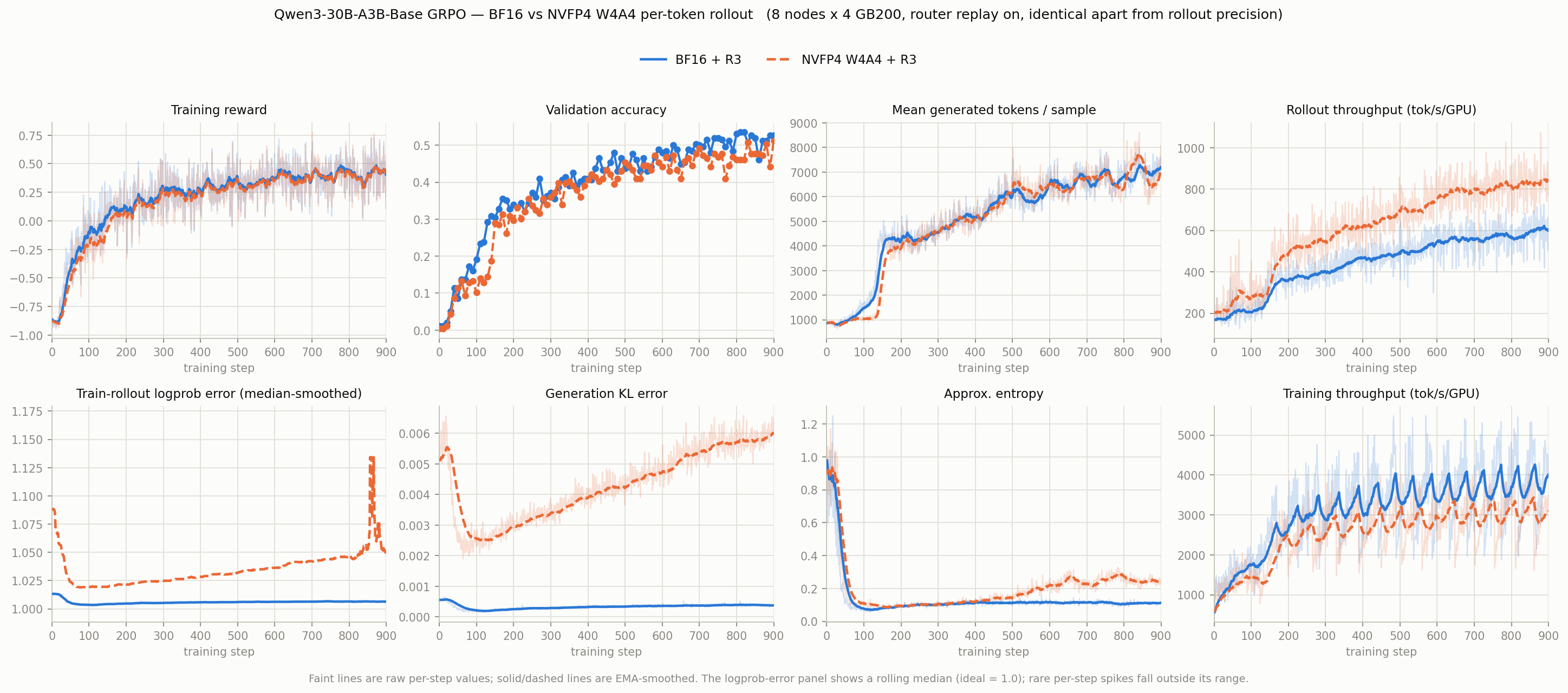
Reward, response length, and validation accuracy track the BF16 baseline, and entropy does not collapse. The train-rollout logprob error stays near its ideal value of 1.0 for both runs. Generation KL error is higher under W4A4, which is the expected cost of a quantized rollout and is the metric to watch when extending this path to other models. The two throughput panels show the same tradeoff as the table: faster rollout, slower policy training.
Longer stability validation is ongoing.
Roadmap#
Reduce refit latency through the native layer-fused MoE parameter loader proposed in vLLM issue #53687 and quantization before the expert-parallel gather.
Add end-to-end coverage for more mapping families and hybrid dense/MoE layouts. Enable vLLM PP>1 after refit handles weights owned by other stages, including coverage for stages with no local NVFP4 targets.
Add native NVFP4 backward computation.
Complete longer stability and model-quality studies and publish the training curves.