

Token Capture Lineage Ledger#
Exact-token capture for blackbox agentic rollouts is coordinated by a single
per-rollout capture ledger: NeMo Gym’s LineageStore, extended so that its
append-only JSONL rows are simultaneously the request-time lineage index and
the token-free record of rollout capture state. There is no separate gate
state machine; serving workers coordinate only through the ledger, and NeMo RL
(the rollout owner) assembles the RolloutReceipt itself at rollout end.
The external staging contract (StagingSink / StagingSource), the vLLM
worker capture path, and the verify_and_linearize() trust boundary are
unchanged from the worker-custody design.
Why a ledger and not a gate#
An earlier iteration paired the lineage store with a RolloutCaptureGate and
a cross-process GateStateStore. The gate did not provide a second lineage
algorithm — parent resolution ran upstream through LineageStore.resolve(),
and the gate cross-checked that result against its own copy of the call state,
storing each call’s cumulative token IDs twice (gate state + lineage
JSONL). Its file-backed state store also serialized the entire global gate
state — every live rollout’s cumulative token arrays — under one exclusive
lock, three transactions per model call.
Everything the gate legitimately provided — admission, rollout completeness, terminal selection, cleanup — is either a pure function of the lineage result or belongs to the framework that already owns the rollout. So each responsibility moved to its natural owner and the redundant state machine was deleted.
The ledger#
FileLineageStore writes one locked, fsynced JSONL row per committed call.
In external-staging mode (token_id_capture.external_staging: true) each row
additionally carries the token-free CallRecord custody columns —
parent_call_id, staging_key, weight_version, prev_len / delta_len /
cum_len, the staged record’s digest and extras_digest, mode, the
served response_id (the envelope id the agent received; terminal
attribution’s join key), admitted_at, and the call’s content fingerprints.
Four surfaces make it the single record of capture state (the
CaptureLedger protocol):
record(...)— the extended commit row, written by the model server’s commit hook after the worker’sCommitCoordsarrive.record_failure(rollout_id, model_call_id, reason)— a poison row for a call whose capture did not commit. Failure rows carry no fingerprint, soresolve()can never return them as parents.manifest(rollout_id)— the token-free read-back (committed rows + failures), exposed over one bearer-protected control route:GET /training-token-capture/control/rollouts/{rollout_id}/manifest.has_rows(rollout_id)— whether any ledger row (committed or failed) exists for the rollout; this is how admission tells a seeded assistant history (no rows) from a broken chain.
InMemoryLineageStore cannot serve the ledger role: its resolution index
evicts rollouts under memory bounds, which is fine for a cache but not for a
completeness record. External staging requires a non-evicting store and
rejects the in-memory store at startup.
Admission is a pure function#
When external staging is enabled, resolve_parent() builds the
CaptureAdmission directly from the lineage result — a strict tri-state:
Lineage outcome |
Admission |
|---|---|
|
|
|
|
|
no admission; |
UNRESOLVED is never silently converted into a new root: doing so would turn
earlier policy-generated tokens into mask-zero prompt tokens and corrupt the
training row. The completion still serves the agent; only training capture is
poisoned.
Commit ordering#
The invariant the external sink requires — a call must not become a lineage
parent until its staged record is durable — holds structurally: the worker
stages through StagingSink.stage() before acknowledging, coordinates exist
only after the bytes are durable, and the ledger row (which is what makes a
call resolvable as a parent) is written only after the coordinates arrive.
On disposition == "staged" the commit hook appends the token-free coordinates
and lineage witnesses to the ledger. On capture_failed, missing coordinates,
or any acknowledgement error it appends a failure row instead. A request that
dies after admission is poisoned from the capture middleware’s finally hook.
Megatron Inference payload staging#
MInf now uses the same canonical durability boundary through two generic engine
hooks. These hooks (DynamicInferenceEngine.payload_stager /
prompt_preparer, the RequestPayloadStager protocol, and the rendered
prior-turn tokens plus EOS id carried as request metadata) come from
NVIDIA/Megatron-LM PR #7015,
which the Megatron-LM pinned through Megatron-Bridge includes.
Gym’s complete CaptureAdmission travels as opaque request metadata.
Before engine admission, the model-parallel coordinator resolves an admitted
staging_chain through TQTokenSource, splices the exact parent tokens into
the rendered prompt with the same replace_prefix_tokens the vLLM worker uses,
and broadcasts that prepared request to every rank. When
generation completes, the coordinator passes that admission, the exact
OffloadedRequestPayload, and the finished request’s policy epoch to
TQMegatronTokenStager. A request that straddles a refit carries more than
one policy_epoch boundary; the stager stamps the admission epoch — the
first policy_epoch boundary — matching vLLM’s begin_call semantics, and
counts the span on epoch_span_count (logged at WARNING) rather than masking
the rollout.
The stager invokes Gym’s engine-neutral RolloutTokenCapture, which constructs
the canonical delta and writes it through the same TQTokenSink used by vLLM.
Only after that write returns does MInf attach ng_commit_coords to the HTTP
response. Gym consequently commits an ordinary token-free CallRecord before
the response is released to the agent. No local metadata ledger or rollout-end
conversion is involved in the active path.
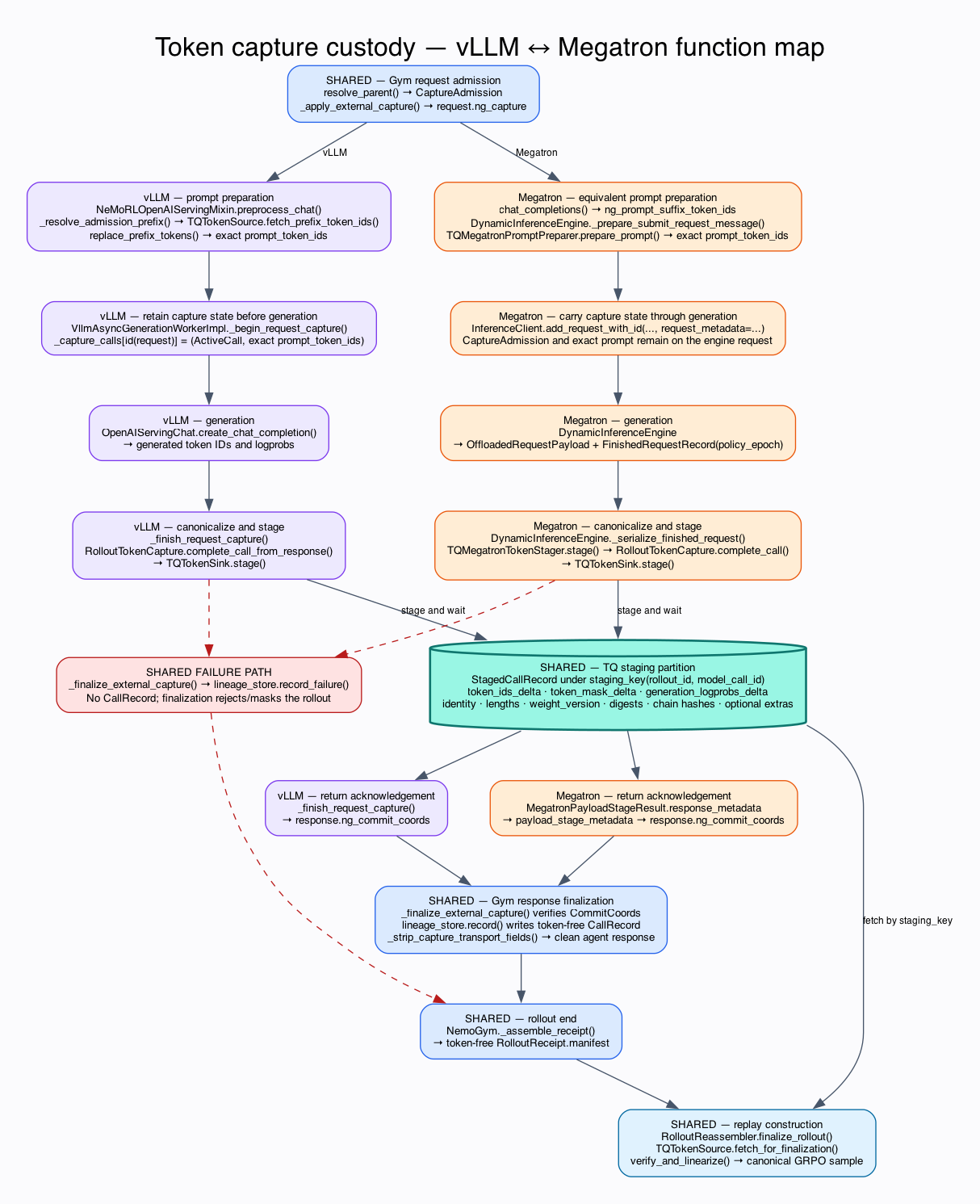
Framework-owned receipt and cleanup#
NeMo RL fetches the manifest at rollout end and assembles the receipt locally. For vLLM:
manifest= the fetchedCallRecordlist, deduped bymodel_call_id;terminal_model_call_id= the row Gym’sresolve_terminal(records, scored_response, declared_response_id=...)attributes: the harness’s declared response id, the scored response’s ownid, and the response’s content fingerprints each independently name a row throughCallRecord.response_idand the recorded fingerprints; agreeing witnesses attribute, disagreeing witnesses attribute nothing;capture_poisoned= any failure row present, or no row for the terminal request.
MInf and vLLM both produce committed manifest rows that point directly to
canonical TQ records.
Terminal selection has a strict precedence: declared / response-id /
content witnesses > heuristic > mask. A harness-declared terminal is
authoritative — a declared id that matches no committed row masks the rollout
and never falls back. When no witness attributes (and nothing was declared),
Gym’s select_terminal_call infers one from the
manifest’s explicit parent links (earliest-admitted root by admitted_at, an
extended sibling beating an abandoned childless retry); any ambiguous shape —
a retry of the final call, divergent extended branches — masks with the
selection reason. The heuristic only chooses among digest-verified rows:
verify_and_linearize still verifies the chosen chain. The receipt records
the resolving stage in terminal_selection (declared / response_id /
content / heuristic) and the finalizer emits
finalize/terminal_selection_heuristic_fraction per group.
verify_and_linearize(receipt, snapshots) runs unchanged. Retry duplicates
appear as dead-branch sibling rows in the manifest: their staged rows are
fetched, verified, and cleaned like any other, but they never join the
terminal chain (_validate_manifest_graph tolerates rows unreferenced by the
terminal chain). Cleanup is manifest-enumerated in the finalizer; an abandoned
dispatch’s staged rows are swept with the staging partition at run end (there
is no prefix-clear primitive in the data plane yet).
Failure semantics (all fail-closed)#
Capture fails mid-rollout: the model call still succeeds for the agent; a failure row is written. Later calls miss resolution →
UNRESOLVED→ more failure rows. Finalization sees failure rows → poisoned → masked placeholder row (the group still publishes exactly N rows).Terminal response lost, harness retries: the retry is a sibling row (per-request
uuid4identity). The harness reports the retry’s response id, so receipt assembly selects the retry’s row; the lost attempt is a dead branch. An ambiguous mid-rollout sibling (identical regenerated text) poisons viaUNRESOLVEDinstead of silently becoming a root.Crash after staging, before the ledger append: descendants resolve
UNRESOLVEDand poison; a terminal orphan poisons via the missing terminal row.
Retry idempotency (harness-minted logical request ids + deterministic
model_call_id, collapsing identical retries into the same row instead of
poisoning) is an explicit follow-up; no retry outcome is silently wrong today.